
As an Amazon Associate I earn from qualifying purchases.
Consommé is one of those classic French techniques anyone who attends culinary school learns to do. I’ve heard all sorts of chefs roll their eyes at consommé as boring or overly fussy. But at its best, this powerfully flavored broth is so clear you can read the Bible through it. I’m here to walk you through a real-deal French consommé recipe.
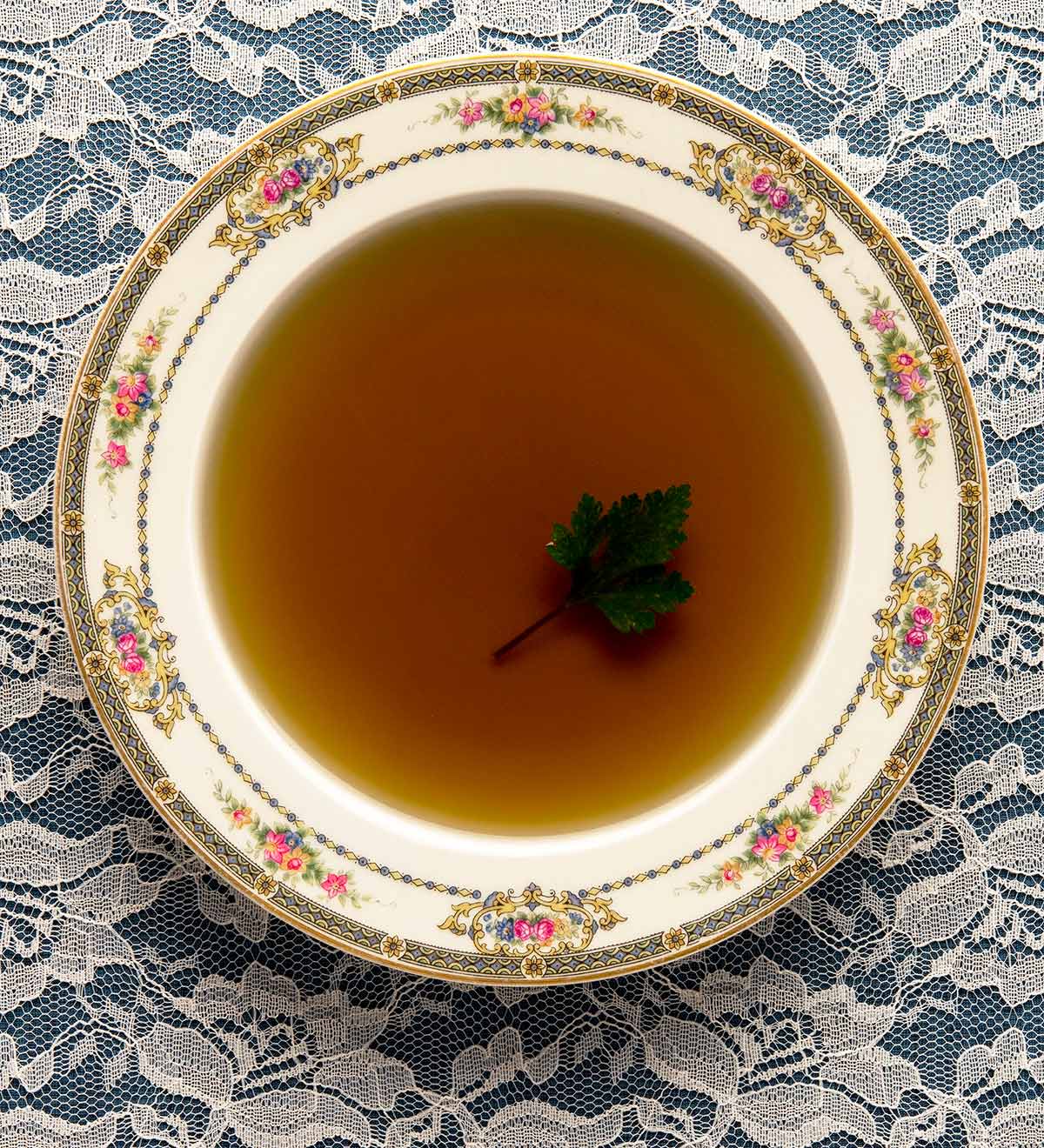
A well-made consommé is also one of those dishes that is far harder to execute than it looks. It shows skill and panache without shouting, like a Saville Row shirt: Crisp, understated, but oozing style and class. Consommé is the Grace Kelly of soups.
Tragically, consommé died about the same time as Princess Grace, in the early 1980s. What happened? Why do we not see it on menus anymore? To too many chefs, consommé is passé, like sole meuniere or steak Diane. But I ask you to consider consommé with fresh eyes.
Broth is lovely, and I have lots and lots of recipes for various broths on this site. But the difference between broth and consommé is clarity and flavor. Broth is easy, consommé is not.
A perfectly executed consommé is almost entirely devoid of fat — although I prefer just enough fat floating on the surface to make it look like there are a sprinkling of gleaming jewels adorning the broth. It will taste powerfully of whatever it is made from, and, of course it will be crystal clear.
It is that clarity that is so difficult to achieve — in life, in writing and in soup.
How to Make Consommé
For years, I’d had the basic consommé recipe in my head, but never dared try it. It seemed impossibly difficult, and, more importantly, expensive. And this may be why few restaurants make it anymore.
Yet it was at a restaurant where I first learned the technique. Those of you who ate at Grange’s Duck Dinner years ago will remember that Chef Michael Tuohy and I did dueling consommé courses. Mine was a classic duck consommé with duck liver ravioli.
Back home, I made the dish again. And again. I finally nailed it, and this version is even better than the one we made at Grange. Walk with me for a bit, and I will show you how to make magic with bones and broth.

Every proper consommé recipe requires two days, but most of the time you can be doing other things, and you can store the initial broth in the fridge for several days if you get busy. Ideally, you start on a weekend and finish the consommé either during the week or even the following weekend. Sound like a lot of work? It’s worth it.
First, you need to make stock. Pretty much any animal can be made into consommé, as can many vegetables. Here I am starting with duck stock, but other good options are venison stock, pheasant stock, crab stock, shrimp stock or fish stock. Once you have your stock you must chill it in the fridge, preferably overnight or up to several days.
The Raft
Now you must make a raft. A wha? A raft. You’ll see why it’s called that in a minute. Remember I said how hard it is to achieve clarity? This is where the raft comes in. You cannot make a perfectly clear consommé without some sort of fining agent. Nowadays I hear there are high-tech hydrocolloids you can use in modernist cuisine to clarify broths, but for centuries the answer has been egg whites.
Egg whites are primarily protein and water, but it’s the proteins we’re looking for. Put egg whites into a liquid and heat it and the proteins will form a molecular mesh that will act like a magnet, attracting the suspended solids that cloud your broth. The egg whites will rise to the surface of the liquid, drawing all the solids with them. Once strained, the liquid will be clear.
But it will also have less flavor, because a lot of those suspended solids taste good. This is why a raft is made from not just egg whites, but also finely chopped vegetables, tomato for acid, herbs and some spices, plus an additional hit of meat.
This is another reason I suspect restaurants don’t make consommé: It is undeniably expensive. You not only need meat and bones to make the stock, but you also need lean meat to grind with the raft to finish the consommé. If your customers don’t appreciate the work that goes into consommé, then charging them $13 for a bowl — for what looks like clear, unadorned soup — might cause a ruckus.
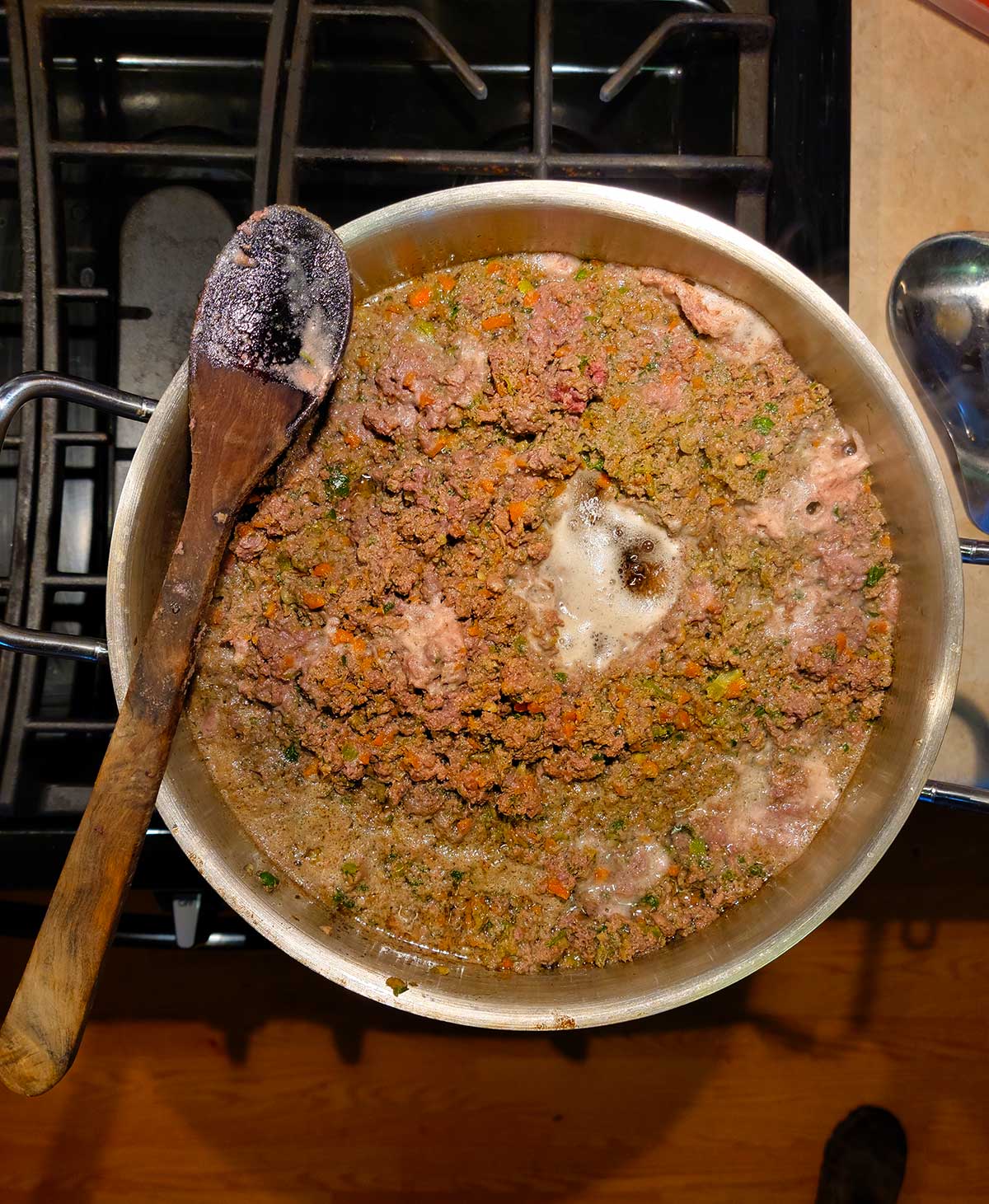
To finish a consommé, you pour your cold stock into a stockpot — the pot needs to be taller than it is wide — stir in the cold raft and turn the heat to medium. It is vital that the stock heat up gradually, and it is important to stir everything frequently until you see the raft start collecting on the surface of the stock.
Once the raft forms, simmer very gently for at least 1 hour, and no more than 90 minutes. If you are making fish or seafood consommé, no more than 45 minutes.
Finally, you ladle your consommé through the raft into a clean container — the soup needs to be poured through a paper towel set in a sieve. Here’s a short video showing you what it is supposed to look like.
Unless I am making it as a base for pasta, like I did at Grange, I don’t garnish it. I want those who drink it (yes, you can drink consommé, without a spoon) to experience the full glory of the soup. But you can garnish if you want. A traditional garnish for wild game consommé is julienned mushrooms.

I urge you to try making this consommé recipe, whether you use duck or chicken, venison or beef, or fish, seafood or mushrooms. Serve it to people you love, and take a little pride in explaining to them what you went through to achieve clarity. It can be a religious experience.
Classic French Consommé
Ingredients
- 5 quarts duck broth (or other broth, see above)
- 1 large onion, chopped
- 2 large carrots, chopped
- 2 large celery stalks, chopped
- 2 pounds lean meat, cut into 1-inch chunks
- 1 ounce dried mushrooms, any kind, soaked and chopped
- 10 egg whites
- A 2-inch piece of fresh rosemary, chopped
- 4 bay leaves
- 2 tablespoons kosher salt
- 12 ounces tomato puree
Instructions
- Make the raft by running the onion, carrot, celery, mushrooms and lean meat through a meat grinder, or by pulsing in a food processor until you have a rough mash. Don't puree it. Mix in the egg whites, rosemary, and bay leaves and chill for at least 4 hours, or up to overnight.
- Pour the cold duck broth into a stockpot and add the salt.
- Mix the tomato puree with the raft and add to the stock. Turn heat to medium and bring slowly to a simmer. Do not let it boil under any circumstances or you will ruin your consommé. Stir every couple of minutes until the raft begins to float on the surface. This takes a while, like 45 minutes.
- When the raft has formed, poke a 1-inch hole in its center and let the consommé simmer gently for 1 hour and 15 minutes. Keep an eye on the hole and clear it if it gets clogged with debris.
- Put a fine-meshed sieve over a container large enough to hold the consommé and line the sieve with a paper towel. Turn the heat to low on the consommé and ladle the soup through the sieve into the container. When you get to the bottom of the stockpot, pick out the raft and discard, then pour the remaining consommé through the sieve.
- Chill the consommé or serve immediately. Add salt to taste before serving.
Notes
Keys to Success
- Classically, you would use the same meat in the raft as you would in the stock, but so long as you are vaguely close it'll work, i.e., meat with meat, fish with fish. Poultry can go with red meat, and seafood can go with fish, but don't get any weirder than that.
- I can't stress enough how much you need to be patient. It takes a while for the raft to form, and then you need to make sure the broth doesn't boil furiously or it will break that raft.
- If you are determined to do something with the leftover raft, feed it to your animals. Dogs love it, as do pigs, and maybe your cat will give it a go. It's no longer super tasty for humans, but it's safe to eat.
- Consommé freezes well, and you can pressure can it. Follow your canner's directions, and shoot for 25 minutes at 10 PSI if you live from sea level to about 1000 feet.
Nutrition
Nutrition information is automatically calculated, so should only be used as an approximation.






not to mentioned this, but don’t feed the raft to your dog. It contains onions. which are toxic to your dog. Just a friendly warning. Otherwise, great recipe.
Hank you’ve done it again, darn near bringing a tear to my eye. I’ve been making consume for 15 years or so, making it once or twice a year. Everything you said – especially that it’s worth the time and to serve it to people you love (which to me means I build the specialness of it up to those people that they darn well appreciate it.) Here’s my approach at “efficiency” for making consume, or just not letting something else good go to waste. I’ll make pot-au-feu a couple times a year, also something akin to that using chicken instead, and when I have way too many oysters to shuck, which is often, I will steam them in a healthy amount of water, a little wine, herbs etc. and eat them. The point is that all of these result in a wonderfully rich broth. I usually strain and freeze what’s left over, but when I have my Hank Shaw on, will strain and refrigerate it, and make consume exactly as you outlined. The result is refined like a consume, but with great depth. The oyster broth makes a wonderful start for a seafood consume, and I’ll use a mild white fish like a perch and maybe a couple shrimp for the raft. I’ve wondered if I’m breaking an age old haute cuisine rule, but I’m just a hunter and fisherman hack in the kitchen. Thanks for the incentive. I’ll make consume before the year is done. Happy holidays.
I am only at the ‘simmer raft without boiling’ part & feel so nervous! Thank you for the recipe and (I never appreciate most prefaces to recipes) the preface!
That’s funny… you reading the Bible.
: )
I heard about this consume. In fact I’m hearing a lot about all these fabulous meals my brother is having and I’m growing quite jealous.
Wonderful post. Worth all the work I’m sure.
Hank,
If you need a more powerful consume, I just make a double stock. I make my stock in pressure cooker, so it’s pretty easy.
I’ve made my own stock for years and I use game for some of it, but I’ve never tried consomme’ This weekend I’m going to try it..can’t wait!
I’m one who cut my cooking teeth on consomme, and I haven’t made any in at least a decade. Truth be told, I doubt chefs really regard consomme as passe. I suspect they regard it as a pain in the ass to prepare and a hard sell on the menu for exactly the reasons you cite. (Also, by the way, sole meunier is anything but passe to someone who has tried it done right. Then it’s incomparable.)
But you’ve inspired me, Hank. I’m taking this in a different direction though. Pork consomme. Yes, my indoctrination said that pork is not a candidate for stock, let alone consomme. I’ve already bucked the conventional wisdom. The stock is in the fridge, intended as a gelatinous sheath for the inside of a classic British raised pork pie. It has good flavor, but is rather dark, even though I was pretty good about skimming while it cooked. It could use a little reduction anyway, since it sets only when completely cool. Might as well clear it up while reducing it, just for yucks. After all, I have incomparably fresh eggs from the back yard.
Exactly how I remember it from culinary school. The result is magical, you turn a cloudy stock into clear liquid gold. The work and time involved is measurable but it is worth it.
Daniel: Haven’t burned one yet, but I can imagine I’d be slamming my head against the wall if I did.
Andrew: Great tip! Funny, I have noticed that effect naturally. When I thaw my frozen stock I get that separation, but the resulting clear broth tastes weaker — no added mirepoix or meat is the culprit, I suspect. Wonder how to combat that?
Kim: I’ve read Richard Olney. And yes, that’s a good point about that final protein skimming. It’s easy to do when you have strained stock you want to reduce. Put the pot askew on the burner so the stock is not heated evenly. The scum will collect on the cool side of the pot, where you can skim it easily.
Sarah: Yep. I start with de-fatted broth, although there is always just enough to give you those jewels…
Florian: Yep. Those tortellini were the size of agnolotti.
Paul: Mmmm….. meat tea. I’ll stick to consomme.
MNAngler: Oh yeah, that beef noodle soup at Tanpopo is exactly what you need when the temperature is below zero…. which is half the year in Minnesota. 😉
Beautiful dish and great tips. I’ve never tried this, but it doesn’t look so difficult. Thanks for the tips!
I was shocked to see that the beef broth that rivaled a French restaurant’s was one by a restaurant in St. Paul, MN. I’ve never even heard of Tanpopo, but now I’ll have to check them out.
My wife makes some great homemade broth. Perhaps I can persuade her to take the next step and make them into consumme. If not, you’ve made it look so simple, I might be naive enough to try.
Wow, this sounds and looks great. I may have to give this a whirl next year.
Nate
Nice to see some respect given to consommes. Sadly, they are far too often overlooked by diners (maybe eater is a more accurate term). One of my favorite local chefs makes a wonderful consomme, but he can’t sell it. As the eaters say they don’t want “soup”. I think there is a lack of understanding from most of the craft that goes into a great consomme (hell even a good one at that). Eaters today eat up the kitchen chemistry of foams and pearls, I do too if done with restraint. However, a consomme is old school kitchen chemistry that has so much going on behind the scenes the finished product never gets it full appreciation.
Enough with the rant, the duck consomme looks amazing. My only dissapointment is I can’t taste it through the interwebs.
Beautiful Hank! It’s rare to see stock so well clarified!
It kind of looks like a cup of tea, which reminds me of reading somewhere that in Victorian England they used to make teas with seafoods and other meats. I’d guess they dried the protein and ground it down it first and then used it just like tea leaves.
This is the first time that the egg white clarification process has been described in a manner that not only is undertandable, seems do-able. Thanks for that.
I love the pictures, I’m having a serious ravioli craving now! Have you ever tried to serve the consomme with tiny agnolotti?
Looks stunning. I love consomme. My raft is much simpler but I really must try your suggestions. I also found it much easier to make a clear consomme if I defatted the broth first. I, too, often forget to salt food before I serve it and then kick myself.
Hi Hank,
“Spider.” I have one and use it. I just never knew what it was called. Thanks.
What a great post. Do you know Richard Olney? He has three stages of skimming the stock/souse that I’ve found really useful. First you take off the scum; then you take off the fat; lastly you take of that thin membrane of protein that floats to the surface – and the stock must never more than shimmer for hours. It is this last instruction that I find so hard. Making stock isn’t hard technically. But, for me, it’s hard emotionally. I’m in too much of a hurry and so fail 9 times out of 10 (well, maybe not quite that often). If you have advice on *that* I’d be really interested.
That consommé looks great.
Best, Kim
Have you ever clarified your stock using gelatin? I find it’s much easier. When I make chicken or beef stock, I usually have enough gelatin in it naturally to work, but you can always add a bit extra if your stock doesn’t set up. Once you have a gelled stock, just freeze it and then thaw it in the fridge in a cheese cloth lined strainer over a bowl. Depending on how much you are doing, it could take a day or two to thaw, but it works well and is dead simple.
It is a very satisfying process, and very frustrating when you burn it (or don’t salt it). Looks gorgeous with those raviolis.