Pork Fat Orgy

Jun 15th, 2009 | By Hank | Category: Charcuterie, Italian, Wild Game | Comments | 21 Comments |

pile of bacon

I was awash in pork fat this past weekend. In the past few days I have made two types of bacon, a dry cured wild boar salami, more than six pounds of lardo — cured back fat — not to mention a gallon of fresh rendered lard.

I blame John Bledsoe.

Bledsoe is the local hog farmer I buy from, and I always knew his pork rocked (his pork shoulder and bellies have been the only meat we’ve bought regularly in several years), but didn’t quite realize just how good it was until Saturday.

Let me back up a bit. Earlier in the week I smoked my two slabs of bacon, made from Bledsoe pork bellies. These were a good inch thick at their thinnest, and nicely striated; I love that the English call this “streaky bacon.” The first slab I rubbed down with red wine and then cured with a set of Italian herbs and spices, like a tesa. The other I decided to make quasi-French, with quatre epices and some local wildflower honey.

I smoked the Italian bacon for just an hour, the French bacon for four hours. Can’t say how they taste yet, because Holly wants me to wait until she returns from a trip to South Dakota. That’ll be this afternoon. I’m betting she won’t be disappointed.

But when I finished smoking the slabs, I rummaged through my box freezer and found I was out of pork fat; I needed some for a wild boar salami. I know, it’s sad. So I emailed Bledsoe and asked if he could bring in some back fat to the Davis Farmer’s Market on the weekend. Sure, he said (or rather wrote): How much do I need? Maybe about 5 pounds, I said. He said he’d bring 40.

Thinking this was some sort of hog farmer humor, I forgot about it. But when I arrived at the market Saturday morning, there was John with a giant cardboard box full of back fat. He was grinning: “Here ya go!”

“Uh, what am I going to do with 40 pounds of back fat?”

“I don’t care. Throw it out if it’s too much.”

Head spinning, I lugged the crate o’fat back to my truck and drove back to Orangevale. Christ. Forty pounds of pork fat?! What the hell am I going to do with it? My first stop was my neighbors from Argentina, who love All Things Meat. Except, as I learned, pork fat. Damn healthy people.

I called Elise, and she said she’d take some to make a moose salami at some point. No problem, I said. OK, there’s a pound-and-a-half allocated.

I’d need another 1.5 pounds for the salami I was making that day, and I reckoned I could cut some into 1 pound-plus chunks to use for future sausage-making endeavors — it is a rare wild game animal that is fatty enough not to need pork fat, so this would come in handy.

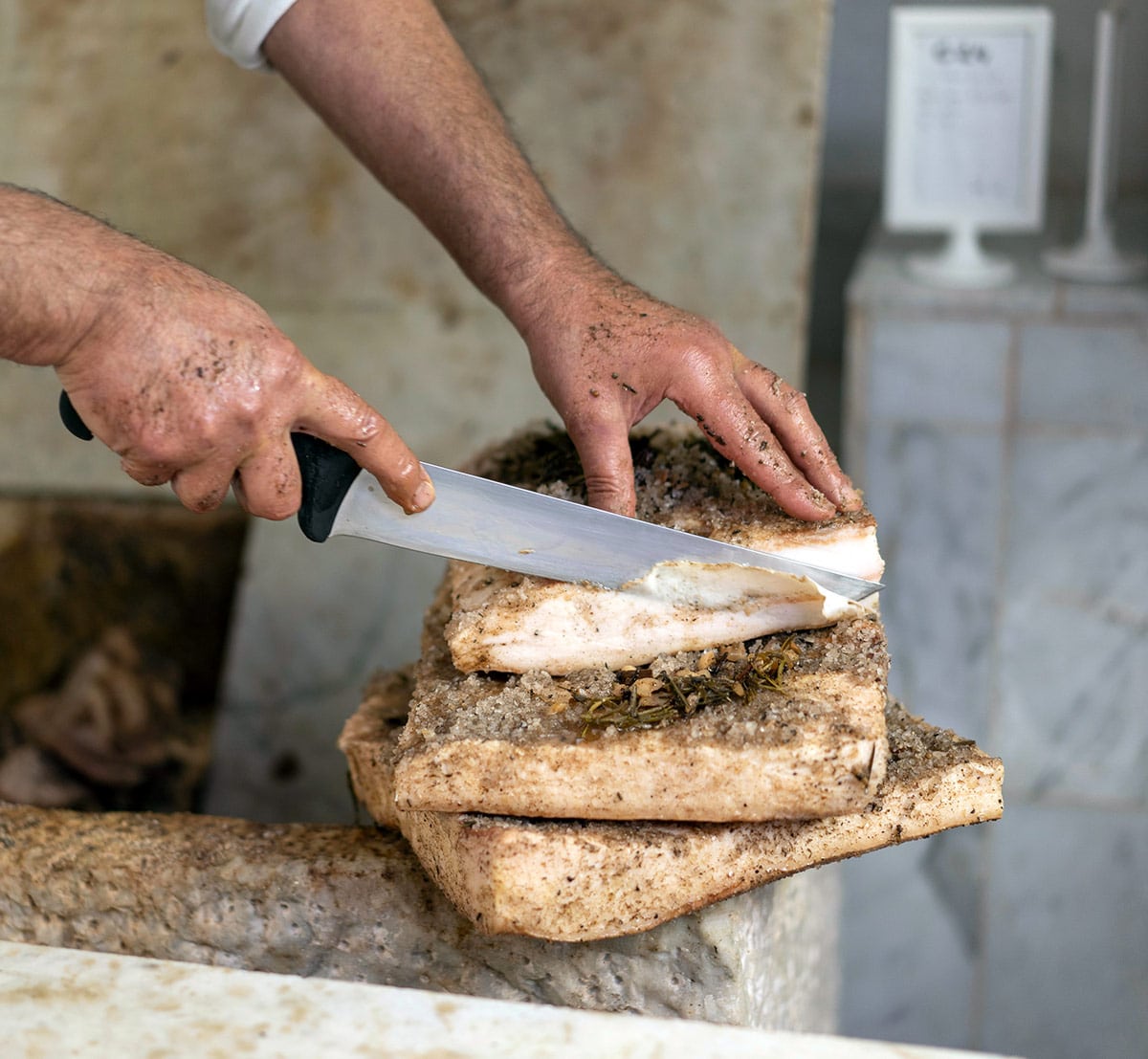
slabs of fatI set about cutting pork fat. That’s when I realized that I was in the presence of a master hog farmer.

Now I’ve cut back fat before, many times. I prefer it for sausages because it is hard and flavorful, unlike some of the softer intramuscular fat I am forced to use pretty often. Back fat is the preferred pork fat to use if you can get it. When I have in the past, it’s usually been in thin strips, sliced from the back of the hog; it’s trim from the shoulder and loins, because consumers don’t want thick fat caps on their pork these days. Foolish humans. But Bledsoe’s back fat was different.

One piece was — and I kid you not — two inches thick. I have never seen anything like it. Many others were more than an inch thick, all with the slightest wisp of pink meat within. I knew then what I had to do: Lardo.

Good lardo is a gift from God. I first had it years ago in New Jersey at an Italian deli (we call them “pork stores” there), served to me by the owner on the sly. “Here, try this.” What is it, Timmy? “Just eat it.” I looked and it was a slice of white something on a piece of rye bread. I ate it, and it tasted like a porky, aromatic butter. Awesome. Can I have more? “Sorry. We just got back from Italy and this is all we got. Next time.”

Next time was 20 years later, at Chef Cosentino’s restaurant Incanto. By that time lardo had become fairly common in the US. Cosentino, who knows his way around a hog, makes an excellent lardo. I resolved to make it myself at that point, but had never seen back fat worthy until Saturday.

I separate the pieces out and wound up with a little more than six pounds of perfect slabs. I read a dozen or so recipes for lardo on the web, and in my charcuterie library, and came up with my own recipe for lardo that relies heavily on rosemary, star anise and black pepper.

lardo curing

We’ll know in a month or so if it comes out.

rendering lardThat still left the scrappy bits of fat, which I rendered down into lard. Ever tried making lard on a large scale? Good lord does it take a long time! I tried an oven-cooking method featured in the most excellent book Fat, but that took an astonishing eight hours! I really don’t want the oven on that long in June. Yesterday I did my stovetop method, and it took only four hours. Better, but still. And both methods wreck the bottom of the pot.

I needed a break after that, so I snacked on success. I’ve had some tough luck making salami lately — I’ve had three batches in a row fail, including the Spanish chorizo I was so proud of. But I think I have finally figured out the problems, however, and one major problem was solved when I cut into a batch of French saucisson sec I’d made a few weeks after the chorizo.

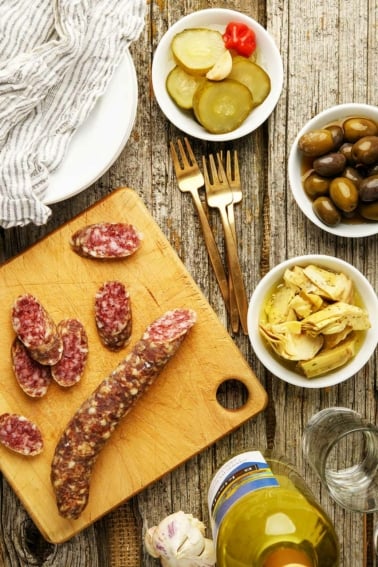
saucisson sec

As you can see, this one, while not perfect, fermented, cured and dried well. It is tangy but not overly so, and the meat bound decently. What made this different from the failures? I used a lot more of the starter culture. I think this made a huge difference.

I upped the ante on my next batch, which I made Saturday. I made it from bits and pieces from Maximus the Wild Boar, plus some of Bledsoe’s awesome fat. This, I hope, will be a spectacular salami.

white sageWhat makes it special to me is that I could put to good use the old saying that if things live together, they will taste good together. I shot Maximus in Monterey County, and while I was there I found a lot of this resinous, sweet-smelling herb I later learned was California white sage. I saved and dried some.

I also had some California bay laurel given to me by our neighbor who goes to school at UC Santa Cruz. To these herbs I added some home-grown garlic and wild fennel pollen – another wild plant I saw a lot in Monterey.

To go one further, I used a 1974 Heitz Cellars Angelica for the liquid in the salami; Angelica is a sweet wine made from Mission grapes, the first grapes brought here by the Spanish missionairies in the 1700s. It is California’s first wine. Pretty cool, eh?

In making this sausage, I added plenty of starter culture and mixed the meat far longer than I normally do — and I hand-cut the fat, which I dropped in as the meat was mixing. It looks like everything went well, and I just put the salami in the curing box this morning. Cross your fingers that in a month or so I will have a glorious Wild Boar Salami California.

If you want to try it yourself, I wrote the recipe down here. In case you had not noticed, I’ve also added a new main page to the site, “Cured Meat Recipes,” which is my catch-all for anything cured or in sausage form. Those of you interested in sausage-making or curing will find my recipes there.

california salami

___________

Tags: , , , , , , ,
Print This Post

________________


Subscribe to comments for this post

21 comments
Leave a comment »

  1. I AM SO JEALOUS I HAVE TO TYPE IN CAPS.

  2. Wow… damn, maybe I should have taken you up on that fat offer. I need to get myself a meat grinder so I can make my own sausage. Can’t wait to hear how the cured bacon comes out.

  3. Holy Cow..or should I say Pig!! I would’ve loved a couple of those backfat slabs. Lucky, Lucky you.

  4. So jealous, I even typed my name wrong :)

  5. Until about 10 years ago when my grandfather passed away we would butcher about a dozen hogs every fall. Day 1 was killing, scalding and cutting. Day two was grinding sausage and making Lard to be put up for winter. We would end up with 3 or 4 stainless steel 5 gallon drums of pure white lard. Best biscuits, cakes and pie dough ever.
    We made lard in a huge black iron caldroon (think McBeth) set over a wood fire on cinder blocks. The chance of a boil over and nuclear explosion was always a possibility!

  6. Hmm, I didn’t think it was possible to have too much fatback!

    Now when I make lard from fatback I grind it first, and then render it; it takes much less time than if you start off with bigger chunks.

  7. Brady: That’s a lot of sausage and lard! How many of you did that feed?

    Andrew: I thought about grinding it, but fat that its super cold tends to gum up my grinder, so I just cut it into dice. Maybe next time…

  8. What kind of smoker set do you use? I am assuming something capable of cool smoke?

  9. Hey bud, Mike told me about your blog yesterday. Love it. And would love to try that boar sausage.

    Gonna pick through the archives and see what else I can find that my wife would never eat.

  10. i am having an orgasm here. this post is it for me. PORK FAT ORGY… how sexy is that? i’m a different type of girl, clearly. LOL

    what i DID NOT realize was that lardo is really from fat back? are you sh*tting me? i can buy a slab of fat back at my market for like 85 cents! i’m so using your recipe to make my own. it’s one of my most guilty pleasures when i can get it. love it on pizza.

  11. Supermarket fat back will work, but may be a bit more than too chewy.

    This is something worth buying decent fatback for.

    That salami looks lovely.

    I just ran across something titled The River Cottage Meat Book. Fell open to the charcuterie section in the book store and could not resist.

  12. I highly recommend The River Cottage Meat book and also his first book, The River Cottage Cookbook. Fantastic reads and great rustic recipes. I just made some more of his chutney this weekend, I cannot get enough of that stuff.

  13. Okay. That. Was. Awesome!

  14. Brady: I have a standard smoker with an offset firebox. I put a load of ice cubes in the drip pan to cool the smoking chamber down. Works OK, but I cannot do a legit cold smoke outside of December to February.

    Rob: There are TONS of recipes here your wife won’t eat…

    WeAreNeverFull: First, I’m with you on the pork fat thing. It makes life better.

    Second, I’m with NTSC on the supermarket fatback: DO NOT use it — like I said in the recipe, factory hogs are full of hormones and antibiotics and other nasties, and a lot of that lodges in the fat. What’s more, the fat of a factory hog will be thin and chewy and tasteless. Why would you want to highlight that through curing?

    So sadly, this is a case of you get what you pay for: Find high quality fatback before making lardo.

    NTSC: I have the River Cottage Meat Book. It’s one of my faves. Their fish book isn’t very useful, though, as it focuses on fish that live in the UK. River Cottage Cookbook is supposed to be good, as E. Nassar says.

  15. YUM. LOVE pork fat. I second you on the terrible quality of supermarket pork fat, or just pork in general really.

    The River Cottage Cookbook is really great – a lot more diverse than the meat book, but doesn’t have such lofty weight to the writing. Both are really great books in my opinion, but I have learnt a lot more from the meat book.

  16. Hey, Hank. I’ve had issues with the binding as well. I’ve found that the issue is not directly related with the starter so much as the food FOR the starter, i.e, dextrose. I find between .5%-.6% dextrose/total meat weight, and .09% starter/total meat weight works pretty consistently.

    Scott

  17. Oh man I love your blog. Not only is your writing great, but the commentors are a kick in the pants. Shoot, I’ve been reading too many tame gardening blogs. But no more! On to pork fat and paprika. I’ve made my own paprika for years, but no more smugness — I can see I’m just a lightweight. Must resurrect childhood fishing pole from attic and cultivate a local organic meat grower for Beyond Beef.
    Dude, I am so dedicated a reader from here on out!

  18. I’m just ‘over the hill’ from you in Carson City. Any chance you’d share the contact info for John Bledsoe?

    You have one fantastic site here. I surfed in here from Cowtown Cop and it looks like I’m going to be spending a lot of time here!

  19. Hey Bill (and anyone else who is interested): John Bledsoe operates his orders mostly via email, so drop him a note if you want his most excellent pork:

    jrbledsoe AT sbcglobal DOT net

  20. I’ve deboned a few wild pigs in my day, but I need some education. I usually take home the shoulder and front legs with bone, and also the tenderloin and the rear legs without bone. As well as the liver, kidneys and heart. So I recently got a nice adolescent pig that lived in an old macadamia orchard, and was so impressed with his fat that I hope to be coming back for his neighbors, and see what mac nut fat on a pig tastes like. What’s the best way to save the back and belly fat of a wild pig, given that I can’t carry out the whole body? Assuming I cut off the fattest areas of skin, and roll it up somehow to avoid getting the inside dirty, what happens at home? I tried barbers clippers, but that chokes up on the thick hair and then leaves stubble. I know you can boil and scrape, but it’s hard to do when the skin is already cut up. Any ideas on the optimal way to do this.?

  21. Jon W. Why can’t you carry out the whole hog? I’d suggest getting a linen or muslin game bag from a sporting goods store and putting the pieces in that.

Leave Comment

CAPTCHA Image