Antelope, Salmon, Duck – Works in Progress

Mar 11th, 2009 | By | Category: Cooking Basics, Wild Game | Comments | 13 Comments |

sous-vide-salmon

There is a truism in any endeavor: If you are afraid to fail, you will never achieve true success. I’ve made no secret of the fact that, more than  just being a decent home cook, I am trying to delve deep into fish and game cookery and return with nuggets of wisdom that I can share with you. Anyone can slap down recipes. What I want is to learn how to extract the full measure from every fish or bird or furred animal that we as hunters, anglers — and eaters — put on our tables.

A tall order. And a dangerous one, in a way. Let me explain: Once they leave the field and enter the kitchen, nearly every hunter I know is deathly afraid of ruining their game, for which they have worked long and hard for and that has died for their table. This fear manifests itself in hunters, and especially anglers, when they stick to one or two tried-and-true recipes for their quarry. How many of us know the guy who fries every fish he catches in cornmeal? Not that there’s anything wrong with this, and I love fried fish. But there is more to life than fried things. Really. No, I mean really there is. Honest.

I am not immune to this fear, except that I have several dozen recipes — techniques, really —  instead of a handful. I sear. I saute. I roast and grill. I rarely steam and never boil. I make good food, sometimes great food. But there is so much more to know. So I have begun looking at recipes in a new way, and I am trying to step out on the high wire a bit more. Nothing a real, trained chef would consider daring, but still.

All of which leads me to the antelope, the salmon, and the duck.

sv-antelope-main

I, like many of my cheffy, foodie brethren, am fascinated by the technique of sous vide, which is essentially precision boil-in-the-bag. I even bought Thomas Keller’s Under Pressure: Cooking Sous Vide to study the technique. Why, I have no clear idea, as the immersion circulator required to do this technique properly costs $1,000. And no, I have not sprung for one. Yet.

Why bother with sous vide? Well, you can get some amazing results, especially with tough meats. And many game meats can be tough. It is also an excellent technique for offal, and I love my guts. You can basically cook something forever without toughening it up. You need a vacuum sealer, which I have — as any hunter or angler should — and I am a big fan of carryover heat in my cooking: turning off the heat and letting the fading warmth within the pot or pan gently finish whatever it is I am cooking. So I decided on a poor man’s version of sous vide.

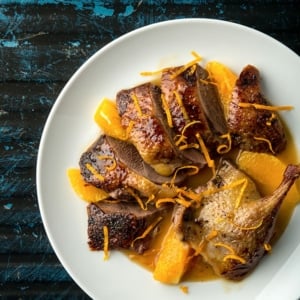
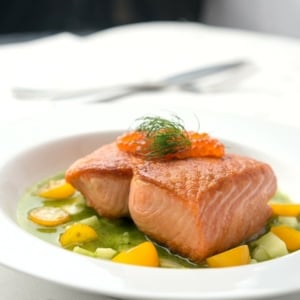
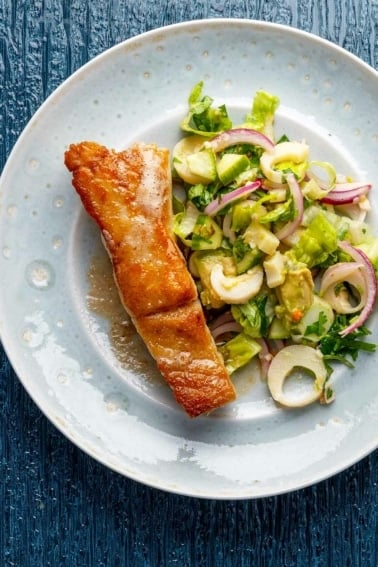
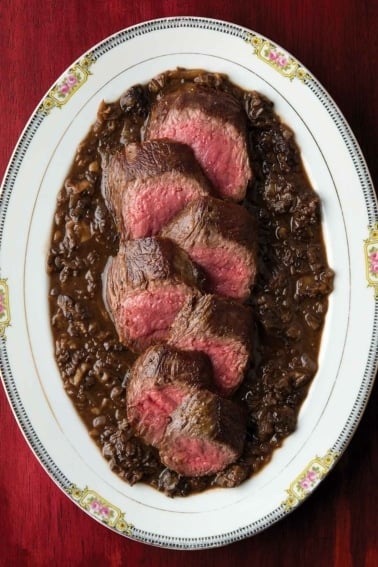
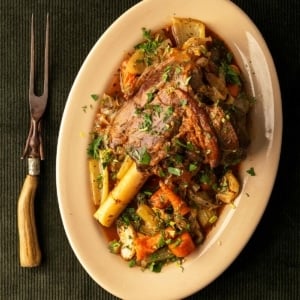
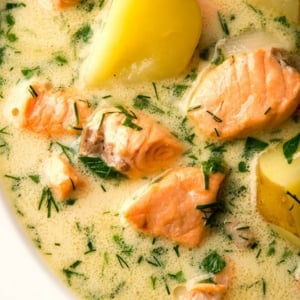
antelope-sous-vide-detailBasically I heated a large stockpot full of water to a little higher than I wanted the meat to be, dropped in the sealed meat, turned off the heat and walked away. All that water holds heat pretty well, so to cook the antelope you see at right, I got the water to 175 degrees before turning it off. To cook the salmon in the top picture, I brought it to 160 degrees. If I had an immersion circulator, I would have set it for 140 degrees for the antelope, 130 for the salmon. I like those temperatures, but that’s just me.

How did it work? Pretty good, although you can see the sealing creases on that piece of salmon. The outsides of each meat were a little overdone, which is fine if you have a nice sear on it, not so fine without it. Think gray. Bleh. I think if I lowered my starting temperatures a little I’d get better results. Here is my working version of the salmon recipe, and I will post the antelope recipe once I perfect it.

One thing I will say is that I like the effect of adding just the teeniest bit of smoked salt onto the sous vide antelope right at the end. A great addition, one I will remember.

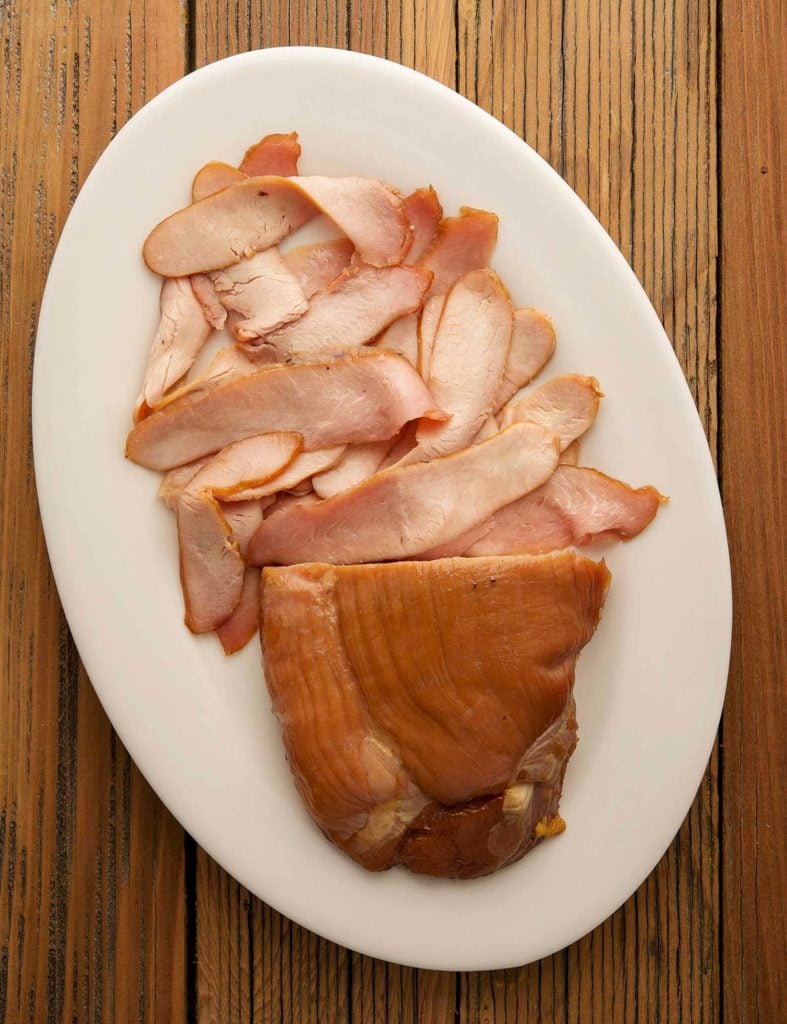
Speaking of smoked things, what about that duck? As crazy as it sounds, I had never smoked a duck before. Other birds, yes, and lots and lots of red meat and fish, but never a duck. So I had these two ringnecks in the freezer that I wanted to smoke, because ringnecks can be strong-tasting and I wanted strong flavors to match it. I also grabbed a gadwall from the box freezer to add to the mix.

smoked-duck-detailI brined them in a mixture of salt, maple syrup, garlic, bay leaves, etc. overnight and then let them dry for an hour in a breezy place. I then smoked them over almond wood for 3 1/2 hours. They looked nice when they came out.

But no crispy skin. I am on a quest to find a foolproof method of getting a serious cracklin’ crisp on my duck skin — without massively overcooking the breast meat. Smoking did not do the trick, sadly.

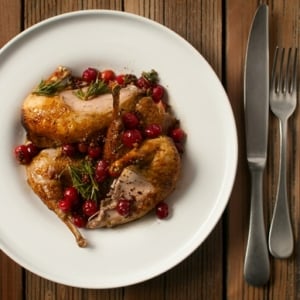
What might crisp up these bad boys? Hmmm…I don’t know…maybe…DEEP FRYING? Yes folks, it’s true: I deep-fried the smoked ringnecks tonight, a sinful thing I know. I deep-fried them in canola oil at about 330 degrees for about 5 minutes on the breast side, 3 minutes on the back side.

smoked-ringneck

It was good. Very good.  But the skin still lacked that awesome laquer crunch of a Peking Duck. How do they do it? Holly and I decided that I need to smoke the ducks for a shorter time — maybe 90 minutes — and deep-fry them in hotter oil for a longer time. Suggestions, anyone?

What I did succeed in making crispy was the salmon skin chip you see on top of the sous vide salmon above. That was a little revelation. What I did was remove the skin from the king salmon (which I received thanks to my friend Jon at Five Rivers Guide Service) and pack it in salt for about eight hours. I then rinsed it off, dried it really well, coated the skin in olive oil and roasted it at 375 degrees for about a half-hour. I topped it with some slices of preserved lemon. It was pretty cool, but the lesson learned was to salt it for less time, as the chip was really salty. I’ll try it for only 4 hours next time.

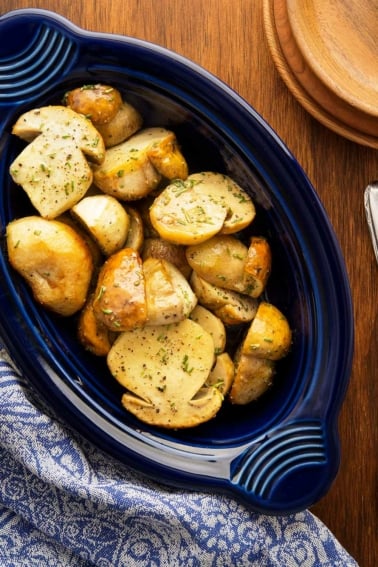
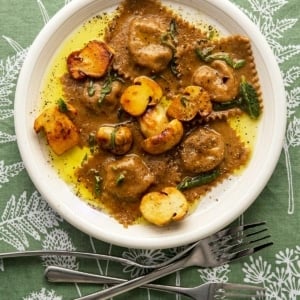
Another coup was the mushrooms. Mushrooms, you say? Where? They are the “potatoes” you see with the salmon dish. I wanted to do something different, and I had a king oyster mushroom, which is basically a big stalk. I cut it into coins, sweated the coins in a dry pan until they gave off their water, then sauteed them over high heat in some niter kebbeh, the Ethiopian spiced butter I made a few weeks ago. Fan-goddamn-tastic.

The bottom line is that most of what hit the plate in these last few meals I had never done before.  Some of it worked, some of it did not. Ski fast, fall hard. I must say Holly is a saint for being my personal tester, and while I rarely cook something so bad we can’t eat it (except for that wretched wild boar liver we still shudder about), she has gotten better at telling me when something isn’t great. More salt here, a little overdone there, less of this and more of that. Eventually, we hit on a winner.

None of this is rocket science, although a basic knowledge of science is invaluable in the kitchen. It’s about stepping out on that high wire, and not caring if you fall off once in a while. Remember, there’s always a net: It’s called the trash can.

Tags: , , , ,
Print This Post

________________


Subscribe to comments for this post

13 comments
Leave a comment »

  1. I like your blog. Sounds really delicous. I have always been a fan of wild meat and other food.

    cheers
    ben

  2. Don’t know how this would work with smoked ducks, but I’ve heard (yet not tried), scalding the duck for about 2 – 3 minutes tightens the skin. Then, pat dry, coat the duck with your marinade, and hang in a cool, ventilated spot for 6 – 8 hrs. The skin should get that dry parchment feel (almost like when your hanging pheasants are ready).
    I guess you could deep fry then, or roast the duck breast down for for 15 minutes at 240°, lower heat to 180° turn breast side up and cook for another 40 minutes.
    I’ll give it a try and let you know.

    Jay

  3. Hank, I’m just curious about something. Since I am neither a hunter or angler, please pardon me for my ignorance. I see that with most meats, you tend to cook to medium rare. Is that actually safe? I have always been told that game should be cooked to well done, or at the very least to medium well, in order to kill off any parasites. This is of course coming from hunters who quite honestly may actually prefer their domestically raised meat this way.

    In my area of the country (Central PA), a great many people would never think of medium rare, or worse yet rare meat as an option. They tend to look at me as though I’m eating live animals when I order my steak. It really freaks them out when I tell them I eat tuna steaks the same way.

    By the way, although I don’t generally cook anything wild, I have learned a lot from your site that I’ve applied to domestic meats and poultry. I really appreciate the way you respect the animals you hunt. It’s something I haven’t seen from too many hunters.

  4. OK, I hate to piss on your fire – are you concerned these days about cooking something for a long time in plastic? leeching chemicals and so forth.. You know a lot more about sous vide than I do, so I figured I would ask you. It is a technique I am interested in, but potential health issues worry me.

    And, hats off for doing sous vide at home. Love the look of the salmon.

  5. Tina: Yes, it is safe, despite what the USDA says. They are just covering their butts and taking into account what you should do if you did get “off” meat. The interior of a piece of meat is sterile, and from my research I’ve found that there are almost no reports of parasites in wild game meat these days — even in wild pork, which does give a few people trichinosis each year. Is there a slight risk? Possibly, but I have never heard of anyone getting sick from properly handled rare (even raw) meat. To each his own, but I think well-done game is nasty, unless you have stewed or braised or smoked it.

    Matt: Nope, no worries on the plastic reaction. I highly doubt that plastic would become volatile at temperatures below boiling. And as for the other big whack at sous vide — the low temperature — it dovetails into what I said to Tina: If you have good, well-handled meat, you have no worries. But you can be damn well sure I’d never sous vide store-bought hamburger…

  6. Really well written post. Crispy wild ocean char is on deck next week here – can’t wait. And cool idea to try the sous-vide w/o immersion. Ballsy.

    And btw – I don’t have a vacuum bagger, and store my meats just fine, thank you very much! ;)

  7. I’ve never had antelope before and it’s definitely on my list to try. I applaud you for trying sous vide. Sometimes I feel that I never step outside my culinary comfort zone to try a technique so markedly different from one I’m used to. Do you feel that it’s a technique you’ll be using on a regular basis?

  8. Angry Brit: First off, why are you so angry? ;-) Secondly, yes, I will be using this technique a lot, but mostly for fish or the breast meat from birds like pheasants, quail or chicken — it is ideal for this, as breast meat tends to dry out easily and needs to be cooked gently. As for more red meat? I may wait until I get the immersion circulator…

  9. ‘there is more to life than fried things. Really. No, I mean really there is. Honest.’

    I want to believe you Hank, but in book this claim is sacrilege, you go too far sir.
    SBW

  10. When we were in Taiwan in 1971 we learned of Fu Pei Mei, television chef and author of fine cook books. Her recipe for Peking duck involved hanging the dead bird upside down in a dark, dry place until a single drop of fat formed onto his beak. How long? Hours? Days? I have no idea. Also, she recommended using a bicycle pump to insert air between the skin and the body of the duck. The thing is, I can’t remember whether this step came before or after the hanging, and I don’t have the book any more. Anyway, I never did it. I always just went to the restaurant and ordered Peking duck like everyone else. Her books are still available on Amazon.com, by the way.

  11. I’m in the process of making my transition from urban dweller to someone who lives a little closer to the countryside and your blog is very interesting because it’s fraught with information that most city dwellers know nothing about. One day I hope I’ll be able to do some of the things you do here.

  12. I’ve played around with the idea of using the ‘bicycle pump’ on wild ducks as I’ve seen it used on some of the trendy cooking shows and read about the technique online. Maybe one day I’ll man-up and try it.

    Carefully pulling the skin away from the meat on whole pheasants, quail, and dove before roasting has ensured a nice crispy skin for me….But they don’t have that thick skin and nice layer of fat a duck does. Hank’s low and slow then broil method has been the closest thing to “almost” crispy duck skin I’ve found.

  13. Sous-vide antelope? I’d definitely try that. :)

    I’m looking forward to seeing more of the results of these experiments.

    (By the way, I think it’s the maltose mixture used for basting that gives Peking duck that crackling-crisp skin.)

Leave Comment

*