
As an Amazon Associate I earn from qualifying purchases.
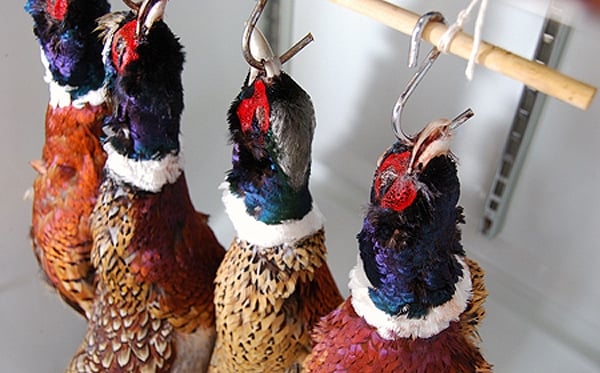
For several years after I began hunting, I recoiled at the idea of hanging game birds. The idea of hanging shot pheasants or partridges undrawn and in the feathers for days and days just did not seem terribly hygienic or sane to me. Old texts wax rhapsodic about the sublime flavor of “high” game, which usually means pheasants and usually means birds that have hung for more than a week. This, I decided, was madness.
I was wrong.
So I took a systematic look at the science of hanging pheasants and other game birds.
Nearly everyone who reads this space would probably agree with me that dry-aged beef is the finest expression of that meat. It is concentrated, savory and tender — and very expensive because dry-aging necessarily means a layer of crusty, slightly moldy ick on the outer edges of the meat. This is cut off before selling or serving.
Hanging beef and venison is important in part because these animals tend to be dispatched at about 18 months to 2 years old — old enough to get a tad tough on the teeth. Think about it: A whitetail buck sporting trophy antlers is likely to be 4 to 7 years old. Conversely, we don’t hang pork because hogs are slaughtered young. Ditto with domestic chickens. Young animals are already tender, so that aspect of aging isn’t needed.
Enter the pheasant. A pheasant really is a “ditch chicken.” It is a close cousin of the domestic chicken and when eaten fresh has, as Brillat-Savarin puts it in his The Physiology of Taste , “nothing distinguishing about it. It is neither as delicate as a pullet, nor as savorous as a quail.”
Those who have eaten fresh pheasant — and by fresh I mean un-hung — can’t help but thinking: “So what? This just seems like a slightly tough and slightly gamy chicken.” They are of course correct, especially with pen-raised birds.
So for my initial experiment I put our four pheasants in the salami fridge, which is set at 55°F. One had a big open spot on it where the breast skin had been ripped, so that bird I plucked after just one day. More on him later.
Off to the library. One of my idiosyncrasies (I have many) is that I collect game cookery books. I have many, and several discuss hanging pheasants.
The great Jean Anthelme Brillat-Savarin doesn’t give a timetable, but says, “the peak is reached when the pheasant begins to decompose; its aroma develops, and mixes with an oil which in order to form must undergo a certain amount of fermentation, just as the oil in coffee can only be drawn out by roasting it.” Sounds pretty hardcore.
Roy Wall wrote in 1945: “The flesh of either wild game or domesticated animals and fowl can certainly be improved by aging, but it is my opinion that there must be a limit to the aging process…aging in the open air for 10 days or a month, according to weather conditions, is, in my opinion, most beneficial to domestic and wild meat alike.”
Don’t freak out. Roy doesn’t specify what game he’s talking about there, and aging an old buck deer in proper conditions for a month isn’t such a crazy idea, although I’d prolly cut it down after two weeks. More recently, Clarissa Dickson Wright — one of the Two Fat Ladies, my favorite TV food personalities — says of pheasant: “Hang it you must, even if for only three days, for all meat must be allowed to rest and mature.” Clarissa’s preference is a week to 10 days.
The current Authoritative Source on All Things Meat is Englishman Hugh Fearnley-Whittingstall, who in his The River Cottage Meat Book says “four or five days would be about right for me” if a bird is hung at 55°F.
This is what the food writers say, but to me that’s only a piece of the puzzle. What about science?
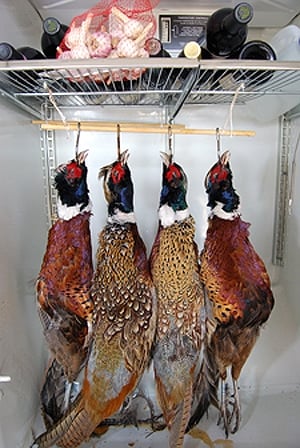
Fortunately science exists on the topic of hanging pheasants and other game birds. My best source is an Australian government publication that did some rigorous experiments. For example:
Pheasants hung for 9 days at 50°F have been found by overseas taste panels to be more acceptable than those hung for 4 days at 59°F or for 18 days at 41°F. The taste panels thought that the birds stored at 59°F were tougher than those held for longer periods at lower temperatures. Pheasants hung at 50°F became more ‘gamy’ in flavour and more tender with length of hanging.
Aha! One issue solved. Food writers rarely talk about temperature of hanging because most of them think about hanging pheasants outside, which is fine if you don’t live in Arizona, Louisiana, Texas or California; even in autumn it is often too warm to properly hang game. It seems 50°F is ideal, and the 55°F my fridge is set at is acceptable.
Furthermore, an English study from 1973 found that clostridia and e. coli bacteria form very rapidly once you get to about 60°F, but very slowly — and not at all in the case of clostridia — at 50°F.
That same study found that field care of the birds is vital. Under no circumstances should you allow pheasants to pile up in warm conditions because doing so will slow cooling so much that the dead birds will develop bacteria in their innards. This is no bueno.
All the bacteria and taste tests converge on two things: 50 to 55°F and 3 to 7 days. That’s your takeaway, folks.
Left undiscussed is the importance of feathers and innards. Brillat-Savarin speaks about a mysterious “oil,” and Wall talks about bacterial decomposition. Here’s my take: The feathers provide protection for the skin against drying out during aging. Pluck the feathers right away and you can still age the bird, but the skin will be unacceptably dried out and unusable.
As for the guts, I am on the fence here. I think they do add something: Fish guts will affect the fillets because of the animal’s digestive enzymes. No reason to think land animals aren’t the same way, although at 50 to 55°F this is going to take some time to develop — for what it’s worth, a pheasant’s body temperature runs about 105°F.
Yet, when I plucked and gutted my experimental pheasants I noticed two things: One, they were pretty dry inside, and two, the innards in three of the four birds looked fine and wholesome, not ratty and stinky. Maybe this je ne sais quoi does not appear until later.

All of which brings me to my own experiments with hanging pheasants. Like I mentioned before, I had one damaged bird I let hang for only a day. This bird’s body was drier and tighter than a fresh-killed bird, and I dry-plucked it because of the damage.
This pheasant went into a pheasant and pork pie, which turned out to be an outstanding dish. Hat tip to Fergus Henderson for the inspiration on this one. How was the pheasant? I noted two things: One, the bird browned better (less moisture?), and it was more flavorful — even after just one day.
That left three birds. I plucked the next one at three days. This is the beginning of the sweet spot in the Australian study. I noticed that this bird was pretty limp, but there was no bad smell and the fat and giblets looked pristine. I was, honestly, pretty shocked. I jointed this bird because that’s what I do with most pheasants; the legs and thighs always need more time than the breast.
The aging really came into play with the breast. It was soft, not unpleasantly so, but definitely less firm than the day-old bird or a fresh one. Then it hit me: These pheasants were pen-raised and had only been wandering around wild for days or weeks (months at the most). They were all young birds. I had originally planned to leave one bird for a full week, but scotched that idea immediately. I plucked the next two birds at 3 1/2 days and 4 days. I kept both whole.
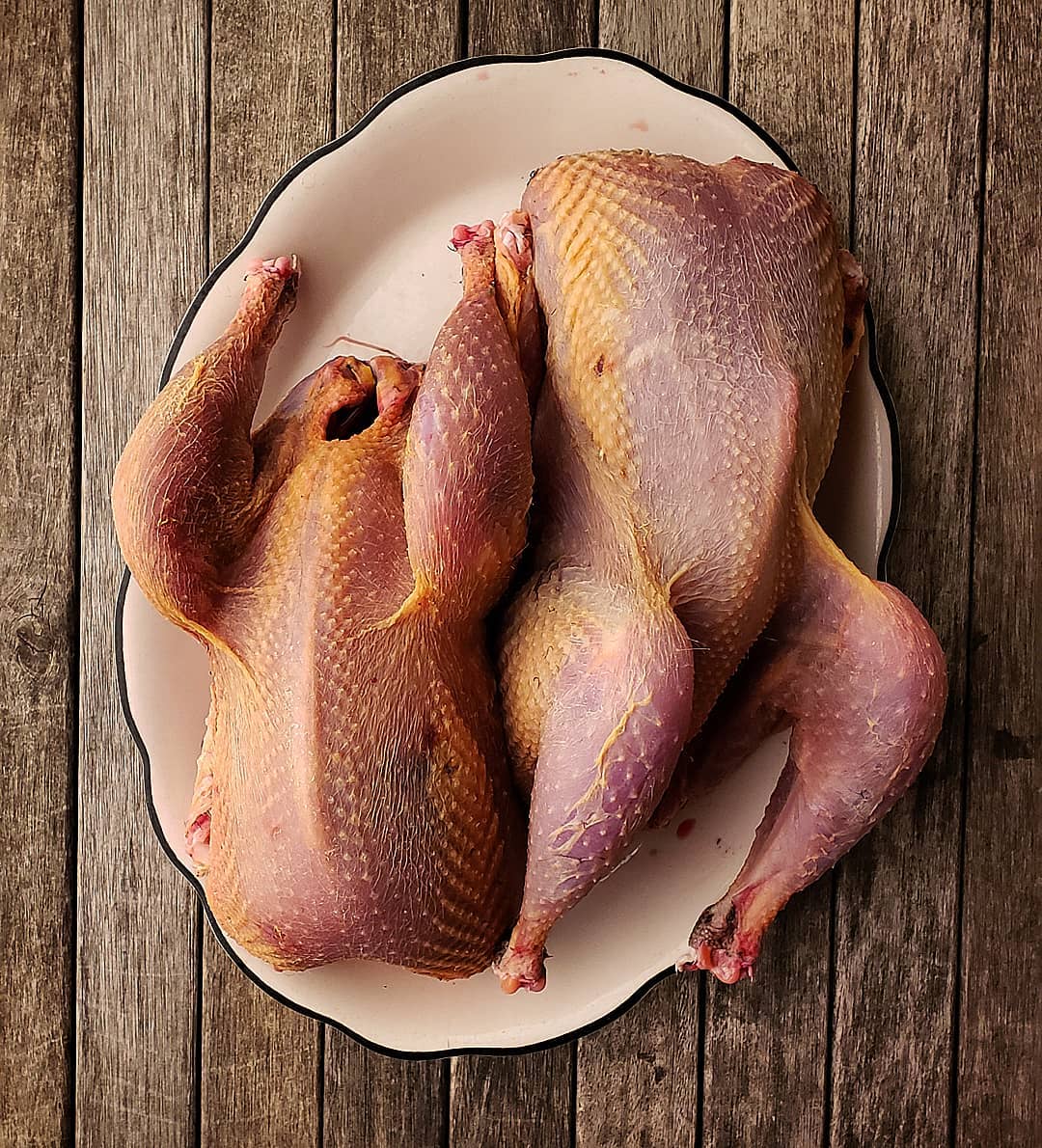
I’ve since done experiments on old roosters and they can be successfully aged for a full week. In fact, if you get an old, wild pheasant, 3 days would be a minimum for proper aging.
This of course with other game birds. Over the years I’ve come to these conclusions on hang time:
- Pheasants, grouse, partridges, turkeys and geese I will hang 3 to 7 days, depending on how old they were. If you hang turkeys or geese you must eviscerate them, as they retain too much heat otherwise.
- Pen-raised pheasants, all quail, woodcock, snipe and ducks I only age 1 to 3 days, again, depending on size and age. The smaller the bird and the younger the bird, the shorter the hang time.
And, to be honest, I rarely age my waterfowl this way anymore. If I want to age them, I do so in the fridge. The problem with ducks and geese is their down: It causes the birds to retain heat too long, and I end up getting a bit of gangrene on their butts, which is no bueno.
A few things you should know. Don’t try to wet-pluck an aged game bird as I instruct you to here. You must dry-pluck these birds because the skin gets looser and scalding did not seem to help one bit with the feathers. It was a major bummer to scald one bird and rip some of the skin. Dry-plucking, you should be warned, sucks. It takes forever, but is worth it for the results.
To eat the giblets or not? I’d say go for it for birds up to three days, if they have not been shot up. Any sign of ickiness in the innards and toss them at once. One way to tell if you are unsure is to render the fat the way you would with a duck. If it stinks, toss it.

So, to wrap up, here’s what I found:
- Keep your birds as cool and as separate as possible in the field. Use a game strap, not the game bag in your vest. Separate your birds in the truck or put them in a cooler — do not get them wet!
- Hanging your birds by the neck or feet does not matter, as several studies has shown.
- Hang upland birds between 50 to 55°F for at least three days, up to a week with an old rooster. Old roosters will have horny beaks, blunt spurs and feet that look like they have been walked on for quite some time. They will also have a stiff, heavy keelbone. Hen pheasants only need 3 days.
- Do not hang any game birds that have been gut-shot or are generally torn up. Butcher these immediately and use them for a pot pie.
- Dry-pluck any bird that has hung for more than 3 days.
- Wash and dry your birds after you pluck and draw them. Only then should you freeze them.



Hank. Enjoyed your exploration into hanging game meats. Have you a source for the Australian Gov. quote on times and temperatures for hanging?
Tim: It should be hotlinked within the article.
Hank,
I appreciate the advice you give and enjoy reading your articles. I am going to Birds Landing in a few days to get pheasant, and would like to age them. They are pen raised, as you know. Can I hang them in my house fridge? It is set for 38F.
Thank you
Al: Yes, you can do that. They won’t likely need more than 3 days.
You might find this interesting. Edna Lewis states in her book The Taste of Country Cooking: “Game had the distinction of holding for a long time; after it was drawn, most game with fur and feathers left on was left to hang in the meat house and used as needed.”
Thank you, this helped me understand what Blackthorne was doing in Sh?gun episode 5.
Haha, I’m here for the exact same reason. Haha?
Hi Hank, I’ve been hanging birds for the last 3 seasons after reading this article with great results. I’ve yet to lose one to a pellet in the guts. Would there be any downside to eviscerating pheasants before hanging them? Even though it’s been going well I’m expecting to lose one at some point and trying to avoid it.
Jacob: The only downside is that they are harder to pluck once gutted.
Any experience or thoughts doing this with sage grouse? Big ones veer into the size you recommend breaking them down, and also I don’t know if aging would make the sageiness stronger or milder.
Centrocercus: I’ve let them hang a couple days, but not more than that. Usually just 3 days to let the birds relax so I can pluck them easier.
Would you do this with pen raised heritage broiler chickens too and farmed quail too? If so, how would you kill them before hanging …i.e. decapitate, or slit the throat? would bleeding them out make a difference/is it important? What would the hang time be for this type of bird? Thanks so much for your article.. Love to hear historical ways as well as the science! It still seems a bit scary but you have given me enough curiosity to try !
Martin: I would not. The point of this method is for older birds, a year old or more. It would work with old laying hens though.
Amazing article- thank you for this. Have you had good results with diving ducks, or have you found it to accentuate the undesirable game notes? I know a lot of people remove the skin for these birds due to subcue fat containing these tastes
Ron: Hanging won’t make a fishy diver duck taste better. But not all divers are fishy. Redheads, canvasbacks and ringnecks all tend to be clean tasting.
appreciate it
Hey Hank!
Great article. Tomns of super information
Couple of comments:
I just returned from 10 days in the midwest and had to keep 7 grouse(ruffed) 12 woodcock, and 13 wild pheasants in good shape for the entire trip( obviously some were only a few days old and some 10 plus days) I brought 2 coolers and about a dozen commercial freezer packs(the ones with some kind of gel inside) I layered birds(in feather) and ice packs and rotated packs into freezers in motels so that I always had icy packs between birds. Everything made it back in great shape. Twice I was able to sped all the birds out over night in a full size fridge so any damp feathers had a chance to dry. I also gutted everything in the field so that they cooled quickly.
Old wild roosters do not have blunt spurs, they have razor sharp( as sharp as rose thorns ) longer spurs and really old roosters( very rare) actually have ivory tipped sharp spurs. I have seen one or two that were over at least 3/4″.Young roosters have short blunt spurs. I have never shot pheasants in a very rocky environment( that would be unusual habitat I think) but that might blunt spurs of older birds. It does with turkeys(like with Rios and some Merriams)
Best
CD
Hey,
Thank you. Do you ever draw birds without opening them? I do, especially when harvesting birds on warmer days and/or when a bird is obviously gut shot. That rids you of the guts with content while avoiding opening the bird entirely. I use a Western bird knife, a folder that has a thin blade on one side and a hook for drawing on the other, but any thin hook will do the job.
/Andreas
Andreas: I don’t, but that sounds like a cool knife!
When i was a teenager and early 20’s my family did a fair amount of pheasant hunting. Raised on a dairy farm with a shaded north wall i never knew why my mother would hang the birds on that wall, sometimes for a while. Oh, if we could go back and ask some of these old folk why they did some of the things they did. I believe the guts were left in and the only thing removed were the feet given to the dog. I’m 78 now and this article brings back great memories.
My question revolves the best way to transfer birds to my home state after a hunt. Looking to harvest a few birds in Montana this October and bring them home to California to enjoy. What if any is the best way to transport them back?
Thanks,
Jeff
Jeff: Depends on the timing, but since I keep them whole and in the feathers for several days before plucking and gutting, I put them in a cooler over ice. I put metal baking sheets between the birds and the ice so they don’t get wet. Works well.
Hi. I have heard of pheasants being buried in England in the winter time rather than being hung. Is this something that you have encountered?
James: No, I have not.
So I am new to this way of thinking. Thinking of getting the Fowl Plucker. I run a dog rescue and will be using some donated duck and geese for dogs with allergies. Grind the meat and bones.
A friend will be hunting for me this year, and I will be putting some whole in the freezer for us.
When I dry plucked fowl that had been cut day of hunting to remove breasts, the birds were on ice about 3-5 days before I got to them in most cases and they dry plucked so easy. The skin felt ROTTEN, tearing so easily while dry plucking. I didn’t want to waste the skin, as the fat and skin are valuable to feed the dogs. Fat full of omega 3 oils, so good for the dogs (and us). Did not smell bad, but was weird…at least to my way of thinking.
I feed five or the 26 dogs here presently the raw diet. All meat/bone/organ and a few ground veggies and fruits for prebiotic value.
Btw, you should write an article about “no waste, use every bit of that bird (except the guts) to feed your dogs and why.” Wild have the right omega ratio and organs are super healthy for the dogs raw. Also raw feet full of needed nutrients for healthy joints on your dog.
Also is there controversy on feeding raw food to hunting bird dogs?
What is your take on that?
Perhaps I missed it, but for waterfowl or even all birds that have been properly hung for 3 days +, once I’ve plucked them, don’t I then want to take out the entrails or are we talking in each case that we cook the birds with their guts inside?
I’ve hunted since I was about 12 and I’ve cleaned literally over a thousand(s) of birds. In part because we got paid by other hunters at our duck club to clean theirs too. However, we always removed head, wings (except when State F&G required we leave a wing on during transport and for tagging) eviscerated them and were left with breasts, legs and wings. Cooking them and/or leaving them to dry at cool temps for days was very foreign to me. In fact, the pun is intended because I only had seen that done in England where I had the opportunity to hunt many times with Lord Michael Onslow and his son Rupert. Good times, but my memory of the taste was that it seemed a bit gamey, though their were times when I expected gamey and got a taste delight.
John: Yes, you gut them after you pluck them.
After aging does one have to pluck and leave the skin on? Can I take the skin off and vacuum seal the breasts and legs for later?
Also can I set my beer fridge to 50* and hang them in there for the 3 to 7 days? Will this accomplish what you described in your article? Thanks
Jeff: You certainly can skin the bird if you want.
When hanging a game bird, do you drain the blood or leave it in?
Auralie: I leave it in.
Greetings Hank
I have aged various game birds, guts in, and have always enjoyed their taste over fresh shot and cooked . Doves, snipe, ducks,rails, you name it. I aged 2 woodies for 2 weeks, guts in, turning them every other day in my garage fridge (beer box) Had them layed out on newspaper to catch any juice? Gently plucked, gutted, singed, washed, dried, then seasoned just salt and pepper, olive oil rub, Roasted in a hot oven for 20 minutes. Breast was lightly pink. The best birds ever. Wife and I thoroughly enjoyed. We shined the bones. If a fellow has time and space thats the way to go. ps birds were shot clean, no holes in bellys.
Best regards, Charlie.
Hi Hank, I am a firm believer in aging game, especially big game, so I really enjoyed this article. I have two problems with hanging fowl – pheasant in particular. The birds I shoot are pen raised birds, so typically they’re shot close. It’s often hard to tell, without plucking, if they’ve been shot through the guts or not. How do you make that assessment, or is it just kind of a feel thing and hope you’re correct? Second, how do you pluck a bird that’s been hung in the fridge for 4 or 5 days? With most upland birds my experience has been pluck them warm or don’t pluck them at all. With pheasant, I always end up ripping the skin, especially around the top of the breast area because the refrigeration seems to dry the skin out. I’ve read some people use tweezers so as not to grab too many feathers at time, but i’m not sure i’m that patient lol. How do you pluck them?
Chip: It’s kind of a feel thing, especially around the vent. Plucking is easy after several days, especially dry plucking. It is way easier than the day of or the day after the hunt. But I won’t lie: dry plucking upland birds requires skill and practice. Wet plucking may be the way to go for starters.
Thanks Hank! Appreciate the advice and all you do.
Hey, Hank…
I dry age prime and Wagyu rib eyes here at home using a KingsfordTM SteakAger fridge specifically for that purpose, and get wonderfully flavorful 28 day and 40 day-aged steaks. Do you think if I skinned my pheasants and partridge I could use the SteakAger to age their breasts and legs? And if so, in the absence of guts and using a cooler fridge temperature (37 degrees) how long would I go? Thanks for a great blog!