Spend enough time outdoors and you will cultivate a few special spots — places where you know, just know, that you will find what you seek. Your ace in the hole. Professional guides call it a “back pocket spot.” I have such a spot for cottontail rabbits. Holly and I dearly love to eat wild rabbit, and our friend Evan has an old barn on his family’s land in Amador County that will always produce cottontails. In five years, it has never failed us.
It wasn’t always so. At some point before we met Evan, one of his relatives (by marriage, not blood) had an ugly penchant for killing these cottontails for sport. The relative was later banned from the property, but for years afterward the rabbits were few and far between. When the rabbits did what rabbits do and finally multiplied enough to make their presence known again, Evan’s father forbade anyone from shooting them. Until we came along.
We promised Evan’s father we were going to eat the cottontails — he was upset that the bad seed relative had left them to rot — and we struck something of a deal with the rabbits themselves. We would come there only twice a year, and we would only shoot two or three cottontails each time. This is so small a number, and our appearance so infrequent that for years, the rabbits have always been there and the hunting has been so easy it borders on “harvesting.”
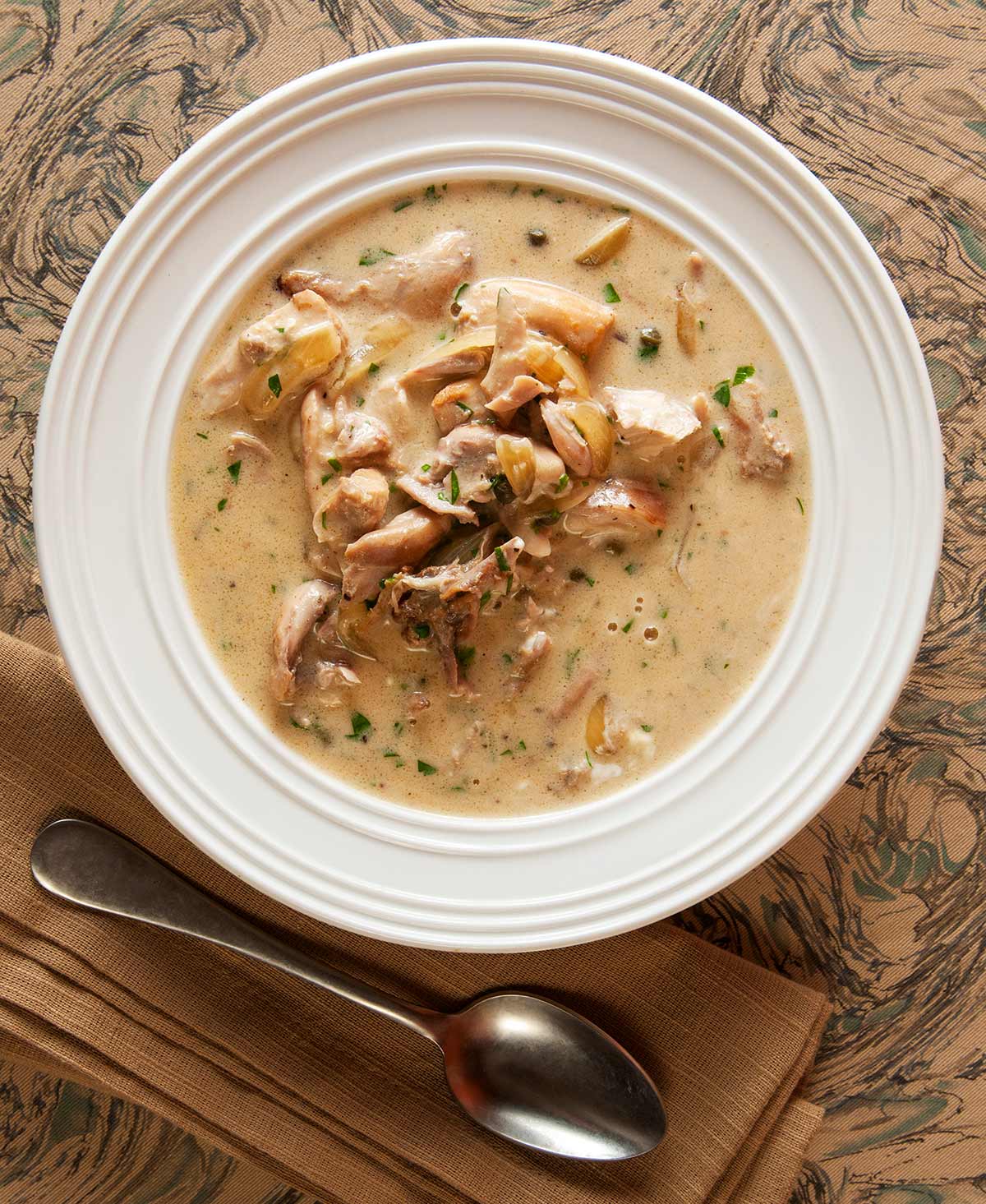
Evan, Holly and I returned last week and sure enough, the cottontails were out. Only this time there were dozens of them hopping around. We were sorely tempted to shoot more than our ritual pair, but we did not. A deal’s a deal. Only two came home with us, to become this stew.
This is an unusual German rabbit stew called, according to Mimi Sheraton in her excellent book The German Cookbook: A Complete Guide to Mastering Authentic German Cooking, eingemachtes kaninchen. It is a Swabian recipe, from Bavaria in Southern Germany. Read the recipe and you don’t immediately think of Germany, but rather of that country’s financial nemesis: Greece. Lemon, capers and bay leaves play a prominent role in this stew. But instead of oregano and olive oil and yogurt, the Germans use parsley and butter and sour cream. It is brothy, meaty and tart, with just a whiff of creaminess. Think avgolemono with more fiscal discipline.
You may be wondering if this is some sort of variant on the most famous German rabbit recipe, hasenpfeffer. It is most definitely not. For starters, hasenpfeffer requires a hase, a hare. And a hare is not a rabbit. Rabbits are light, mild white meat. Hares are heavy, strongly flavored red meat, and hasenpfeffer is a heavy, strongly flavored stew. In America, hasenpfeffer should be made with jackrabbit. I have one that Holly shot, but you will have to wait until the weather cools for that recipe.
This recipe, however, is a perfect stew for early autumn. Strong enough to comfort you on cool nights, yet still light enough to enjoy with a chilled white wine outside on the porch as you watch the sunset, thinking about the next time you’ll get a chance to reach for your ace in the hole.
German Rabbit Stew
Flavorwise, this stew is similar to my recipe for German meatballs, with a little sour cream, capers and lemon. It is a flavor combination common in southern Germany, and really works well with lighter meats. I would not use hare or jackrabbit for this recipe, so stick to cottontails, domestic rabbits or snowshoe hares, which are all white-meat rabbits. Chicken thighs would work well here, too, as would pheasant. There is another version of this stew in Germany that uses veal, too. So if you have some humanely raised veal, go for it.
It is a two-step stew, meaning you make the base and “mount” it with sour cream, white wine and capers right at the end. Once you add those final ingredients you are committed, so if you want to make this for dinners or lunches for the week, store just the base (up to Step 4) and add the remaining ingredients when you want to eat.
Serve this with bread or potatoes and a crisp, German white wine. A lager beer would be good, too.
Serves 4 to 6.
Prep Time: 10 minutes
Cook Time: 2 hours
- 2 cottontail rabbits, or 1 domestic rabbit, cut into serving pieces
- Salt
- 2 tablespoons unsalted butter
- 2 tablespoons flour
- 1 to 2 cups chicken stock
- 1 onion, sliced root to tip
- Zest of a lemon, cut into wide strips (white pith removed)
- 2 to 3 bay leaves
- 1/4 cup lemon juice
- 2 tablespoons capers
- 1/2 cup sour cream
- White wine to taste, at least 2 tablespoons
- Black pepper
- Parsley for garnish
__________
- Salt the rabbit pieces well and set aside for 10 minutes or so. Set a Dutch oven or other heavy, lidded pot over medium-high heat. Pat the rabbit pieces dry and brown well on all sides. You may need to do this in batches, so don’t crowd the pot and don’t rush things. Remove the rabbit pieces once they’re browned. This may take 15 minutes or so.
- Add the remaining tablespoon of butter, then the sliced onion and cook until the edges just begin to brown, about 6 minutes. Sprinkle with flour and stir well. Cook, stirring often, until the flour turns golden, about 5 minutes.
- Return the rabbit to the pot and add enough chicken stock to cover. Use a wooden spoon to scrape any browned bits off the bottom of the pot. Add the lemon zest, bay leaves and lemon juice and bring to a simmer. Cover and cook gently until the rabbit wants to fall off the bone, which will take anywhere from 90 minutes to 3 hours, depending on how old your rabbit was.
- This is an optional step, but I prefer it: Turn off the heat, fish out the rabbit pieces and let the cool on a baking sheet. Pull all the meat off the bones and return the meat to the stew. I don’t like fiddly stews with bones in them, so I do this. You can leave everything on the bone if you want.
- You can now store the stew for several days. Or you can serve it at once. Turn the heat to low just to make sure the stew is nice and hot. Do not let it simmer. Add the sour cream, capers and as much white wine as you want — you want the stew to be a bit zingy. Stir in a healthy amount of black pepper and garnish with parsley.


Loved your writing in this piece and the recipe sounds mouth watering all the better I am sure if made with a rabbit which you have dispatched yourself in the managed way you describe.
The first time I had rabbit was in Switzerland with a friend and his Swiss Aunt. Such a fond memory, not sure why I haven’t made it myself. Your description of this dish- comfort on cool nights and light enough for a chilled white wine on the porch watching the sunset- might mean a first. With a nice bauernbrot to sop up the liquid, how could one pass that up?!
I have heard Holly talk about the trip you two took out to Evans place and bragged that she got some cottontail. Sure enough I was hounding her to bring in some cottontail into work. To my surprise she brought in some of the German Rabbit Stew you made. This dish reminds me of comfort food that my grandmother from the old country would make, if she was 5 star chef. This recipe is definitely a keeper. I let Holly know that I would go gay for you as long as you would make this dish all the time.
Should be: eingemachtes Kaninchen, in German all nouns are capitalized, all the time. I have had eingemachtes Kalbsfleisch (veal in gravy).
But the dish we had every summer was eingemachtes Bohne (green beans in gravy). Fresh green beans from the garden, just a bit of bean to provide flavoring, and the gravy made of sour cream. Delicious!
And influence from my father’s side of the family (from a Schwabian village in modern Hungary) the gravy had paprika as the dominant flavoring — hot & sweet.
This sounds amazing and just the ticket for the rabbit waiting for inspiration in my freezer.
The wastefulness of that relative must have really saddened and angered Evan’s family. It’s people like that that give hunters like you an unjust bad name.
oh cool- I plan on raising rabbits and already have Mimi Sheraton (which my husband’s German mother bought for me. Great cookbook).
Hank-
Here in Indiana people always advise against eating wild rabbits during the summer months/until after the first freeze due to parasites or tularemia. Any thoughts on this? I’m guessing you haven’t had a freeze where you are yet–it doesn’t seem to have stopped you.
Thanks
Wow. Quite tasty. Made it today with young sharptail grouse…perfect. Gonna try some roosters next. Thanks for the recipe.
We’re trying this one out for dinner tonight (domestic rabbit). I’ll refrain from adding mushrooms and fresh rosemary, and stick to the recipe!
This looks absolutely wonderful. We have 6 rabbits ready to butcher in the next week or so. I really hope my husband will let me make this for the family. Live weight, our rabbits will be about 4lbs–is this a fair size for 2 adults and 2 small children for this recipe? The rabbits are New Zealands and will be about 22 weeks old.
Mike: Thanks for the German lesson! (Seriously. I don’t speak German, and I like to get things right.) Your version sounds like it is slipping into goulash territory… dangerous.
Nate: You need not worry about rabbits in summer. They do have tapeworm cysts inside the guts, but you don’t eat them so no biggie. Tularemia is an issue, which is what I wear latex gloves when I butcher all my rabbits, no matter what time of year. You might also be thinking of botfly larvae, but I’ve never seen them in cottontails, only jackrabbits. They are hideous, but do not affect the meat.
Saeriu: I’d think one rabbit of that size would work, although you will need potatoes or something else on the side. If you use 2 rabbits, you will definitely have leftovers.
This looks uncommonly good. We have a neighbor who raises rabbits for meat, and we often buy from her. She gives us a good price, as we help skin and eviscerate the rabbits we buy. I’ll definitely try this recipe the next time we get some bunnies.
This looks amazing!!! When my hubby catches another rabbit, I know what I’m making! I too often make a rabbit stew made mostly of wine tomatoes and lots of mushrooms. Thanks for this idea!
I made this the night before last. I used store-bought rabbit because I don’t hunt wild rabbits enough to get enough to freeze. Anyway, I used two, not thinking out the fact that they were half again as big as any cottontail I’ve ever bagged. It made A LOT, which is fine since it was so, so good- really over the top good. I pretty much followed the recipe with the exception of adding 8 oz. of sliced cremini mushrooms (just seemed like the right thing to do). I cook a lot of German dishes and it’s refreshing to find one that doesn’t start with a pound of bacon (not that I don’t love bacon, but it’s nice to have something a bit lighter seeming once in awhile). This is definitely going to be a go-to recipe for the next time I get a wild rabbit, and I may even give it a go with squirrel.
Hank: I assume this recipe would work with young, Eastern Grey Squirrels?
Michael: Yep. It will work very well with squirrel, just be sure to pull the meat off the bones.
I made this last night using a rabbit we raised. It was excellent – will definitely become a regular on our menu. Thank you Hank!
Thanks for the GREAT recipe! Look forward to trying it with squirrel and some pheasants I have in the freezer!
I made this last week with some local bought farmers market rabbit and it was simply the most delicious stew I have ever made. I did a few things different. I brined the rabbit overnight in a simple brine of peppercorns, bay leaf, thyme and salt. I also used homemade elk stock instead of the chicken broth (which because I used a roasting pan, I used probably 4 times as much stock). Yum! Served it over some freshly dug up potatoes from the back yard and served it with butter and baguette. I ended up cooking it for around 3 hours. I also like the meat plucked from the bone and put back it.
I’ll be making it next week again. Thanks for the recipe.
Made this recipe two nights ago, using a pair of cottontails hunted in the Arizona desert. The stew turned out very good, when I pulled out the rabbit parts to pull the meat from the bones, I found much of it was already falling off on it’s own. I’ll definately make this again.
I made this recipe for dinner yesterday, it was fantastic! My rabbit was 2 pounds, 12 oz. and I did use more chicken broth than called for to cover the rabbit in my pot. I removed the rabbit from the bones, which made the stew more enjoyable not having to pick through bones, thanks for that tip. I served the stew over mashed potatoes, a lovely meal.
[...] Recipe from Hunter Angler Gerdener Cook (Hanks’ recipe for German Rabbit Stew) [...]
wow this is the best rabbit stew ive ever seen, cant wait to give this a go, do you think it could go a handful of wild mushrooms?
or is it best left alone?
best regards from the U.K
Geoff: Absolutely! The Germans, from what I understand, are very fond of chanterelles, so I’d start there. Blewits or cepes wouldbe other good choices.
The stew sounds delicious. It would most likely be served with Spaetzle. One correction, however, Swabia is part of Baden-Wuerttemberg not Bavaria. This Schwoab is shuddering at the thought of it being a region in Bavaria.
Trying this recipe tonight. I looks great.
I have found botfly larva on cottontails but only once. They are hideous as you say but they did not affect the meat.
Could you use duck stock, my son cannot eat chicken?
Melissa: Yep. No problemo.
I made this for dinner tonight using pheasant and chukar, and it was delicious! My husband and son loved it!
I cannot BELIEVE I *finally* found the recipe my mom used to cook with rabbit. This is DELISH, btw. I’ve craved it for years and now I can finally cook it … although all we have here in NYC is frozen rabbit.
Oh, well, better than nothing.
German cuisine is highly underappreciated here. Strong German culture has influenced quite a bit of S. Louisiana cuisine. Can’t wait to try this stew, sounds fabulous!
Hank,
Have been so grateful to find your delicious recipes to highlight the snowshoe hare I’ve been hunting this winter in northern Vermont. Do you think this recipe would work with a hare or two?
How large of dutch oven is necessary for this recipe?
Made this recipe for my husband’s annual game feast. Everyone said it was delicious and I’d have to agree. Even though I didn’t think I liked rabbit very much! Thank you for sharing such a good recipe.