
As an Amazon Associate I earn from qualifying purchases.
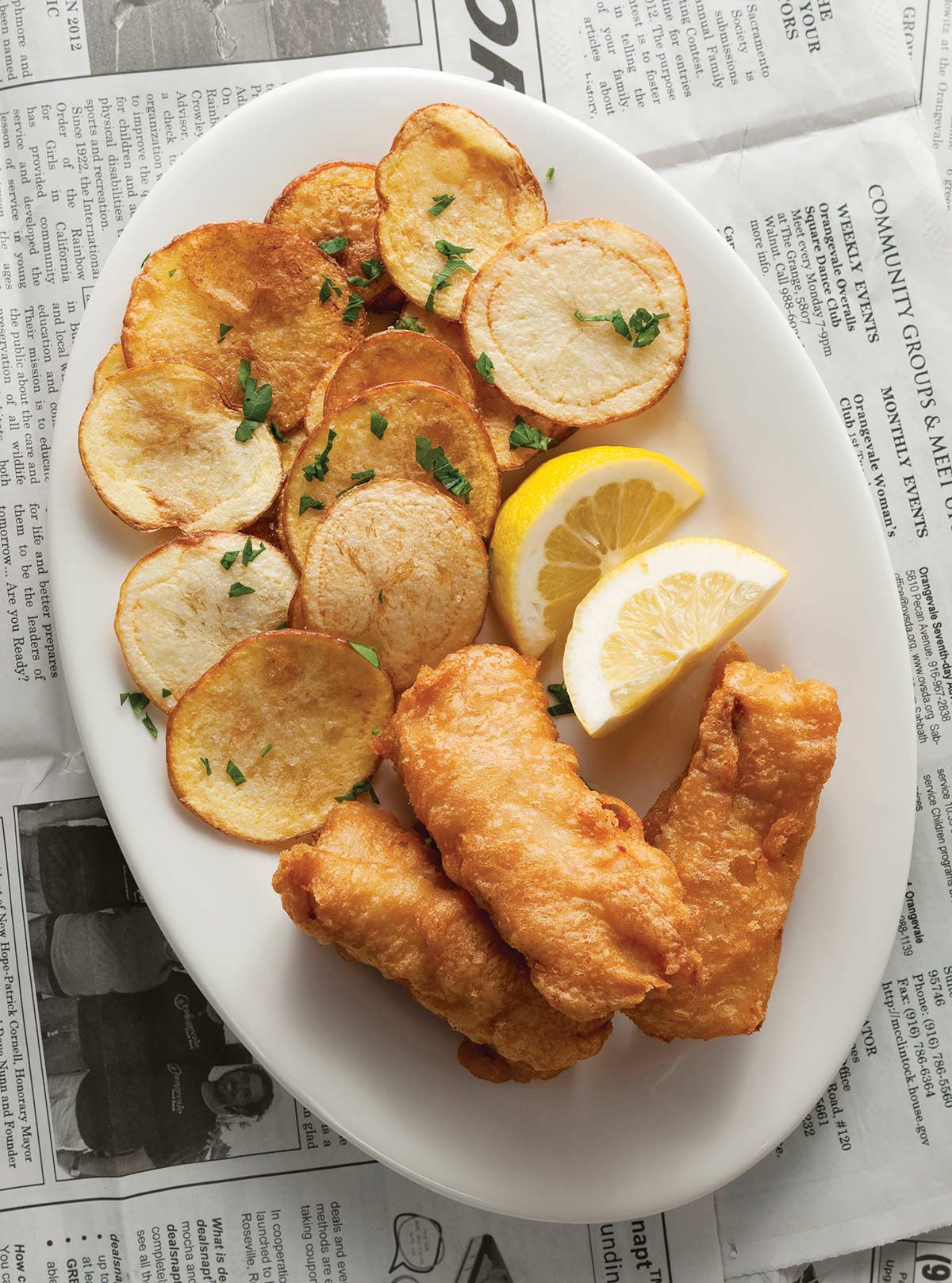
Beer battered halibut fish and chips are a necessary part of human existence, and I am here to help you perfect this classic.
At some point, all of us have sat face-to-face with a pile of English fish and chips or fried clams. As this usually happens first when we are tiny tots, the experience can alter the course of our dietary existence: After that virginal fish fry, many of us we emerge either as committed fish lovers — or, like many Americans, committed fish haters.
Only about half of Americans eat seafood more than once or twice a year, and I suspect that a big reason for such a gulf between fish eaters and fish haters is what was on that first plate of beer battered fish and chips. Try to think back to your childhood now: Did your mom cook her own fried fish, or did she open a box and shake out a few frozen fish sticks?
I have vivid memories of both cases. My mom cooked her own fish. I have a crystalline image in my head of mom busily making fried flounder. It must have been the mid-1970s. She’s standing next to a pile of flounder fillets, each layer separated by paper towels sodden with oil. We’d eat these with lemon and lots of “tah-ta sauce.” Mom is from Massachusetts.
I also remember eating at some of my friends’ houses. That image is of pre-breaded fish sticks clunking out onto a foil-lined tray that somebody else’s mother popped into the oven, often a toaster oven. I remember these being dreadful.
But neither of these are halibut fish and chips, or really any beer battered fish. These, for most of us, are only eaten at restaurants. Here’s how to make them at home. Correctly.
English fish and chips may be that nation’s culinary gift to the rest of the world, although the English are experts at roasting large pieces of meat, too. Let’s start with the fish.
Best Fish for Fish and Chips
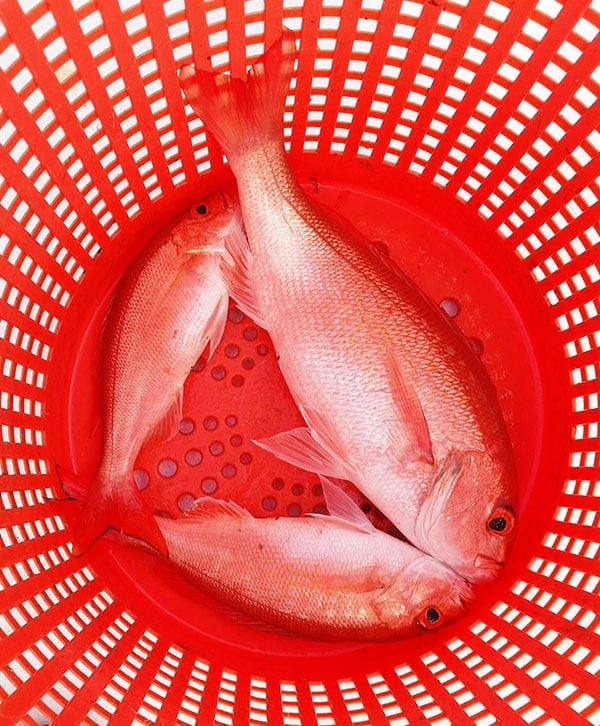
I’ve eaten beer battered fish and chips six ways to Sunday, but all the best share a few characteristics: They’re all firm, white, and lean — and of course skinless and boneless. My go-to here at home is halibut fish and chips.
Cod, haddock and pollock are classics in the East, as is halibut, rockfish or lingcod in the West. In Wisconsin and Minnesota, walleye and yellow perch are king. In the South, it’s all catfish until you get to the Gulf, where snapper and redfish take over. Hell, I’ve even used tilapia.
Dogfish and leopard shark are the perfect frying fish, and in fact are traditional with northern English fish and chips. The meat is white as snow, very lean, and firmer even than halibut. And, happily none of these fish are threatened, so you can eat them with a clean conscience.
Bottom line: You want a reasonably thick, firm fish for the best beer battered fish and chips. Avoid soft textured fish like mackerel or bluefish, or really thin fish like flounder; they are best cooked a little differently.
Seafood? You bet. Beer battered shrimp and lobster is amazing. Obviously you can batter clams, as many do, and I suppose you could batter squid, too, although it’s usually just floured and fried.
Best Beer for Fish and Chips
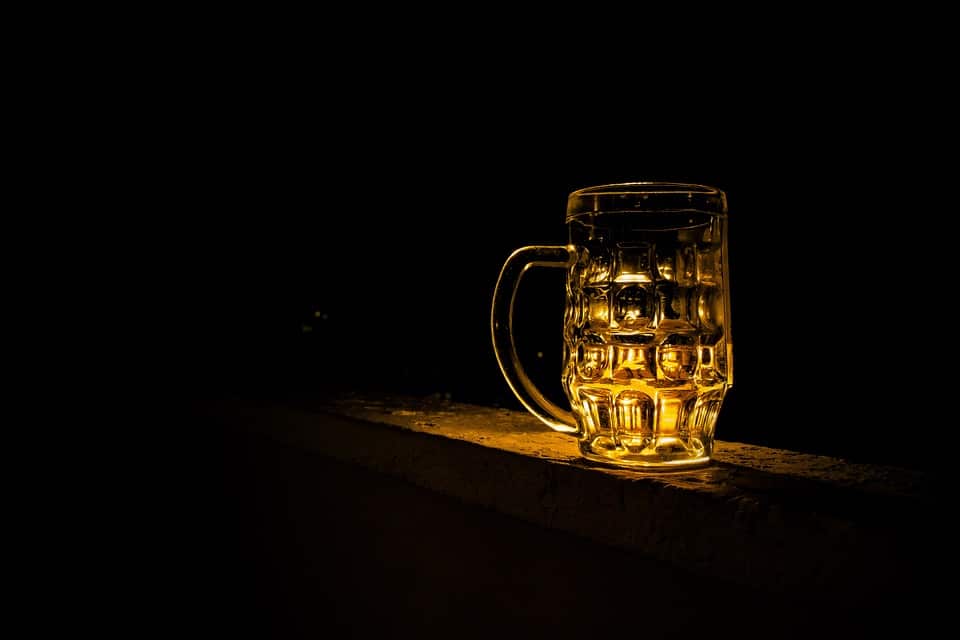
Take a tip from the origin of the dish. Halibut fish and chips is best with English beer. A mild, malty beer is my absolute favorite. It is distinctive enough to get you noticed among beer battered fish aficionados, and won’t ruin your batter like an IPA. Never use IPAs for beer battered fish and chips. The bitterness will wreck the dish.
Other than that, the sky’s the limit, although my next favorites after the English ales are German (really American and Mexican) lagers. Avoid a really good pilsner since it too will be hoppy in its own way. Cheap American macro beers are great for beer batter.
And while they have their adherents, “weird” beers like sours or heavy Belgian beers or oddly flavored beers might end up as your favorite, but it won’t please a crowd.
Oh, and what’s with the beer anyway? Beer’s carbonation makes a lighter batter. This is another reason why you want to avoid sours or IPAs, which are not normally heavily carbonated. Lagers are typically the most carbonated beers you will normally buy.
The Flour
You can absolutely go minimalist and use plain flour for halibut fish and chips. Many do. But you will get a better batter if you use self-rising flour, or just add a bit of baking powder to your regular flour.
Want to play? Play with the flour. Different flours will give you different results. Most, however, will be heavier than all-purpose flour. I rarely deviate from the ole’ AP flour.
You can add whatever seasonings you want to the flour, but I generally keep things very simple because any spices or whatever you add will be exposed to the raging hot oil and can burn and become bitter. Paprika is especially prone to this.
I don’t cook gluten-free on purpose, but here is a pretty legit gluten-free beer batter for fish if you can’t do flour. Not as good as the real thing, but hey, better than nothing!
Achieving The Crisp
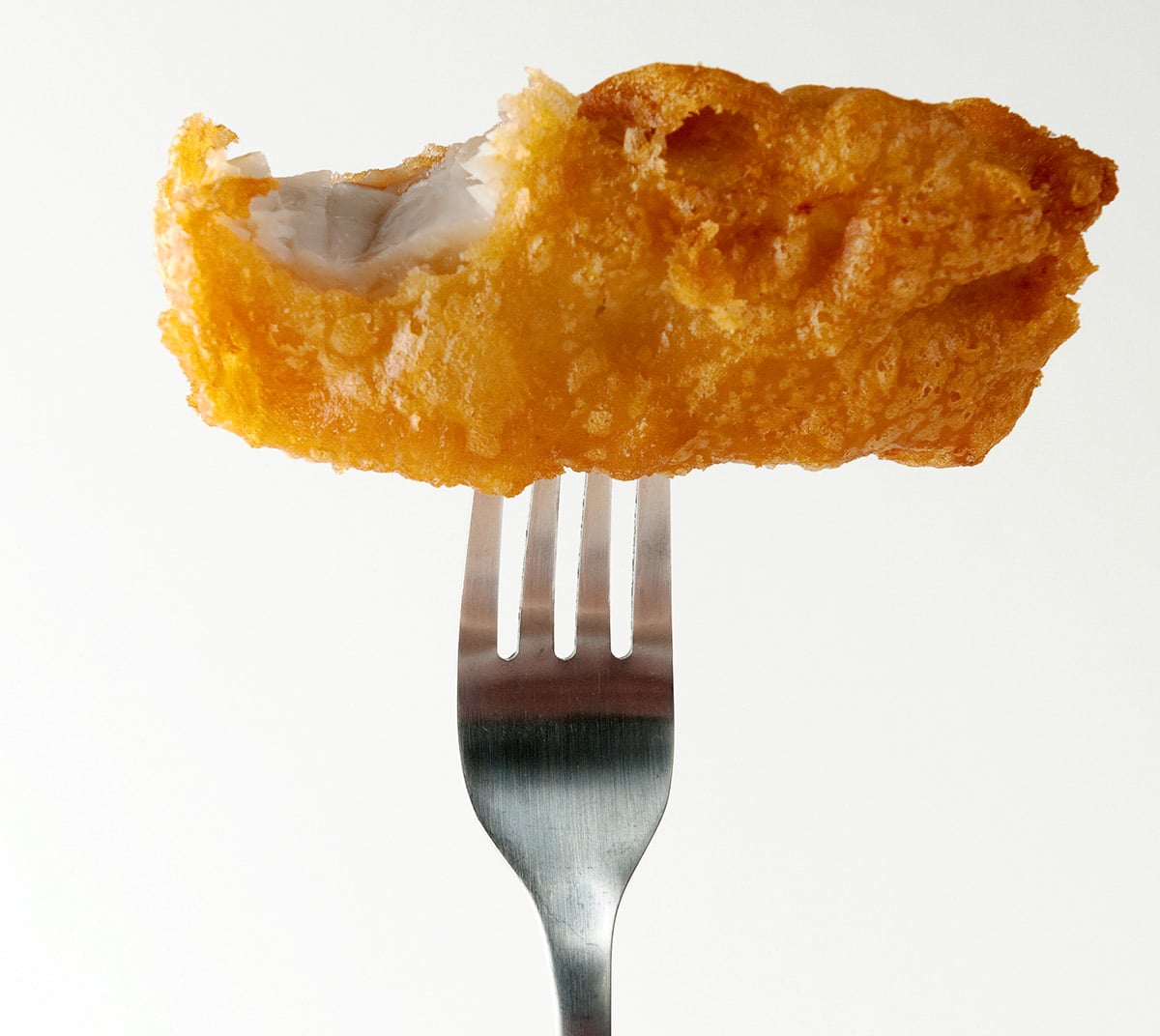
We eat halibut fish and chips because we want that juxtaposition of perfectly cooked, essentially steamed fish, inside a crispy, crispy exterior.
You get that with hot oil. I know this seems obvious, but I need to stress this. People get scared of hot oil, and if you are, beer battered fish and chips are not for you. You need the oil at at least 350°F and really 360°F. Good oils like refined peanut oil, canola, corn oil, grapeseed and avocado can all handle this easily.
Hell, regular vegetable oil will, too, although you will then want to watch that the oil doesn’t climb above 400°F at any moment. Not a problem in most cases.
Yeah, it can be sporty to have a half-gallon of 360°F oil roiling on your stovetop, but so long as you know it’s that hot, you’re fine. Bad things happen when you don’t, and the oil gets too hot. Thermometers are a must.

I like deep fryers because they restrict the amount of vaporized grease that gets into the air. And while that aroma really adds to the ambiance of a place like Pike Street Fish Fry, its not so good in your house. But a heavy Dutch oven will work fine, too. Just keep the oven fan on high.
Oil temperature isn’t the only factor in ultra crispy halibut fish and chips. How you hold the finished pieces matters a lot, too. Remember me talking about Mom frying fish and stacking them like cordwood? Don’t do that.
(Like this recipe? I have lots of variations on fried fish here, from Chinese salt and pepper fish, to Mexican fried fish, to a simple fried snapper with Saltines.)
Instead, place a cooling rack on a baking sheet in the oven and set it to “warm,” or about 185°F. Set the finished pieces on the rack and they will stay crispy.
Overloaded fryers also cause soggy fish and chips. Place each battered piece in the hot oil separately, and make sure you wait a second — or have enough room — for the batter to set or so that the pieces never touch in the first 30 seconds or so. After that, they can bounce around if they want.
I know, so many words about halibut fish and chips. But even though this is a simple recipe, it is technique driven, and there is a reason that the best fish and chips places are revered.
Side note: When eaten cold the next day, halibut fish and chips (or those made with little sharks) tastes astonishingly like cold fried chicken. Go figure.
The Chips
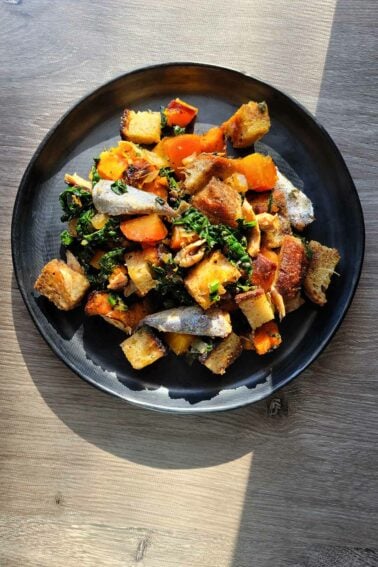
A word on the chips: I am not very good at making my own French fries, which require double-frying. Here is a good recipe for the French Fries.
Instead I make my own chips, which I like just as much. Potatoes sliced just thick enough so the center is soft, just thin enough that a quick bath in hot oil will crisp the outsides.
You make these before the fish, actually, because they take longer and hold well in the oven. Pro tip: Use waxy potatoes like Yukon Golds, not russets. The texture is more like a fried potato and less like a store-bought potato chip.
Beer Battered Halibut Fish and Chips
Ingredients
FISH
- 2 pounds fish, skinless and boneless
- Salt
- Oil for frying
- About 1/2 bottle beer
- 1 teaspoon salt
- 1/2 cup self-rising flour
CRISPS
- 2 pounds Yukon gold potatoes, sliced into 1/8-inch thick rounds
- 2 tablespoons vegetable oil
Instructions
- Salt the fish and set it aside at room temperature. Get your oil going: You want it to be 350°f to about 360°F. Turn the oven to the "warm" setting, and put a cookie sheet inside. Place a cooling rack on top of the cookie sheet.
- Mix the flour, salt and beer together, stirring all the while. You want enough beer in the batter to give it the consistency of house paint, or melted ice cream. Put the batter in the fridge to rest for 20 minutes.
- While the batter is resting, slice the potatoes and put them into a large bowl of cold water. When you are done slicing, remove the potatoes and pat them dry with a paper towel.
- The oil should be hot by now. Fry the potatoes, a few at time, for 3 to 5 minutes, or until they start to brown at the edges. Don't cook them until they are uniformly brown or you will overcook them; they will continue to brown a little out of the fryer. Salt each batch the moment it comes out of the fryer. Store each batch on the wire rack in the warm oven.
- When the potatoes are done, take the batter out of the fridge. Dredge the fish in the batter and let the excess drip off for a second or two. Lay each piece gently into the hot oil. Do this by letting the bottom end of the piece of fish fry for a second or so in the oil before you let the whole piece get a bath. This helps prevent the fish from sticking to the bottom of the pot. Keep a chopstick or something similar around to dislodge any pieces that do get stuck.
- Fry in batches until golden brown, about 5 to 8 minutes depending on how large the pieces are. Keep each batch in the warm oven while you finish the rest. Serve at once when you're done.
Video
Notes
Keys to Success
- Keep the fish in manageable pieces, no bigger than your palm.
- Make sure the oil is hot, 350°F or a little hotter, and the batter is cold. This shock makes a lighter batter.
- When in doubt, make the batter thicker.
- Keep seasoning simple. If you want jazz, do that with the sauce.
Nutrition
Nutrition information is automatically calculated, so should only be used as an approximation.



I used this batter tonight for my battered mushrooms and they were delicious! Thank-you so much it is easy to make and light and tasty to eat. Thanks again
Fish looks great, but they ain’t chips!
This batter recipe is AMAZING!!! For my first time ever attempting to make fish n chips it turned out so well! My husband loved it and I did mushrooms too! It is definitely my go to now
Oh my GOODness! Hubby fishes Alaska every summer and brings home lots of halibut. But… I only have one “go-to” recipe for that: halibut slathered with sour cream/mayo and baked in super hot oven. Great, but boring after a while.
THIS RECIPE made the most amazing Fish and Chips! Never had success with deep fried fish before now. Better than any we’ve ever eaten at restaurants – here in the PNW, that’s saying a lot!
Followed your directions TO THE LETTER, and even made an amazing first batch ever of crisps.
Bravo! Will be using this one for ever and ever… Husband is in heaven with this recipe!
Recipe worked great with some farmed steelhead, not ideal fish for this but still turned out very good. I really appreciate the temperature range you provided as my my deep fryer on the “fish setting” was only at about 310 degrees when sitting outside in the sub freezing temperature. Was able to ramp up the temperature to get it where it needed to be to ensure crispy success. Thx Hank!!
This is my standard for fish and chips. Rockfish, shark, halibut, etc… this recipe is great.
Made this tonight with cod and scallops. We skipped the crisps and did fries/chips in the air fryer. Everyone loved it!
We’re visiting our family in Haines, Alaska. They were gifted with beautiful halibut and my daughter-in-law asked for my help as she’s new to deep frying. We came across this awesome recipe and made it tonight. Everyone loved it!! We had a good time with this.
Win/Win!!!
Thanks for the great recipe and helpful tips!
I’m confused as the video shows adding vegetable oil to batter but you say none is used in batter!
On a related note, love your site! The pan seared cod loin is a huge favorite. Got an “excellent” rating from my chef cousin when I served to him!
Great site but let me tell you, this recipe would be a fail in England. Ireland fine, but the Brits like their fish and chips soggy. Crisp batter doesn’t make it on that island.
Ray: Really? I’ve eaten it in London and the batter was crisp there. Maybe an outlier?
USe Guiness for the batter, doble fry the chips (1/4″ thick no thicker!)
You CANNOT get Rock (shark or Dogfish) in the North of England at all! It is a Southern dish.
One fillet at a time after the first chip fry (stick them in the oven and do the 2nd fry after all the fish are done and in the oven).
Four, teaspoon of baking powder to the flour will help, flour the fish before dipping in the batter.
Other than that add a wally (gherkin – pickle to you Americans but NOT DILL, use a german barrel pickle or similar) or get some real English pickled onions, add malt vinegar and a sprinkling of salt and you will be in fish n chip heaven 🙂
I’ve never been able to get a beer batter to stick to the meat, with any recipe. Is there some kind of proper technique to it?
Ken: Not sure what’s happening, because this batter will stick. But if you want some extra insurance, dust the pieces of fish in flour first, then dip in the batter. That will make it stick even more.
This was my first ever go at making home made fish and chips. Chilled the batter while letting the oil heat and used my digital thermometer to make sure the temperature was 360 degrees as recommended. Used a Vancouver Red Racer Pilsner as my beer and found the laymen’s description of ‘house paint or melted ice cream’ for consistency very helpful. Also the advice to wait 30 seconds or so before putting another piece in to keep pieces separate. Added 1 teaspoon of baking powder since I didn’t have self-rising flour and that worked great when the beer was added.
The halibut came out at fish and chip stand quality. 4 to 5 minute cook time for each batch and watching for that same golden colour I expect when I buy from a vendor. Saving this recipe for future use and highly recommend giving this a go.
Go to fnc recipe. It’s one of those recipes you just have to try. The self rising flour or baking powder is the clutch move on this one
Can I give this 10 stars?! My neighbor brought us a huge piece of halibut fresh off the boat in Seattle, and I decided to give this a shot. My husband gave it “The Best Thing You’ve Ever Made” status! (Previously held by a chicken tikka masala recipe) So stoked; thanks for a great recipe! The fam is already asking when we can do it again.
Hi …I have one question. Do you add 2 TBS of oil to the batter? You mention that amount with with the Crisps but I think it is to be included with the fish batter???
Diane: There is no oil in the batter. It’s for the crisps. It’s actually the minimum amount you would use for them. I actually use more to fry the potatoes.
Hands down the best homemade fish and chips I’ve ever had…perhaps the best I’ve had anywhere, in fact. Even with gluten-free flour (plus baking powder and a pinch of salt to make it “self-rising”) and Omission gluten-free beer, and it rivaled what I’ve had in British pubs and my hometown restaurants in Seattle, too. Fresh halibut was available at Costco and held up beautifully in this recipe. Used a Fry Daddy fryer, which only heats to about 380, but still fantastic. Only modification was that we cooked for only 5 minutes, which was plenty (just watch for a change in the bubbles). Thanks a million for this recipe. Perfection.
Hank,
How important is the self rising flour versus using AP?
Beth: Very. But you can use AP flour and a teaspoon of baking powder though for the same effect!
I made this recipe for a Friday night fish fry (big thing here in Wisconsin) and the kids went crazy for it. They dubbed it “fish nuggets” despite my not having cut the walleye into small portions, but now they ask for “fish nuggets” ever Friday regardless!
Having this tonight with fresh Walleye out of the Columbia River. Went with a local IPA for the batter. Can’t wait
How did it turn out Tim?
Typically, IPAs are not recommended for cooking use as you will lose most of the nice aromatics/fruity hop notes and really crank up the bitterness. IPAs are great for sauces and other non-heated dishes though.