
As an Amazon Associate I earn from qualifying purchases.
If you’re looking for one great cardoon recipe, this is it.
This is what I do with my cardoons, which grow all over my yard, uncontrollably. If you’ve never heard of them, cardoons, Cynara cardunculus, are a relative of the artichoke — only you eat the stalk, not the flower. They taste like a cross between celery and artichoke heart, with a little bitterness thrown in for good measure. The texture is like burly celery.
I’ve grown cardoons since I moved to California nearly 20 years ago — or, more accurately, cardoons have taken hold of my garden ever since I planted that first one. If you let them bloom, a cardoon is a majestic plant with a flower stalk that can grow 10 feet tall. Once those flowers fade, they send out hundreds of seeds on parachutes that fly all over your yard.
This is a good thing. I let a few live each year, and those that are settled in the garden are perennial. I get two crops, one in spring and one in fall. The spring one is better, as the stalks are less bitter then. Once temperatures get beyond about 70°F, the plant will be unpleasantly bitter.
Actually eating these giant thistles can be a bit of work. And pretty much every cardoon recipe requires this prep work. I learned my method from Paula Wolfert in her Mediterranean Grains and Greens, a hard-to-find, yet excellent cookbook. If you can get this book, you will not be disappointed. In it, Wolfert goes into some of the deepest lore on unusual grains and plants eaten in the region. Fascinating.
Finding cardoons has become much easier in recent years. I’ve seen them at my local Raley’s, as well as in Whole Foods in early spring, and any good Italian grocer will be able to get them. In Italy, they’re often called gobbi, the hunchback. And, as you may have guessed, cardoons grow easily from seed. You can buy cardoon seeds here.
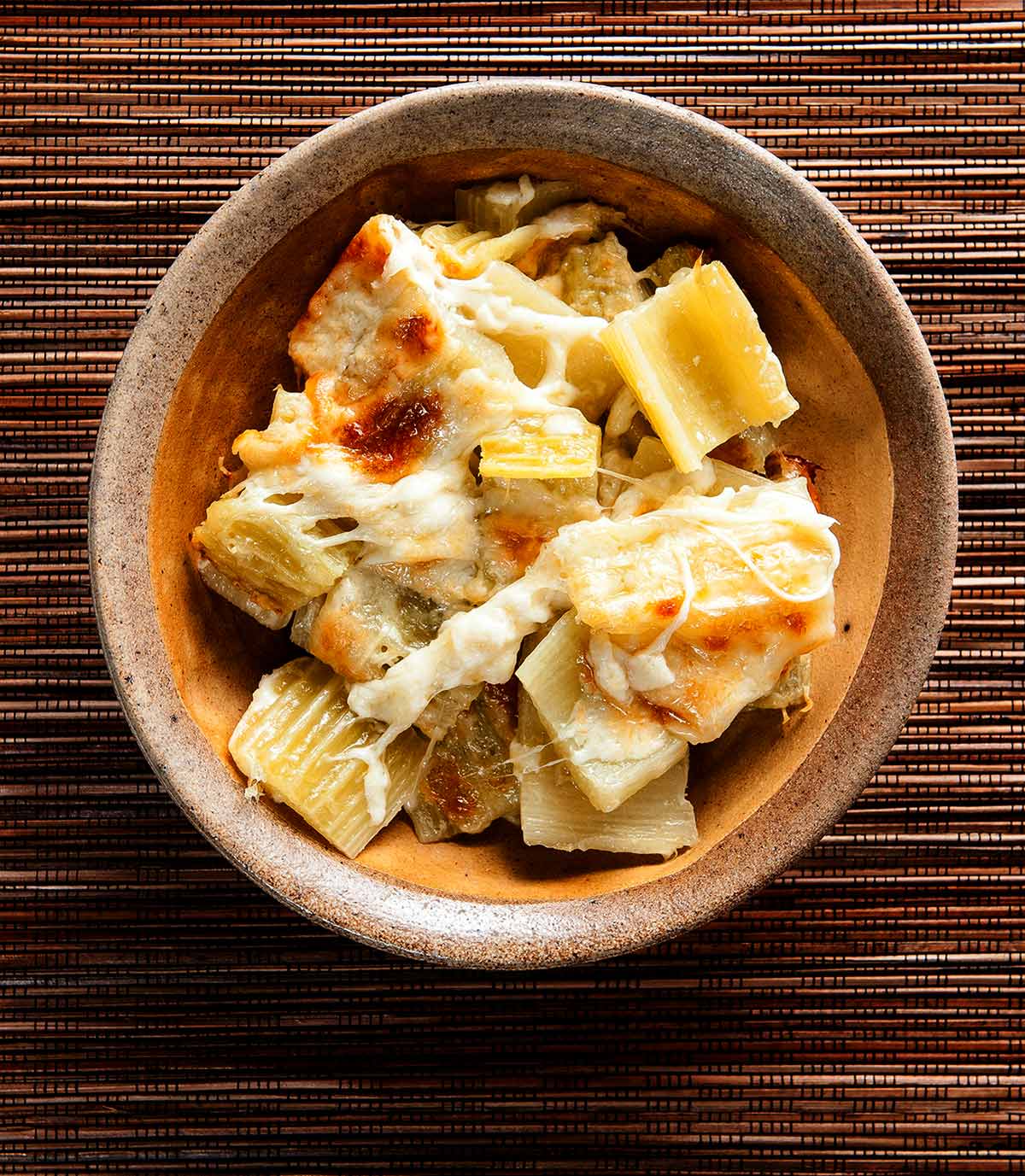
This particular cardoon recipe is my all-time favorite. Cardoons gratin. After the cardoons are boiled for a while, you finish them in the over with lots of melty cheese — that cheese offsets the slight bitterness in just the right way.
Serve this as a vegetarian dinner, or as a side dish for, say, ossobuco or a pot roast.
If you are looking another good cardoon recipe? Try my cardoon risotto or my recipe for honeyed cardoons. I have a whole article on how to cook cardoons, too, which goes into growing, prepping and many different ways to cook them.
I like them all, but again, this is my favorite cardoon recipe.
Cardoon Gratin
Ingredients
- 1 large cardoon
- 2 lemons
- Salt
- 1/4 cup all-purpose flour
- 2 tablespoons bacon fat or olive oil
- 1/2 cup coarsely grated provolone or mozzarella
- 1/2 cup finely grated pecorino or parmigiana
- Freshly ground black pepper
Instructions
- Bring a large pot of salty water to a boil and preheat the oven to 400°F. While the water is heating, use your fingers to zip off the little strings on the ribs of the cardoon stalks. You don’t have to get them all, just do your best. Don’t dig too deep or you will break the stalk.
- Juice one lemon and pour the juice into a large bowl of cold water. Chop the cardoon stalks into batons of whatever length you like; I like 2-inch batons. Put the cut cardoons into the lemon water to keep them from discoloring.
- Toss the already squeezed lemon pieces into the boiling water, then whisk in the flour. Let this boil for a minute or two. The lemon-salt-flour combo affects the cardoons in some way that keeps them a pretty light green and removes some of the bitterness. (This is author Paula Wolfert's trick.) Toss in the cardoons and boil for 40 minutes.
- Smear butter, olive oil or bacon fat all over the inside of a casserole just large enough to hold the cardoon pieces in one layer. When the cardoons are done, arrange them in the casserole. Sprinkle over the mozzarella, then the pecorino. Bake for about 35 minutes, or until the cheese begins brown.
Notes
Nutrition
Nutrition information is automatically calculated, so should only be used as an approximation.



I grew cardoons last year to try it out, and it was one seriously vigorous plant! Very easy to grow indeed.
So then I needed to eat it, and this is the recipe I tried. I was disappointed in the cardoon because it didn’t taste like artichokes to me, but not the recipe. The recipe is great, and lends itself nicely to many other veggies, such as broccoli.
My friend’s grandmother used to fry them, she called it “gardoona” and told us it was the stalk of the artichoke. I never knew what it really was until I made the connection a couple of years ago while flipping through a seed catalog. I finally planted a few in my flower garden this year and I am very excited to try to cook with them.
I have a few questions:
How many stalks should I use for your gratin recipe? Do you know if the stalks freeze well once they have been boiled with lemon?
Thank You for your post.
I chop white center parts of cardoon in wedges like celery and use in a vegetable soup, wonderful addition towards the end when they will get just a delicate softness and add a savory depth to the vegetable soup. Everyone wonders what it is. Also great chopped same size & added to peas, butter & thyme. I also freeze, 30 second blanch first.
I am looking forward to trying your gratin recipe, but i’ll use newspaper or papertowel cardboards to blanch as they grow to avoid bitter green.
I’ve also noticed they sell in healthier stores here in SB, early October but charge over $4 lb.
Finally a recipe for the majestic but often ignored Cardoon, well at least in the States. Cardoons are some of the most stunning plants in my garden, and I’ve always wanted to tap their culinary side. Thanks for the fine recipe.
We planted a cardoon in our yard this year in Texas. I find them a little odd texturely, but my boyfriend loves them. Are you saying its going to take over?
Hank – I take it that you do not wrap your cardoon in the garden to blanch them? I had heard about the flour in the water trick but I thought it was just to prevent oxidation… if that also removes bitterness maybe I do not nee to wrap my plants in the fall – the only time when I can eat fresh cardoon here in the Northern Virginia Piedmont. Unlike you I have to pamper my plants to get a crop, they sure aren’t perennial here, and the climate doesn’t give them a chance to produce a flower. So I don’t get my traditional cardoon grating for Chrismas Eve dinner, but at least it is on the Thanksgiving table.
Even though cardoons are more labor intensive, and I’d decided too much work, your gratin is enticing me. BTW- made the porcini pasta and got an “AFP” from the hubby.