
As an Amazon Associate I earn from qualifying purchases.
Ossobuco, if you are not familiar with it, is a Northern Italian classic: Braised shank with a tomato sauce, usually served with risotto, which makes it ossobuco milanese. To make it right, you need the shank of a large animal, like beef. This is an elk osso buco.
Beef or veal shank is traditional, and pork shank is common, too. I’ve seen it with little lamb shanks occasionally. But I mostly make ossobuco, which means “bone with a hole” in Italian, with shanks from larger animals.
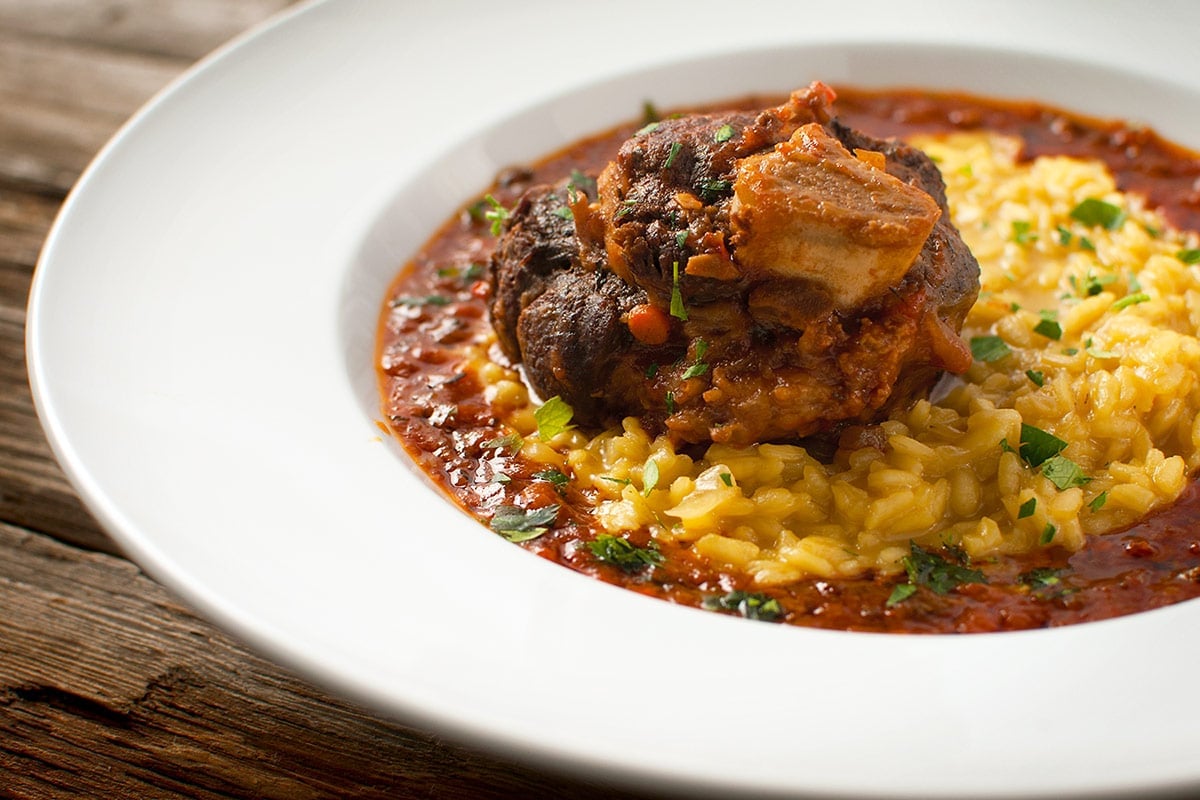
Making ossobuco milanese is straightforward: Dust the shanks in flour, brown in olive oil or butter (or lard), sauté veggies and braise until tender with white wine and tomato sauce. A veal shank might take 2 hours; elk osso buco might take 4 hours.
And you don’t need to serve it with risotto, although that is what makes it a proper ossobuco milanese. Polenta is a great alternative, as is a loaf of good, crusty bread. Just don’t forget the red wine at the table.
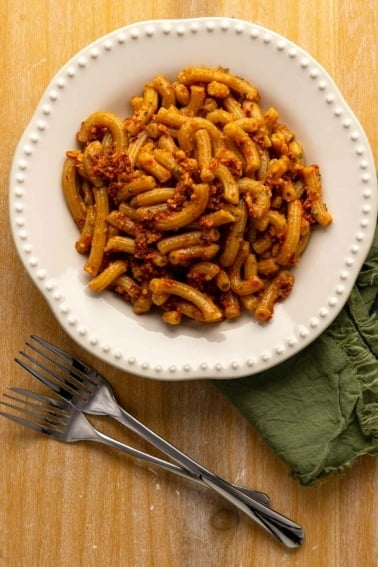
You will have more sauce here than you need for this meal. My advice is to use it as a pasta sauce, maybe with homemade squash gnocchi. And if you have leftover meat, shred it up and use it as a filling for homemade agnolotti.
Any sort of shank will work here. One important tip on dealing with large shanks: Use kitchen twine to tie them tightly while cooking — this keeps them together and compact. Mostly it’s for presentation, but if you skip this step you run the risk of the shanks falling apart in your sauce. Not always a bad thing.
I’ve seen, very rarely, ossobuco milanese made with oxtail. It’s not traditional, but the cuts of meat are very similar, so if you have that, go for it.
A note for hunters, who will be cutting their own shanks for ossobuco: Use a knife to slice the shank meat to the bone, making each cross cut about three fingers’ thick. Then use a hacksaw or Sawzall to cut through the bone. Wipe any bone debris away with a cloth or paper towel.
If you are making osso buco from smaller animals, like small deer, javelina or smaller pigs, leave the shanks whole.
One nice, and very traditional, option for topping your ossobuco milanese is to make a quick gremolata, which is minced Italian parsley, fresh garlic and lemon zest. A good ratio is 1 large garlic clove, 1/4 cup minced parsley and 1 or 2 tablespoons minced lemon zest. This brightens things up a lot.
Ossobuco Milanese
Ingredients
- 4 cross-cut shanks, about 2-3 inches thick
- Salt
- Flour for dusting
- 1/4 cup olive oil, butter or bear fat
- 1 onion, chopped
- 2 carrots, chopped
- 2 celery stalks, chopped
- 1/2 ounce dried porcini mushrooms about a handful, chopped
- 1 cup white wine
- 1 cup chicken, beef or game stock
- 1 28- ounce can crushed tomatoes
- 1 teaspoon dried thyme
- 1 teaspoon dried oregano
- Zest of a lemon cut into large strips, white pith removed
- 2 bay leaves
- 1/4 cup chopped fresh parsley, for garnish
Instructions
- Preheat the oven to 300°F. Heat the olive oil in a Dutch oven or other large pot set over medium-high heat. Salt the shanks well and dust them in the flour to coat. Brown them well in the pot. Take your time and get a good browning on them, which should take a solid 10 minutes. Remove and set aside.
- Add the onion, carrot, celery and porcini mushrooms, and sauté until slightly browned around the edges, about 6 to 8 minutes. Sprinkle some salt on them as they cook.
- Pour in the white wine and use a wooden spoon to scrape up any browned bits on the bottom of the pot. When this comes to a boil, add the stock, crushed tomatoes, thyme, oregano, lemon zest and bay leaves and bring to a simmer. Return the shanks to the pot and turn to coat with the sauce. Cover the pot and move it to the oven. Cook until tender, between 2 and 4 hours, depending on the animal. Serve on top of risotto or polenta, or alongside some bread, garnished with the parsley.
Notes
Nutrition
Nutrition information is automatically calculated, so should only be used as an approximation.



Made with the shank of a large Indiana whitetail buck. Fall off the bone tender and delicious. 5 stars
We tried venison shanks, finally, using this recipe. I did not change a thing (except cooking for 3.5 hours as alternately suggested) and it was fabulous. Instead of risotto we just had rice using duck and mushroom stock instead of water and the whole thing was delicious. 4 shanks would have fed 6 or so because the dish is quite rich in my opinion.
Thanks once again for a great recipe.
I made this with moose shanks for some friends of ours. The wife wasn’t a big fan of game meat. They both loved it! Thanks Hank!
Spot on, fantastic recipe! Served it on/with risotto Milanese and included a gremolata for garnish. Amazing meal. Thank you!
This is the reason to keep your shanks! We cut them with a sawzall and freeze them just so we can make this recipe. It makes a lot of sauce to be prepared to have leftovers. Have made it with venison and elk shanks. Cooked 4 hours at 300 and everything comes out fork tender. Serve with polenta made in the insta pot and vegetable makes for a hearty dinner. I chop the onion, carrot and celery in the food processor all together. Use rehydrated morels for the chopped mushrooms. Thank you Hank for another wonderful recipe.
I bought a dutch oven specifically for this recipe. Fantastic way to serve venison shanks.
Delicious!!!! Great use of deer shanks!
Never having ossubuco before I was a bit skeptical. Testimonials from friends talking this recipe up was enough encouragement for me to “sacrifice” two shanks from last years deer to try this recipe out. It did not disappoint and will absolutely be taking a seat in the “go-to” recipes for wild game. As always, thanks for another gem Hank!
Made this last night using elk and it was sensational! I cooked it an Instant Pot on high pressure for 1 hour followed by a natural release of the pressure and reduced the sauce a bit on the stove before serving it atop Risotto Milanese.
Thanks for the Instant Pot adaptation. Exactly what I was looking for.
Made this two nights ago; with crosscut elk shanks. Followed the recipe with the exception of the carrots, which I didn’t have on hand. Still, it was the best quarantine meal I’ve had so far
I am very interested in trying this recipe as I really despise either putting the shanks trough a grinder and stopping to clean it often or trying to fillet the meat off the silver and barely even having a mouthful (I mostly harvest Antelope, with occasional deer and rare elk). But I was wondering, with the advent of CWD, which is rampant where I hunt, could I, and how could I, implement using Beef bones (or similar) to substitute for the deer, elk, and/or antelope bones so as not to expose my family to this possibility? I’m not overly concerned, but I’d rather be safe than sorry, but still be able to try and make this dish to enjoy my animal to the fullest.
Bryan: You’d use lamb shanks, or a cross cut of a veal shank. That’s actually traditional in Italy.
I’ve done moose-o bucco, each shank was cut 6″ tall and would feed 3-4 easily, just delicious. However, after 3.5 hours they were catchers mitt tough. I thought it was going to be a failure but gave an additional 3 hours at 250?, came out perfect.
Made this with elk last night, 5.5 lb shank fed 5 with leftovers. It was awesome. Took 4.5 hours at 325. Made the leftovers into pasta sauce today…holy smokes! Highly recommend that move!