
As an Amazon Associate I earn from qualifying purchases.
For years, cranberries had been something of a Holy Grail for me. They only live in the North Country, and then only in certain boggy places. Places that are closely guarded. The location of a good cranberry bog is secret kept as secret as the location of a good morel spot, or a duck hunting honey hole in the marsh. You just don’t ask someone where they get their cranberries.
So for years I’d blundered around in vain. Until one fall when I was in Massachusetts visiting my family. My friend Nate lives there, too, and he is almost as into hunting, fishing and foraging as I am. When I told him I’d be coming, he casually mentioned something about picking cranberries. Wait, what? Really?! Yeah, Nate said. He’d spotted some around Cape Ann.
We spent some time fishing for mackerel in a steady drizzle, but no fish were biting so we scotched that idea pretty quick. “Let’s see if those cranberries are still around,” Nate said. I nonchalantly agreed, but inside I was squealing like a little girl. But as we drove toward the secret spot, The Negative crept in: We’ll get there and the berries will have gone by. Or someone else will have picked them. Or they won’t be ripe yet.
Nate started looking around in some pines and walked down into a little depression among them. “Here they are!” I looked down at the first cranberry bushes I’d ever laid eyes on.
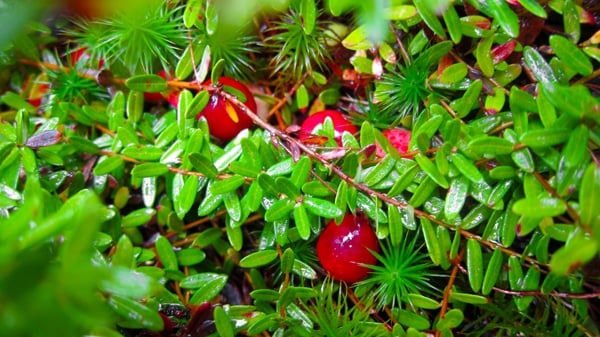
I almost danced a jig. Almost. It looked like mice had decorated the place for Christmas. Nate and I dropped to the ground and began picking. And picking. And picking. Our backs were sore by the time we’d gathered our fill — each of us had filled a gallon bag. A gallon bag full of ruby jewels! I knew I was being irrationally exuberant, and I still am. Sue me. I love cranberries.
Cranberries, if you hadn’t noticed, will keep for a couple months in the fridge — and will store almost forever in the freezer. This is good, because I picked them in October but I did not want to use them until Christmas. Normally I would have made cranberry sauce for Thanksgiving, but we didn’t cook this year. So the magic berries will not make their debut until Christmas Dinner.
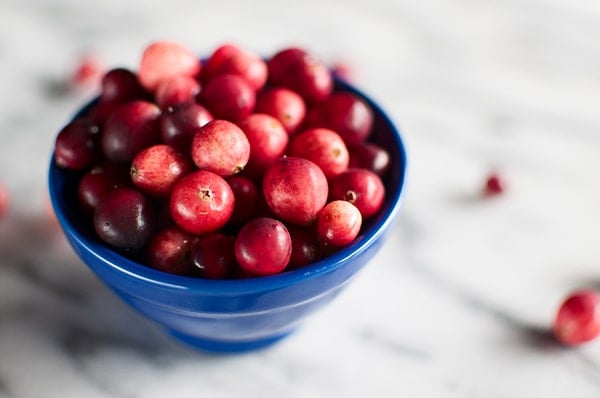
Cranberry sauce is about as American as it gets, although it is believed that our love of cranberry sauce owes its origin not so much to the New England Indians the Pilgrims first met — the Wampanoag did use cranberries, but mostly for pemmican — but rather to Scandinavia and Germany, where a similar sweet-tart sauce is made with cranberry’s little cousin, the lingonberry. The cranberries we picked are Vaccinium macrocarpon, while the lingonberry is Vaccinium vitis-idaea.
No one has yet placed the true first reference to cranberry sauce in American cookery; the earliest recorded culinary use of cranberries is in 1672, where they are baked in a tart. The word “cranberry” itself is thought to be American in origin, however, and it dates from the 1600s. The earliest reference to the sauce that I could document comes from an 1808 memoir of an unnamed traveling Frenchman, reprinted in Boston under the title “Miscellanies” in 1821:
Preparing them for the table is very easily done the berries are stewed slowly with nearly their weight of sugar for about an hour and served on the table cold… It is eaten with almost every species of roasted meat particularly the white meats: turkies, partridges &c. Some even eat it with boiled fish and I knew one person, otherwise a very worthy man, who eat it with lobsters for supper.
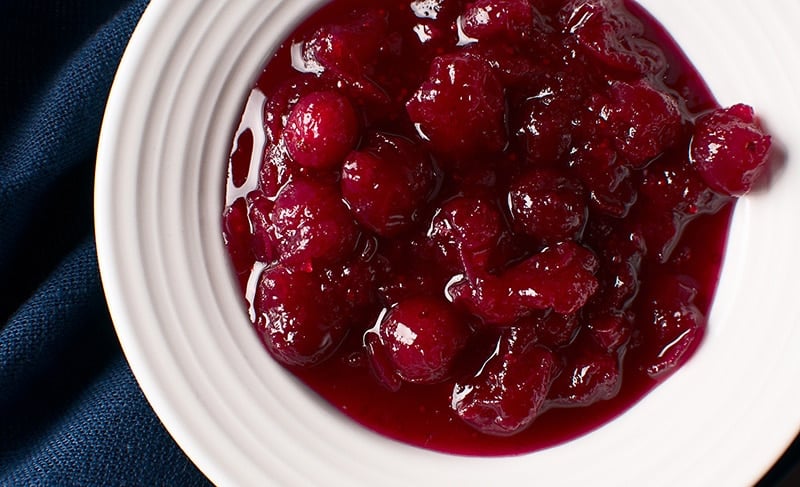
There are as many versions of cranberry sauce as there are cooks. All involve some sort of sweetener, as cranberries are unbearably tart without it. Most recipes include “warm” spices such as cinnamon, cloves, nutmeg and ginger, and oranges and other citrus made appearances often, too. Here is my recipe, but feel free to modify it as you will.
Wild Cranberry Sauce
Ingredients
- Zest of 1 orange, cut into large pieces and pith removed
- 4 cups cranberries
- 1 cup maple syrup
- 1/4 cup water
- 1 teaspoon apple pie spice, or 1/4 teaspoon each of clove, cinnamon, nutmeg and ginger
Instructions
- Combine all the ingredients in a heavy pot and turn the heat to medium. Bring everything to a boil, then simmer gently until all the cranberries have burst and the liquid has reduced somewhat, about 20 minutes. Remove the orange zest and chill the sauce. It should thicken dramatically once it's cold. Serve chilled or at room temperature.
Nutrition
Nutrition information is automatically calculated, so should only be used as an approximation.



I can’t stop making this cranberry sauce…
It’s by far the best I’ve ever had and I have made it 4 times since thanksgiving! It’s so good, I eat it as a snack or a dessert. You can’t beat the simple, natural ingredients and maple syrup instead of white sugar!
Thank you for this recipe. It checks all the boxes. A little background…. My husband’s family were maple syrup producers in rural New Brunswick, Canada…horse and buggy, wild maple trees and requisite log cabin sugery in the woods, so maple syrup is a staple in our house. In summers, I travel back to the Pine lands of Saskatchewan and pick wild berries with my elderly father. He has been a forager for most of his 84 years. I can barely keep up to him. This summer was a bumper crop and after a solid morning we each came away with about a gallon each. I can’t wait to share these! Delicious!
Just made this tonight with cranberries my husband and son foraged. It’s so good! Even without the orange peel which I didn’t have. Made it for an harvest meal we’re having with friends tomorrow and I tested it on some homemade soy crackers with wild turkey meat and homemade goat cheese. Fantastic! Thanks for this. Great recipe!
This is a fantastic recipe! We have low bush cranberries coming out of our ears up here in Alaska (definitely not complaining). I made this today for Thanksgiving dinner and my partner Joel licked the serving dish clean. Thanks so much for sharing.
I get wild cranberries from family in Canada. These have a small, flat seed. Do you have a recipe for these?
Jane: Those are not cranberries. Those are so-called highbush cranberries, which are a viburnum. You need to make syrup or jelly from them, as the pits are not edible.
thanks for this one.
1 bag bog berries.
pure maple syrup 1/ 2 cup. (ain’t jo mama may need more).
grapefruit juice 1/ 2 cup
water 1/ 2 cup.
1 tspn powdered pink lemonade mix.
dash hot pepper vinegar.
1 tbsp brown liquor.
whole stick cinnamon, remove when done cooking.
Why put any spices into the sauce? The cranberry flavor is overwhelmed by them
How do you seed the berries?
Pauline: Uh, you don’t.
Hi Lisa,
Whereabouts on the north shore do you live? I am in Gloucester. While I can’t give away the spot where we picked these cranberries, I’ve recently learned of a bigger patch over in Rockport. It’ll have to wait till fall, but perhaps that is a spot we could search out and then pick till our heart’s content.
Nate
So, do you want to give some more details on where you found those? (I know I’m breaking your rule on asking about cranberry spots…) I live in the North Shore and would love to figure out some cranberry locations this year. The Trustees of Reservations are giving a talk and taking people picking on the Crane Estate next month but, alas, I can’t make it. I’ll keep my eyes peeled and eventually, I’ll know some cranberry spots of my own. Looking forward to learning more from the blog.
If I told you, I’d have to kill you. 😉 Seriously, it’s not my spot, it’s my friend Nate’s. Sorry!
Happy Holidays!
Here in Mexico fresh cranberries are hard to find. I saw canned sauce at autum and winter in Walmart last year or the year before, but seems it didn´t sell so well, because I don´t see them this year. Dried cranberries, juice and beverages are another story. They are becoming pretty common.
So, can dried cranberries be used to make sauce? Are they worth the try? Any adjustments?
I’m making cranberry sauce this afternoon to use as glaze for tomorrow’s ham. I hadn’t thought of orange zest, great idea. With four pounds of berries, I have plenty to try several variations.
There are a lot of damp areas in clearings in our woodlot so I’ve been considering planting vines. Maybe this coming year, while I’m concentrating more on food, will be the year.
Merry Christmas!