
As an Amazon Associate I earn from qualifying purchases.
Guanciale. Jowl bacon. Pig candy. I can’t remember the first time I had this magnificent pork product from Italy, but it was probably in some pasta carbonara I had back home in New Jersey; carbonara should, traditionally, be made with guanciale, not bacon. Ditto for spaghetti all’amatricana.
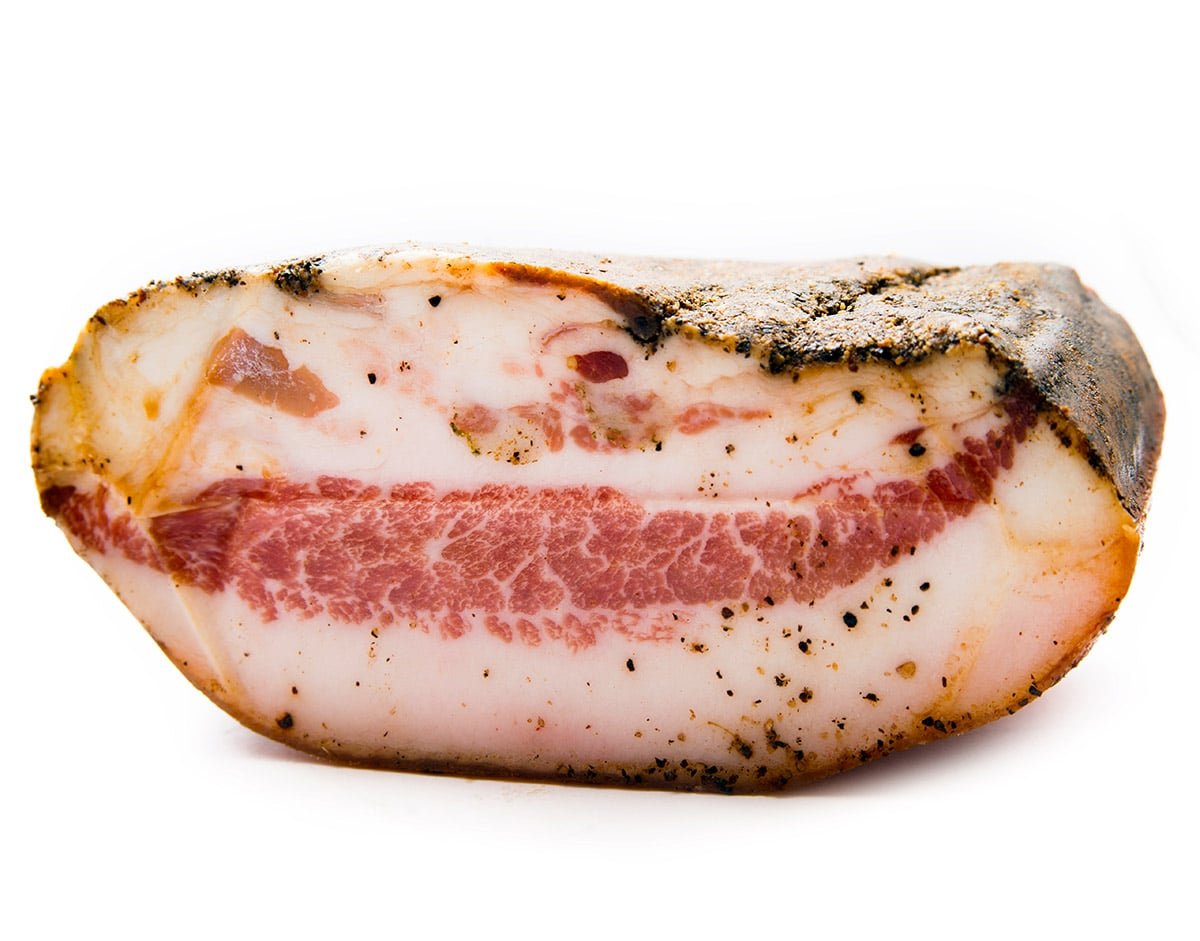
I’ve made guanciale many times, and I’ve referred to it on this blog for more than 15 years, so here’s my guanciale recipe.
Keys to making guanciale are salt, humidity and time. I also use Instacure No. 2, which has nitrates and nitrites, for added safety; you can buy Instacure online from Butcher & Packer. If you have a thing against using them, skip it.
A word on the salt. You need to weigh your meat in grams and then measure out 2.5 percent of that weight in sea salt or kosher salt, then another 0.25 percent – that’s one quarter of one percent – in cure no. 2, which contains sodium nitrate. I use Instacure No. 2.
My curing fridge set-up is this: An old refrigerator connected to a temperature regulator, which lets me control the temperature where the meat is hanging; you can buy these at homebrew shops. You will also, in most cases, need a humidifier to keep the air moist in the fridge. I have one connected to a humidity regular (available online) so I can ratchet the humidity down, week by week, from 85 to 90 percent down to 65 percent.

A general rule is you want the air to be about 5 percent drier than the interior of the meat. So start at 90 percent for the first couple days, then ratchet down 5 percent a week until you get to 55 to 60 percent, then hold it there.
So in short, you will need:
- A fridge, basement or other cool, dark place to hang your cured meat
- A way to control temperature, either in a permanently cool basement or with a temperature regulator
- A way to control humidity, either a humidifier, or, in some places, a dehumidifier. If you can control humidity in 5 percent increments, you can make a better product
- Patience
Guanciale, as with most cured meats, requires time to be really good. I started by curing mine for only 3 to 4 weeks, but now I prefer 12 to 16 weeks. The depth of flavor in a longer-cured guanciale is markedly better than one cured for a shorter period. You could go longer than 16 weeks, if you’d like.
Why bother making guanciale when you can make regular belly bacon? Because jowls work harder. They did an awful lot of chewing when Mr. Piggy was alive and any muscle that works hard tastes better, in this case, porkier. Guanciale, especially long-cured guanciale, will have a stronger, more pronounced flavor, than regular pancetta or bacon.
How do you use guanciale, which, by the way, is pronounced gwan-chee-AHL-ay? I prefer it in chunks with beans or pasta, or sliced thin as an antipasto or as part of a charcuterie plate. And yes, you can fry it up like bacon, but it will be so dry you will need to put a little water in the pan first to let some fat render; this prevents the meat from burning.
Guanciale, or Jowl Bacon
Ingredients
- 1 large hog jowl, skin on
- Instacure No. 2 (see above)
- kosher salt (see above)
- 1/3 cup sugar
- 1 tablespoon garlic powder
- 1 tablespoon crushed black pepper
- 2 teaspoons dried thyme
- 1 teaspoon ground allspice
- 5 or 6 bay leaves crushed
Instructions
- Mix all the cure ingredients together and pack the jowl with it. Massage the cure into the meat and fat. Put the jowl into a container (plastic, glass, ceramic, stainless steel) that just barely holds it, and toss in any remaining cure. Cover the container and put in the fridge for 4 to 7 days. Turn the jowl over once a day.
- When the meat has stiffened up at the thickest part, usually 5 days or more, rinse off the cure (you can leave a little on, but get most off), and pat the jowl dry. Put on a rack in a drafty place for several hours.
- Poke a hole through the skin on a corner of the jowl and tie string to it. Hang the jowl in a cool, moist place (50-55°F and at least 65 percent humidity, but see above for more curing instructions) for at least 3 weeks before eating. To store, cut into large chunks and vacuum seal or cover with plastic wrap and butcher paper before freezing. Guanciale will last, well-wrapped, in the fridge for several months.
Notes
Nutrition
Nutrition information is automatically calculated, so should only be used as an approximation.






Moving into spring it’s warmed up and I neglected my guanciale for too long, now it has white fuzzy spots growing on it. Hard to imagine because it was also over-salty, a real shame because otherwise the flavour was incredible. As unappetizing as it sounds, do you think it’s possible to cut it off and salvage it?
I’ve tried this in my basement and, after 3 weeks, I tried it. The meat is fairly dry on the outside and tastes quite good, but the meat is somewhat translucent raw and does not have the snow-white stiff texture guanciale should have. What am I doing wrong?
So I was so excited to have cured and hung two skinless Tamworth jowls in a very cold upstairs bedroom. I cured them for 8 days or so. They’ve been hanging for three weeks, but I’m feeling a bit worried about them…. Firstly, I didn’t wash off the cure. Oops! Can I do that now and just rehang them? Also, they don’t seem to be drying much, but aren’t molding or anything either. Could that be because the room is too cold? Or because of the non-rinisng mistake? In some photos the final product looks very dry and in others it looks kind of wetter.
Michael: Wow. Poorly made guanciale. I’d use it in stews or something and then under-salt everything else in that stew. Works really well for oversalty cured meats.
I bought guanciale from Harris Ranch already cured. I soaked the jowls for 2 hours in ice water and scraped the curing from the meat. But it’s still salty….What to do?
Anya: I leave a lot on, actually. It’s all up to you — you are going to cook your guanciale at the end, anyway. I like it to be like 2/3 fat to 1/3 meat.
now we just had our pigs done and the butcher cut the cheeks of for me…now there is a whollota meat on there too. I trimed it down a bit so its nice and tidy looking but How much of that do you leave on?
I recently made a dozen or so of these beautiful cheeks. I was lucky enough to obtain these jowls from a local meat market.$2.29 a lb.I set up a Refrigerator in my garage. Hung for 30/60 days after curing for 2 weeks. 55-60 degrees 55- 65% humidity. I didn’t think I would be able to do this in Florida. I’m from upstate NY where I have made many of cured meats. Have been in Fla for about 4yrs. I decided to make a curing chamber which works fantastic.30 days they were awesome, 60 days even better.Gave one to a local 4 star Italian eatery. . They went nuts. Owner keeps calling me to make it for them. One of the best things I ever ate in my life. So easy to do. Good luck all.
We raised two Tamworth pigs this summer. Just hung my first jowl in the root cellar – which happens to be 56 degrees and 75% humidity. Now the hardest part – waiting 4 weeks!
Carolyn: Nope, it would not kill the product, but you do need to be on it with some regularity. If you walk in and it is jerky, well… you have jerky.
Mark: You are talking about lardo. And I don’t make lardo in a marble box. Sorry!
Iso: Best way is with a metal pastry scraper or fish scaler and boiling water. Pour boiling water over part of the head, scrape, scrape, scrape, then move to another part of the head. Use a disposable razor for the final bits.
Thanks for posting this, Hank! I have my very first attempt at Guanciale still hanging in my spare refrigerator. I still have another month or so before I can cut the string and start slicing it. I found a nice Berkshire jowel at Lindy & Grundy here in Los Angeles back in April and put it on the cure as soon as I brought it home. From the looks of your directions, I think I did it all correctly, but only time will tell.
Thanks again!
Whats the best way to get hair off a wild hog head? A blowtorch? Was thinking that might mess up the skin.
Iso
So, we are half way ‘home’. Where’s the recipe for grosso? And how did you get a marble tub made? What glue for sticking the marble slabs together that is food grade?
I am still trying to talk the husband into letting me convert our garage fridge into a curing station. He’s suspicious of potential odors (and probably would miss the beer space). Worried about one thing though: I have long periods of forgetfulness when school and work get hectic. If I miss ratcheting down the humidity for a week or so, will it murder the product? Not that I would *plan* to screw up, just basing on previous experience…
Also, have you seen what Ken Albala’s up to? Scary: https://kenalbala.blogspot.com/2011/06/nduja.html
Great post, and something I will try one day.
Two things keep popping into my head after reading this:
1) An English-accented man keeps asking, “Pardon me, fine sir; where do you get your hog jowls?”;
2) I keep chuckling over “makes one large jowl.” Pounds of port do tend to have that effect!
Rachel: Yes, you can make guanciale without the skin, but it will dry out faster. Hang it for less time than you would one with skin. Try it at 4 weeks or so…
Russell: Good point on the glands. I cut them out as a matter of course, and I forgot to mention that. Thanks for the reminder!
I want to do this! I have the fridge in the garage, sitting empty. Other attempts at smoking and curing, not so successful, but I’ll give it a try! To make a carbonara with it will be worth the effort! I’ll blog about it when I do!
Guanciale is fantastic! Got one hanging in my kitchen right now. After the week in the cure (I do thyme, garlic, bay, black pepper, grains of paradise and crushed juniper berries) I just hang it in my basement until it’s nice and firm, about 2-3 weeks. Then it hangs out of the way off my hanging pot rack. Whenever I need any I just take a few slices off and hang it back up. Easy peasy.
One thing I’d mention though is removing the glands. There are some marble sized olive-gray glands sometimes, cut them out if you can. Here’s a recap of a round I made a while back https://russelleverett.blogspot.com/2009/12/guanciale-ii-return.html Got Armandino Batali’s Carbonara recipe in there too. You can buy guanciale at Salumi here in Seattle, and they gave me a handout with the recipe last time I did.
Oh, one question – can this still be done without the skin? Another thing the butcher took for himself….
Thank you for posting this! I’ve got a hog’s head in my freezer and I was going to make headcheese with it but the butcher didn’t give us the trotters or several other key charcuterie pig parts from the pig we had them slaughter and butcher for us (BIGGEST pet peeve ever!). Now I know what to do with at least part of the head.