
As an Amazon Associate I earn from qualifying purchases.
It’s hot. I don’t feel like cooking outside much. And I have lots of wild game in the freezer still. What to do?
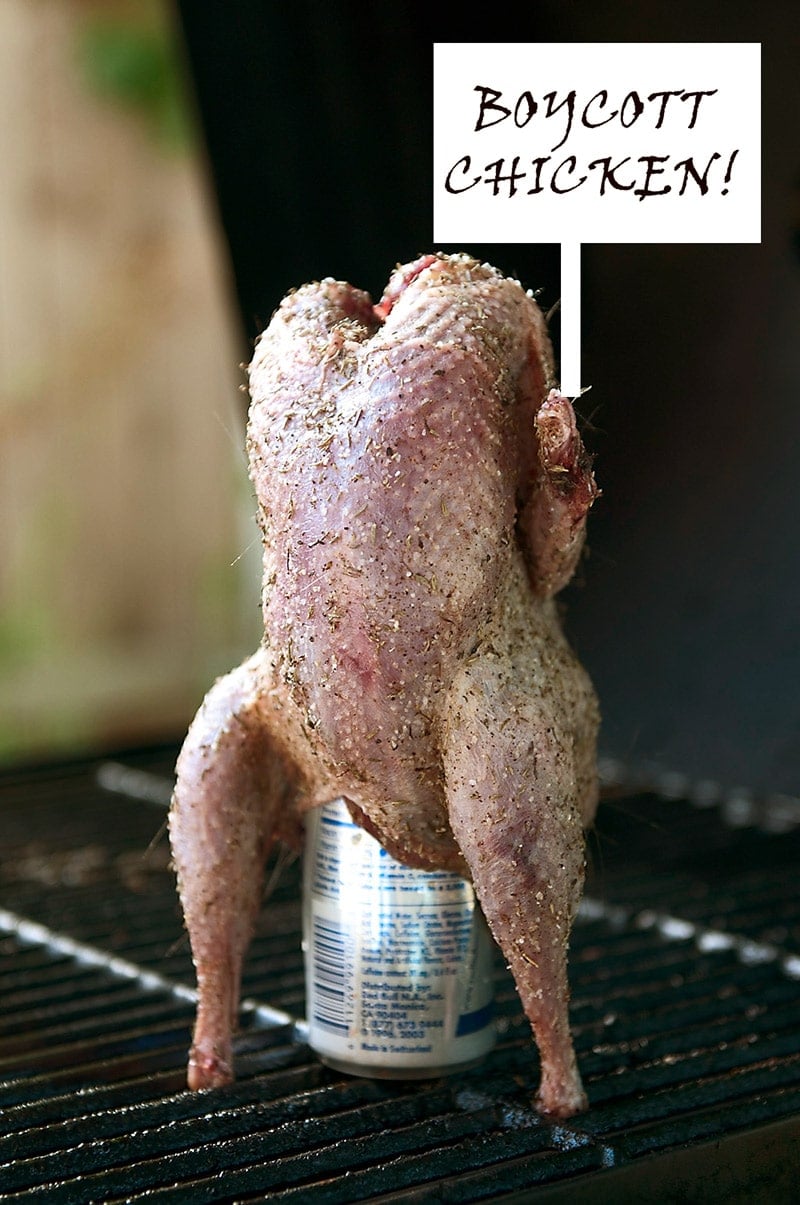
BBQ! I’ve been doing a lot of grilling and barbecue over at Simply Recipes with Elise, and nearly everything I do there with domestic meats translates well with wild game. Elise and I played around with a beer can chicken recipe, and it was so good I knew I had to try to make beer can pheasant, using my last remaining whole pheasant.
If you’ve never eaten beer can chicken before, you are missing out. It may be the second greatest thing the NASCAR crowd has brought to American cooking, behind true barbecue itself. Done right, you get a crispy skin, meltingly tender breast meat, and the legs and thigh meat practically falls off the bone. It’s the perfect chicken. But would it work for pheasant?
First problem: Pheasants have slim hips. Too slim to jam a regular beer can up inside them. Hmmm… what sort of can might fit in a pheasant? I got it! Red Bull. Now I detest this stuff — tastes like sweet tarts — so I poured it all out and washed the can well to get rid of the Red Bull taste, then I filled the can up halfway with beer.
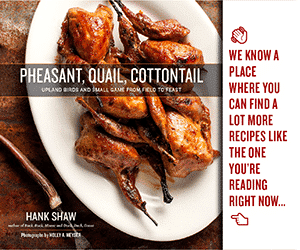
I just managed to get the Red Bull can up into the pheasant, as even it was slightly too wide. But it works.
Oiled up and dusted with salt, black pepper and thyme leaves, I closed the lid on Mr. Pheasant and set the burners to keep the temperature up at about 500 degrees for the first 10 minutes or so. I then dropped the heat to roughly 450 for the next 20 minutes, then dropped it again to about 400 degrees for another half-hour.
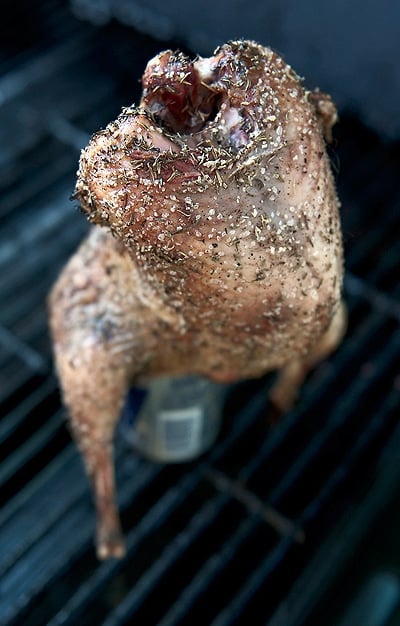
Turns out a pheasant cooked this way needs only about 45 minutes. I overcooked mine by thinking it would need an hour. But, the skin was crackling crispy, and the legs looked fine. I let the pheasant rest for 10 minutes before cutting into it.
The moment of truth: When I sliced into the breast, it was, miraculously, still juicy! Definitely cooked more than I wanted it to be, but it was not dry at all. All the steam coming out of the can kept the breast moist. Thank you, Red Bull can!
Could this work for other game birds? Maybe. The key is the can. I’d try a Foster’s Lager “oil can” for a wild turkey, and I bet the Red Bull can would work on a large grouse. Not sure who makes cans small enough for partridges or quail, however.
Hunters out there: Do you grill or barbecue your game birds? If so, care to share any tips and tricks?
Beer Can Pheasant
Ingredients
- 2 empty Red Bull cans
- Enough beer to fill half the cans (use any beer you want)
- 2 whole pheasants
- 1/4 cup olive oil to coat birds
- Salt and black pepper
- 1 tablespoon dried thyme
Instructions
- Take the pheasants out and let it rest at room temperature for about 30 minutes. Bring the beer out, too, as you don’t want cold beer in the can.
- Prepare your grill for indirect heat. If you are using charcoal, put the coals on one side of the grill, leaving another side free of coals. If you are using a gas grill, fire up only half of the burners.
- Rub the pheasants all over with olive oil. Mix the salt, pepper, and thyme in a bowl and sprinkle it over the pheasant.
- Fill the Red Bull can halfway with beer; it doesn’t matter what kind. Drink the rest of the beer. Put the can inside the pheasants' cavity and place the pheasants on the cool side of the grill. The legs and the can will act like a tripod to keep the pheasant upright.
- Cover the grill and come back in 40 minutes. After that time, check the pheasants and add more coals if needed. Stick a thermometer into the thickest part of the pheasant’s thigh — you want it to read 160 degrees. If it’s not there, close the grill lid and come back in 15 minutes. Keep checking this way until the pheasant is done. If you don’t have a meat thermometer, poke the spot between the leg and breast with a knife and look for the juices to run clear, not pink.
- Carefully move the pheasants to a pan. Let them rest for 10 minutes. Carefully lift it off the can and carve up into serving pieces.
Notes
Nutrition
Nutrition information is automatically calculated, so should only be used as an approximation.



Leftover beer?
Trying it now
the bullet shaped coors tall cans 19oz fit that little bird *PERFECT*
I can’t wait to try this recipe..Here’s a trick I use with my beer can chicken. I cut a wedge of citrus fruit (usually lemon, but I have used lime and orange) and stuff it into the neck cavity. This helps seal in the bear steam and aids moistness while adding a nice citrus note to the bird.
The big juice cans (46 oz?) work for the biggest domestic Turkeys those 25-pound or bigger monsters. I prefer to do this rather than deep fat fry them for Thanksgiving like so many others. I also find that it really doesn’t matter what liquid you use for the can – it’s really just ballast and doesn’t give much flavor – most of it is still in the can when the bird is done.
Anyway – thanks for the tip – I’ll have to try this on a Pheasant – although since I don’t live in Kansas anymore when I do get Pheasants I tend to do the spatchcock thing (saving the spine for stock) and grill them quick and hot with just simple seasoning.
Never get tired of it.
Can it be harmful to cook over aluminum like that? It’s so good, I hesitate to ask but always wondered.
Those pineapple and v-8 cans (think airline size) that come in 6-packs work for quail.
Am definitely trying a pheasant. I adore it and get tired of braising it all the time.
Hank, thanks for mentioning the cucumber drink! I just found it in my Hmong cookbook (which I heard about on Elise’s site, btw). I wasn’t able to make the one on Gabriela’s site because I didn’t have the lemon verbena leaves – or know where to get them, so I will try the Hmong one first.
Carolina Rig: I do the butterfly thing on the grill, too — the birds cook more evenly. I think the key is that you want some birds medium-rare, and others medium.
Cheryl: The Hmong make a cool drink with cucumbers. I will have to check out more on agua fresca!
Chris: Shit!! I coulda had a V8!! 😉
Sarah: Good idear. Lots of Asian markets around here.
V8 sometimes comes in a very slender can, perhaps small enough for game.
Another place I would recommend looking for cans would be a Chinese or Japanese market. I see small cans there frequently for vitamins, iced coffee, and even candies.
Funny, Holly!
My first thought was a tomato paste can for the small birds. I’m thinking this post will give us all reason to spend some unusual time in the canned goods aisle…
Hank,
What about one of those small V8 cans? I think they are 5.5 oz size.
Regards from Music City, USA
You likely had or saw some while in Mexico(?). They are pretty common here at farmers markets and other places where there are street vendors in so cal, so maybe up north too? They are a mixture of fruit blended with water and sugar, and other things. Kind of like lemonade if you used the fruit itself, rather than just the juice. Here’s a link to a recent post (where I discovered an agua fresca made with a vegetable (cucumber) – hadn’t seen that before but it sounds really good!): https://gabrielaskitchen.com/2010/06/24/testing-contemporary-aguas-frescas-for-food52/
I’ve found some birds take high heat better, while others are more suited for indirect heat. Dove, quail, chukkar, and wookcock I prefer to blast over a hot fire…taking care not to over cook. Turkey, pheasant, rail, and grouse I’ve had more luck searing then moving away from the fire for an indirect cook (or hot smoke after throwing on some hickory or oak). Not saying that you can’t slow cook a dove or sear a turkey….just some methods that have worked well for me. Regardless of the grilling application, I prefer to always brine and grill the whole bird butterflied.
Cheryl: Never made agua fresca. What is it?
MikeW: I will look for some. Another reader suggested those narrow glass canning jars you sometimes see. I have one or two and will give it a go.
Cork: Nice haul! 286 crawdads, eh? Worth a little knee and ankle injury, I’d say.
Thanks for the shout-out, Hank. A fan of low and slow for moisture and softening tough cuts, I’m surprised I didn’t even think of the practice for wild turkey legs–definitely going to give it a try on some pesky vineyard turkeys this fall!
Right now just recovering from the realization that I’m no longer a kid after a knee and ankle tweaking crawdad hunting expedition with a buddy in a mountain stream on Saturday…but we did get 286 of them, up to 9 inches long from tail to tip of claws–there’s definitely a difference between a slow and muddy water crayfish and a fast and clear water crayfish, the latter being so much sweeter!
What a great way to adapt beer can chicken! I’ve never tried cooking pheasant on the bbq, but it looks like you had some great results.
I just made beer-can chicken as well after seeing Elise’s post and had a similar overcooking incident, but still plenty of good juicy meat! As for the smaller birds out there, Coke now makes little mini coke, diet coke and dr. pepper cans, they come in a 10 pack and would probably fit a small bird. I’d love to hear if you give this a try (as I unfortunately do not have any wild game in the freezer!)
Small cans of Vitamin C are popular in Korea — the cans would be perfect for small birds. I don’t expect a trip to Korea soon, else I’d be glad to bring some cans (and help test them!).
Maybe they’re available in the US somewhere?
I’ve never had pheasant in any form, but would love to try this. We’ve made beer can duck (which we didn’t use beer for, but instead used a marinade my husband mixes up). The duck came out beautifully! I’ve been experimenting with a lot of different barbecue sauces and rubs this summer, and I look forward to giving yours a try. Do you enjoy agua frescas? I would think they would be very nice with the heat you are getting up there, and that you’d probably come up with (or have already) some wonderful recipes for some. We’ve yet to realize it is summer down here in L.A. yet, but I made some watermelon agua fresca yesterday hoping to encourage some summer sun today – to no avail. The agua fresca is still very nice though, but more refreshing when it is hot outside 🙂