
As an Amazon Associate I earn from qualifying purchases.
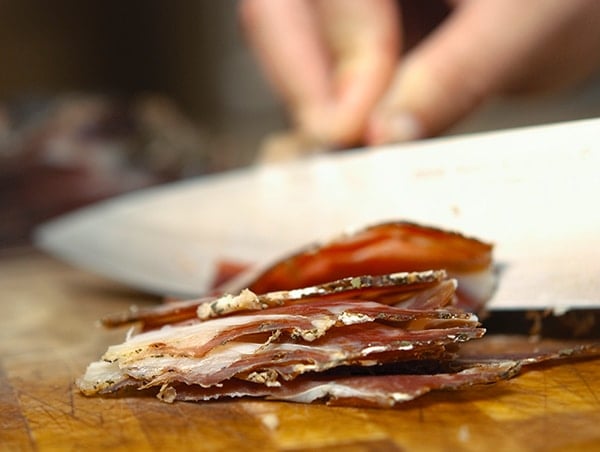
I present to you: mocetta. It was my first-ever dry-cured ham, and it does not come from a pig. This is venison ham.
Mocetta (MOE-chet-uh) is a Northern Italian air-dried goat ham that, I’ve discovered, works well with venison, too.
I wish I could tell you I have an old recipe handed down by the nonnas from Alto Adige, but that’d be a lie. A good lie, yes, but a lie nonetheless. Actually making mocetta became something of a detective job. I can read Italian well enough to read recipes, so I turned Google onto it and read scores of accounts about mocetta, product descriptions in Italian online catalogs, references to it in books, etc.
What I found is that mocetta always has “Alpine herbs and spices.” Um, what the hell does that mean? I decided to go with a piney, aromatic mix of juniper berries, rosemary, bay leaves, black pepper and garlic. Most of these ingredients are mentioned in someone’s mocetta description, so I figured I was close enough.
Why make mocetta? Because it’s a skinless ham. Skinless hams cure easily but are tougher to age well because they can dry out fast. But since we all skin our deer, it’s what you can do.
I do the standard two-step cure many of us use with big hunks o’meat: Rub half the cure mixture on the meat, put in the fridge for several weeks, then rinse and repeat. Yes, you will need to have a leg or two lurking in your refrigerator for the better part of a month. Get a big Tupperware or just deal with it…
Once it’s time to hang the mocetta, you will need a curing space with high humidity and pretty low temperatures. I started mine at 80 percent humidity and about 55°F. As the meat ages, the humidity needs to go down and the temperature needs to go up. At the end, my goat hams were at 60 percent humidity and 60°F.
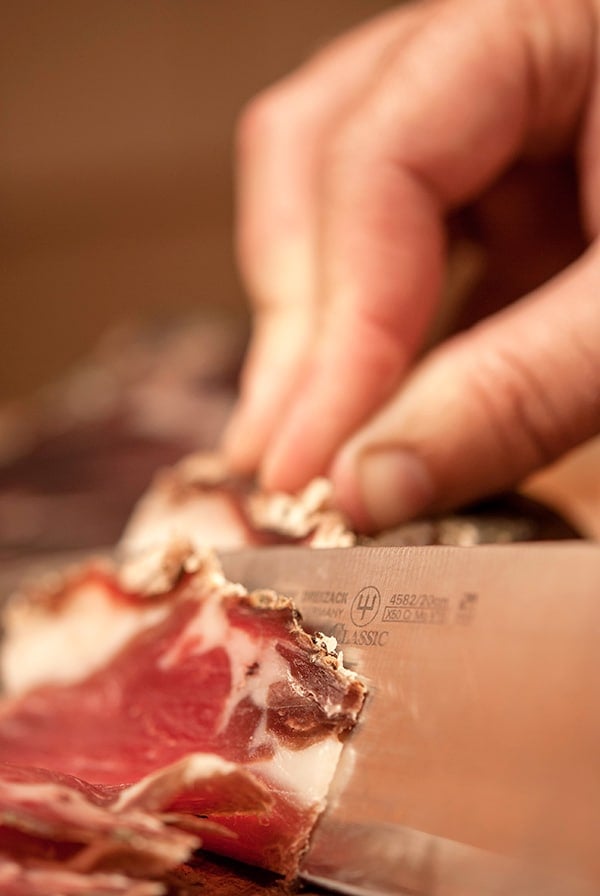
Mocetta is not cured for very long, relatively speaking, precisely because it is skinless.
Why? Because originally the Italo-Swiss who made it used wild ibex that lived in the Alps — not easy to haul a wild goat out of the mountains with skin on, only to scrape the fur off to preserve skin like you would a real prosciutto. I was very glad to hear that even in Italy, where some of their best products are massive pains in the asses, they took the “easy” way out on this one.

Still, mocetta needs 2 to 5 months hanging. Better than the 12 to 18 months for a real prosciutto, but long enough to begin to develop those mysterious esthers and flavors that a truly old ham gets. Funky yet aromatic.
Make no mistake: I do not think my venison ham tastes anywhere near as good as real jamon iberico. But sliced thin, it is excellent: Good color, firm but still supple, meaty, fatty and with an aroma that is just this side of goaty. I like it a lot with a husky red wine.
A note on salt. You will need to weigh your meat in grams and then weigh out 2.5 percent of that in sea salt or kosher salt, then another 0.25 percent – that’s one-quarter of one percent – in cure no. 2, which contains sodium nitrate. I use Instacure No. 2.
Mocetta, Italian Venison Ham
Ingredients
- 1 small hind leg of a deer, about 5 pounds
- Instacure No. 2 (see above)
- Kosher salt (see above)
- 1/2 cup white sugar
- 25 grams garlic powder
- 10 grams juniper berries
- 12 grams black pepper
- 5 grams dried thyme
- 12 grams fresh rosemary
- 15 bay leaves
Instructions
- Grind the juniper berries, black pepper, thyme and bay leaves together until fine. Mince the rosemary. Combine all the spices with the salts and mix well. Divide this mixture in half. Put one part of the cure away in a sealed container.
- Carefully rub half the mixture into the goat legs, making sure to get lots into the ball joint that had connected the leg to the pelvis; this is where leg cuts often spoil. Massage the spices and salts into the meat.
- Put the legs into a large container and refrigerate for 2-3 weeks. Drain off any liquid that seeps out of the meat. You will know it’s about done when the meat has firmed up quite a bit.
- Rinse off the cure and pat the legs dry. Repeat Step 3 with the second half of the cure.
- Let the legs cure in the fridge for another 7-10 days. The longer you go, the saltier the meat will be — and the longer it will last without spoiling.
- When you are ready, rinse off the cure again and soak the legs in fresh water for an hour. This relieves a little of the saltiness and results in a moister cure — you needed to cure with so much salt for so long to make sure it penetrated all the way through to the bone. The water soak removes some of that salt so it won’t be overpowering when you ultimately serve the mocetta.
- Hang for 2-5 months. You want a temperature between 40 and 60°F (colder at the beginning, and warmer near the end), and a humidity starting at about 80 percent and slowly decreasing — say, 5 percent a week) until you are at about 60 percent humidity.
- Once it’s ready, you can cut the meat from the bone and slice thin, or slice bone-in. Serve at room temperature with cheese and a husky red wine. Wrap closely and store in the fridge, or seal it and freeze it.
Notes
Nutrition information is automatically calculated, so should only be used as an approximation.



IF youy nare going to use SALT +Cure2 why not use CURE ONE inthe first place because in essence it’s th same thing. OOR do as I do for some cures use SALTPETERE [Potassium Nitrate at a recommend 0.08% t 0.1% cure. [I in 4000/5000] Take [for a 0.08% concentration] 120 grams of FINE or KOSHER Salt [ OR 120grams of CRYSTAL and blitz ] and ONE GRAM of SALTPETER and mix Traditionally CURE ONE is been used for Product though not exclusively that is to be cooked whilst a SALTPETRE based cure is used but once again not exclusively by DRIED FERMENTED product. The use of SODIUM SALTS is quite a recent practice and back in the day [ and my Grandad was a FARM BASED PORK BUTCHER from mthe late]ish] 19th century right up to the 1950’s] I’d never even heard of SODIUM SALTS until maybe 20 odd years ago. Healthwise there is no great difference difference and here in the UK SALTPETRE is easy to obtain. A KILO lasts for the hobby user a long long time
Hank,
Any thoughts on what this might do/ or turn out if i try it on a beaver hind quarter? i have a beaver that has aged for 2 weeks now and am working on recipes for it. it has a really nice fat cap on the rump. Thank you
Cody: It should work, although the drying time will be much shorter. Weigh it after it’s been cured, then check after 3 weeks of hanging. Look for about 30% weight loss, or even a little more.
Uncle Buzz again on Maui. Did my third batch of Mocetta, flavor was fantastic, smooth texture, Salami flavor.
The first batch I dumped because I used a standard refrigerator, the humidifier clogged up the vents to the freezer, temperature rose to about 80, so I dumped it, error on the side of caution.
Second batch, I found a wine cooler that I used an external temperature module to regulate the temperature, this helped with the frost up and my Mocetta was prefect, that white mold that you get on Salami was everywhere .
I think I made the mistake of over sanitizing my drying chamber with bleach on my third batch, because there was less white mold, but the Salami flavor was there.
I do have to work on drying it slower. Had a lot of wasted meat on the outer rind on both batches. I was wondering if I remove the hair from the hind quarters and leave the cleaned skin on, if that that would help in preserving the Mocetta from having a hard uneditable rind? Plus I wanted to try to use a looped gambrel instead of a standard gambrel where you cut into the hind shank to hang the deer, this would leave an unadulterated ham leg.
Any help would be most appreciated.
Buzz: Yes, I now only hang the hind leg, not the shank. Humidity is the key on that rind! You want it high, like 80%. If by chance the ham is small enough to cram into a vacuum bag, sealing it and letting the meat sit in a fridge for a week will help equalize moisture and make the rind smaller, or even non-existent.
Very informative. Following your Mocetta recipe . I started the process of curing a white tail deer ham. Lean meat, when do I know that is ready to eat? Is there an end weight as a reference? Like 70% of the initial weight?
Thanks
Federico: Yes, something between 70 and 75% of initial weight.
Really excited to try this recipe next season when I have some fresh bone in hams.
Question, would there be any harm in covering the entire hind quarter in a sugna layer and hanging longer to develop flavors?
Thanks and love your stuff!
Hank, just confirming step #4 in the recipe. So when I wash off initial spices/cure, then re-rub, do I refrigerate for another 3 weeks or 7-10 days?
Just pulled my first go at this with a 3 month hang. Pretty wonderful, next time I’ll take it a little further to see what more age does.
Hank. I want you and your readers to know that I have used this recipe on wild hog hams (I have an unlimited supply). I try to do different things with the meat because I give so much away. Everyone loves the end product. I also enjoy curing the meat along with fresh sausage. It is a way I can keep the hogs at bay and not waste the meat.
Can anyone advise:
I have a 8 foot by 12 foot walk in cooler that I age my venison. What sort of humidifier could I put inside to deliver the recommended levels of humidity?
I have the same size cooler i hang my deer in. I ordered a humidifier off of amazon that you can set the % humidity level you want. I had to fill it every day at the start, but it worked well and now a little over 2 months later i am ready to start slicing. it smells so good when i cut it off the bone.
an ultrasonic humidifier designed for a room slightly bigger than the walk-in would be good. Make sure to use distilled water
Hank,
I am working on this and am just about done with the first round of the rub. When i start the aging what is the tell that it is done? 2-5 months is a huge difference. I am doing a duck prosciutto right now and it ages until it looses 30% of its weight. Is this hind quarter the same process? Im just trying to figure out after the 2 month mark and i start checking it more often, how will i know when its done?
Thank you
Cody: yes, you have it right. You are looking for about 25% weight loss, and you want to stretch that process out for at least 2 months, and longer if you can manage it without overly drying the ham.
I am using this recipe now and I am getting white mold spots on the outside of the ham. Does anyone know if that a problem? Do I need to move it to a different place or increase the humidity?
Thanks!
Louis
Louis: White mold is normal. Ideally it is a tight, sort of felt like white mold, not the cotton candy stuff. I’d carry on as is and keep an eye out for green or black mold, which should be wiped away immediately.
Excellent, thank you! Yes, felt would be a perfect way to describe this.
Thanks again!
Lp
By the way, just received Hunt, Gather, Cook for Christmas and I am loving it.
Thanks,
Lp
Good morning Hank
Have a curing chamber built amd my son shot a small whitetail buck a week ago. Has been dry aging in my refrigerator for that week. I want to try this with the hinds, do I need to “skin” them again as they obviously have the layer of dry meat now?
Thanks
Jared
Jared: Yes, if you want to make this ham, you need to start with fresh meat, so you’ll need to remove the rind.
Is this doable with bear? Or do I need to worry about trich? I’ve always been unsure on dry curing bear. Yeah or nay?
Scott: It is. The salt level is high enough, and the cure time long enough to “deactivate” the larvae, if they are present. That’s a technical term for saying that while still alive, the larvae can no longer hurt you.
I don’t mean to be contrary, but do you have a source for that information? All the cautions I’ve read and been told about trichinella, especially the species that commonly infect bears, is that freezing and curing do not reliably kill/deactivate it. If you could point your readers to where you found this, it would certainly help me (and I assume others) feel confident I was making a well-informed decision.
Read this: https://honest-food.net/on-trichinosis-in-wild-game/#:~:text=As%20it%20happens%2C%20the%20trichinae,trichinosis%20in%20all%20of%20America.
So sorry to bring up an old thread. Do you have a link to the refrigerator converted to keep Temp/ humidity for the venison Mocetta? I’m in the Deep South so humidity is easy but temperatures are never constant in winter or fall. Any help would be great.
Hank,
Buck Buck Moose recommends starting with 90% RH, and here its suggested to start of 80% RH. Which one do you recommend?
Also,
Do you inoculate with Mold 600 or just let it go natural in the curing chamber? We do cheese in the same fridge so a little worried some mold might get going if I don’t inoculate with something that will outcompete.
Dave: If you have good humidity control, start at 90% and ratchet it down as you go.
Hank,
I used Maldon smoked salt on second seasoning and left in refrigerator for full term them rinsed washed in fine Japanese whiskey & dried for two days, then greased with organic vegetable shortening to hold further drying while hanging.
slicing is closer to soft jerky with
Great depth in flavor.
I’m so excited to come across this post, because I have a couple small hind quarters from a wild pig in my freezer, but we skinned them out when we processed them. This recipe is sort of exactly what I thought to do with them, but I didn’t know if they would dry too fast. I had thought of doing more or less exactly what you described in regard to coating with some sort of fat to slow the drying. You’ve given me the confidence to try it. Thanks for your input!
I have a venison roast (given to me by my nephew). Would this be ok to cure?
Mark: Probably. Weigh out 2% salt + 0.25% cure no. 2, vac seal it and let it sit in the fridge for a week or so. That’ll cure it, but the drying will be dicey. You will need to suspend the meat to age it, maybe with a netting or you can truss it. Keep the humidity up high in your chamber, like 80% for the first couple weeks.