Classic Hasenpfeffer with Semolina Dumplings

December 04, 2012 | Updated June 06, 2022
As an Amazon Associate I earn from qualifying purchases.
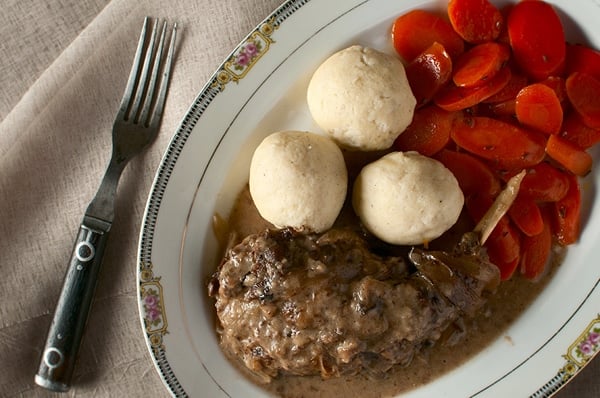
Whenever I’m talking to someone about hunting and the conversation turns to chasing rabbits, I am invariably asked about hasenpfeffer. It seems to be the only rabbit recipe anyone knows, and I am pretty sure we can thank Bugs Bunny for that one.
There is a 1962 episode of Loony Tunes where the king demands hasenpfeffer from his cook, who is of course Yosemite Sam. “Where’s my hasenpfeffer!” Sam grabs a knife and hilarity ensues.
Interestingly, there is a hidden truth in this episode: At the end, Bugs notes that this is the only time a “one-eyed Jack (rabbit) beats a king.” Hasenpfeffer, you see, is not a rabbit recipe. It requires a “hase,” the German word for hare. And our most common hare here in North America is the jackrabbit.
Hasenpfeffer is an old dish. It’s combination of vinegar, wine and lots of spices suggests it is at least as old as the Renaissance, and probably older. One source puts its origins in Westphalia, in the 1300s.
The “pfeffer” refers in this case not just to black pepper, which would be the literal translation, but to a general spiciness. not chile spicy, but highly seasoned with herbs, juniper and Spice Trade goodies like black pepper, allspice, cloves and such.
Like its cousin sauerbraten, hasenpfeffer hinges on a flavorful marinade and a long soak time of up to four days. You then braise it slowly and serve with a vegetable of your choice, plus noodles, potatoes or dumplings. I love dumplings, and the Germans happen to be masterful dumpling-makers. Only the Chinese beat them at it, in my opinion. Spätzle is my favorite, but I wanted to try something new for this recipe.
I am amassing a collection of German cookbooks, but so far my favorite is still Mimi Sheraton’s classic: The German Cookbook: A Complete Guide to Mastering Authentic German Cooking. This is to German food what Julia Child’s Mastering the Art of French Cooking is to French food.
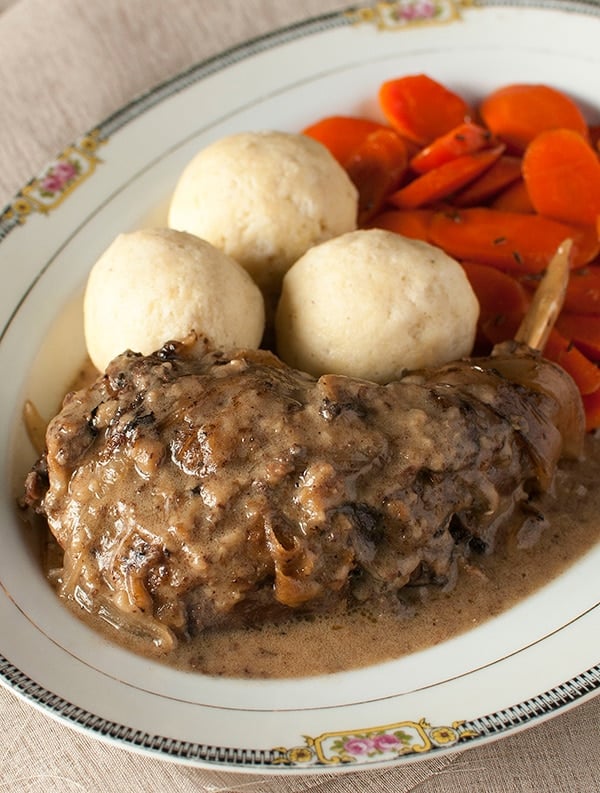
Sheraton has lots of dumpling recipes in her book, and I was intrigued by one for semolina dumplings: Balls of semolina dough bound with egg and heavily spiced with nutmeg; it’s a perfect accompaniment to the hasenpfeffer. Done right, these dumplings are (like all good dumplings) light and fluffy. Done poorly, they are gut bombs.
A nice side of classic glazed carrots rounds things out. (The link is to a recipe for glazed carrots I developed with my friend Elise over at Simply Recipes).
This was our Thanksgiving meal, and we did not miss the turkey one bit. Warming, comfy and very traditional. Give this recipe a go for a Sunday dinner when the weather is cold and nasty, even if you use rabbit instead. You will not be sorry you did.
Hasenpfeffer with Semolina Dumplings
Ingredients
MARINADE
- 1 cup water
- 1 cup red wine
- 1 cup red wine vinegar
- 1 tablespoon salt
- 2 tablespoons chopped rosemary
- 1 tablespoon juniper berries, crushed
- 1 tablespoon crack black peppercorns
- 3 bay leaves
- 4 cloves
- 1 teaspoon dried thyme
- 2 green onions, chopped
HARE
- 1 jackrabbit, snowshoe hare or domestic rabbit, or 2 cottontails or squirrels
- 4 tablespoons unsalted butter
- Flour for dredging
- 2 to 3 cups chopped onion
- 1/4 cup sour cream
DUMPLINGS
- 1 cup milk, whole or 2%
- 1 teaspoon salt
- 6 tablespoons semolina flour, or use farina or Cream of Wheat
- 2 tablespoons unsalted butter
- 1 egg, lightly beaten
- 1/2 to 1 teaspoon ground nutmeg
Instructions
- Marinate the rabbit. Bring all the ingredients for the marinade to a boil, then let cool to room temperature. While the marinade is cooling, cut up a hare into serving pieces. Find a covered container (plastic, ceramic, glass) just about large enough to hold the cut-up hare and put the meat inside. Cover with the cooled marinade. If you have leftover marinade, put that into a different container. Put everything in the refrigerator and let it sit at least 8 hours, but 2 days is better.
- Remove the hare from the marinade and pat it dry. Save the marinade. Heat the butter in a large, heavy pot with a lid. Dredge the hare in the flour and brown well on all sides. Do this over medium to medium-high heat so the butter does not burn. Remove the hare pieces as they brown and set aside.
- As the hare is browning, preheat your oven to 325°F and strain the marinade into a bowl.
- Once you've browned the hare, add the onion and stir to coat with the butter. If there is not much butter left, add another tablespoon or so. Cook the onions over medium-high heat until they are soft and a little brown on the edges. Sprinkle salt over them as they cook.
- Return the hare to the pot and add the strained marinade. Bring to a simmer, cover and put into the oven. Cook until the meat wants to fall off the bones: This will take 2 to 4 hours for a wild hare, or between 90 minutes and 2 hours for a store-bought rabbit. To finish the hasenpfeffer, remove it from the oven and uncover the pot. Spoon off about a cup of the sauce and put it into a bowl. Add the sour cream to the bowl and mix to combine. Return the mixture to the pot and swirl it around to combine. Serve at once with the dumplings.
- Make the dumplings. Once the hasenpfeffer has cooked for an hour or so, make the dumpling dough. Heat the milk to the steaming point and add the butter and salt. Start stirring the milk with one hand while you sprinkle in the semolina with the other. Stir well until the semolina absorbs the milk and forms a stiff dough. Take the pot off the heat and let the dough cool. Bring a large pot of salted water to a boil on the stove. once it boils, turn off the heat until the hare is done.
- When the hasenpfeffer is ready, turn the heat off the oven but leave everything inside. Mix the egg and nutmeg into the semolina dough. Let the dough stand while you bring your pot of salty water back to a boil, which won't take long because you preheated it. Get a bowl of water ready to wet your hands, so the dumpling dough doesn't stick to them.
- Roll the dough into balls. I like to make dumplings the size of a walnut. As you make them, drop each one into the boiling water. Do not crowd the pot. Once the dumplings start bobbing on the surface, let them cook another 2 to 5 minutes, depending on how soft you like them. Remove with a slotted spoon and set aside.
Notes
Nutrition
Nutrition information is automatically calculated, so should only be used as an approximation.



So a question for those who have done this with rabbit, or with both rabbit and hare. If rabbit is so different a meat than hare, and it sure sounds like it is, is it worth doing the recipe with rabbit? I ask because it sounds like a totally different dish without hare and my chances of acquiring a hare of any kind in North Carolina seem slim. It I’ve always been curious about it thanks to bugs bunny…
Ian: It’s perfectly fine, but yes, is a very different dish. In Germany, it’s hare, and dark, moody and wintry. With rabbit, it will be lighter. Try it with rabbit, and then, if you want, try it again with, say, venison shoulder or shanks, or squirrel, or lamb.
Thank you for your thoughts Hank. I appreciate it.
Hank’s Hasenpfeffer is my absolute favorite rabbit preparation (no hares where I live, but we do have swamp rabbits and eastern cottontails). My wife is a fan as well. Can’t wait until the season rolls back around so I can make this again!
My child’s favorite recipe. It takes some prep but it is worth it.
Followed the recipe… came out perfect. Not too strong or vinegary or anything. Even better on day 2.
Although I used a tight dish, I struggled to get all the hare covered in marinade so the only thing I would change is double the quantities of marinade. If there’s too much wet sauce at the end then I’ll reduce it separately and then pour it back over.
I really enjoyed this meat so that is bad news for the hares on my land although there are plentg of them so… a few won’t go amiss!
If I make this recipe again I will use a less potent vinegar than red wine vinegar or I would be tempted to take the edge off of the tartness with a little sugar or some dissolved ginger snap cookies. I believe I over cooked the dish looking for the meat to fall off the bones. I cut a conventional store bought dressed rabbit into 6 pieces. For future endeavor I believe I will trim the meat from the small bones as they ended up in the final sauce making it a nuisance to deal with like very bony fish. Flavor wise other than being overly tart it was good. The hind legs were the best part. The back would have been better had I trimmed off the tenderloins. The front would have been better had I trimmed away all of the ribs and neck. Thanks, Rob
If jackrabbit and groundhog are OK then just about anything should work.
Better get whistlepigs early before they get a real layer of fat. I’m now too old to hunt the snowshoe country and jackrabbits and squirrels are protected. NEVER thought I’d see that happen. Hmmmm. Coyote anyone?
I have never had hasenpfeffer before so keep that in mind. All my life, I wanted to try it and the only idea I had was from Bugs Bunny cartoons. When my local butcher got rabbit in stock I decided to try this recipe.
I followed it pretty close though I used the marinade to deglaze the pan before I put it in the oven. I also found it lacking in, of course, pepper! I don’t know if it is just the years of imagining that it would taste peppery or what, but I needed to add a bunch of pepper to it on my plate and then, poof, it tasted perfect. That black pepper offsets some of the vinegary and sweetness the marinade imparts. It brings it back down to earth.
I like to modify recipes heavily and I am thinking I will be making changes next time. First, I am going to use white vinegar instead of red wine vinegar. I thought the combination of red wine and red wine vinegar was a bit too much.
Second, I eat low carb so I just ate the meat (no dumplings). My thought is to change the sauce to a creamy horseradish and pepper sauce and drizzle that over it. I think that combination with the vinegar would be perfect.
Thanks for a great recipe and a perfect place to start!
Why marinade for 2 days? Won’t the salt and acid essentially cook the meat much like a ceviche? I believe it would become stringy with such long marinade time.
Jesse: This is a 200-year-old recipe, tried and perfected over centuries. It works. But if you don’t like the long marinade, skip it. But it will not be the same recipe.
Believe it or not, as many say rabbit “tastes like chicken” – in a pinch if you can’t find hare or rabbit, this recipe works really well with chicken also! Hard to find rabbit to buy around where we live, occasionally seen rabbit in a low-end discount grocery, from China, but I don’t trust it’s quality or even if it IS a rabbit! Could be a cat for all I know!
Thank you for the great recipe I am 70 years old and a German background I had a great recipe in German but I lost it after my wife passed away so thank you for this great recipe I’m going to try it right away
It has been over 50 years since my DAD and I had tasted Hasenpfeffer. My Father passed April 26, 1978. I’m now 76 and vegan. However, before I pass into the spirit world will taste this wonderful dish again. Thank you for the information.
So almost big enough to hold the rabbit?
While the marinade is cooling, cut up a hare into serving pieces. Find a covered container (plastic, ceramic, glass) just about large enough to hold the cut-up hare and put the meat inside.
Hank,
I used this recipe to prepare a woodchuck, having never eaten one before. We made German potato dumplings rather than the semolina as well. To us and our guests’ surprise, it was absolutely delicious. I butchered and used the entire animal using the same method you described for rabbits. Not a single bite was left. It was quite pot roasty, with a touch of grassy like lamb or goat. Paired with white asparagus and German red cabbage, it was a big hit. I recommend giving it a try!
Alec
Missouri
Actually, Hasenpfeffer has nothing to do with rabbit, it is , believe it or not, MEATLOAF!!!
Actually hasenpfeffer has everything to do with hare/rabbit. l lived in Germany. It is a great dish. Meatloaf had nothing to do with it. Hence the name hasenpfeffer.
You’re right, it has everything to do with hare / rabbit.
But most don’t know is why it’s called „Hasen-Pfeffer“. It has nothing to do with the spice Pfeffer/ pepper. „Pfeffer“ in context to this dish means that hare blood ( or pig blood) is added to the sauce and then boiled. It gives the sauce the darker color und creamy consistency.
Simple ingredients go a long way with this recipe, and the glazed carrots were a nice side. Overall, very easy to make if you are willing to be patient with the marinade and cook times.
Using Bob’s Red Mill Semolina, our dough never firmed up quite enough. Delicious flavor, but tricky to work with. I’ll try with 20% more flour next time.
We also made a simple cabbage dish for a little more variety on the plate: fry chopped onions in butter until beginning to brown at the edges – medium-medium high. Add thin sliced cabbage, some mustard seeds, and a little bit of sugar, and continue cooking until soft, possibly browning at the edges.
Oh my!!! Made this tonight for supper, and it was SOOO delicious! Thank you so much for your wonderful recipes! We’ve enjoyed all the recipes we’ve tried from you! Thanks, Hank!
I deglazed the pan after browning the onions to release all the brown bits of delicious from the bottom of the pa with about 3 ounces of GIN….a little more juniper flavor can’t hurt. It didn’t………delicious. I also tossed a generous 1/4 cup of minced fresh chives into the dumpling dough as I have a lot on the garden. Thank you for the time it took you to put this information on your site. Bon appetit!!!
I have now prepared this meal for over a dozen first time rabbit eaters. It takes a little planning ahead for the brine time, but very worth the wait. Absolutely incredible!
So now I am home sick!! Hasenpfeffer and Red Cabbage was a Sunday meal! Thnanks for the recipe