
As an Amazon Associate I earn from qualifying purchases.
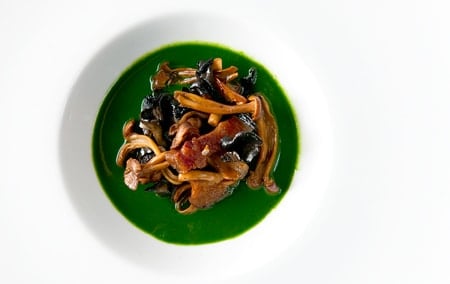
It’s January, and our porcini mushrooms have finally petered out over here in California. But like everything in life, their end heralds the beginning of a new season, our winter mushroom season on the North Coast. Our coast is blessed with damp, cool winters, perfect for mushrooms. Chief among them are our cornucopia of winter edibles: black trumpets, yellowfoot chanterelles, two kinds of hedgehog mushrooms, pig’s ears, candy caps and the queen of the forest, the chanterelle.
This is what I call the Winter Pick.
On a good day on the North Coast, You don’t so much “hunt” mushrooms as pick them. The forest floor can be carpeted with mushrooms, most of them edible.
Chief among them is Craterellus cornucopioides, also known as the black trumpet or horn of plenty. This black chanterelle cousin was the prize when I went mushroom hunting with my family in New England back in September, but they don’t start popping in California until winter. And they can fruit in impressive numbers.
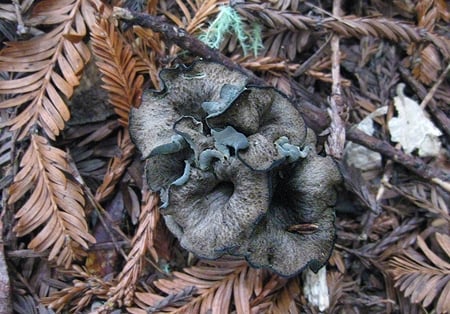
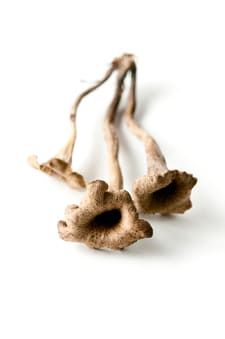
Clusters like this can be all over the forest, usually in dark places littered with pine duff. They look like something from the Addams Family, or Beetlejuice, which — and I am sure you are not shocked about this — was one of my favorite movies of the 1980s.
Black trumpets are as delicious as they are macabre. They are so aromatic, so savory that I might just like them better than the regal porcini or chanterelles. The only problem with trumpets is that they are black — and that color stains anything they are cooked with, so you need to either go with it, as in my midnight rice recipe, or cook them separately.
Black trumpets are a mainstay in the dried mushroom medley I use as something of a secret ingredient in most of my stocks, broths and stews. I always have several quarts of dried trumpets hanging around in my pantry. The other dried mushroom staple in my house is a brother of the black trumpet, Craterellus tubaeformis, the yellowfoot chanterelle.
Candy caps, Lactarius fragilis, are another drying mushroom — although you can certainly eat both black trumpets and candy caps fresh. This little mushroom, which is believed to only live on the Pacific Coast, has an amazing power: It tastes and smells like maple syrup!
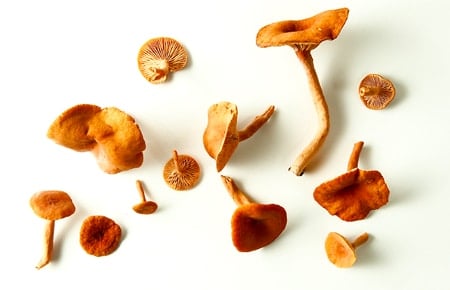
They are pretty little mushrooms, with caps rarely more than four inches wide. They like to live together in loose patches around moss and salal bushes. Most of the mushrooms you see in this picture above are the size of a penny. Candy caps are not a beginner’s mushroom, as there are several lookalikes, some of which are poisonous. (I have some of my favorite mushroom books linked below if you are looking for a full-on identification guide.)
The finest fresh-eating winter mushroom in these parts is the hedgehog. There are two kinds of hedgehogs for the most part (there are others, but they are less common) — big ones and little ones. The big ones are Hydnum repandum, the little ones Hydnum umbilicatum. These are umbilicatum:
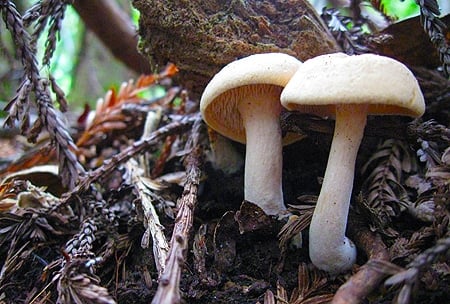
Little hedgehogs are friends with black trumpets. You will often find them in close quarters in the piney-salal-huckleberry woods. Black trumpets are typically in darker places, hedgehogs where the light gets a little dappled.
Why are they called hedgehogs? They lack the gills of many mushrooms, and the pores of boletes and polypores. Instead, they have “teeth” under their caps, and those teeth make the mushroom look a little like a prickly porcupine or hedgehog. Another name for this shroom is “sweet tooth.”
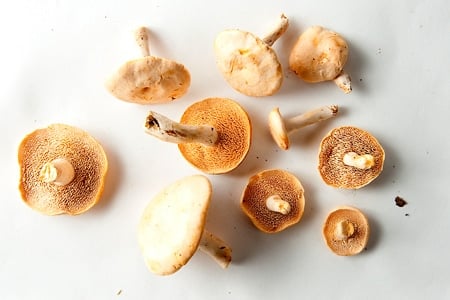
From a cooking standpoint, these are some of my favorite mushrooms of all. They are a lot like regular chanterelles, sweet and meaty, but without the apricot aroma. They are especially pretty sauteed. One of my favorite ways to cook them is to combine slow-cooked gizzards. It sounds strange, but this dish was judged as my best when I was in a cooking competition at Grange a few years ago. But you can use small hedgies in place of chanterelles.
Large hedgehogs, on the other hand, are the porcini of winter.
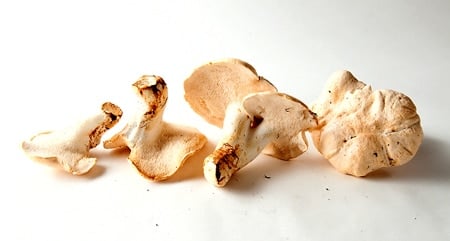
They can get large, up to 8-10 inches across at the cap. They are not as dense as porcini, but you can still slice them thin and saute or grill them nicely; they make a good centerpiece on a plate. I have a spot I’ve returned to for 6 years, under a fallen branch. It never fails me. If I catch it right, I can score a couple pounds.



Hi Hank,
How late in the year are you able to find black trumpet mushrooms?
They were wonderful with blacktail venison.
Mark
Mark: Depends on the year, but I’ve found a few in April.
Just curious, the huckleberry you mention… is that the evergreen huckleberry or is there another type of huckleberry that grows in your area?
Amy: We have several varieties, but yes, I am talking about the evergreen huckleberry here.
Out walking in Poland today in the forest and saw many Horn of Plenty, the very first time I have seen them, must have been about 10kg all high up in forest under Beech Trees on Limestone ground that was quite damp. Not far away were some Hedgehogs, wish I had a basket to put them all in now after reading about how prized they are!!!
@ Kevin. I usually pull in pounds of black trumpets around my home in Maine, many growing in tight clusters as shown. I think there are a couple variations of black trumpet varieties. Don’t know what it’s like down south though.
I’ve been wondering if there were any mushrooms up there, but because of the rain factor, I thought there wouldn’t be many. I did try to factor it fog drip, but since the drive up is about 2 hours and 20 minutes, it’s hard to take the chance.
Now with the rain, I’m hoping to find more black trumpets and candy caps (The butternut squash and candy cap creme brulee from Connie Greens’s cookbook is divine!!) when we get there.
I’m so jealous! I love hedgehog shrooms but haven’t been able to find any anywhere for years!
Hi Hank,
You talked about some of our wonderful winter edibles, always a delight to find. One correction, though: our candy cap is not Lactarius fragilis, a not so fragrant eastern species, but Lactarius rubidus. Another similar western candy cap species that is larger and redder and occurs with oak is called Lactarius rufulus. Here’s my web page on these fragrant finds: https://www.bayareamushrooms.org/mushroommonth/candy_cap.html
Best,
Debbie Viess
Bay Area Mycological Society
According to Mushroomexpert.com, the trumpets don’t grow in the tight clusters as shown except in the West. In East(SE), I usually see them scattered over moss. Never bothered to eat them though.
Nicely done, Hank. I really like the plating on the sauteed mushrooms with parsley sauce. Elegant is right. Beautiful contrast. We were back out there this weekend and though the tubies were beginning to show their age, the black trumpets were more consistently large (which sure makes cleaning multiple pounds of them easier!) and the sweet tooth hogs had just completely exploded in number (to the point where you get picky and only crouch down to pick them when you find a substantial cluster). On top of it all, I finally found my first edible-quality matsutake. I’m thinking pork chops with black trumpet and yellowfoot wine sauce for dinner tonight, but what to serve it over? Polenta, maybe?
I knew I shoulda gone with you! Darn! To think, all those years I spent tromping the redwoods where you were and I never realized what I was walking over!
I haven’t been going out because of the lack of rain. Good to know they are coming up anyways!
Hedgehogs and black trumpets are some of my favorites. We’ve looked for candy caps on our mushrooming trips but haven’t yet found them.
I had a great time picking with you Hank and I’ll have a great time, trying this one out. If HOP’s are a poor man’s truffle, I don’t want to be rich. Kudos to Holly on the awesome pics.
Looks amazing. Will definitely try this out!