
As an Amazon Associate I earn from qualifying purchases.
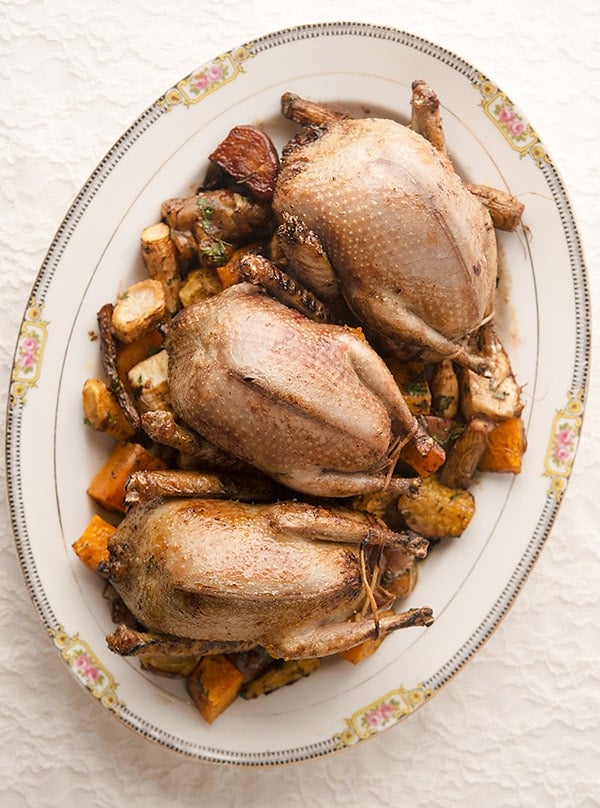
Here in America, everyone seems to think there’s something dodgy about hunting and eating pigeons, which are, after all, a non-native, borderline invasive species totally unprotected in most states (although in the Northeast they are, inexplicably, considered a songbird).
Mind you, I’m not talking about hunting city pigeons, whose crops are stuffed with Doritos and cigarette butts. We chase “barnies” that live in semi-abandoned barns who spend their days gorging themselves on grain and seeds. Still, talk to any American about Columba livia and you’ll get the squinched nose. “Ew! Dirty!”
Sorry, but I have a thing for pigeons. I love hunting them, I love how fast they fly, how tough they are and I love how they taste. I know, I know, some of you are already tuning out. Fine. More for us. But can I hear from the Britons out there? Back me up: Wood pigeons are damn good, right?
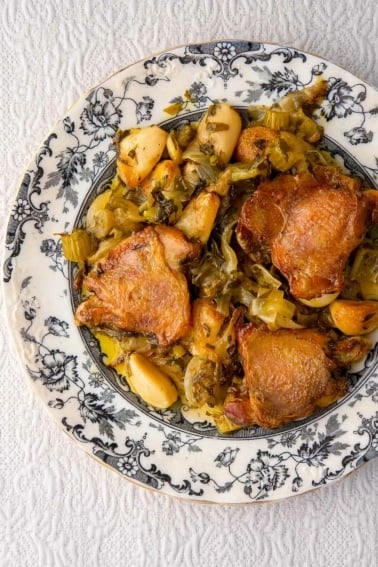
This recipe is an homage to my British ancestors. It is just a simple roast pigeon, served atop a bed of roasted root vegetables, with a little malt (or beer) vinegar splashed on and served, ideally, with a British pale ale or a glass of claret.
The great chef Fergus Henderson’s The Whole Beast: Nose to Tail Eating serves as my inspiration, with a few modifications. I probably cook as many little birds as anyone, and I have a few pointers you might want to learn before you start your roast pigeon.
First, pigeons are a red meat bird and should be eaten somewhere around medium.
What’s more, they are rarely fat, although once in a blue moon you’ll find a pigeon so morbidly obese you have no idea how it flew. (Those are a treat for the table, by the way.) Normally, however, you need to deal with athletic birds, able to cruise around at 55 miles an hour with a top end at close to 90 miles an hour; this makes them the fastest game bird in North America. Impressed yet?
Incidentally, if you like doves you will like pigeons. Pigeons are to doves what hares are to cottontails, or geese are to ducks: Bigger, smarter, tougher, older. Where most doves barely live a year, the average lifespan in the wild of a typical pigeon is five years. Yep, that’s older than most deer you shoot. So you’ll need to deal with that.
You can sometimes tell if you have old birds. Their feet look like they’ve been walked on for years and their keelbones are super hard. Young birds have a flexible keelbone and are just generally fresher looking. They also tend to have lighter colored meat. But it’s not an exact science.
So as an insurance policy against toughness, you need to start the cooking of the legs and wings before the breast. The easiest way to do this is to sear the legs and wings in hot butter or oil before you roast the bird. You don’t want to sear the breast, though, because you want it to be pink when you serve it. To do this, you need to hold the pigeon with tongs in the hot oil and be vigilant.
There is another way. I recently bought a nifty kitchen device called the Searzall Blowtorch Attachment. You screw this baby onto a Bernzomatic TS4000 Trigger Start Torch, which uses for fuel those little green propane tanks you get in the supermarket. Why not just use the torch? Because it gives meat a nasty propane stink. The Searzall converts the propane flame into radiant heat energy. I used the Searzall to pre-cook the legs and wings of the pigeons here, and it worked like a charm.
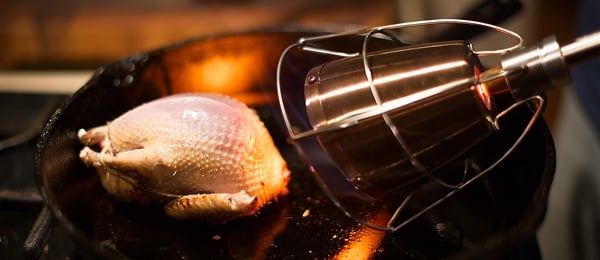
I could have easily seared the breasts, too, and, had I wanted to, I might have been able to cook the whole bird with the torch. But I am still working out the ins and outs of this thing — and I wanted you to be able to make roast pigeon without special equipment.
For any of you who have eaten doves, pigeons taste pretty much the same, although they can be a little more aggressively flavored. Squab, readily available in fancier restaurants, is just a baby pigeon. The closest parallel beyond that is wild duck, like a teal, only without the fat layer.
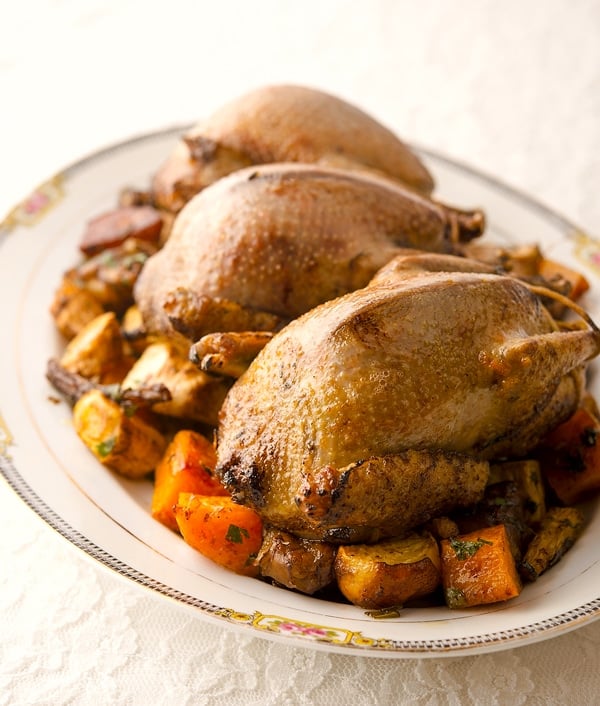
Pigeon is meaty, but not so much as venison or beef. Very tightly grained, especially the breast meat. It takes salt and vinegar very well, and is “gamey” only in the sense that it tastes like something, not like flaccid, corn-fed, penned beasts.
Roast pigeon is a bird to get down on, too: Pick it up and gnaw. Sure, you can carve it and get all white linen, but I find it so much better eaten caveman style. Juices flowing, crispy skin on the legs, which are the best part to my mind.
So. Damn. Good. Go get some, people!
Roast Pigeon with Root Vegetables
Ingredients
- 2 to 4 pigeons, plucked and dressed
- 1/4 cup melted butter or olive oil
- Salt and black pepper
- 2 large carrots, peeled and cut into chunks
- 4 to 6 Jerusalem artichokes, cut into chunks
- 2 parsnips, peeled and cut into chunks
- 2 to 4 salsify roots, scrubbed and cut into 2-inch lengths (optional)
- 1 or 2 roots of Hamburg or root parsley, cut into chunks (optional)
- 3 tablespoons chopped parsley
- Beer vinegar or malt vinegar, for garnish
Instructions
- Preheat the oven to 425°F. Put all the chunked-up vegetables in a small roasting pan and coat with about half of the melted butter. Salt them well and pop them in the oven to roast. Take the pigeons out of the fridge when the veggies go into the oven. Let the pigeons come to room temperature for 30 minutes.
- Stir the root vegetables, which should be starting to get brown. Paint the pigeons with more melted butter and salt them well. Pour the remaining melted butter into a small pan and get it hot. Sear the sides of the pigeons in the hot butter. You want to get the legs and wings halfway cooked before the birds go into the oven. This should take about 6 to 10 minutes. Don't sear the breast meat.
- Check the vegetables. They should be pretty close to being done. If they are, remove them from the oven, put in a bowl and cover with foil. Turn the oven up to 475°F, or even 500°F if it will go that high. Wipe out the roasting pan. Let the pigeons rest for the 10 minutes or so this will take. When the oven is ready, put the pigeons into the roasting pan, breast side up. Roast for 10 minutes.
- Remove the pigeons from the oven and set on a cutting board. Turn off the oven, pour the vegetables back into the roasting pan, toss with the chopped parsley and set into the oven to re-warm and cook a bit further. Let the pigeons rest for 5 minutes before serving. Serve them surrounded by the vegetables, which you can season with a little vinegar if you want.
Notes
Nutrition
Nutrition information is automatically calculated, so should only be used as an approximation.



Hank: The roast pigeon recipe was amazing! Rich flavor, tender moist. My room mate didn’t like it, she has very common tastes. Still have some things to work on, but will have to wait until next year. Thanks.
Great recipe and article!
I Live in an agricultural community
I hunt for and eat Barn pigeons year round. For years I have taken my barnies at work ( a fruit processing plant) where the pigeons are a pest roosting in the harvest bins. I hunt the pigeons with my homemade slingshot and find my harvests rewarding and delicious. I have eaten pigeon in stews, baked, in pies, and as a taco filler.
Never tried roasted pigeon, will try it soon.
Amazingly delicious and easy.