
As an Amazon Associate I earn from qualifying purchases.
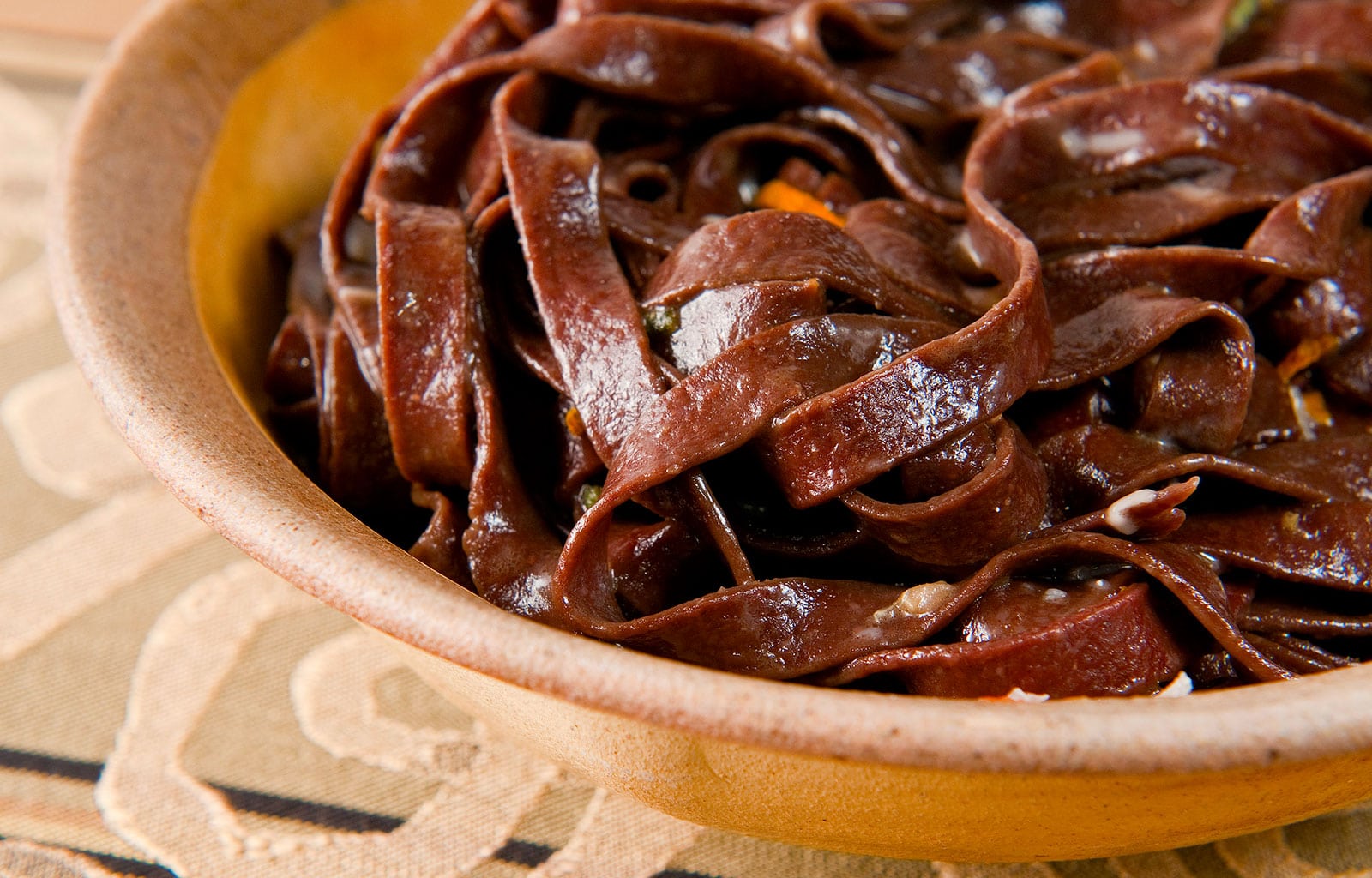
This is what you think it is. Blood pasta. Pork blood pasta, to be exact.
It’s something I’ve been wanting to make for more than a year. And let me tell you folks, as weird and as Andrew Zimmern-like as this dish is, it was totally worth the wait. This stuff rocks.
Of course, that is to say this pasta rocks if you a) eat pork, b) like pasta, and c) aren’t irretrievably skeeved out by the concept of eating something made with blood. Vegetarians might want to skip this post.
My infatuation with this pasta started with a book. Oretta Zanini de Vita’s Encyclopedia of Pasta, to be precise. I began working through some of the cooler pastas I’d read about. I made Sardinian saffron gnocchi and I made strettine, a pasta made with nettles in the flour. I made acorn pasta, a famine food of Puglia.
But always I thought of blutnudeln, pasta al sangue. Blood tagliatelle. If there is a stranger pasta that is traditionally eaten in Italy, I can’t think of one. Blutnudeln is a specialty of Pusteria, in the Trentino-Alto Adige region of Alpine Italy along the Austrian border; thus the German name.
Pasta al sangue was, historically, part of a family’s annual hog butchering ritual. It’s made with a combination of rye and wheat flours — rye being the dominant grain in this chilly area — an egg, and lots of fresh pork blood. It’s served with butter, sage and a local dry cheese. Simple.
I got a chance to meet Mrs. Zanini de Vita at the James Beard awards in 2010; her book won Best Cookbook in the Reference and Scholarship category. I practically bum-rushed her table afterwards. As best as I could in my broken Italian, I gushed to her how much I loved her book. She smiled, and said in her broken English how happy she was to have her book read in America. I was over the moon.
Finally I screwed up my courage and ordered some pork blood. It comes in gallon jugs, so I plan on making some blood sausage with it, too. For the dough, I used some Italian “oo” flour, some rye flour, an egg, a pinch of salt, and the pork blood. The raw dough was alarmingly pretty.
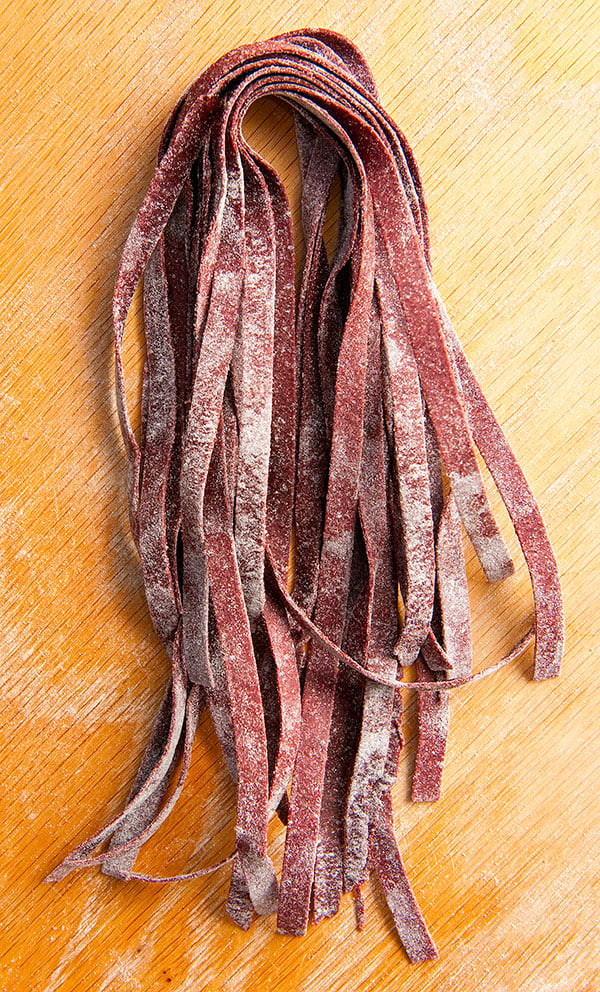
It sure looks like a beet pasta dough. But it ain’t. According to Zanini de Vita, blutnudeln are rolled out thin and cut into 3/8″ noodles, like tagliatelle. I rolled mine out to No. 6 on my Atlas (No. 9 is the thinnest setting) and ran it through my tagliatelle cutter. Pretty!
Now for the sauce. Why not make a blood orange sauce?
The sauce would be butter in which I’d fry some sage, reduce blood orange juice and top with blood orange zest, grated cheese and black pepper.
Holly and I sat down to eat. I admit to a twinge before digging in. There is something about blood that’ll do that to you. Blood, more than anything else, symbolizes life. There’s a reason many of us hate to see the sight of it, why the vampire mythology touches something deep within us. For me, meat is animal turned into food. But blood is akin to the anima of the animal itself and occupies an entirely different mental space.
Intellectually it doesn’t make any sense. But we humans are not ruled by intellect alone.
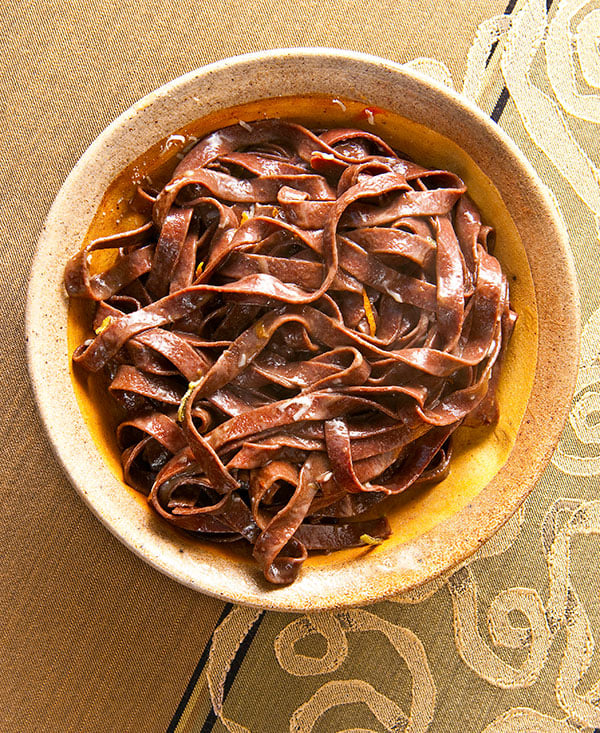
I took a bite and was immediately aware of two things: That I’d nailed the texture of this pasta — it was perfectly al dente and perfectly shaped — and that I was tasting blood. Coppery, minerally, savory. The tang of the citrus brightened the dish, the sage added bitterness, the butter smooth sweetness. I liked it.
This is not comfort food. Yes, at its core this is still pasta, and the overwhelming sensation you get while eating this dish is definitely grain, but you feel the blood’s presence with every bite. As you eat it, you can’t help but think about what went into this pasta, and about that pig.
And that’s as it should be.
Blutnudeln or Italian Pork Blood Pasta
Ingredients
- 5 ounces rye flour
- 5 ounces Italian oo or regular all-purpose flour
- 1 egg
- A pinch of salt
- 2 3/4 ounces pork blood
- 4 tablespoons unsalted butter
- 1 tablespoon fresh sage, finely sliced
- 1/3 cup blood orange juice
- Salt
- Grated blood orange zest and pecorino cheese for garnish
Instructions
- To make the pasta, whisk together the two flours and salt in a large bowl. Make a well in the center of the flour and crack the egg into it. Pour in the blood and stir everything together with a fork.
- When the dough is a shaggy mass, begin to knead it in the bowl. It will be sticky at first, but will smooth out as you knead, first in the bowl, and then on a floured work surface. Knead for 5 minutes.
- Wrap the dough in plastic wrap and set at room temperature for 2 hours, or in the fridge up to 1 day.
- Roll out the dough into 3/8-inch flat noodles that are not too thin. I use No. 6 on my Atlas (No. 9 is the thinnest). Set aside to dry.
- To make the sauce, reduce the orange juice by half, turn off the heat and add salt to taste. Set aside.
- Bring a large pot of salty water — the water should taste like the ocean — to a boil. When it boils, melt the butter in a large saute pan over medium-high heat and fry the sage. Add the pasta to the boiling water.
- By the time the pasta is floating, the sage will be nicely fried. Add the orange juice mixture to the butter and sage.
- Allow the pasta to cook 1-2 minutes after it begins to float, then transfer it to the pan with the sauce. Sprinkle some salt over everything and toss to combine. Serve at once with the orange zest and grated cheese.
Nutrition
Nutrition information is automatically calculated, so should only be used as an approximation.



Interesting looking recipe. Do they offer it in restaurants in Germany or Italy? What size serving do you recommend?
Realmente, acredito que não tenho coragem de comer, embora esteja com uma aparência agradável mas o fato de ter sangue de porco fresco tirou o meu apetite.
I had a very similar dish at Constantino’s restaurant in SF some time back. His addition was trotters. Gave it an amazing, silky texture from the collagen. Thanks for the recipe Hank. I’ll be making this the next time we butcher a hog..
OK, now I’m curious. I never considered the blood of an animal as something to be kept or used. I am slaughtering a steer tomorrow and I could try capturing some of the blood…but I know it will coagulate almost immediately. How was the pig blood treated so it didn’t become a solid mass?
Becky: Pour a little vinegar into the fresh blood, mix it, then refrigerate it for up to a couple days. It doesn’t keep long.
I had the same question Al did (though I guess the blog author doesn’t check out the comments on these old posts) – weight or volume on the flour? 1 ounce (by weight) of rye flour is 2+ ounces in volume, makes a huge difference.
Brian: By weight. No one in America I know of measures solids in ounces by volume. We measure liquids in ounces by volume, but not solids. Always by weight with these.
WOW – I haver seriously never heard of anything like this. As strange as it is I would probably love to try this!
Quick question – for your recipe, are the 5 oz of flour(s) by weight or volume? Want to give this a try. (I’m assuming the blood measurement is fluid ounces…)
After trying the dish out – fantastic!
My hand-rolling could definitely use improvement, but the flavour was spot on. The noodles had the distinct mineral taste, but it didn’t overwhelm to the point where every bite was “bloody”. I will definitely make these again. Unfortunately, my temperature probe broke partway through slow poaching eggs, and I ended up overcooking them, so the texture of the egg/noodle mixture was a tad dry.
Thanks for the idea – I can’t wait to try some other ideas from the site.
Just wanted to say that I stumbled across this blog a few weeks ago, and it was this recipe that kept me coming back every couple days to read your site!
I’m making this recipe tonight. Getting the fresh blood was a journey to a local abbattoir, but I hope it was worth it (versus buying some frozen blood down the street at the asian market). I’ll be following the recipe closely, but using my hands to roll and cut the noodles, and adding some sliced and pan fried blood sausage on top of the finished dish. I also think I’m going to crack a small slow poached egg over each serving, reducing the butter a bit as to not make the dish come across as overly creamy from eggs and butter.
Thanks for the inspiration. If the noodles taste good, I’ll definitely be making this again!
Wow. I love blood sausage, and I would definitely be game to try this pasta, though I don’t know about making it myself. I probably can get fresh pork blood easily here in China… the question is whether I’m willing to trust the source!
Hello! It was really interesting to read your post. I found you when browsing through foodgawker and stopped thinking ouuu – chocolate pasta 😉 You see I was living for 2 years in Perugia, that hosts chocolade festival, and chocolate pasta was always there, one of the most common foods to buy.
Anyway back to blood pasta 😉 I would never think one can actually use it for pasta. Growing up in Poland I was quite accustomed to blood sausage. We also do have blood soup (it’s called Czernina if you’re interested to google that curiousity 😉 it is made, at least in my fathers family, with duck or geese blood), but I never had the courage to try it 😉 Partially because of less than appealing colour 😉 Once I moved to Finland I have discovered yet another way of using blood (pork or reindeer) is to make blood pancakes! They are very good and are served with lingonberries jam. The more I travel the more I learn that blood can indeed be a versatile ingredient. Thanks for this post, I really enjoyed it 🙂
That is certainly a bowlful of awesome.
I love it that you used blood orange in the sauce! Stroke of genius, I must say.
I made blood sausage a few years ago after helping kill a pig on my CSA farm. I used apples, shallots, eggs, cream and herbs all from the farm in the filling.
Poured a glass of wine in the bucket before collecting the blood, kept if from coagulating.
Now you’ve got me thinking of other ways to use blood.