Black Walnuts and Holiday Cheer

Dec 14th, 2010 | By | Category: Foraging | Comments | 40 Comments |
California black walnuts

Photo by Hank Shaw

You’d think that if anything would bring out the Greed of Man in me, it would be truffles, a sexy, intoxicating food that can fetch $300 a pound or more. Yet I’ve found myself giving plenty of them away to my friends for the past week. No, what really makes me feel like Gollum from Lord of the Rings, the wild food I hold most precious, is my store of shelled black walnuts. Don’t even ask. You can’t have any. They are mine I tell you, all mine!

For those of you who don’t know what a black walnut is, it is a generic term for the wild walnuts native to North America. There is one main species east of the Rockies, two in California, and a couple of others in Arizona and Texas. Black walnuts are, more or less, related to hickory nuts and butternuts.

What’s the difference between a black walnut and the kind you get in the store? The vast majority of walnuts you buy in stores are English (also called Persian) walnuts, which are larger and easier to shell than black walnuts. In some places you can buy black walnuts in stores, although they are rare. Fortunately you can buy black walnuts online.

Size is not the main difference between black walnuts and domesticated ones. Flavor is. Black walnuts taste far stronger than regular ones, more concentrated, walnut-y, and even a touch more bitter. To me they are the difference between cream and skim milk, grouse and chicken, a wild strawberry and one of those gigantic ones grown on the coast of California. I will take black walnuts over regular ones any time, and for any price.
Luckily that price is free: Black walnut trees grow all around us here in Northern California. My friend Josh tipped me off to a great spot, too, which has so many old trees it took my just 10 minutes to fill two 5-gallon buckets.
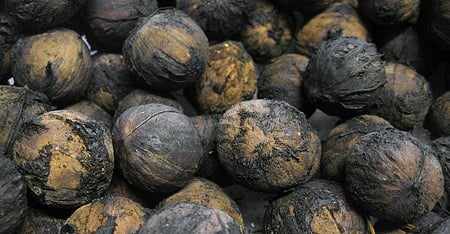
hulled black walnuts

Photo by Hank Shaw

OK, maybe I lied. Black walnuts are not free — if you take time into consideration. Nothing I have ever done, not winemaking, gardening, big-game hunting, processing acorns or curing olives is as labor-intensive as harvesting, hulling and shelling black walnuts. As my fellow forager Connie Green says, “black walnuts are a fortress.” Here’s the method I figured out to storm the gates.

First you need to harvest the walnuts at the correct stage of ripeness.
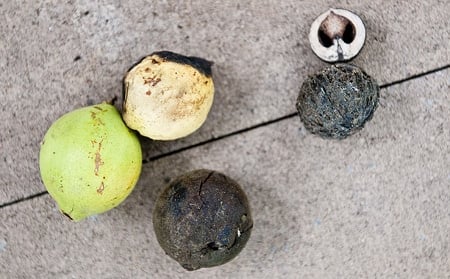
black walnuts in various ripeness

Photo by Holly A. Heyser

For starters, walnuts will probably not be ripe where you live until October, so wait until then to begin. November should be fine, too, and you can pick up fallen nuts from the ground around the trees into December, but by then our Little Gray Friends the squirrels will have had at them.

So you’re standing at a tree. You see all these forms of walnuts in front of you. Which to pick?

Green ones will most likely still be on the trees. Yes, you can collect them, but they have a surprise in store for you. The beige ones are rotting green ones — they are the hardest to work with, but the nut inside will still be fine. The black one at the bottom is how you will find most of your walnuts: It has its hull rotted and is pretty dry. Finally, if you’ve had lots of rain, you will find some nuts that will be pre-hulled, like the one under the half-shell. Pick only pre-hulled walnuts that feel heavy for their size, as they will dry out in the shell once hulled.

For the most part, you will need to hull your walnuts. Lots of people say you should just drive over them with a car, but this stains your driveway. Stain? Why yes. Black walnut juice stains like nothing else. And it will not come off with any amount of scrubbing. If you fail to wear gloves when you hull black walnuts, you will have the Black Hand of Death for several days.

Sam Thayer, in his book Nature’s Garden, suggests stomping on the hulls in the field to get them off. This works, but incompletely in my experience with Northern California walnuts, juglans hindsii. So I sit outside on my porch with three buckets — one with walnuts in it, one for the soon-to-be-hulled walnuts, and one for the hulls. I then don gloves and use a pocketknife to hull the nuts by hand.
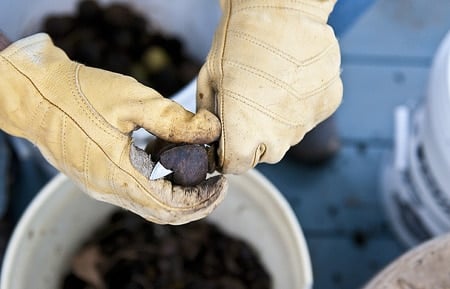
hulling black walnuts

Photo by Holly A. Heyser

You want a relatively dull knife that you can slice with and not be in danger of it piercing your work gloves. The work can get a little slippery, especially with the green walnuts — remember the surprise? That’s it. A hal-hulled green walnut is slipperier than goose shit on a doorknob.

This is why I prefer the walnuts with the fully rotted black hulls.
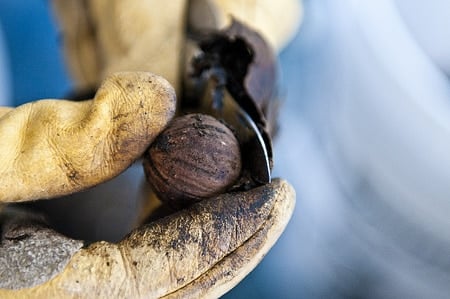
black walnut, juglans hindsii

Photo by Holly A. Heyser

Beware when you are hulling walnuts outdoors. Our Little Gray Friends could be lurking anywhere, just waiting to steal your walnuts for themselves. I use a biological countermeasure to keep the squirrels away:
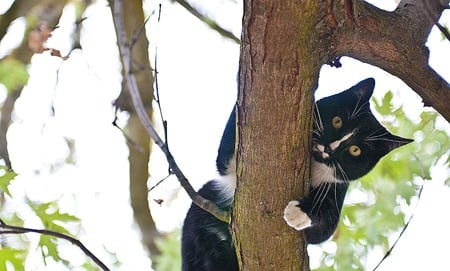
Harlequin the Cat

Photo by Holly A. Heyser

Once hulled, your work has just begun. Now you must shell your walnuts.

This is the point at which you can kick back a bit. Hulled walnuts store well in the shell, and in fact crack better once they’ve dried for a few weeks.

Once you start shelling, however, you need to banish from your head all notions that you will be able to crack black walnuts and get those pretty perfect halves you can get with regular walnuts. Won’t happen. Bits and pieces are the price of precious black walnut meats.

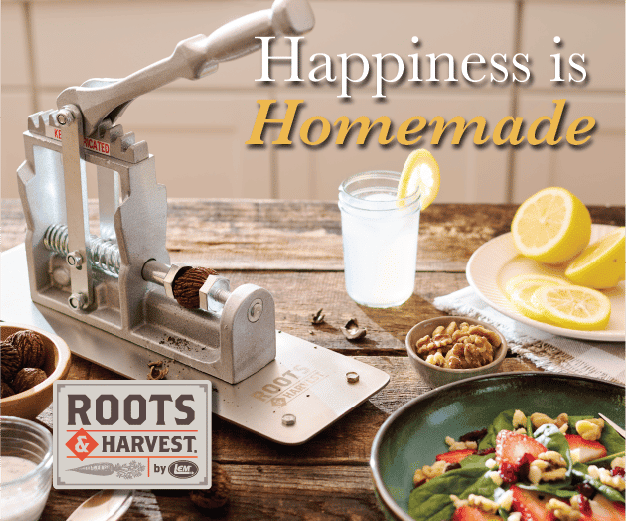
I crack mine with a hammer, on the concrete floor of my garage. Such force is necessary. I’ve never heard of a regular nutcracker fierce enough to break a black walnut, although some people in the Midwest, where the Eastern species lives, have created special black walnut shellers. Anyone ever use one? I’ll buy one if they work well…

The key to the hammer technique is to use a terrycloth towel to cover the nuts, so the pieces don’t fly all over the room. Use a towel you don’t care about, as it will get holes. Smack the nut with enough force to break it, but not enough to pulverize the nut; after a few, you’ll get the hang of it.

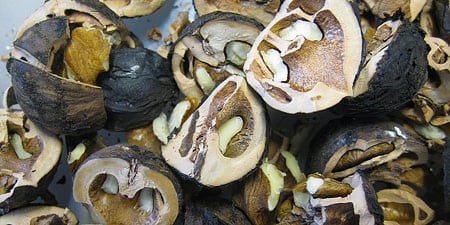
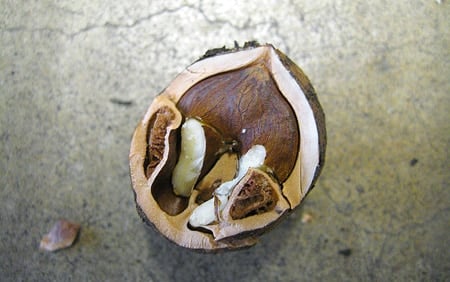
So now you have a bucket of cracked nuts. You’re still not done! Now you need to gently remove the meats from the impossibly complex interior of the walnut. I find the best piece of equipment to do this is a stout pair of wire cutters and a nutpick. I use the wire cutters to clip the shells in key spots so larger pieces of walnut fall out. Again, after a few dozen nuts you’ll begin to know where to clip. The nutpick’s use is obvious. This is tedious work, people. Do it during commercials of your favorite TV show.

black walnut closeup

Photo by Hank Shaw

Let me tell you before you begin a black walnut adventure that you need to be patient. It took me probably six hours of work to get 15 ounces of nutmeats — although that includes hulling all of my nuts, not just the portion I cracked and picked. But all this work is worth it.

Just the aroma of black walnuts is payment for the effort: They smell toasted without actually being so. And I’ve already mentioned the flavor, which is so strong many recipes say just half the amount of black walnuts will fully replace the flavor of regular ones. I’m not so sure about that, but you can use a bit less. If you want.

Which brings me, finally, to what I did with my black walnuts. It is the holiday season, so I decided to make something that would help the group Share Our Strength raise money to fight child hunger in America.

Regular readers of this space know I normally do the World Food Program charity event, but this year I feel I need to focus on our children here at home. My friends Gaby and Michelle suggested I join a blogger’s charity ”progressive dinner” in which we all feature a piece of a holiday dinner — and ask you, our readers, to donate a little to Share Our Strength.

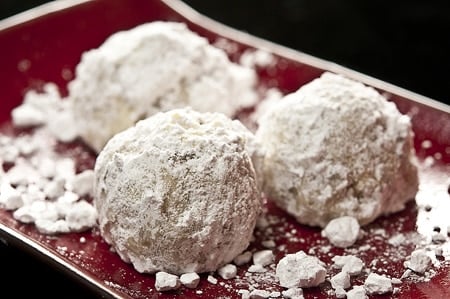
My task? Dessert. Yeah, I know, I am Mr. Meat Guy. But I will venture into desserts on occasion, especially when they involve wild ingredients. So I present to you a Christmas cookie. No, really. I’m not lying. I actually made a Christmas cookie, and a traditional one at that:

black walnut snowball cookies

Photo by Holly A. Heyser

It is my version of a traditional walnut snowball cookie, also known as a Russian teacake or a Mexican wedding cake. My version has black walnuts, of course, but also orange flower water and a little orange liqueur. It’s an awesome cookie, a riff off one my mum has made for decades.

These cookies are stupid easy to make — no mixer necessary, just clean hands — and are so good you really need to make a double batch, because you will eat half of them before your friends or family come home. Trust me on this one.
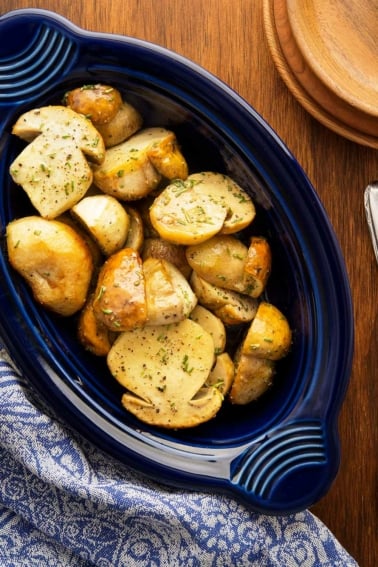

So I hope you make these cookies (even if you use regular walnuts), and, if you are so inclined, give a little something to help make some kids in a town near you less hungry this holiday season. Here’s how to donate.

black walnut snowball cookies

Photo by Holly A. Heyser

MORE SHARE OUR STRENGTH DESSERTS:

Tags: , , , , ,
Print This Post

________________


Subscribe to comments for this post

40 comments
Leave a comment »

  1. Hank, I found your blog for the Outdoor Blogger Network. Love the posts.

    When I lived on he farm in Iowa, we also used the black walnut hulls gathered from the farmyard, though not for culinary purposes.

    The hulls were placed in a metal bucket with water poured over them and placed over a fire to boil.The hulls provide a great natural dye (that will also color your hands should you skip the gloves while hulling the nuts). Metal traps that were used for raccoons, muskrats, etc. were dropped in to remove their scent (and on new traps dulled the metallic shine).

  2. Esperanza of Pluck and Feather Farm served us Nocino, a wonderful liqueur from black walnut hulls, during a dinner party a few months back. It had a slight licorice flavor. Spicy and slightly sweet. I highly recommend it!

  3. [...] Hunter Angler Gardener Cook (read the post) [...]

  4. [...] Walnut Snowball Cookies from Hunter Angler Gardener Cook [...]

  5. My Grandmother was a black walnut maven. She lived in rural Iowa and had several walnut trees in the yard. Her secret was to soak the walnuts in bucket of water until the hulls were black and saturated. Then she ran them through an old corn hulling machine. It was a hand crank, but way the hell quicker and easier than trying to whittle them off.

    Then she’d sit all winter at the kitchen table with a rock with an indentation in it to hold the walnuts. Probably an American Indian artifact my Grandfather picked up in the field. She’d hit them with a ball peen hammer and then pick them out in complete halves.

    Oatmeal cookies with black walnuts in them is such a distinct memory I can almost taste them now. Black Walnuts…..

  6. oh my gosh…I had no idea how much work went into hulling/shelling these things!!!! I would’ve stabbed myself [unintentionally at first then purposefully after an hour] a million times. wow. WOW…

  7. Out of curiousity, is the juice in teh hull or the shell (I’m guessing hull, but..)

    I’ve been considering hunting down some walnut trees to collect dying material for yarn.

  8. Hank,
    Thanks for the great idea for black walnuts. We picked several gallons a while back visiting family in Springfield, MO and I think I quit after a few hours and a few tablespoons of nutmeats. The family graciously sends pre-cleaned nutmeat now, and maybe I’ll get a chance to try good old-fashioned snowballs. I think this is a nice idea that will highlight the flavor well.
    Have you tried pickled black walnuts? I saw them on an English blog somewhere (as something to eat along with a cheese plate) and ordered them from a place in MO, but they were really nasty. I’m not really sure what they’re really supposed to be like – this was like eating a pickled dirt ball.

    Congrats on the book – the cover (so far) looks great! Can’t wait to order it.

    jenny

  9. Reading your post makes me miss walking around the Chico State Campus. I remember all the walnut trees. They made such a mess on the bike path! What a perfect cookie to showcase such a prized ingredient.

  10. [...] Hunter Angler Gardener Cook (read the post) [...]

  11. So glad to be participating in this wonderful event with fellow bloggers like you, in support of a worthwhile cause. Informative post on walnuts as I’ve never hulled or shelled walnuts before.

  12. Did you ever try a bench vise for cracking the walnuts? We had a windfall (can’t remember who gave them) of black walnuts several years ago and it seems like that was our solution to cracking them. Might be slow– one at a time– but less explosive.

  13. I just discovered a great new way to hull mine:
    Waste disposal. Really. Ten seconds in there and the hull is in half. Of course then you have to eat a black walnut that’s been down the waste disposal, but it saves me from destroying my countertops with a hammer….

    I’ll try the outside thing. I have biological countermeasures too.

  14. I feel a tad sick to my stomach. We threw away a garbage can full of black walnuts from our tree this fall thinking they were poisonous. Had I known otherwise, I certainly would have tried to tackle the feat. If you pick up the dropped walnuts and they’re still pretty green, can you just store them in containers until they darken? Almost all of the walnuts we picked up either were greenish or yellow. We’re from North Dakota, by the way.

  15. After a year technical writing for a Russian-owned CTI company in the 1990s, tea cakes are my downfall, Hank. But, hours working on black walnuts by hand I leave to artisans like you. :) I’m more of a “bigger bang for your buck” kind of guy when it comes to collecting for my dining table: why I prefer to hunt elk than deer, moose more than elk…

    And a special thanks to you and Holly for such great photos fitting your fine description: I can’t tell you how many stories and emails I get from people doing what you’re doing–GLOVELESS! You’ve probably saved quite a few from a trip to the dispensary for suture thread and surgical needle, or worse cat gut if they slice all the way through their palm to bone. ;)

  16. Never used the sheller you link to, but I have used a vise. Even so, I have to agree with you, I prefer the hammer method. I find the longer I wait (dry out) the easier it is to pick the meats. Though, there is a point of no return! I hope to harvest a gallon or so next week at my mom’s house.

  17. That’s inspirational–I’ve often collected our native California walnuts only to get rid of them after being too lazy to process them. I’ll have to try harder…

    Also remember not to put the hulls into your regular compost pile, as they might kill your plants unless they are really, really well decomposed.

  18. Here is a good trick for hulling a bunch of black walnuts at one time. Fill a five gallon plastic bucket or similarly sized container about half full of unhulled walnuts. As you stated, black gooey ones are best, but you can get by with some that are green. Now fill the bucket with water until the all of the hulls are covered.

    Now the fun part. Take a coat hanger and squash it together to flatten it. You want to have two parallel strands of wire touching (or nearly touching) each other. Take this wire and chuck it into an electric drill – either corded or cordless will work. Now stick the wire into the bucket. It should touch the bottom or come close. Turn on the drill and proceed to make a walnut hull smoothy. Make sure you are wearing clothes that you don’t mind staining.

    Several minutes of blending should remove all of the hulls from the nuts. The shells themselves are the hardest organic substance on the planet earth, so you’re not going to harm them. Dump the waste water someplace where it won’t leave a stain. Note that the hull water is a fairly powerful herbicide, so you may not want to dump it in your garden or in the middle of a manicured lawn.

    You may need to rinse the nuts in clean water once more or even go through another round of power scrubbing to get them totally hull-free. After that, just put them somewhere to dry for a day or two and then you can get down to the really difficult business of shelling them. I have no good tricks for that other than to outsource the work to child laborers. I find that using a bench vice works better than a hammer, or at least is easier to clean up.

  19. Rachel: Nocino is not made from the hulls of walnuts, per se, it is made from whole unripe walnuts harvested in spring. So yes, it’s from the hull, but also the whole nut – I plan to make some this spring!

    David: I’ve heard about the corn huller! Living outside the Corn Belt, though, I can’t find one. Great idea, though. Your grandmother got perfect halves? Wow. I’ve never, ever heard of someone getting them from black walnuts. Black walnut maven is right!

    JenJenk: I am recovering from several self-inflicted stab wounds now… ;-)

    Jen: The black juice is in the hull.

    Jenny: Thanks about the book! I am excited, too. I’ve eaten pickled walnuts, and plan to make them in May. Hopefully they will not taste like dirt balls.

    Oregon Coast Gardener: Yes, I’ve used the vise method, but a hammer and a towel is faster and cleaner.

    Rebecca: Now THAT’s innovative! Bet you need to clean the disposal before and after that one. And I love my biological control! She’s stolen my heart after old Paka the Cat died this spring….

    Tyler: Stab yourself in the eye for that one! Yes, you can let them sit — in one layer, so they don’t mold up — and they will dry and darken.

    Cork: Aw, c’mon! You’re not up for hours of “fun” shelling walnuts? Where’s your sense of adventure? ;-)

    Carolina Rig: I am waiting for the Bowl Games to finish my stash.

    Meredith: Good point! Walnuts emit a substance that is a natural herbicide. Good way to push out nosy neighboring plants.

    Brian: GREAT idea, and it would make a classic YouTube video, too! And I like this child laborer thing. Wonder where I can acquire some? 8-)

  20. [...] Hunter Angler Gardener Cook (read the post) [...]

  21. Great choice for the dessert course, these are one of my absolute favorite cookies. I’ve yet to make them using black walnuts, they sound exquisite!

  22. If only I could get my hands on some Oregon truffles *or* some black walnuts. Not much to forage for in the San Diego region. Plenty to fish for, but little to forage for…

  23. I saw the ravens pick the walnuts, fly 100ft into the air and drop them on the asphalt. I never found enough meat to try them myself.

    How are those American pickled walnuts prepared? I absolutely love Armenian walnut preserve, made from young walnuts in a dark, sugary syrup. Here are recipes:
    http://www.ifood.tv/recipe/green_walnut_preserves
    http://www.armeniapedia.org/index.php?title=Adventures_in_Armenian_Cooking_-_Misc_Recipes#Sweet_Whole_Walnut_Preserves_.28UNGUYZ_MURAPA.29

    I have not prepared them myself yet. People that have warned me that it is a lot of effort. Thats why in the East it typically is a granny laborer thing.

  24. Oh, Russian Tea Cakes. Best. Cookies. Ever.

    Those bastards will be my downfall. You can count on it.

    I’m getting a giant bucket of walnuts from a friend in the next week or so (the boring kind), but have a good spot for blacks – just haven’t gotten out to it! Ugh. I need more hours in a day.

  25. I miss our old house, not for the house itself but for our black walnut trees. Every harvest season they’d drop on the ground and we’d roll over them with our cars. The cracked walnuts gave off the most amazing smell :) :) So proud to be blogging with you for Share Our Strength! (I did the soup course). My mother used to make these cookies…and I’d forgotten *Going to look for her recipe* :D Cheers!

  26. When I was a little kid, maybe four years old, and we were poor (I had a single mom who was an artist) my mom and I used to take burlap sacks and walk around town picking up black walnuts. There were trees all over our neighborhood, including one in our front yard. My mom hated it because it dropped the walnuts in the lawn. She disdained black walnuts–her dad was a farmer who had an English walnut orchard, and she thought black walnuts were too much work. I always thought they were pretty much impossible to crack without smashing the nut to bits. But anyway, we would walk around with our gunny sacks and pick up walnuts and sell them to this little market in town. I’d completely forgotten about this. Your picture of the walnuts in different stages of development took me back. They are so familiar to me, but I haven’t seen a black walnut in years and I think most of those trees have been cut down now. Cities don’t like trees that make a mess.

  27. Oh, good grief! I’ve had a black walnut tree right next to my house that’s housed a family of fox squirrels for ages. I always thought it was some sort of poisonous squirrel delicacy bearing tree ;)

    Very informative post; thank you. There are still some entirely blackened ones on the tree that apparently I’m going to get down in the next few days and check out.

  28. My mother always gave the task of cracking open walnuts during the holiday season. She would always be gifted with a grocery bag full of walnuts by someone at work — she would bring them home — and it was my job to shell them so she could use the meats for holiday treats. My method — which I developed over the course of a few years — works pretty darn well. I use one of those gallon sized ziplock backs — fill it with 20 to 30 walnuts and seal it shut. I then lay the bag o’ nuts flat on a concrete surface — and make sure the tip of each nut is pointing up. I then deliver a nice whack with a hammer — and if I do it right with just the right pressure — I can crack that shell into four or five pieces without harming the nut inside.

    Another source of already shelled nuts? The American Legion Hall in Rio Linda. Someone out there has access to many a tree — and you’ll find quart-sized bags of already shelled walnuts for $3 to $4 per bag. Unlike the nuts you find in your local supermarket — these have that “freshly hulled” smell.

  29. I live in the lower peninsula west coast side of Michigan, Muskegon to be exact.
    Black walnuts trees abound. I seem to be the only one other than the squirrels collecting them.
    Lucky me……
    I use a hammer to remove the hulls while they’re green green/yellow
    it’s messy but once you get the hang of it, it ain’t so bad.

    Banana nut bread made with black walnuts rules.
    I don’t even mind the occasional bit of tooth jarring shell.

  30. Thanks for this great article. I enjoyed the memories that returned to me of my frustration of that wonderful nut meat so close and yet so hard to acquire. My family tried many methods none to any success. I’m amazed if you can really get more than 6 ounces in 6 hours. I must try your way!
    Joy

  31. I grew up in Ohio and my grandmother regularly made Black Walnut Cake. It is one of my favorite childhood food memories. I have recreated the recipe (we could not find it) by talking to my relatives and researching recipes for the cake. There is a great article and recipes for black walnuts in Raymond Sokolov’s book, “Fading Feast.” The tree that grows in Ohio is the American Eastern black walnut. Incredible, distinctive flavor. I purchase them now from Hammons Nuts. I don’t have access to the trees in Northern CA and I don’t have the patience to go through hulling/cracking process. There is also Black Walnut ice cream, an incredible, traditional dessert. I wrote an article on black walnuts for the “San Jose Mercury News” quite a few years ago. Wonder if it is still available online? We do own a gingko tree, Hank. Have you had any experience with gingko nuts?

  32. This isn’t what my grandmother used, but looks promising – http://www.pleasanthillgrain.com/corn_sheller_hand_operated_crank_manual_antique_walnut_stationary.aspx

    They even promise walnut hulling.

  33. Wow! What a memory you’ve brought back. When I was a kid in the 70s, we were friends with a family that had an orchard of 20 acres of black walnuts down in Visalia. I remember the harvesting and the walnut juice stains all over EVERYTHING. And we must have saved the hulls, because my grandmother was a weaver/spinner/dyer and I know she used the walnut hulls at one time or another.

    I just stumbled across your blog, and will definitely be back…

  34. Black walnuts are indeed a rare treat. I try to at least harvest and hull a couple cups (uh, that’s about 5 hours) so I can make the incomparable black walnut ice cream, ooooh wee doggie it’s intense, rich and good.

  35. Great blog. The walnuts here in the East have thicker husks. I gathered 80 pounds this year. I used Samuel Thayer’s husking method, but I’m not sure if it works on Western walnuts. Anyway, I just used a 6 foot long heavy stick to “stomp” them. They usually split right open, and you can remove the husk by hand.

    I should have a more detailed account up on my foraging/art blog soon.

    Nate

  36. I live in London, Ontario and we have a long row of black walnut trees. They make the deck lethal in September and the darned squirrels don’t help. Apparently they only produce nuts every other year (so says my arborist) and this year is a bumper crop. I have started collecting and hulling. Thanx for the helpful hints.

  37. I remember harvesting black walnuts as a child from my grandparents yard…gave us grandkids something to keep us busy! Our reward was holiday fudge! We were given gloves and buckets, but often ended up with stained hands anyway! This was typically October in WV, we’d hull a bit later, after they sat and turned ‘blacker’ a while then the nuts had to dry until right before the big event and it was cracking time. Only the older kids were allowed to do this, as hammers were required! We cracked and picked for days on end at times, and I loved every minute of it! I was the eldest grandchild, so I have to remind some of the younger ones of details when we reminisce at holidays now. My grandparents are long gone, but their love for black walnuts will live on in me forever. There is no flavor like that!

    We dried them on newspaper in the basement before hulling, which happened on the paper as well, then the cleanup of hulls was a bit easier. I remember stepping on them and rolling them mostly, but I’m sure that’s much less practical than some of the methods I’ve seen here! The nuts were put into buckets and after cleanup, were laid out on a fresh layer on paper to dry for the time remaining, a few greener ones were put in the oven on low (150-200) for a while (couple hours or so maybe, not sure on that). We always used hammers to open the nuts and were praised on larger chunks, altho with fudge, the chips were just fine!

    I have collected a nice batch from a neighbor and am looking very much forward to holiday fudge this year, as I knew it as a child! In looking up methods of hulling and cracking, I came across this page and want to say thank you for bringing back those great memories and you can only imagine the impact that my holiday packages this year will bring to many families of my cousins who lived this with me! Yes, they’re all getting walnut fudge!

  38. Awesome article, Hank! My basement floor here in Michigan is covered with hulled black walnuts, just drying out a bit before the task of shelling them begins. I have a 2 X 4 with a 1 5/8″ hole drilled through it which I use to hull my walnuts. Smack ‘em through the hole with a rubber mallet into a bucket below. I then barely cover them with water and, similar to another blogger, I use a cordless drill with one of the paint mixing wands attached. The mixing action and the abrasiveness of the nuts whipping around in the bucket cleans the hulls off easily, although you may have to change the water a couple of times.

    When it comes to shelling them, I use a bench vise. I cover the top with a plastic bowl to redirect errant pieces of shell and nutmeat and rig up a cardboard contraption to direct the pieces into a bucket on the floor. I use a nut pick to remove the meat. Biggest problem I have is eating as I pick. Takes me forever to amass enough nuts for a recipe. Still, processing black walnuts is a wonderfully rewarding way to kill several weeks during winter!

    By the way, my wife got me your book for Father’s Day. I really enjoyed it. Keep up the good work, and Happy Thanksgiving!

  39. After years of using a bench vise to crack black walnuts, due to arthritis I bought one of the lever things. It works great for me. I read where. It takes on average, about 600 pounds of pressure to crack the nut. The lever device sort of shatters the nut but usually the meat comes out in four good size pieces. For me it was worth the money.

  40. I began cracking my walnuts this year and used a hammer against the towel-covered walnut on a cement floor. I ordered the “Hunt’s Black Walnut Nut Cracker” from H&C Nut Cracker Company, P.O. Box 36711, Des Moines, IA 50315 and have been much relieved to be able to crack the walnuts at the kitchen table without flying shells or accidentally hammering my fingers. Thanks for the information–especially about letting the meat dry before storing it.

Leave Comment

*