‘Trash’ Ducks and the Perfect Meatball

Jan 23rd, 2010 | By | Category: Ducks and Geese, Italian, Recipe | Comments | 20 Comments |
wild duck meatballs

Photo by Holly A. Heyser

As I have been laid up with a torn Achilles tendon now, my duck hunting season has been over for a month. Not so for Holly, who is as I write this is lurking in a marsh 75 miles north of here hoping a mallard or pintail or teal flies too close, so she can bring home dinner for us.

Holly has become quite the skilled duck hunter since she started the pursuit a few years ago. Now she nearly always comes home with at least a duck or two. But she doesn’t always come home with those prime mallards, gadwall, pintail or teal. Sometimes she returns with what our fellow hunters call “trash” or “garbage” ducks.

This happened last week. The primary results of her two hunts were a motley string of four spoonies (officially known as Northern Shovellers), a bufflehead and three Ross’ geese, which are the smaller cousins of snow geese, which you can sometimes see flying in vast flocks across the sky. Here Holly is hamming it up with her strap o’spoonies.

Ugh. These birds are a challenge even for me. Spoonies and buffleheads are overly fond of crustaceans and algae, and Ross’ geese have almost black skin (and yes, I of course decided to call them Diana Ross’ geese… ) and no fat. I’ve written about how important diet — and fat — are to waterfowl flavor, both here and in the latest issue of the magazine Art of Eating. Suffice to say they are what they ate…

What to do? Same thing you must do with coots or sea ducks like eiders, which are so fishy they’ll stink up your house if you cook them like a mallard. You skin them, and remove all the fat. I did this with the bufflehead, all the spoonies and two of the Ross’ geese; one was good enough to eat normally.

Sausage was my initial plan, but making sausage on one leg ain’t easy. So I switched and decided on wild duck meatballs. I had meatballs on my mind because a few days earlier, my friends Tom and Ani came over to feed us, and as Tom is a classic New York Italian, he made a pot of red sauce with homemade meatballs. Spaghetti and meat sauce is one of my most favorite things in the world.

For whatever reason, despite this I rarely make meatballs nowadays. I did make a lot of Greek-style meatballs a year ago, and I am still very fond of this Greek venison meatball recipe. But Greek meatballs are not the same as a classic, Italian American meatball. You do do know that spaghetti and meatballs is most definitely an American creation, right? More on that later.

I began thinking about all the meatballs I have known and loved. What makes the Perfect Meatball? Is it the meat? If so, I might be out of luck with my melange of garbage ducks. But to all those who use the traditional combination of veal, beef and pork, I hate to break this to you but the secret to a perfect meatball is not the meat. If lean, one meat is very difficult to distinguish from another, test after test shows. Again, fat is flavor. The reason for the traditional trio is for the differing flavors of texture and fat, not meat.

I decided to cut my duck meat with pork fat. What grind? That’s a no brainer. A fine grind, of course. All the best meatballs are finely ground, both for mouthfeel and for cohesiveness; it is not easy to get a coarsely ground meat to bind into a pretty ball.

ground wild duck and pork for meatballs

Photo by Holly A. Heyser

I went with a nearly two-to-one ratio of meat to fat, 2 1/2 pounds of duck and goose meat to 1 pound pork fat. Lean meatballs suck. Period. Once I had my ground meat, the next step is also vital: Perfect meatballs are not all meat.

Photo by Holly A. Heyser

Yes, it’s true — and counter-intuitive. Your mind says that an all-meat meatball will be better than one with “fillers” like bread or flour or bread crumbs. Your mind is wrong. To me, a perfect meatball is pillowy yet substantial at the same time. One way you get that is by adding bread to the mixture. 

I owe this particular bread technique to Marcella Hazan in her Essentials of Classic Italian Cooking, which is to Italian cooking what Julia Child and Simone Beck’s Mastering the Art of French Cooking is for French cuisine. Basically Marcella heats up a little milk and drops stale, crustless bread into it until the bread absorbs the milk, then she mashes everything into a slurry and lets it cool. Brilliant.

The other primary step in making perfect meatballs is to not take your aggressions out on the meat mixture. You mix gently, gently, gently, and not completely. It is OK to have some uneven spots. It makes things more interesting. Think cake, not bread. Note my open hands. Do not squeeze.
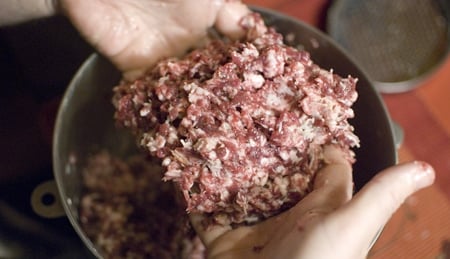
Photo by Holly A. Heyser

You follow that up by forming the meatballs with equal finesse. Use your palms, not your fingers. North African meatballs are made with your fingers (as is their couscous, but that is another post.), Italian ones with the palms. You want a nice round ball that just barely holds together.

After that you want to roll them in flour or bread crumbs. I like bread crumbs because they add some texture to the meatball. These meatballs will deform as you roll them in the crumbs. No worry, just reshape and place on a cookie sheet that has a piece of wax or parchment paper set on it.

To me it is pretty obvious, but there are actually a lot of meatball recipes out there where you don’t fry the meatballs before finishing them in sauce. This is blasphemy in the part of New Jersey I grew up in. And when I say “fry” I mean fry, not saute. Meatballs and spaghetti is a dish designed to show off — really — as newly “wealthy” Italian immigrants found they could serve expensive meatballs and “expensive” factory-made pasta all the time. Much of Old Italy was so poor that these were festival ingredients, not weekly commonplaces.
This means you need lots and lots of oil to properly fry your meatballs. Can you saute them? Yes, but they will massively deform and probably develop burnt spots. Meatballs made with my method require the buoyancy of hot fat. Besides, you can reuse the fat for the rest of the week after straining it.

frying duck meatballs

Photo by Holly A. Heyser

Again here, perfect meatballs require a bit of technique. The amount of oil should come up to exactly half the meatball — when they are all in the pan. Y’all remember Archimedes and his bathtub, yes? That means start with about 1/4 inch and get that hot, then add more oil little by little until it is at the halfway point. This keeps the oil hot and prevents the “Saturn’s Ring” of un-fried, or double-fried, sections in the middle of the meatball. It’s an aesthetic thing.

Oh, and flip the meatballs only once, after about 5 minutes.
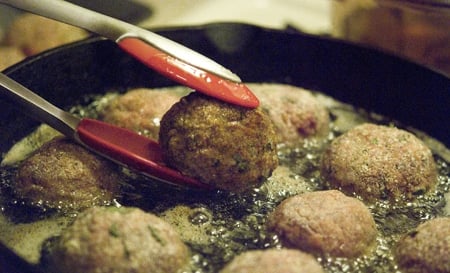
Photo by Holly A. Heyser

Once they are done, remove to a rack to drain. This is better than simply putting them on a paper towel, although that’s fine, too.
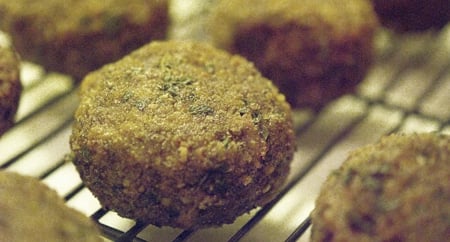
wild duck meatball

Photo by Holly A. Heyser

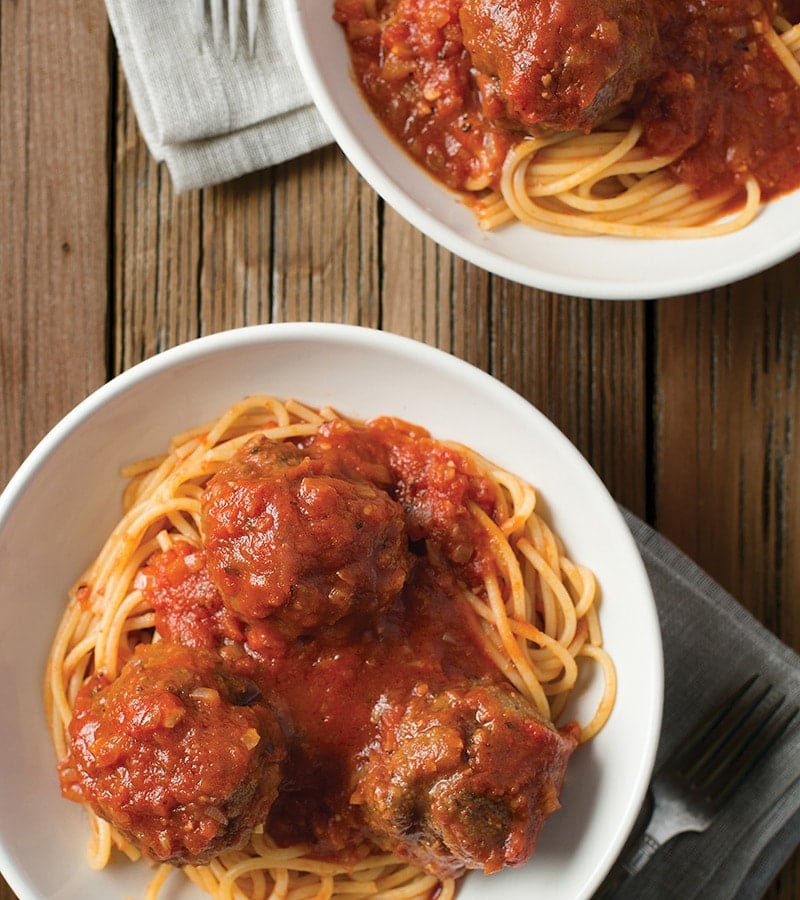
You now have perfect meatballs, which need only to be finished in your favorite sauce. A classic tomato sauce is great, but Holly and I had eaten leftovers from Tom and Ani’s visit for days, so I decided on another recipe from Hazan’s Essentials, meatballs with stewed cabbage.
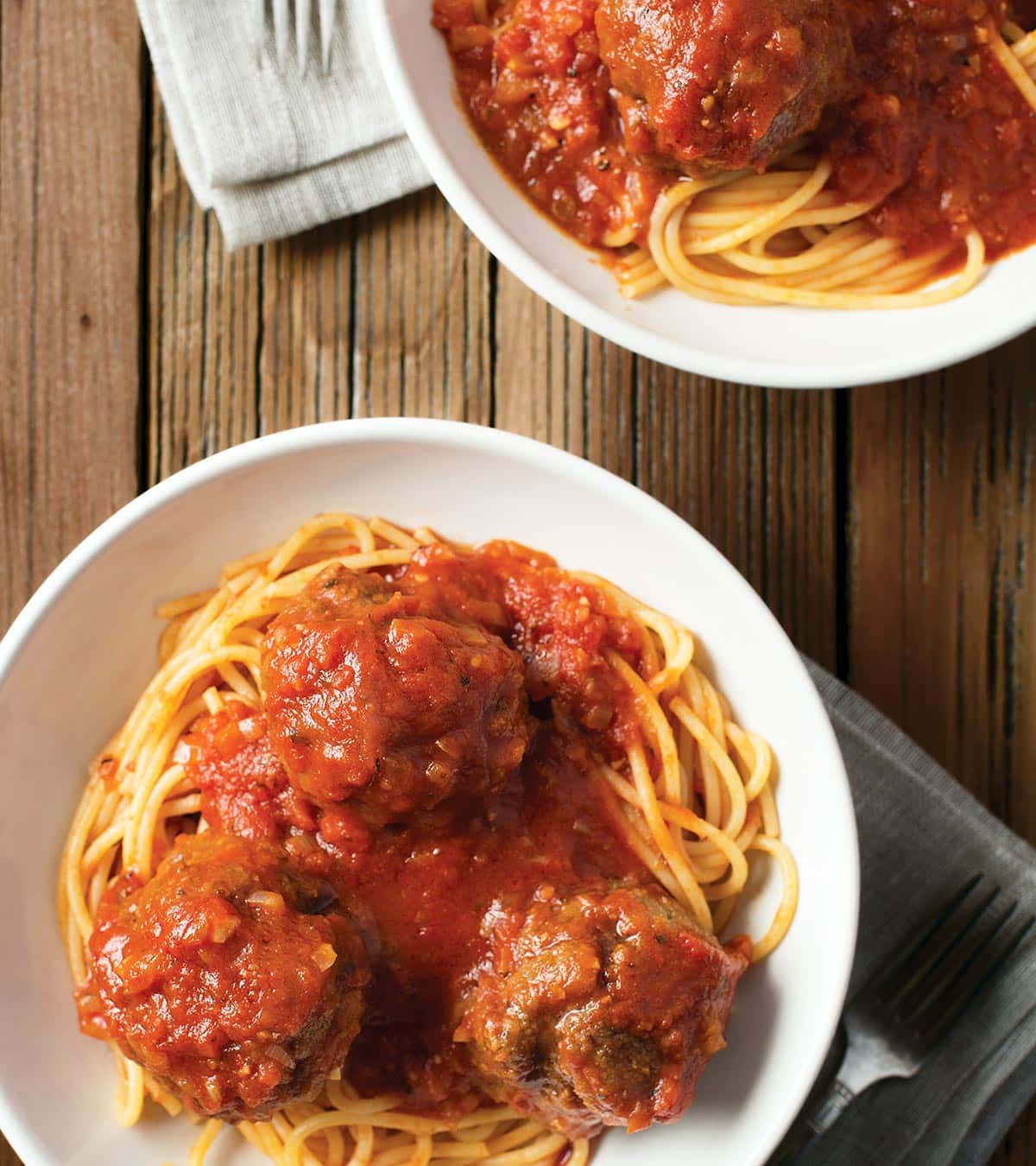
Basically you slice and stew savoy cabbage with some garlic and oil taken from the meatball frying pan until it is soft and slightly nutty tasting. For all you cabbage-haters out there, and I know there are a lot of them, try this dish. It is not “cabbagey” at all, and the little bit of tomato sweetens things up and gives you a taste link to that familiar red sauce your mind wants with meatballs.

wild duck meatballs with stewed cabbage

Photo by Holly A. Heyser

I know some of you are thinking, “so what about those garbage ducks?” What about them? Could we taste that these were waterfowl, and not beef? Yes we could, because I cannot remove every trace of fat from the duck and goose meat. But were they fishy? Not in the slightest. These meatballs were pretty much as I’ve made, off and on, since I was taught this method by the Italians I knew back home: Light, large, meaty, slightly herby and so good you find yourself eating so many you regret it an hour later.

That’s what the grappa is for.

___________________

DUCK or GOOSE MEATBALLS

This is a great recipe for ”garbage ducks” that may have off flavors if you ate them roasted simply. I’m talking about sea ducks, some diver ducks, most spoonies as well as Ross’ and snow geese. Hell, Canada geese can often be sketchy tasting. And who doesn’t love meatballs? They are a classic comfort food and easy to make.

For you non-hunters, you can easily substitute domestic duck or goose, or just make these meatballs the traditional way — with a combination of beef and pork. NOTE: If you do this, omit the pork fat, as it will already be mixed into the pre-ground meats.

Makes between 18-22 large meatballs.

Prep Time: 60 minutes

Cook Time: 25 minutes

  • 2 1/2 pounds duck meat, skinned
  • 1 pound pork fat 
  • 2/3 cup milk 
  • 3 slices of good but stale bread, crusts removed 
  • 2 eggs 
  • 1 tablespoon Kosher salt 
  • 1 tablespoon black pepper 
  • 1 teaspoon fennel seeds 
  • 1 teaspoon dried thyme 
  • 2 cloves garlic, finely minced 
  • 4 tablespoons grated cheese (pecorino or parmigiano) 
  • 1 1/2 cups bread crumbs 
  • Vegetable oil for frying

  1. Chill the duck meat and pork fat until it is almost freezing by sticking it in the freezer for an hour.
  2. Cut both the meat and fat into 1/2 inch chunks.
  3. Grind through your fine die in a meat grinder. If you do not have a meat grinder, you can use a food processor, set on pulse. Don’t crowd the processor and chop the meat in pulses until you get something that looks like ground meat — it will not be as good as with a grinder, but it is easier than hand-mincing everything, which is also an option. Put the meat in the fridge.
  4. Pour the milk into a pot and set it on low heat.
  5. Cut the crusts off the stale bread and break it into pieces. Add it to the pot. It will begin to absorb the milk. When it does, turn off the heat and mash everything into a paste. Let it cool to room temperature.
  6. In the meat bowl, add the salt and spices and herbs, as well as the cheese. Crack the eggs into the bowl, then pour the bread-milk mixture in.
  7. With clean hands, gently mix everything together. Do not knead it like bread, and do not squeeze things together. Just gently work the mixture — think cake, not bread.
  8. When it is mostly combined — you need not get everything perfect — grab a palm-full and roll it into a ball with your palms, not your fingers. You want meatballs about 1 to 1 1/2 inches across.
  9. Gently roll the meatballs in the bread crumbs. You may need to re-shape them before putting them onto a cookie sheet lined with wax or parchment paper.
  10. When the meatballs are all made, get a large pan ready; I use a big, old cast-iron frying pan. Fill it with about 1/4 inch of oil. I use a combination of canola and olive oil. Bring it up to temperature over medium-high heat. When a drop of water splashed in the oil immediately sizzles away, drop the heat to medium and add the meatballs. Do not crowd them.
  11. You want the oil to come up halfway on the meatballs. Add a little oil if need be; don’t worry, you can reuse the oil. Fry on medium heat for 4-6 minutes. You are looking for golden brown.
  12. Turn only once. The other side will need 3-5 minutes.
  13. When cooked, set the meatballs on a paper towel or wire rack to drain. They can be used right away or cooled and then refrigerated for a week, or frozen for several months.
  14. How to serve? In a standard red sauce — you could try my ducky tomato sauce – or as I did above, with stewed savoy cabbage and tomatoes, or any old way you want. Red wine is a must, though.

More Duck and Goose Recipes

Tags: , , ,
Print This Post

________________


Subscribe to comments for this post

20 comments
Leave a comment »

  1. Call me crazy, but I always use the coarse grind, and my meatballs stay together just fine. I deviate again by baking my meatballs because I hate cleaning aerisolized grease from every nook and cranny of my kitchen (spatter screens never work). Also, a 1/4 cup-sized ice cream scoop works pretty great for forming the balls. A little neater, a little less worked, and perfectly consistent. That’s my $0.02.

    I hanker for some duck meatballs. Those, I can’t just go to the store for. I guess I could pick up some cheap duck from the Chinese market. Hmmm.

  2. Heather, in the Hunter Angler Gardener Cook household, we consider aerosolized grease a home decor accent. And as long as I don’t get fat or develop high cholesterol, I’ll embrace it – because it means the food is SO GOOD!

  3. Bless your heart for going the stale bread route. I’ve always done it with water and not milk (Gramma Crucitti was Old-World on that, where milk was a little too precious). I’ve never coated with breadcrumbs before frying, however.

    Also, my grandmother brought over her meatball recipe from Calabria, so can you point me to where you learned that was an American creation?

  4. It is wonderful that even for the muddy duck there is a purpose on the platter… good for you. Using pork fat is a great idea if the bird’s fat isn’t sufficient or ill-flavored.
    Informative post. Waste not , want not and get great meatbballs!!!

  5. Great food! We like Marcella’s sausage with cabbage and her chicken with cabbage – delicious.
    Belated compliments on the new site design. It’s bold & clear, befitting the subject! And I really like the access to the recipes.

  6. Thanks, Hank.

    Part-Italian though I am (and full-Italian though my wife is), I’m really looking forward to trying that Greek Venison Meatball recipe, too. There are pounds and pounds of venison in the freezer, just waiting for such fine treatment.

  7. This sounds good. I have some goose legs I need to use. This’ll be a great use for them. Unless we are really planning on roasting a whole goose, we breast them and save the legs for pot pie and such.

  8. Heather: I’ve made meatballs with the coarse grind and while they will stick together, the texture is not as nice, at least to me. As for baking, it is lower in fat and easier to clean up but if you use Alton Brown’s mini muffin method I often get the bottom of the meatball cooking in a pool of rendered fat. I do agree, though, the ice cream scooper does work well.

    Jennifer: Polpettine as such are indeed Italian, but Italian meatballs are generally smaller and are not typically served with pasta. They are their own thing. Pasta and red sauce is Italian, meatballs are Italian, but jamming the two on a plate is Italian American. There is actually all kinds of scholarship on how Italian immigrants to the US changed their food — and then influenced the food back home.

    Deanna: Pork fat cures a multitude of sins…

    Tovar: You can use venison for this recipe no problem.

    Russell: It is a lot easier to use duck or goose breasts in this recipe, but you can definitely use leg meat, too.

  9. LOVE the attention to detail here. that is really what sets your blog and cooking apart from the rest out there.

    Totally agree about lean meatballs sucking, and those “100% meat” ones too. I agree there needs to be some bread in there.

    I am rather addicted to the meatballs from the A16 cookbook of late – course no duck in there though

  10. Made these tonight with some Canada goose legs we had in the freezer and trimmings from a pork roast we had. They were great. I baked them in tomato sauce instead of frying and they turned out fine. Great recipe! Thanks.

  11. I need to stop reading food blogs before lunch. Now I want spaghetti and meatballs, and I can’t hoof it to Boston’s North End and back to campus in time for my afternoon class.

    I could, however, go to my butcher in the North End when class is over, and make meatballs for dinner… Hmm.

  12. With you on the fine grind for good mouth feel and cohesiveness.

    Of the other “texture softeners” used in Italy for meatballs (butter, mashed potato, dampened bread) my favourite is ricotta.

    And another trick I have, taught me by a cooking class student from Singapore, is to pick up and throw down the meatball mixture over and over – lightens the texture he said, and I believe it does, or even if it doesn’t, it’s a lot of fun!

  13. Oh and PS, I have the original – I believe – Italian spaghetti (alla chitarra) with meatballs recipe up on Pasta Channel here

  14. Hank –

    Looks like I’ll have to go after some more hard-to-ever-do-right ruddy ducks in the SF Bay next year to try this recipe.

    As we’re grinding meats that potentially can tear up a blade with shot: what’s your best technique for making sure you birds are shot free?

    Cheers,
    Cork

  15. Hank,

    Finally, I have a second option for spoonies. The cheapo spoonie breakfast sausage I make is getting kinda old. Thanks.

  16. Matt: A lot of people have mentioned the A16 book. I need to get it, as Chef Nate Appleman is a friend of a friend…

    Russell: Sounds like a good use for Canada legs. Confit would be good, too.

    Carmelita: I like using ricotto as well. Thought about doing it for this recipe, but I had stale bread in the kitchen and not ricotta, so you know how it goes.

    Cork: I’ve only gotten shot in the grinder once. I typically use breast meat for grinding, and once you cube the meat it is pretty easy to see if there is shot inside.

    Duke: Reminds me – I need to write down a recipe for a wild game breakfast sausage…

  17. I wonder if I can connect you to another website http://www.rainbowcooking.co.nz They have a different take on meat balls in Frikadelle (meat balls) in tomato, wine and onion sauce. The site is nothing to do with me, except I am a Brit, married to a Kiwi and have SA friends – so blending traditions is useful!

  18. [...] Made the best meatballs I’ve ever had – though I owe the recipe to Hank Shaw’s Trash Duck Meatball. [...]

  19. I can’t believe how easy this looks! I’m excited to try it with deer meat.. my husband just got back from hunting and we are loaded up with deer meat. I was looking for some interesting recipes and this definitely fits the mold. YUM!
    -Sylvia

  20. What a fabulous meat ball recipe! I’ll whisper my secret meatball ingredient: Replace half the milk with sour cream trust me you will be amazed.

Leave Comment

*