Acorn Cake and Acorns Around the World

January 03, 2010 | Updated May 19, 2020
As an Amazon Associate I earn from qualifying purchases.
One of the first questions I had as I began researching acorns years ago was what do other groups do with them? The literature is dominated by roughly hewn recipes from either various American Indian groups or hippies. Neither, quite frankly, are recipes I am overly jazzed about.
Oaks live all over the world, from Asia to North Africa to Europe to North America. And where there are acorns, people have eaten them. They have their own methods, too.
Turns out the acorn-eatingest people in the world right now are the Koreans. If you go to a good Asian market, there is a good chance you will find acorn flour and acorn noodles, which look just like soba noodles. From what I can tell the noodles are eaten in the same way soba noodles are; and yes, they also appear to a lesser extent in Japanese cuisine.
Any Korean food experts out there? My question is whether acorn flour and noodles are considered low-class or poor people’s food. Because that is their stigma everywhere else in the world, best I can tell.
This is interesting. A certain set of scholars think that sometime around 10,000 years ago, humans — who ate acorns with aplomb at the time — grew in population to the point where they were overeating them and threatening the oaks. Great big oaks that gave sweet acorns would be in demand and might even be fought over, as the Indians did in parts of California.
So with too few acorns and a burgeoning population, the scholars theorize that the people looked to wild grains as a secondary source of vital carbohydrates. And carbs are key to a hunter-gathering society; remember the Forager’s Dilemma?
Turned out these wild grains — emmer wheat, spelt, barley and rye — domesticate easily, are annuals so can be planted anywhere if your tribal group moves around, and give easily collectible seed that is lighter than a big ole’ bag of acorns, which have a pretty long lag time from acorn to acorn-bearing oak. And good luck moving a giant oak when invaders arrive, but you can flee with some barley seed and plant again next spring.
Acorns, which are, for the most part, bitter and need to be water-leached at least once or twice to be palatable, fell by the wayside. Acorns also lack gluten, which is vital in making bread items stick together. Wheat, barley and rye all have at least a little gluten. So acorns, and in Europe chestnuts, which have a similar consistency, fell to the status of emergency or famine foods. A fixation with whitened wheat flour furthered this. Black bread was for peasants, and acorn cooks up dark. It’s the sugars in them.
Consequently, you need to search far and wide for acorn recipes in European circles. North African Berbers do use them, however. I corresponded with Paula Wolfert, who wrote the great Couscous and Other Good Food from Morocco, which is the sine qua non of Moroccan cookbooks. Wolfert told me that Berbers will sometimes make couscous from acorn flour. Fascinating. I have heard that Italians will make acorn flour pasta, too. I developed my own recipe for acorn flour pasta here.
Another source on Moroccan food tells me they also roast and salt acorns and serve them like roasted chestnuts. Linda Berzok, who wrote American Indian Food, says that the Indians around Tuscon, Arizona, sell roasted acorns from the Emory Oak, which are so sweet they don’t need leaching. An expert on Mexican food says in Chihuahua they do the same thing; makes sense, as the Emory Oak lives there, too.
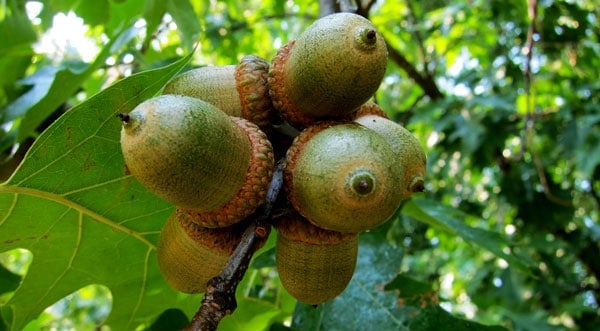
Back in Europe, acorns from the cork oak are pretty sweet, and those that the famed jamon iberico pigs eat, the bellotas, reputedly need no leaching. Janet from The Old Foodie sent me a recipe for acorn bread from an English book written in 1802 that is a little like the acorn flatbreads I made last week, although with no wheat flour. These English acorn cakes are more like acorn meal hamburger patties cooked in embers.
In Europe, the thread running through most acorn and chestnut cookery is that they are fillers when wheat flour is scarce. Considering the reverence many groups have for wheat it’s pretty easy to see why anything they need to fill out a bread recipe would be seen as an adulteration, not an enhancement.
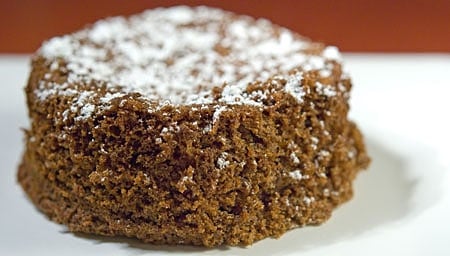
There is one European food that uses acorns that isn’t stigmatized: It’s an acorn cake. The Italians make a chestnut flour cake called castagnaccio, but it contains no leaveners. I imagine it’s like a hockey puck. So I Frenchified it and added beaten egg whites, baking powder and baking soda. I baked it in little ramekins and topped it with powdered sugar.
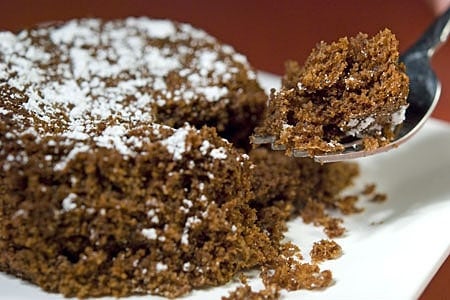
Now I am not a cake maker. The cake itself was really crumbly — too crumbly for my taste. But the taste of the cake was amazing! It was a dead ringer for a gingerbread cake, only there was no gingerbread spices in it at all! I was shocked. All that’s in it is acorn flour, eggs, honey, olive oil, sugar and a pinch of salt. How did it get to be like gingerbread? Must be the acorns.
Acorn or Chestnut Flour Cake
Ingredients
- ½ cup olive oil
- 1/2 cup acorn or chestnut flour
- 1/2 cup cake flour or all-purpose wheat flour
- ¼ cup toasted and chopped pine nuts (optional)
- ½ teaspoon baking powder
- ½ teaspoon baking soda
- 1/4 teaspoon salt
- 3 separated eggs
- ½ cup honey
- ¼ cup sugar
- Confectioner’s sugar for dusting
- Butter for greasing pans
Instructions
- Grease the springform pan or ramekins. Preheat oven to 350°F.
- Mix the acorn flour, wheat flour, baking soda and powder and salt in a bowl. In the bowl of a stand mixer, or in another large bowl, beat the egg yolks, oil, honey and 2 tablespoons of sugar together until it looks like caramel. Mix in the dry ingredients.
- In another bowl, add the egg whites and just a pinch of salt and beat into soft peaks. Add the remaining sugar and beat a bit more, so the whites are reaching the firm peak stage.
- Fold this into the dough a little at a time gently. Pour, or really gently place, the dough into the ramekins (remember they will rise!) or the springform pan. Using a rubber spatula flatten out the top and place in the oven as fast as you can.
- Bake for about 30 minutes. After 20 minutes, watch for burning, as acorn flour browns faster than chestnut flour. Remove from the oven, let rest 5 minutes, then turn out onto a rack to cool.
- When they have cooled for a good 15-20 minutes or so, dust with the confectioner’s sugar.
Nutrition
Nutrition information is automatically calculated, so should only be used as an approximation.



I made this recipe and it turned out good. Thank you for sharing. I’m really curious to know why it tastes a bit like gingerbread!
Did you use dried acorn flour? I used acorn flour that was still slightly damp and the cake didn’t seem that crumbly. I wonder if that affected it somehow?
Sciuromorpha: Yes, I used fully fried acorn flour. The gingerbread flavor is in part from the spices.
I would like to add that ????/dotori muk/Korean acorn jelly is treated more like mung bean jelly than noodles, but it’s very, very similar. the bounciness of the jelly texture is different from the bouncy texture of noodles; both are wonderful!
I am so happy I stumbled onto this page! It seems like there are some fascinating and vibrant groups of people doing things that I am borderline jealous of! Book clubs and cooking groups and mature reasonable discussion. Well done acorn fans!
I have been sharing simple acorn cookies at a local farmers market to help introduce the taste and concept to more people. It is almost more education than anything else, and I’m glad to see that this page also includes all the things I typically tell people.
Keep up the good work!
Great stuff, as usual. If interested you could check out what Rob Spengler II, a noted archeobotanist has to say regarding the use of acorns between around 6000 to a few hundred years ago in his book, Fruit from the Sands. He cites two extremely important research papers on excavations and analysis of what edible items were found at a specific site in China. Acorns were indeed extremely plentiful, and widely eaten. I’m giving a lecture ( a discussion for people not really deeply into the science sounding stuff on how fermented foods were used throughout the world to help people survive. Although once agriculture become prevalent wild and forged foods were considered poor peoples food until adopted by the wealthy as exotic items, there is a lot of history of fermenting acorns. https://Cultures.Group if anyone wants me info or links to any research studies, peers, etc.
Please consider revising your use of the word “Indian”. You’re clearly not actually referring to Indians (people from India) you’re referring to indigenous or native people of the Americas. Reading this article is extremely cringy because of it, I wouldn’t have read it except a group I’m in is going to be making this cake this week. There’s really no reason to refer to a group of people by an entirely different nationality of people’s name in today’s age. Thank you for your consideration, otherwise I appreciate the knowledge you have collected and shared here.
Cris: Well, every person I talked with for researching this article referred to themselves as Indian. I generally refer to someone as they refer themselves.
To be honest, I am “Native American” and I read the article without any issues at all. Cringy? Perhaps you are too sensitive to the wrong things when surfing the internet. The term “indian” has it’s basis in the early explorers that came here. They were wrong but the term stuck. It is not considered offensive or inappropriate by my people. It was never an offensive moniker to begin with. There are better ones, more correct but there is not a thing wrong with this article or the writers writing.
thanks i will cook and eat with the folsom public library acorns
As a Korean I can tell you, there is zero stigma against eating acorns there. Dotori-muk (savoury “jelly” made with acorn starch) is very popular and ubiquitous, especially in season. Very tasty tossed with some spicy-tangy dressing and lettuce, or over some cold broth and topped with roasted seaweed.
Freddie: It is a European thing then. Thanks for that info!
As a Korean American living in LA, I always buy it from Korean markets. My dad would make hot dotori-guksu from slightly dried muk when we used to live in Korea 30 years ago. He would prepare anchovy broth and kimchi topping before julienning the muk and quickly blanching it. Sort of hand-made noodle, I would say. It was the best late-night munch, especially during the winter.
A very close friend of lower-class people as well, but it was also served to the king on the season as we can find the record from Silok (Annals of Joseon Dynasty).
Great way to use the homemade acorn flour from the “How to Make Acorn Flour” you published!
Hey! I find that, if a cake is too dry or crumbly, adding condensed milk makes it more moist and the cake more… Well, condensed.
Exactly what I was wondering! I hope others who experimented and found a way to make the cake moister and less crumbly will post as well!
I made this last night for my book club group (we read William Bryant Logan’s “Oak: The Frame of Civilization”) and it came out perfect! I did make one small substitution: I replaced the 1/2 c. of honey with 3/8 c. of maple syrup (water content is slightly higher in maple syrup), and I skipped the pinenuts since I didn’t have any on hand. I doubled the recipe and used two 8-inch “easy release” cake pans; baking time was exactly 30 minutes. The cakes rose beautifully and stayed moist inside with a nice crust (thanks to the buttered pan), and the flavor was delicate and nutty. Great recipe–thank you!