
As an Amazon Associate I earn from qualifying purchases.
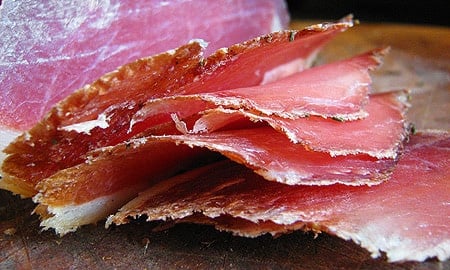
Pork is the lone meat I still buy, in no small part because I have access to heritage pork raised the old way, with a varied diet and generally darker and fattier meat than that crap you get at the supermarket. I do routinely shoot wild hogs, too, and they are excellent for this recipe, Italian lonzino.
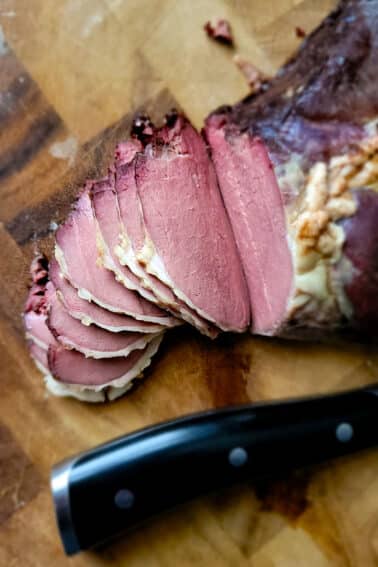
Lonzino is a fabulous dry-cured cut of pork that ages into a lovely pink, slices well and tastes not unlike a good cured ham. The Spanish call this same thing lomo. And if you coat the meat with a certain set of spices, it becomes the Armenian favorite basturma.
You use the loin of the pig for this recipe. Trimmed of all sinew, and, depending on your preference, fat. I prefer my lonzino lean, but some people love the fat v. lean you get with each bite. Either way works.
The coolest thing about lonzino is how easy and relatively quickly you can make it. Unlike prosciutto, which takes more than a year, lonzino can be ready in a month.
The only special equipment you need is curing salt and a cool place to hang your loins. You can get curing salt, Instacure No. 2 online, and your hanging place can be anywhere that isn’t bone dry (70 to 80 percent humidity is good) and is anywhere from 40°F to 60°F.
And like I mentioned at the beginning of this, you also need good pork. Lonzino highlights the innate qualities in your pork, so if it is factory-farmed you will very definitely notice – especially if it is put up next to a piece of quality pork. So do youself a favor and buy the good stuff.

Note that the time in the recipe does not include cure time.
A word on salt. You need to weigh your meat in grams and then weigh out 2.5 percent of that weight in sea salt or kosher salt, plus 0.25 percent, that’s one-quarter of one percent, in curing salt No. 2, which contains sodium nitrate. Weigh out an equal amount of sugar to the salt and add that to the mix.
Lonzino, Air Cured Pork Loin
Ingredients
- 1 length of pork loin, about 3 pounds
- kosher salt (see above)
- sugar (see above)
- InstaCure No. 2 (see above)
- 10 grams black pepper
- 5 grams garlic powder
- 5 grams ground cloves
- 10 grams onion powder
- 8 grams dried thyme
Instructions
- Mix all the dry ingredients. Rub them well into the loin, then put the meat into a plastic bag or wrap with plastic wrap. This is to keep it from drying out. Keep the meat refrigerated for a week to 12 days.
- When the meat has firmed up, remove from the wrap, rinse it off and then let it dry on a rack for 2 to 3 hours. I use a portable fan set on low to oscillate over the meat.
- Truss the meat with kitchen twine (the white stuff) as you would a roast. Leave a long loop at one end so you can hang the meat. You can also use pre-made sausage netting.
- Hang the meat in a cool place to dry. It needs to be humid, about 70 percent humidity. How long? At least another 12 days. It should feel firm throughout and be a pleasing red. How long can you hang it? Up to six months or more, but it will become harder and drier the longer it hangs. If you've found you have dried it too much, let it go all the way to hard-as-a-rock stage. Then use a microplane grater to grate the dried meat over pasta or rice.
- To store: Wrap tightly in butcher paper or, better yet, vacuum seal pieces of it – I cut the loin into three chunks – and freeze. Unfrozen, it will last indefinitely in the fridge, but it will continue to dry out.
Notes
Nutrition information is automatically calculated, so should only be used as an approximation.






Would elk eye of round work here?
Ron: yes.
About to start the drying process. I have conditioned wine rooms that maintain humidity level at 50 to 55% and 55°. Is that OK to age for the entire time or is the humidity level too low to begin with?
Ron: It’s too low for the first week or so, but you can hang there, and spritz the meat with water once or twice a day in that beginning period.
Hello, thank you for sharing all this great content.
I am trying to do the Lonzino for the first time.
First 12 days left on ziplocks in my refrigerator and I was expecting to come out a bit firmer than it did. Is it normal? Should I leave it longer?
Second, day 12, I hanged it in my small refrigerator on 50 degrees and could not get humidity lower than 80 degrees. Today day 20 in the process I found a bit of white and green mold and the meat were a bit gooey. Could you share your thoughts on that, hopefully I can still save it.
Thank you.
Hey Hank,
Thank you for all the great instruction. On #4 you say hang it for at least another 12 days, are you saying that after the 2nd round of hanging we can eat it after 12 days?
Frank: You can, but it benefits from drying a lot longer than that. I normally hang them at least 6 weeks.
Hello Hank. Just want to let you know, my pork loin turned out excellent, with your recipe. For my 1st attempt, this was great! Now l’m currently developing a curing chamber to continue this delicious hobby!
Thanks
Hello. This is my 1st try doing a pork loin. Using your recipe. l’m not sure if l already made a mistake. l put all spices on the loin. But then wrapped it in cellophane wrap and then put it in a ziplock bag. So basically wrapped it in plastic TWICE. Its been in the fridge 5 days. While massaging it, looks like the cellophane wrap is leaking juices out from the meat and into the ziplock bag. So do you think this a problem?
Hoping for a reply,
Thank you.
Michael: Sorry for the late reply. But you should be fine. I’d change the plastic wrap to drain the juices.
Thanks for your reply Hank
Could this be done with a lamb loin?
Jess: Yes, it can.
Hey Hank,
When using wild pig for this should I be concerned about trichinosis? Does curing effectively kill it?
Donnie: I typically use thawed meat, as the freezing kills it. But the high salt content of this cure renders the parasites inert, too.
after cure and 3 weeks of dry time in a controlled atmosphere the loins have gained weight this past week. I measure every 4-5 days. Not a lot but 1-2 ounces each of the loins that started at 3 pound weight. first 2 weeks they dropped around 30% of their weight. Is this an anomaly or normal?
How much air movement is needed when curing meat?
I read this part, so I used 2.75 percent of the weight in sugar. Is that correct or was I supposed to equal the curing salt #2?
“A word on salt. You need to weigh your meat in grams and then weigh out 2.5 percent of that weight in sea salt or kosher salt, plus 0.25 percent, that’s one-quarter of one percent, in curing salt No. 2, which contains sodium nitrate. Weigh out an equal amount of sugar to the salt and add that to the mix.”
Just quick 2 cents. Curing salts are optional for whole muscles. You can cure it in your regular fridge with dry curing wrap. Most charcuterie products are ready to eat when they loose 35% of moisture by weight.
Thanks
MR
You say that using these sheets in the regular refrigerator is fine. Does the humidity level not matter? It seems like the humidity level in my fridge stays about 50 to 55%.
Thanks a bunch!
Can I vacuum seal during the initial cure stage before I hang it? And I’m guessing a beef bung is not compulsory? Would you recommend it, though?
Nilsson: Yes, you can vac seal it in that initial step. It’s a good idea. And I don’t love the beef bung “casing” Too often air pockets get in there and you can’t see of anything is going wrong as you hang the meat. I prefer to truss it.
hey hank quick question, Ive raised my own heritage pigs for years and as i have done a lot of dry cured sausage I have not done a larger whole piece yet. Have you ever used the tenderloin? Tenderloin often sits in my freezer the longest cause it lacks some of the great flavor you find in cuts like the coppa. would it be worth trying ro dry it? to small of a piece?
Robert: I think it’s too small. I normally eat it first thing, too.
I have a dry aging fridge set to 3 degrees celcius and about 80% humidity
Could i put the loin in there? How would the lower temperature and humidity affect the process?
Would it just take longer?
Thanks again
Made my second loin??? however i m using umi dry bags, works well. Had the white mold going. What do i do to remove it( vinegar?) This is an awsome easy recipe. Thanx
Bill: If the white mold is tight and not fluffy, leave it. If it is fluffy, salty water is the best way to remove it.
Have you ever tried with beef eye of round? The pork I did was crazy good. Even got a vegan to try it.
Chris: Yes, but that is called bresaola. Similar. https://honest-food.net/bresaola-recipe/
Hank, my conditioned (wine) room is maintained at 59º temperature and swings between 60-70% humidity which is right at both limits you mentioned. Do you foresee any issues or are there any changes you might suggest to your curing time formula in this situation? For instance; would hanging directly in front of the air conditioner fan (which runs 24/7) be better or not? Thank you.
Jim: It should be good, but can you kick the room temp down even a couple degrees? 59F makes me nervous.
Will the meat harden as it cures? Mine seems to be maintaining the texture of the pork loin. Please advise.
Eric: Yes, slowly. It should take maybe 2 months or so.
Is there any reason why I can’t cure the meat on a rack and simply rotate it every so often instead of hanging it? Thanks for any advice!
Justin: Yes. The meat will get rack marks that will not go away, and the places where meat meets rack are spots where mold will develop.
Thanks Hank – I am lazy, but I get it. I can pull all the racks except the top one and hang from there. I do have a nice curing box which I repurposed from a pretty good sized glass chiller that crapped out. I have a fan for circulating the air and keepin the humidty at 70-80% simply by keeping a small dish of water in the fans path…the fan cycles on and off. I monitor it all with a small temp/humidity gauge. Anxious to see how it turns out – the meat is getting later today! Wish me luck!