
As an Amazon Associate I earn from qualifying purchases.
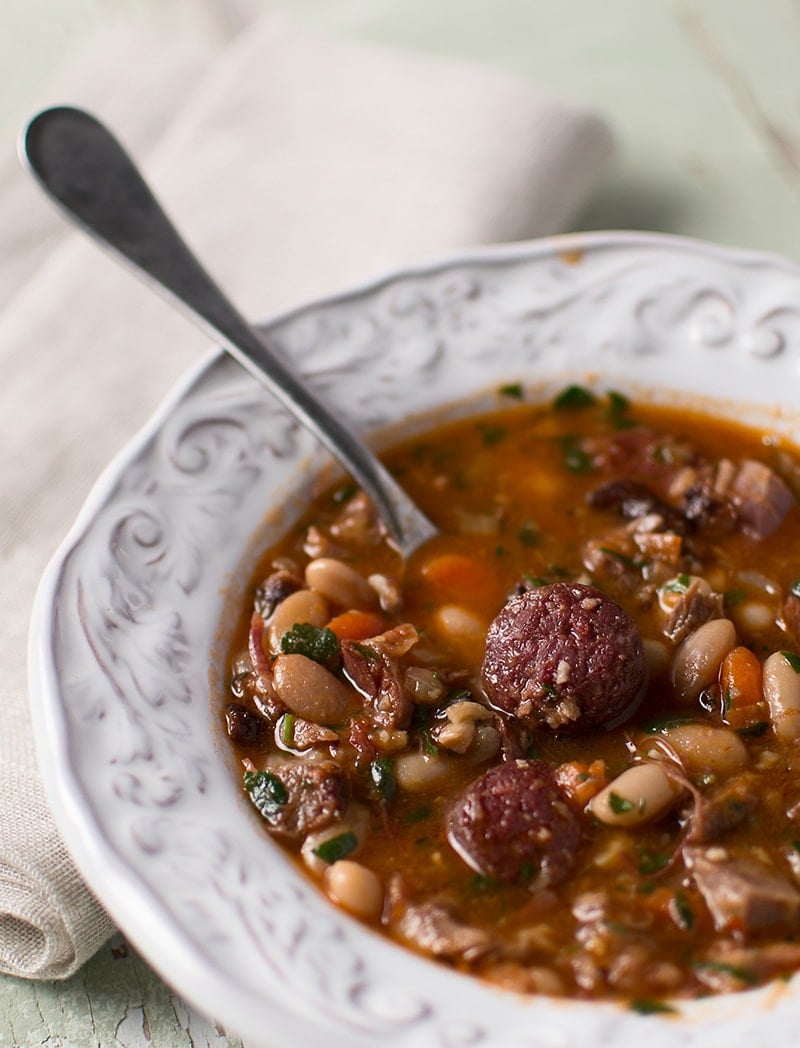
If you search this site, you will find several recipes for various versions of pork and beans, largely because I feel the combination is divinely inspired. Feijoada is a great example of this.
Most people are more familiar with the Brazilian version of this dish, but its origins are in Portugal, which ruled over Brazil for quite some time. The more familiar Brazilian feijoada (fay-zhwahd-duh) uses black beans, where the Portuguese one uses white or kidney beans — although I’ve seen it done here in California’s Central Valley with yellow canario beans.
Fascinatingly, there are versions of feijoada everywhere Portugal once ruled: Chinese Macau, Angola and Mozambique, Timor and Goa, and even Cape Verde. If anyone knows the details of what makes those versions unique, I would love to hear it!
However you make yours, the stew is a perfect cold-weather meal that uses various bits from the pig that most people throw away: feet, tails, ears, shanks, hearts, etc. You can make your feijoada as sporty or as tame as you’d like.
My feijoada recipe is pretty tame, although I really do prefer it with a trotter or two tossed in — it adds a lot of collagen to the soup, which makes it richer and thicker. Besides, you chop up all the meat and fat from the feet before you serve.
I made this version with various bits and bobbles from a wild pig I shot, but there is no reason you couldn’t do this with a domesticated pig. Go Latin or Asian markets to find things like pig’s feet, hearts, livers, fresh ears, etc.
If you can possibly find it, a nice Portuguese red wine is absolutely perfect with this stew.
Portuguese Feijoada
Ingredients
- 2 pounds white beans, Canario yellow beans, or kidney beans
- 1 ham hock or smoked turkey leg
- 2 pounds linguica sausage
- 2 pounds pork shoulder or chopped heart, or shanks, cut into large chunks
- 1 pig's trotter (optional)
- 2 large carrots, sliced into rounds
- 1 large onion, chopped
- 1 head garlic, peeled but otherwise whole
- 1 tablespoon hot sauce or chile paste
- 1 tablespoon ground coriander seed
- 3 bay leaves
- 1/2 cup crushed tomatoes
- Black pepper and chopped parsley to garnish
- Salt
- 2 quarts pork broth or water
Instructions
- Soak beans for at least 8 hours. If you don't have 8 hours, soak repeatedly in the hottest water you can get from the tap, replacing it when it cools. This second method should take about 3 hours.
- In a large pot or Dutch oven, gently brown the pork shoulder in a tablespoon or two of olive oil. Do this in batches and don't crowd the pot. While you are doing this, preheat oven to 300°F. Hack at the trotter with a cleaver or heavy chefs knife to open it up in many places -- this is to let the collagen and fat infuse into the stew.
- When the pork shoulder has browned, remove it for the moment and add the onions. Cook until translucent. Add back the browned pork shoulder, the trotter, ham hock, coriander, bay leaves and a healthy sprinkling of salt, then add the beans and mix it all together.
- Cover by 1 inch with pork broth or water. Ideally you are making this as an adjunct to making stock, such as when you have large pieces of a hog, like, say, a head. The feijoada will be better with pork broth, but don't despair if you don't have any. Use water or vegetable broth. Do not substitute beef or chicken broth. Bring to a simmer and cover. Put in the oven for 90 minutes.
- Remove from oven and test the beans. If they are getting sorta tender, you're good. If they are still rocks, return to the oven for another 20 minutes. If the beans are getting tender, add the carrots, garlic cloves, chile paste and tomatoes. Cover and return to the oven for 30 minutes.
- Check to see how the carrots are doing. The beans should be tender by now. Once the carrots are soft but not falling apart, add the sausage. Pull out the shanks and trotter if you are using them and pull off all the meat and fat, etc. Chop as coarsely as you like and put back in the stew. Return to the oven for 10 minutes.
- Remove and, still covered, leave the pot on top of the stove for up to 20 minutes, although you can serve immediately. Slice the sausages into disks before you serve. Ladle into bowls, garnish with chopped parsley and black pepper, and serve with crusty bread and a lusty Portuguese wine, such as Touriga Nacional.
Nutrition
Nutrition information is automatically calculated, so should only be used as an approximation.
Wild Pig and Bear Recipes
You can find lots of recipes for pork, wild or domestic, right here on Hunter Angler Gardener Cook.
Read More



Hi Hank, I made the Portuguese Feijoada! The taste was simply the out of this world. We loved it. It really went down well. I still have plenty left which I’ll divide up and freeze. Thank you for a great recipe!
Hello Hank,
Should I leave the thick skin on the smoked hock or remove it?
Thank you.
Valerie: Leave it on, then when it’s soft and tender, pull it off, mince it, and return it to the pot.
I love pork and beans in most forms !
I have to smile at the notion that there is a correct (thus) wrong version of this dish! Having lived among the poor in Mozambique, the dish is made with what is currently available and beans, definitely originated with the Portuguese, as Africans are quite accustomed to eating… well just the beans which are delish. So experiment with the beans, I have always eaten it with mixed meats, as in pork and other things, never had the sausage version as you just don’t find sausage in rural Mozambique, and I have to say I have yet to find a version that is not amazingly tasty. On an extra note, meat on the bone does make it better, so if you are “selecting” the meats you will use, the tip about the trotter is a very good one.
I read through the various comments and recipes here. Being raised in Portugal I would say these recipes have been modified to simplify the use of can food instead of fresh vegetables the real recipe is supposed to made of. But to go back to its roots the feijoada is actually made with pig feet, intestine and then the sausages. The meat and blood sausages. Initially the Portuguese used red kidney beans but overtime white beans were also used. Perceived as not as heavy. Because I am married to French Canadian and live in Canada I replaced “Le Cochon de porc” by beef ribs which I boil and then separate from the bone. I use dry beans, carrots, celery, fresh tomatoes, and various fresh herbs for taste. I add Spanish paprika for colour and always start my sauce with chopped onions, garlic, add celery amd tomatoes and let everything slowly boil till tomatoes have turned into a sauce. Then mix the cooked beans, the beef and sausages and add the sauce and let slowly boil till the beans can gain the flavours of all ingredients.
Hello,
Yes, feijoada is made with kidney beans. Period.
White beans are used for the Northern “version” of feijoada, a dish called “dobrada” (comes from ‘dobrar’, to fold), that will use an ususual part the of the offal: the intestines. They are thoroughly autoclaved and used in this dish. And again, it comes from times when people were under siege and had nothing more to eat – so they became inventive! Porto (as you call it “Oporto) dwellers are fiercely proud of their dobrada!!
Marta: OK then on the kidney beans… I don’t much like kidney beans, so I will stick to the white ones. Thanks for that extra information about the dobrada — very interesting!
Tradicional Portuguese feijoada actually has many versions depending on the region. In my family, the tradicional dish is made with red (kidney) beans! Mine is quite tame, and the richness comes from the variety of sausages (smoked) used. We also add a kind o kale that I can only find in Portugal… and sometimes replace with wide leaf kale.
I’m pretty sure the origin of Feijoada is actually from the Africans slavers in Brazil, as they ate what’s considered the bad part of the pork, the Portuguese Lords/ Farmers used to find this dish disgusting, though.
Addie: Nope, it’s from the poor in Portugal, who ate the “bad” parts of the pig back home. The Brazilian version just translates across the Atlantic. Pretty much the same circumstance, just on opposite sides of the ocean.
What is a pig trotter?
Faith: A pig’s foot.
Hello there
Congrats on the site, i am also an angler and hunter, and like to cook what i capture. great recipes.
About the feijoada
The true Portuguese Feijoada is actualy made with red beans, althoug the white beans are also good.
here is the original recipe
1kg red beans, dried and set in water for 8h
2 farinheiras (its a smoked sausage made with wheat flour, pork fat, white wine, paprika, salt and pepper)
1 smoked meat and red wine sausage (chouriço)
1 Portuguese Black Pudding (Morcela)(its also a smoked sausage made with flour, pig blood, and pig fat)
1/2 pig feet salted for 8h
400g pig rib salted for 8h
400 pig belly salted for 8h
300g pig head salted for 8h
1 pig ear salted for 8h
1 diced onion
2 finely choped onions
some salt (by taste)
2 leaves of bay
200ml of olive oil
600g of peeled diced tomato
400g of choped carrots
Boil the beans, all the pig parts, the diced onion, the chouriço and the morcela for 40 mins
remove the meats, the chouriço and the morcela.
remove enoouth liquid to another pan enouth to cover the farinheiras, poke them with a toothpick a few times and boil them for 15 mins
cut the pig in dices
slice the chouriço and morcela
in another pan heat the olive oil, the choped onions and the bay leaves until the onion is light brown
add the tomato and carrots
let it cook for 10 mins
next add the diced pig and mix.
add the beans without the water and mix
add the water used to cook the farinheiras, if needed add also some of the water of the beans
cook for 10 mins or until everything is well cooked
serve with the sliced chouriço, morcela and farinheira on top, and a side of white rice.
🙂 sorry by the metrics and the bad english
lol at the black/white bean comment. White beans certainly make for a more photogenic soup though it kinda looks like minestrone and there’s something to be said about a big bowl of inky deliciousness too (jajangmyun). Whenever I had this with my Brazilian friends we always ate it with rice where the grains were pre-fried and lightly toasted with garlic, onions, and other spices before being cooked. I don’t know if that’s traditional or if this particular group just loved eating rice. I will try it with the trotter. My mom always has a few stashed in the freezer for random cravings.
John: Absolutely.
Peter: I dunno, the Portuguese are pretty thrifty, too. 😉
While the origins of feijoada doubtless were Portuguese, what I was told when I worked in Brasil was that the inclusion of off parts like snouts, ears, hearts etc were the result of slaves getting as much out of the pig as possible while their masters ate all the good parts.
When I first worked there in the 1950’s, Saturday noon was the day of feijoada. The work week was still 5 1/2 days, knocking off at noon Saturday. Everyone would go home and sit down to a giant feijoada, probably accompanied by plenty of caipierinhas and Brahma or Antarctica beer, and the rest of Saturday would be spent in a hammock
This dish is about to make is way down to South Louisiana. This sounds perfect as a dish for this area of the world!
“Divinely inspired”? Not if you grew up in darkest Indiana where the words “beany-weenie” were as terrifying as Stokley-Van Camp! Fortunately I moved to England with regular business trips to Portugal, Brasil and France.
When I settled here I learned a wise man’s maxim that “Feijoada was God’s first attempt at Cassoulet”! Now that is Divine Inspiration.
Ward Horack
Yes, yes, and yes. I completely agree with “divinely inspired”. I’m pretty sure there is a version of pork and beans on my death row meal menu.
Hank,
Could I replace the trotter with a halved pig head?