
As an Amazon Associate I earn from qualifying purchases.
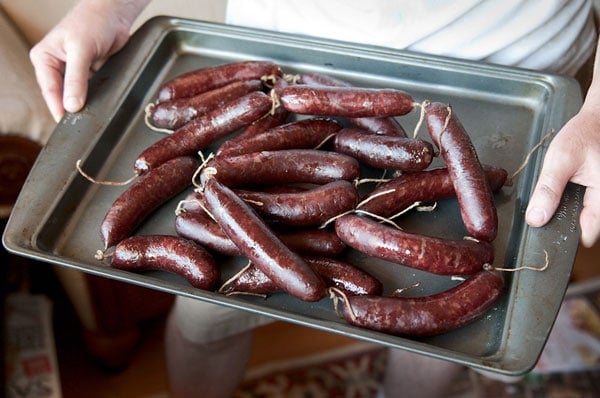
Landjaeger. Such a cool name, eh? It’s a German dry-cured sausage that is made small enough to fit into your coat pocket on a cold day hiking, fishing — or hunting. Thus the name.
Traditionally made with beef and pork, my landjaeger is made with venison and pork fat. You could use any red meat — goat, lamb, elk, etc.
This is not a beginner’s sausage. It requires a few advanced sausage-making skills and some equipment. If you’ve never made dry-cured salami before, I’d suggest starting with something a little easier, like my basic salami instead.
And if you’ve never made any sausages before, stop. Make a few batches, using my tutorial on Simply Recipes, and then come back to this recipe.
You will need a few things before you even start:
- Curing salt No. 2, and a special bacterial starter that ensures the good bugs beat the bad ones.
- A humidifier, or a place where the humidity is over 85 percent.
- A place to hang your sausages in this humid environment.
- A place to hang your sausages after the initial ferment, preferably a place with humidity about 80 percent and about 55 degrees.
- A smoker. Landjaeger is lightly smoked before it hangs to dry.

The details on how to make your landjaeger are below, but so far as dry cured sausages go, this one is pretty easy, as it comes together in weeks, not months. Two other recipes with short hang times are stångkorv, a Swedish breakfast sausage, and kabanos, a smoked Polish meat stick. Once the landjaeger is made, it will keep in the fridge for weeks, and indefinitely in the freezer.
At room temperature, it will keep a few days, but I’ve had them out in the field in cold hunting weather for many days and they were fine.
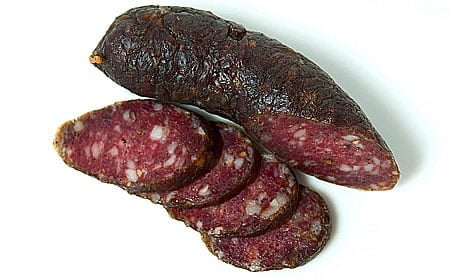
Venison Landjaeger
Ingredients
- 3 pounds venison
- 2 pounds fatty pork shoulder or pork belly
- 51 grams (about 3 tablespoons) kosher salt
- 15 grams (a scant 2 tablespoons) sugar or dextrose
- 6 grams (about a teaspoon) Instacure No. 2
- 1 teaspoon garlic powder
- 1 teaspoon caraway seed
- 1 teaspoon ground coriander seed
- 2 tablespoons ground black pepper
- 2 teaspoons ground allspice
- 1/2 teaspoon celery seed
- 5 grams (about 1 tablespoon) starter culture T-SPX
- 2/3 cup distilled water
Instructions
- Cut the fat and meat into chunks that will fit into your grinder. Trim as much sinew and silverskin as you can. Mix the salt and Instacure with the meat and fat and put it in the fridge overnight. If you have a grinder with a very large die, like 10 mm, grind it first and then set it in the fridge. If you only have the standard "coarse" die, which is normally 6 mm, just put the meat and fat as-is in the fridge Doing this helps develop myosin, which will give you a tighter bind when you stuff the links later.
- The next day, put the fat and your grinding equipment — blade, coarse and fine die, etc — in the freezer. Mix the spices into the meat. Put the meat mixture in the freezer, too. Let everything chill down until the meat hits about 28°F or so. It won’t freeze solid because of the salt. Normally this takes about 90 minutes. While you’re waiting, soak about 15 feet of hog casings in a bowl of warm water.
- When the meat and fat are cold, grind through the coarse die of the grinder, the 6 mm die. If the meat is 35°F or colder, go ahead and grind half of it one more time through the fine die, which is normally 4.5 mm. If it's too warm, freeze until it hits 35°F and then grind it.
- Regardless, once it has been ground, put the meat and fat back in the freezer while you clean up. Dissolve the starter culture in with the distilled water. Let this sit at least 15 minutes.
- When the meat mixture is back below 35°F, you can mix it. I put the mixture into a big plastic bin with the starter culture mixture and mix it by hand for about 2 minutes. If you do this, you’ll know the mixture’s cold enough if your hands ache from the chill. Or, you can put everything into a big stand mixer and mix on low for 90 seconds to 2 minutes. I prefer to mix by hand.
- Put the sausage in the fridge while you clean up. Run some clean water through your casings to flush them and to see if you have any leaks.
- Pack the sausage into your stuffer and get ready to make the salami. Leave 4 to 6 inches of casing hanging from the edge of the stuffer as a “tail;” you’ll use this to tie off the salami in a bit. Start working the meat into the casing, using your fingers to flush any air out of the casing and to regulate the flow. Do a whole coil before you make links.
- Tie off links of about 6 to 8 inches with kitchen twine. Now gently rotate the links to compress the meat within each casing, watching for air bubbles. Heat a needle or a sausage pricker in the flames of your stove to sterilize it, and prick the links to let any trapped air out. Hang your sausages from “S” hooks or somesuch on a wooden rack. Let them hang at room temperature for an hour or two.
- Now you need to ferment the sausage. You will want to tent the hanging sausages with black plastic from some garbage bags, or some other plastic sheeting. If you have one, put a humidifier under the sausages. You really want them to stay moist. Let the sausages hang for at least 24 hours, and up to 48 hours. Every few hours, spritz them with a spray mister to keep them moist. This is the fermentation stage, the stage where the starter culture you are using defeats any bad bacteria in the sausage.
- When the sausages are ready, fire up the smoker. Put ice cubes in the water tray to keep the temperature as cool as possible. You are not cooking the links here, you are giving them a good smoking. Use oak, hickory, any fruit or nut wood. Avoid mesquite, as it is too distinctive. And no pine -- too much resin. Smoke the links for 2 to 3 hours, making sure the temperature stays cool. If the smoker got beyond 125°F, douse the links in an ice water bath to stop any cooking. Pat them dry.
- Now you need to hang them in your drying chamber. I use an old fridge with a temperature regulator and a humidifier in it. Hang the links at about 80 percent humidity for a week or two before eating. Store in the fridge, or vacuum sealed in the freezer.
Notes
Nutrition
Nutrition information is automatically calculated, so should only be used as an approximation.






If using #1 cure wouldn’t it need to be cooked to 150 degrees?
Jason: No.
Can i ferment the meat before stuffing, say covered with plastic at desired fermenting temp. for F-RM-52 culture?
Mark: Technically yes, but once it has fermented it firms to the point where it won’t stuff into casings well at all, so I do no recommend it.
Is it okay to use F-LC SafePro starter culture?
Dave: Yes, but you will get a tangier sausage. Not a bad thing, just different.
I love landjaeger, but I’ve gone vegan recently. I’m hoping to find a way to make a legit-as-possible landjaeger using something like Beyond Meat (ground beef, or their brat sausage links) for the meat.
Throwing some links on a smoker is easy. But I’m hoping to replicate a denser / half-hardened cured meat texture.
Any recommendations on how to approach such a thing?
I was literally reading this article on similar hopes, so I’ll send on it tomorrow. Texture wise compared to cured/smoked meat I’m thinking tamales, bean paste w chip and olive oil in a smoker. (Play w humidity and Type of wood chips). Does this sound crazy? Sure does, but I’m now super set on this impossible imposing idea ???
I’m planning to give this a go next weekend using duck meat. I plan to follow the variation on this recipe in Duck, Duck, Goose. However, as a fermented sausage noob, its unclear why the recipe calls
for Insta-Cure #1. Given the aging time of 2-4 weeks, seems #2 is more appropriate.
Can Hank or anyone on here advise?
Chris: This one is indeed a leaner. 2 weeks is still in cure no. 1 territory, longer is cure no. 2. If you have both, I’d gauge it off the width of your casings. If they are narrow, go with no. 1 and dry 2 weeks. If they are wide, go with no. 2 and hang longer.
Much obliged Hank! Supplies for a few 5 lb. batches just arrived today. I plan to use narrower sheep casings (~20mm average) on my first attempt, so Instacure #1 it is. Can’t wait to grind and stuff and try to press these little guys!
So, a quick report back. Duck landjaeger in sheep casings were done in 12 days of curimg/aging at 50°F 80% humidity.
This is my first attempt at fermented sausage and they have the tangy flavor and soft center texture I was hoping for. Already have another batch smoked up and in the chamber.
Worth noting that the sheep casings dry down to more of a snack stick, but who cares – they are delicious!
Thanks for the recipe and guidance Hank!
Just finished a batch of these and they’re terrific. Great smokey, peppery flavour. Followed the recipe exactly, although venison is a bit hard to find in Australia so I replaced it with kangaroo. I guess that makes mine ‘Land-down-under-jaeger’. Thanks.
Has anyone added chopped garlic to the recipe? If so how was it
Emil: Yes, I have. It’s good. Maybe mince a few cloves in on your next batch.
In step 9 you say to hang in humidity for a day or 2. Is that at room temp?
Ryan: Yes it is.
Is this an update to an earlier recipe? It started with 4lbs venison and 1 lb pork and the rest of the recipe was the same.
Do you know where I can get a tube nut for a John Wagner meat stuffer. I have been looking for a long time, all over internet. Thanks
I have experimented with this one a lot. Antelope, elk, and goose. With added fat and without. I think toasting coriander and peppercorns, then grinding to get your quantities is key. I’ve liked both the with-pork-n-fat and without versions are both great. I also built a refrigerator-fermentation chamber and I tend to hang for at least 20 days and up to 40. I tend to like this better with at least 40% weight loss. I never get the snapable product that I think is traditional for landja(e)ger, but I settle for slicing thin. I typically use a ~32mm hog casing, but may try to hang a batch in sheep casings and see how it goes.
Thanks again Hank. I’m always surprise how much kids and other neophytes like this fairly-funky meat magic.
What is the temperature of the drying chamber
Paul: Typically around 50F.
How is a week or two enough time to be able to eat without cooking? Thanks brotha.
Rudy: Because you’ve salted it and smoked it and there is that special curing salt in there, too. All that protects the meat.