
As an Amazon Associate I earn from qualifying purchases.
There is nothing quite so wonderful as a piece of perfectly seared fish: Crispy crust on one side, just-barely-done meat in the center. It is one of the great tastes of the world, and it is my go-to method for cooking most any fish. Here’s how to do it perfectly.
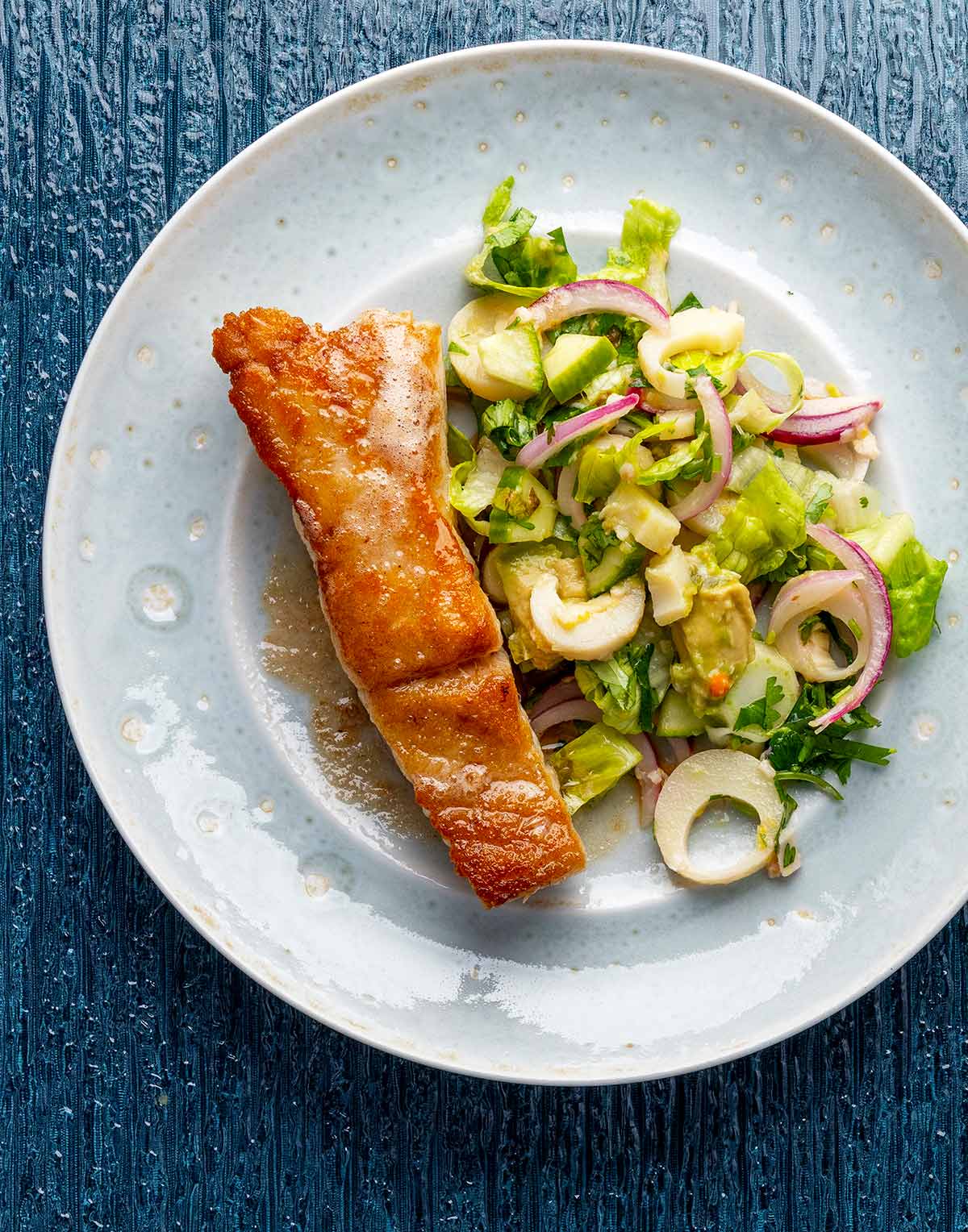
I was primarily a seafood cook for 15 years before I ever touched a piece of wild game. Fishing is in my DNA, and I am proud to say my parents taught me well how to catch all sorts of sea creatures. I did not learn this technique from them, however. I learned how to sear a fish when I was a line cook years ago. Pan-searing is a classic restaurant method of cooking fish.
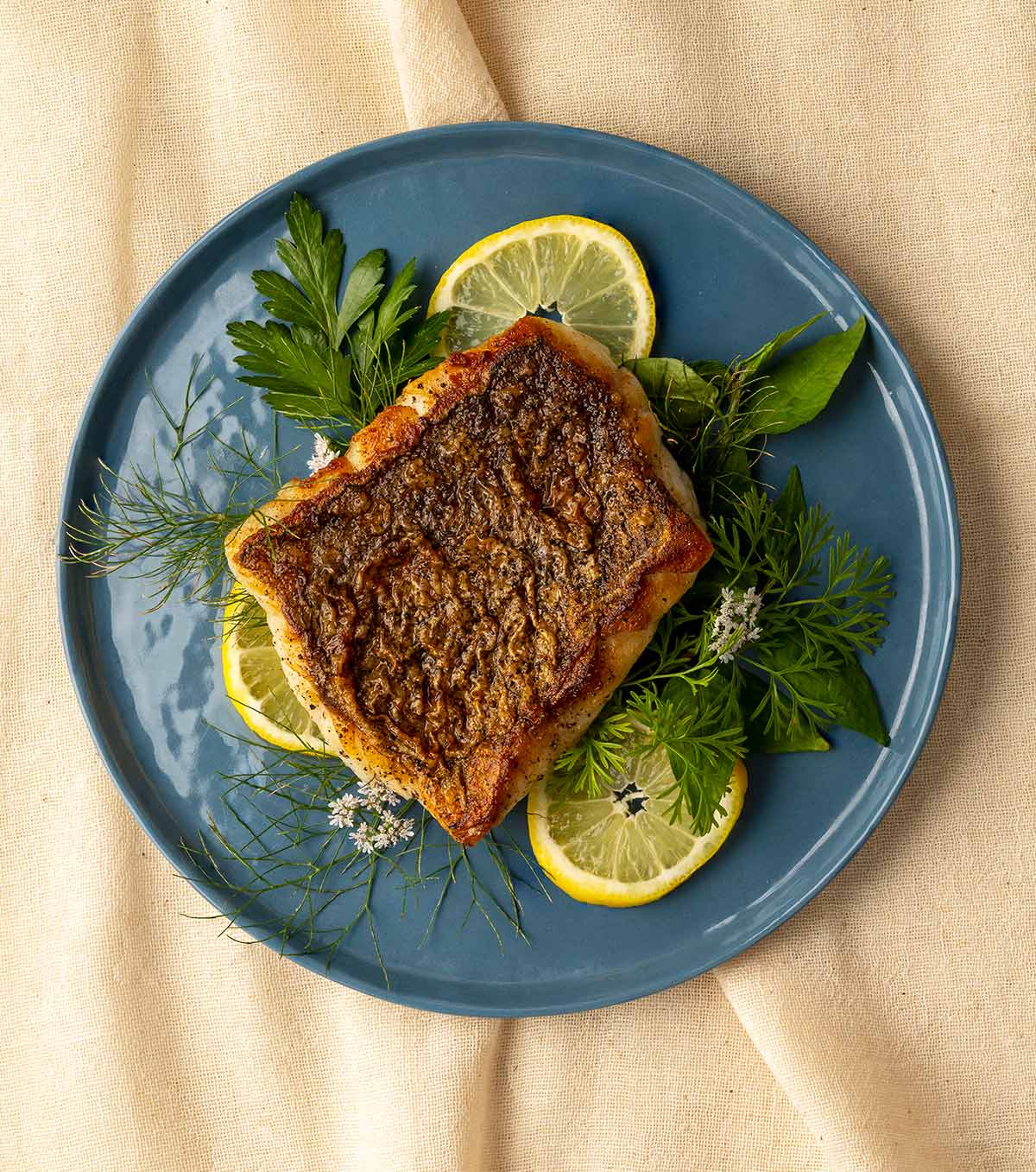
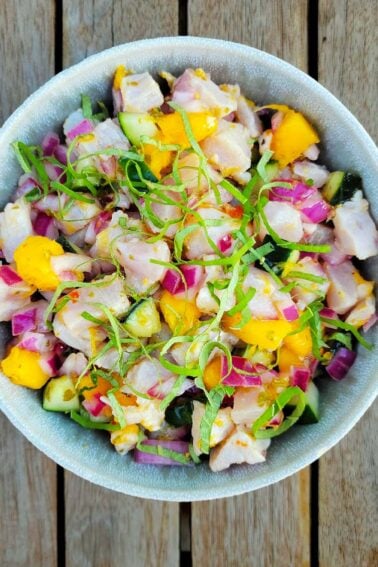
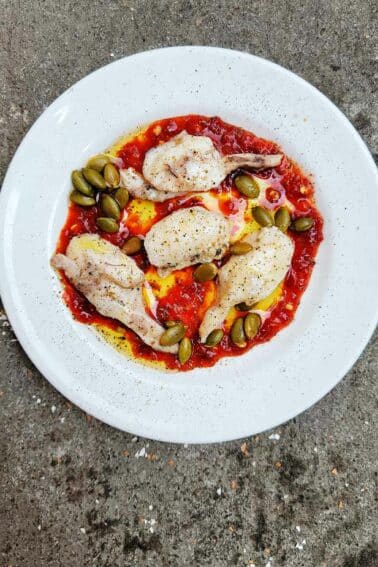
The technique works on any thick fillet or fish steak. I am using striped bass in the process shots below, but most fish will do; grouper is in the photo above.
I’ve made pan seared fish with dozens of species, from salmon and tuna to catfish, snapper, mahi mahi, lingcod and seabass. The only fish that don’t respond well to searing are those with lots of bones, like shad; very small fish, like sardines; or very thin fillets, like sole or small walleye.
Searing fish is not hard to master, but there are some tips and tricks you need to know.
(I seared fish for the TV news in Alabama recently, which shows the technique really well. Here’s that video.)

Skinless or Skin On?
A few things first. Most fish have very tasty skin if it is cooked properly.
Some, like triggerfish or sturgeon or swordfish, have skin so thick or rubbery that it’s essentially leather. Others, like mackerel, have skin so thin you can’t get a decent crisp on it. But ye olde fish, such as bass, perch, salmon, flounder, snapper or rock cod, have excellent skin that crisps nicely. Be sure to scale the fish (or have your fishmonger do it), but leave the skin on the fillet.
I wrote a whole article on which fish have tasty skin, and why, for the most part, it’s a good idea to eat more fish skin here.
But I get it. Some people don’t like fish skin. You can absolutely make seared fish with skinless fish, too. Just sear the side the skin used to be on first. The grouper photo up top is skinless.
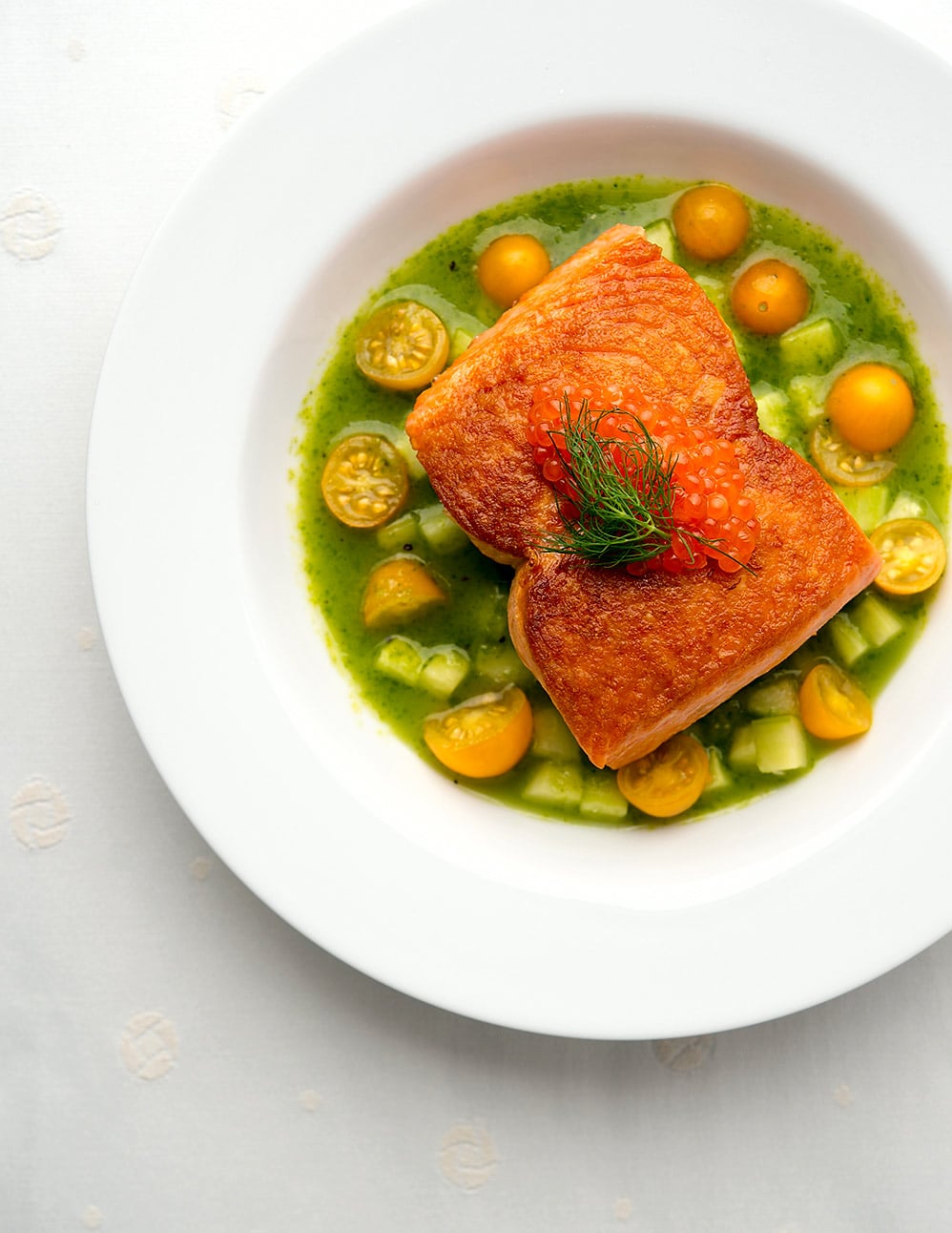
Oil for Seared Fish
I almost always use two sources of oil or fat for seared fish: A very high smoke point oil, or sometimes clarified butter, and then either regular butter or a flavorful finishing oil right at the end.
The reason is because you sear fish at high temperatures, and regular butter will burn and turn bitter. God choices for searing oil include avocado and refined safflower oil, which have smoke points above 500°F. Other options would be canola oil, rice bran oil, refined peanut oil or refined sunflower oil. Clarified butter or beef tallow also work well.
The finishing oil or fat is just for flavor. I almost always just use a knob of butter, but toasted sesame oil is good for a Japanese touch, or a high quality olive oil works for a Mediterranean flair.
Seared Fish Step by Step
Here’s how I sear fish, step by step. Take your fish out 20 minutes before cooking and sprinkle a little salt on both sides. If it is a very thick piece of fish, like swordfish, let it rest at room temperature 30 minutes.
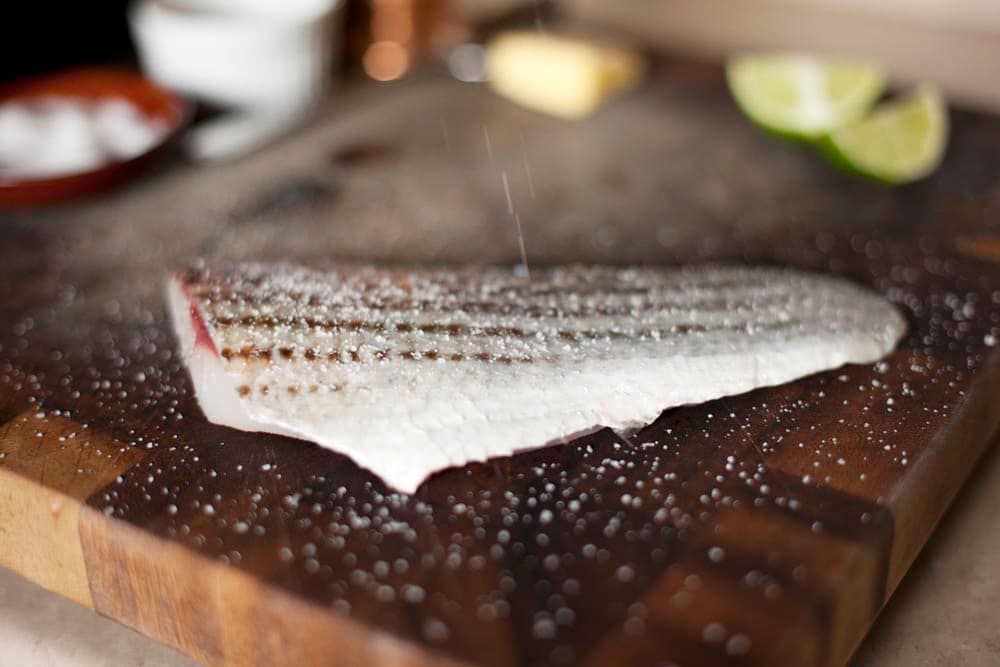
When you are ready to start cooking, set a cast iron or steel pan (don’t use non-stick, because you can’t cook with these pans over high heat) over high heat until it is roaring hot.
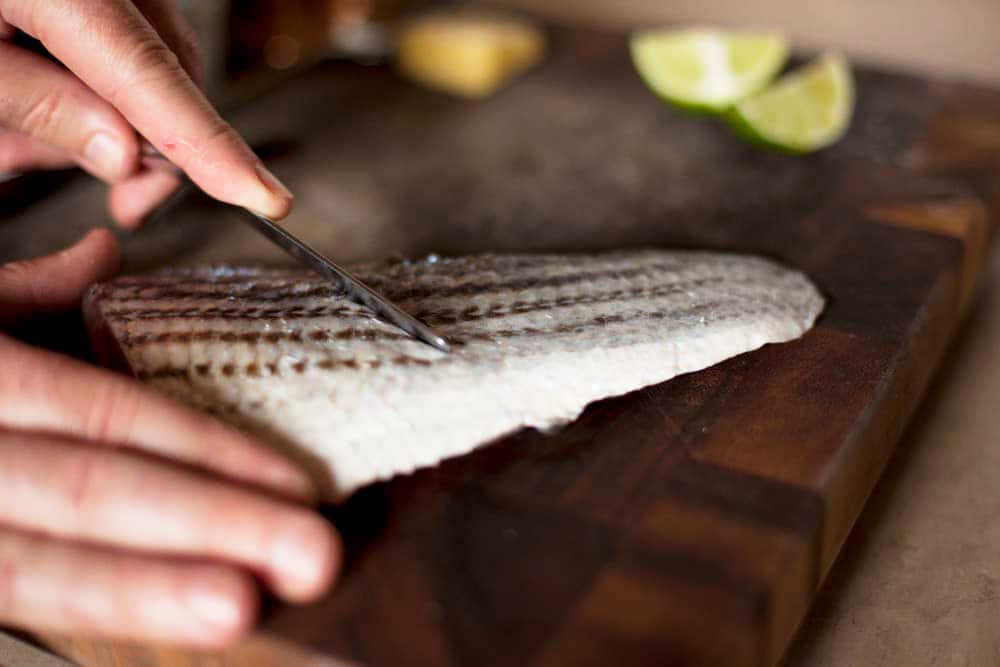
While the pan is heating up, take a butter knife and scrape down the skin of the fish fillet to remove any excess moisture. (If there is no skin, skip this part.) Either way, pat the whole fish fillet dry with a paper towel.
Pour the oil into the center of the hot pan. Swirl to coat the pan and let it get hot. If it starts to smoke, take the pan off the heat until it stops. Place the fish fillets skin side down. If there is no skin on the fish, lay it down on the side the skin used to be on. The moment the fillets hit the pan, jiggle it so the fish doesn’t stick. This is a very important step!
Turn the heat down to medium-high; medium if it is a thick fillet. You want it to sound like sizzling bacon.
Using a bacon press or a metal spatula, press down on each fillet for 30 to 60 seconds. Fish tends to arc when it’s seared like this, and you want the skin side to brown evenly.
Don’t touch the fish. Let it cook undisturbed for at least a minute, possibly as many as 7 to 10 minutes, depending on whether you have a bass fillet or a sturgeon steak. The key here is to let 2/3 of the cooking occur on the skin side. That is what crisps the skin. The thicker the fillet, the longer the cooking time, and the lower the heat.
To Turn or Not to Turn
When to turn your seared fish? Sometimes never. Normal fillets, like on walleye, small striped bass, black seabass, Pacific rockfish — basically any smallish fillet — you can cook through without turning. You cook the exposed side of the fish by constantly spooning the hot oil over it until the meat turns opaque. This trick works very, very well with delicate or smaller fillets.
On thick cuts, like a block of salmon, swordfish, tuna or a really large jack or bass, look at the side of the fish where it meets the pan and you will see the cooked portion climb up the sides; when the fish has a solid ring of browned goodness around the sides, turn.
A good test is to shake the pan — if the fillet moves, you can flip. Use a metal spatula to do this flipping. Be prepared to scrape the skin off the bottom, as if it were stuck. If you have done this properly it will not be stuck entirely, but a few spots might be anyway. This is a critical step.

It is vital that if the fish is really stuck to the pan to let it keep cooking! Be patient. It will release when the sear is perfect. Once you have the fish dislodged, turn it with the help of your free hand stabilizing the fillet on the uncooked side. Gently turn.
How long now? Again, depends on the width of the fish. But remember you did 2/3 of the cooking on the other side, so give it at least a minute for a small bass, 3 to 5 minutes for other fish. In most cases, your pan will be very hot, so you can turn off the heat and let carryover heat finish the job.
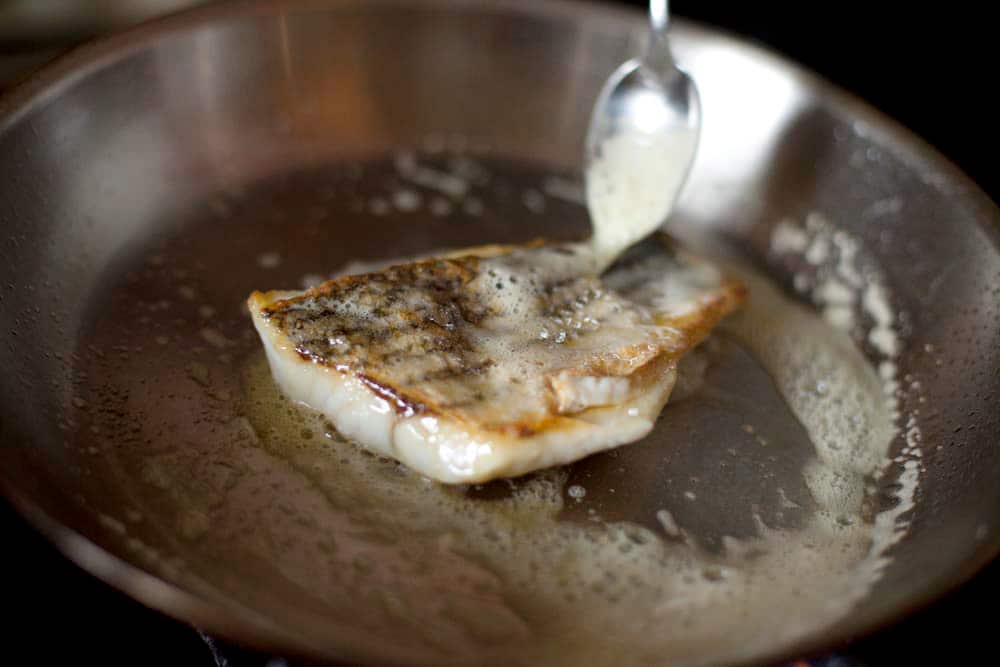
Add a tablespoon of butter to the pan and swirl it so it melts quickly. Tip the pan and use a spoon to baste the fish with the butter.
When the fish is done, serve at once: Unlike terrestrial meats, seared fish (other than swordfish and sturgeon) doesn’t like to rest. Oh, and that crispy, yummy skin? It goes on top. You worked hard for it, and you don’t want to ruin that crisp by exposing it to moisture. If you are using a sauce, it goes underneath the fish. Serve with a lemon or lime wedge on the side.
Pan Seared Fish
Ingredients
- 4 fish fillets, about 1 1/2 pounds
- Salt
- 2 tablespoons grapeseed, safflower or peanut oil, or clarified butter
- 1 tablespoon unsalted butter
- Lemon or limes for garnish
Instructions
- Take the fish out of the fridge and salt both sides well. Let them come to room temperature for 20 minutes.
- Near the end of that time, heat a large steel or cast iron sauté pan over high heat. When it's hot, add the oil and swirl it around. Pat the fish dry with paper towels, and if it has skin, use a butter knife to scrape the skin dry; there is often slime on it still.
- Have a metal spatula or a bacon press handy. Set the fish fillets, skin side (or the side where the skin used to be) down, and the instant they hit the pan, jiggle it so they don't stick. Set the bacon press down on the fillets to flatten them, or press down with the spatula. Keep the pressure on for 30 to 60 seconds.
- Baste the exposed side of the fish with the hot oil by tipping the pan a little to collect the oil. Do this until the fish turns opaque, about 30 seconds to 1 minute, if the fish is thick.
- Drop the heat to medium-high -- you want it to sound like bacon sizzling. Let the fish cook undisturbed until it wants to release from the pan, usually about 4 to 6 minutes. Jiggle the pan to see how it's going. With fish thinner than about 1 inch thick, you will not be flipping.
- When the fish has mostly or completely released, use a metal spatula to flip thick fillets, which get cooked another 3 to 5 minutes, or to remove thinner fillets to serve. Set them skin side up and grind some pepper over them.
Notes
Nutrition
Nutrition information is automatically calculated, so should only be used as an approximation.



It is no exaggeration to say this is one of the most important recipes/techniques to my cooking evolution. This is my go to for pan searing pretty much any type of fish fillet. And it should be yours. Seriously.
Read it, do it a few times, and it becomes second nature. Master this and you won’t mess up a fish filet again. I haven’t. Highest possible recommendation for anyone who likes to cook fish or is afraid to do so.
I love this recipe! It came out beautifully. I was wondering if you had the recipe for your hearts of palm salad. It looks so fresh next to the fish.
Nova: Yes, you can use the search bar to find it. It is in the recipe for pan seared grouper.
Bro, can you come over next Pandemic? I discovered the sous vide (Christmas present from kids) just prior to being put on holiday. We bought meat and fish by slab and froze everything which mortified me. Steaks (vacced and seasoned) went straight to water bath and then hit flaming grill or cast iron. And they were perfect. Fish on the other hand has been a challenge. Tonight is Halibut in sous vide cast iron brown butter….I’m nervous but thanks for your guidance.
I like mine really crispy, so I coat it with potato starch before pan frying! Always turns out pretty great, and soaks the coating and sauce that you add with it.
Awesome, awesome, awesome! Just did this with some frozen Mahi Mahi.
The skin was just perfect. I usually don’t like the skin but it was devine!
Holy smokes!!! Great recipe. I made this with skinless crappie filets. Served it with steamed broccoli and spinach salad. Very fast, easy dinner…. Delicious.
Thank you! I don’t think I’ve left a blog comment in over ten years … but I had to say how much I appreciated the wonderful, clear instructions and the video. I made the best fish I’ve ever served last night, and I’m typically a reluctant cook. Looking forward to reading through your other posts now. 🙂
More of a technique than a recipe.
Hank’s video really helped as I had made this several times prior to realizing the ‘scooping’ method to transfer the hot oil onto the top of the fish to cook without having to flip.
https://www.youtube.com/watch?v=3Q2uikGxPiQ
An excellent description of how to perfectly sear a fish filet. The video was very helpful too with the trick for adding butter at the end of cooking as well as basting with the butter.
This is one of the most helpful descriptions I’ve read on how to properly wear a fish! Not only do you tell us what types of skin work but you also give good examples of certain fish! The way you wrote this post was so professional. I loved how personable reading this felt.
i use this information for my presentation and it usefull. thanks.
Thank You!!!!!!
Outstanding !!
I have been baking my fish because I didn’t want to screw up the Sear ! But it’s not to much unlike Searing a Steak ! Just leave it alone until time and internal temp is right , and it releases itself. I cook a lot of Maui Maui good solid fish !
Your method works perfect !
Thanks again
If you ever want a good fighting fish on your line go fishing and hook up a Maui !
This is absolutely one of the best descriptions of how to pan sear fish I have read or seen in a video. NOT ONLY do you give instructions but you tell me the reason why things must be done the way you do them. Wonderful. Your presentation is professional but not haughty. You actually inspire me to do what you you do so well.
Well Done!!