
As an Amazon Associate I earn from qualifying purchases.
Ritual and tradition are powerful forces, both for good and for ill. Such it is with me and this salmon chowder.
I grew up eating chowder, all sorts of chowder, really, but my mom’s is the best. It is a brothy, Maine-style clam chowder that is always made from the same ingredients. always in the same way. Any deviation is apostasy.
Needless to say I developed a taste for that sort of chowder, no matter if it’s made with clams or fish or whatever. Sure, I like Manhattan “clam chowder,” but I view it as more of a perfectly nice clam soup than a proper chowder. There is also a Rhode Island style chowder with no tomato or dairy — also a lovely soup, but not a chowder.
There is, however, one incarnation of chowder I loathe: It is that hideous, gloppy monstrosity a particular set of New Englanders are known to concoct, mostly I suspect for Midwestern tourists. And I say “Midwestern” because I recently had a version of this chowder in Minnesota that was so thick you could stand a spoon in it.
My first tentative steps to break from tradition came with a perch chowder I designed specifically for the Great Lakes region. It’s made with yellow perch and Polish kielbasa and is damn good if I say so myself. This salmon chowder is my second step.
To me, chowder is different from soup in that it contains dairy products, in most cases cream or whole milk. Some are thickened with a butter-and-flour roux; mine are generally not. If you choose to thicken your salmon chowder with a roux, use equal weights of butter and flour; weight is a better way to do this than tablespoons. I’d suggest an ounce and an ounce. (If you insist on tablespoons, it’s about 2 tablespoons butter and roughly 3 tablespoons flour.)
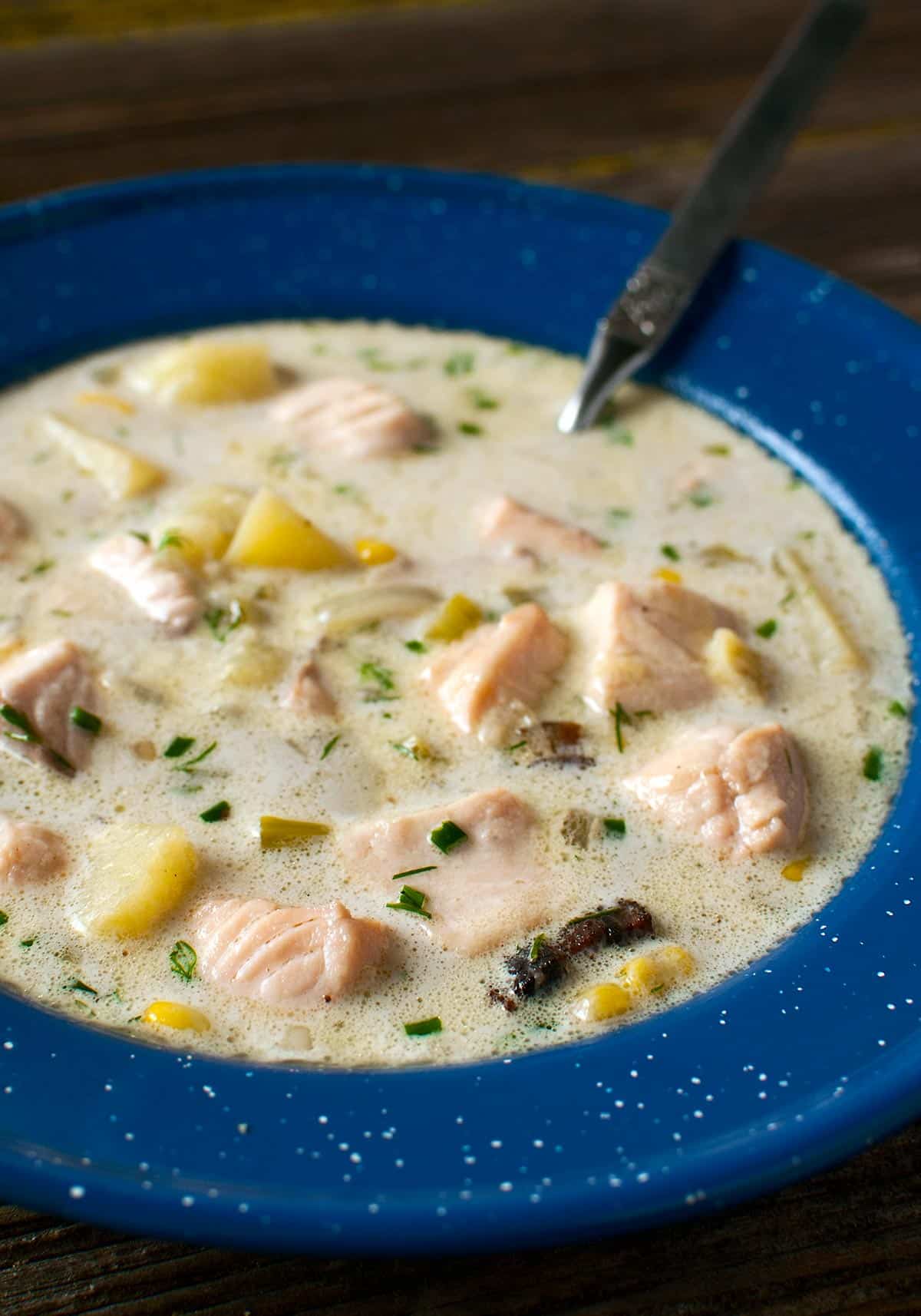
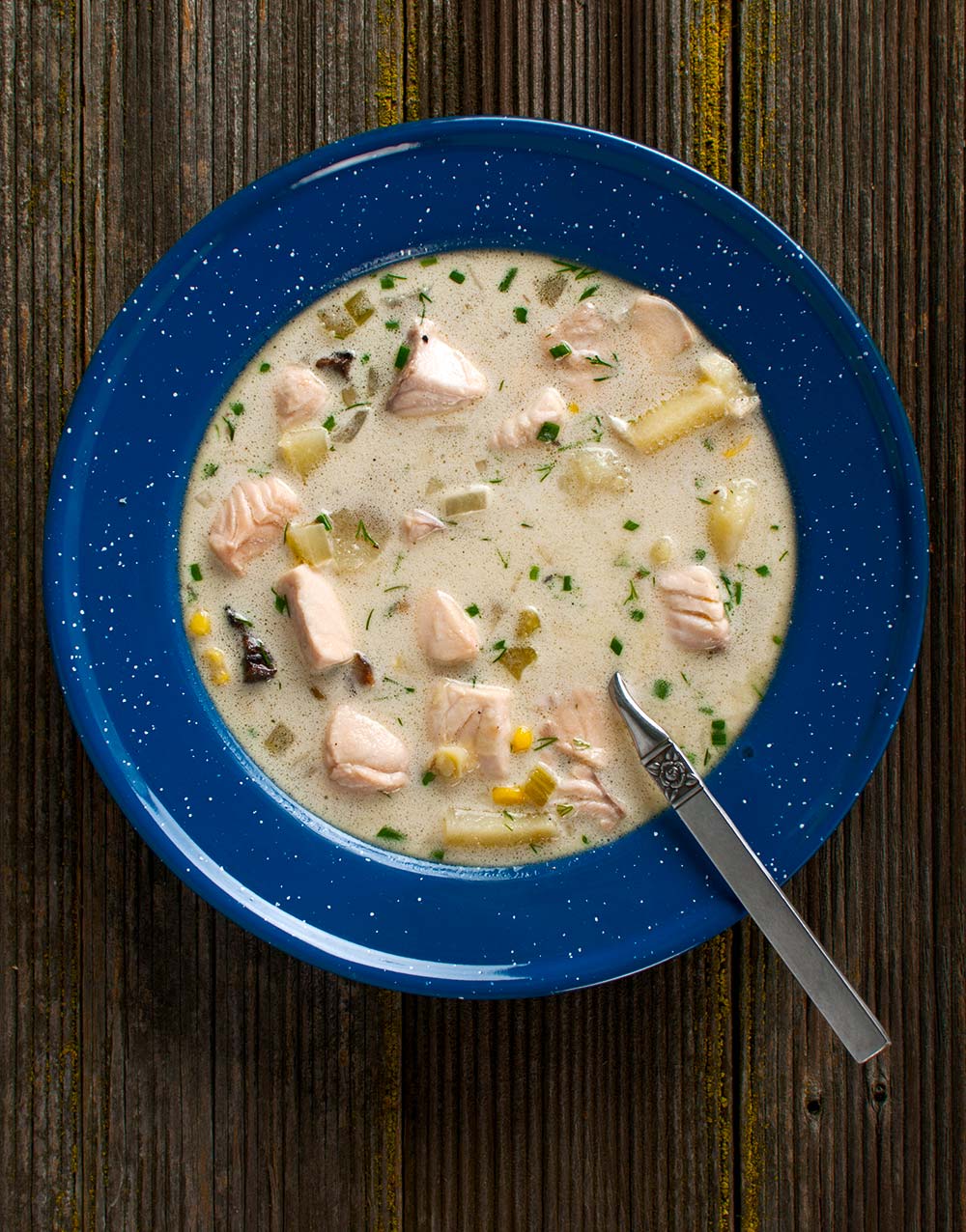
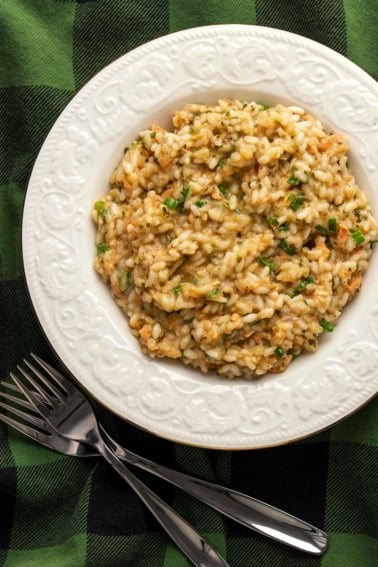
I should start by saying that what you see in the picture is not, strictly speaking, a salmon chowder: It’s made with a steelhead trout. Steelhead is very close to salmon, although it is a little leaner and a lot paler (unless you are working with pink salmon, which is the same color). Any salmon, char or trout you feel like using will work here.
I live in Northern California, where the chinook salmon is king. This is the very southern end of its range, and what, ecologically speaking, could be called the Pacific Northwest — and it is the Pacific Northwest, with its vast salmon runs, trout in the mountains, steelhead in the rivers and char in the snowy North — where I drew my inspiration here.
So my salmon chowder has a salmon stock, bacon, corn, lots of herbs and a homemade stock. None of this would fly in mum’s clam chowder. I’ve even added chanterelle mushrooms, and it was a great choice; if you want to do that, add about 1 cup chopped or torn chanties.
Here’s the thing: People move West to escape tradition, to be free to be whomever they wish to be. Why can’t their chowder follow suit?
Salmon Chowder
Ingredients
SALMON BROTH
- 3 to 4 pounds salmon heads, fins and bones , gills removed
- Salt
- 1 onion, chopped
- 2 carrots, chopped
- 2 celery stalks, chopped
- 1 cup white wine
- 1 handful of dried mushrooms, preferably matsutake
- 2 bay leaves
CHOWDER
- 1/4 pound thick bacon
- 1 cup chopped yellow or white onion
- 2 celery stalks, chopped
- 1 1/2 pounds potatoes, peeled and diced
- 5 tp 6 cups fish broth, or 4 cups chicken broth plus 1 to 2 cups water
- 1 to 2 pounds skinless, boneless salmon meat, cut into chunks
- 1 cup corn, fresh or thawed
- 2/3 cup heavy cream
- Black pepper to taste
- 2 tablespoons chopped fresh dill or chives, for garnish
Instructions
- To make the broth, put all the broth ingredients into the pot and cover with water. Bring to a bare simmer, or even just let it steep like a tea, for 30 to 45 minutes. Strain the broth. Pick any stray salmon meat you want off the bones and reserve. Discard the rest of the solids and reserve the broth.
- Wipe out the pot, add the bacon, and turn the heat to medium, and cook the bacon until crispy. Remove the bacon. Eat 1 piece. Chop the rest and reserve.
- Sauté the onion and celery in the bacon fat, stirring often, until they are soft, about 4 to 5 minutes. Add the potatoes and the salmon broth and bring to a simmer. Add salt to taste. Cook until the potatoes are tender, about 15 to 20 minutes.
- When the potatoes are tender, add the corn and the chunks of salmon. Cook gently until the salmon is just cooked through, about 5 minutes. Turn off the heat and stir in the chopped bacon, dill, heavy cream and black pepper.
Video
Notes
Keys to Success
- Don't get all low fat on me and sub in milk for the cream. The chowder can break and curdle. Ew.
- If you want, skip the bacon and use olive oil. I won't mind.
- Any dried mushrooms will do for the broth, not just matsutake.
- In a perfect world, you would use meat from the head and collars for this chowder, because they are fattier and nicer and won't dry out. Regular fillet meat is fine though.
Nutrition
Nutrition information is automatically calculated, so should only be used as an approximation.




Hank, went salmon fishing in Alaska last summer & brought home 25 lbs of silver filets. Your recipe was the best looking one out there & I feel as if I hit the jackpot when I made it! It’s been the hit of our recent dinner parties. Thanks much for sharing it. Can’t wait to try some of your other recipes.
Hi Hank,
I found this recipe in your cookbook while looking for ways to use the seafood stock (your recipe too) we made with lobster shells a while back.
We used steelhead we caught at Costco for our fish (which is pretty high in fat). The chowder turned out great. The best we have had in quite awhile.
Thanks for the great recipe!
Hi Hank,
Can half and half be used in place of the heavy cream? Thanks! Looking forward to trying this with my whole Coho salmon.
Susan: You bet!
This is the first time ever making Chowder and it turned out delicious! Thanks for the great recipe Hank.
Hi Hank,
I just came about your website as I was searching for a salmon chowder recipe. Your recipe sounds delicious, however I would like to skip the process of cooking a fish broth. What other broth could be used? Also, would white wine be something to consider adding?
Best,
Linda
Linda: Yes, you can use store-bought fish or seafood broth, or a light chicken stock is another excellent option. And if you add white wine, add no more than 1 cup. I’d say a half cup would be good for a regular batch.
Hey,
I’m making this for a big event and I’m wondering how many cups are for each serving.
Amy: Typically a serving is about 2 cups for a main, 1 cup for an appetizer.
Another fantastic recipe, thanks Hank! Used leftover salmon and stock made with a bit less bones than called for. Also had no cream but made a roux and thickened some whole milk (plus a touch of cornstarch), cause i didn’t want to go to the store. Wish I’d thought about cream cheese or evaporated milk like some others here. Mom declared it “delicious!”and everyone else ate up with nary a peep. Looking forward to having again tomorrow, after the flavors meld a bit. And heck, maybe I’ll get some cream for the heck of it.
Hi Hank,
My husband was out from Bodega and brought home some great king salmon. After portioning out fillets, I had him save me the rest to do something with tonight. Yum! This chowder recipe was perfect! I’m not one to be overly precise with measuring and whatnot, it turned out great following your basic guidelines. Looking forward to finding some of your recipes in elk season 😉
This recipe is fantastic! Had a bunch of fins I got in a mixed bag of fins and collars (grilled the collars) I got at Princess in Noyo…made the perfect stock! Only add was carrots and Kale (my wife puts kale in everything) in the final product, and it turned out perfect- thanks for the dinner idea!
The best chowder. I went the chicken broth route and added the wine, bay leaves, one carrot, dried mushrooms. Then followed the recipe with part of a king fillet including collar…perfect.
Thanks!