
As an Amazon Associate I earn from qualifying purchases.
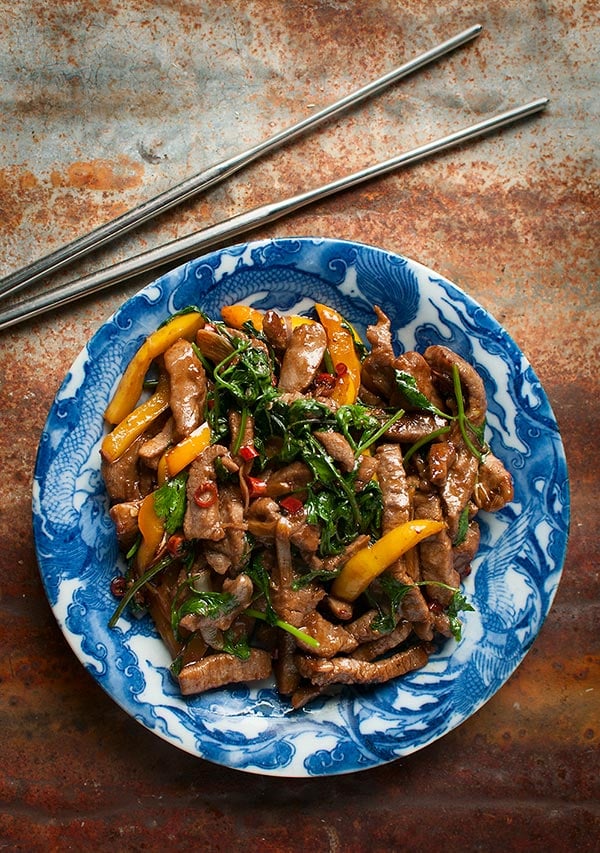
While there is indeed a recipe for venison stir fry at the end of this post, I want to talk more about technique than any specific recipe. I want to show you a Chinese trick that will make any wild game meat tender and juicy. Learn this technique and you will never go back.
I am assuming you’ve had Chinese food at a restaurant, right? Ever notice that the meat is never dried out? There is a reason for that, and that reason is called “velveting.” Velveting is the process of coating the meat with a delicate layer of ingredients, usually involving some sort of starch, and then stir-frying it.
It’s not so much a batter as it is a gossamer layer of protection for what is typically very lean meat. And those of us who cook wild game a lot know all about very lean meat.
I’ve now velveted everything from rabbit to duck to pheasant to venison, and the trick works on any meat. It is a great way to highlight leg steaks or pheasant thighs, but it’s best with lean, tender meat such as backstraps or breast meat.
There are lots of ways to velvet meat. Some are uber simple: Marinate it in soy, cooking wine and corn starch and proceed to the stir frying. This works pretty well.
A better way, however, is to “pass through” the coated meat in lots of reasonably hot oil. It is the same general idea as double-frying French fries. A quick bath in 275°F oil sets the velvet coating, and helps the meat hold up better under the ferocious heat of a proper stir-fry.
The downside is that you need to use a couple cups of oil. But, you can strain and save the oil for several uses, so it’s not all that bad.

The result will give you that “ah ha!” moment when you realize you have cracked one of the secrets of Chinese cooking. No matter what you include in your venison stir-fry, if you do this velveting trick you will be overjoyed with the texture of the meat. Give it a go. You’ll see.
I have a few other Chinese-inspired venison recipes, if this isn’t exactly what you’re looking for, including kung pao venison and Sichuan venison with cumin.
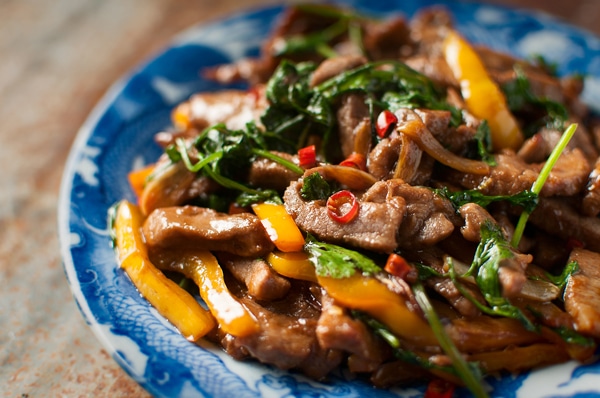
Venison Stir-Fry
Ingredients
MARINADE
- 2 tablespoons Shaoxing wine or dry sherry
- 1/2 teaspoon salt
- 3 tablespoons soy sauce
- 1 tablespoon potato or corn starch mixed with 2 tablespoons water
STIR FRY
- 1 pound venison, trimmed of fat
- 1 1/2 cups peanut or other cooking oil
- 1 to 4 fresh red chiles
- 1 red or yellow bell pepper, sliced
- 3 garlic cloves, slivered
- 1 bunch cilantro, roughly chopped
- 1 tablespoon soy sauce
- 2 teaspoons sesame oil
Instructions
- Slice the venison into thin slivers of about 1/4 inch or less and anywhere from 1 to 3 inches long. Mix with the marinade and set aside while you cut all the other ingredients.
- Heat the peanut oil in the wok or a large, heavy pot until it reaches 275°F to 290°F. Don't let it get too hot. Add about 1/3 of the venison to the hot oil and use a chopstick or butter knife to separate the meat slices the second they hit the hot oil. Let them sizzle for 30 seconds to 1 minute. Remove with a Chinese spider skimmer or a slotted spoon. Set aside and cook the remaining venison one-third at a time.
- Pour out all but about 3 tablespoons of the oil. Save the oil for the next time you cook Chinese food.
- Get the remaining oil hot over high heat on your hottest burner. The moment it begins to smoke, add the chiles and bell peppers and stir-fry for 90 seconds. Add the garlic and cook another 30 seconds. Add the venison and stir fry 90 seconds.
- Add the cilantro and soy sauce and stir fry a final 30 seconds, just until the cilantro wilts. Turn off the heat and stir in the sesame oil. Serve at once with steamed rice.
Nutrition
Nutrition information is automatically calculated, so should only be used as an approximation.



Made it, boys ate it, thanks for the velvet tip that just changed my life.
Can I use avocado oil instead of peanut oil?
Veronica: Yes, you can.
I love looking at your cooking porn (watching someone else do it as opposed to really doing it myself).
I learn so much that I may or may not ever get to use.
love it was so tasty will be making it again!!!!
This is wonderful! My whole family loves it! Do you rinse the meat after marinate if!
I did not and it was so good. A friend told me I should rinse off the meat before cooking it.
Quick, simple, and utterly delightful. I used the mildest chiles I could find, because unfortunately I can no longer tolerate the heat I used to be able to, but the flavors here were still wonderful and the meat tender.
Hi, Hank
Thank you for your site and your books, Hank. Excellent sources of good info.
Have you ever used this velveting technique on old squirrels?
How well does it work? Any adjustments needed?
Thanks for sharing your wisdom and stories with us.
Chris: Yes, it will work with deboned squirrel meat. But the deboning process is tedious, so I rarely do it.
Thank you, Hank!
Braising & pulling the meat is so much easier for squirrels, but I was looking for something a little different. Glad to know velveting can tenderize an old squirrel as well. I’ll give it a try.
Thank you
Had some butterflied venison medallions. I had 1.5 lbs so had to expand the recipe a little but it worked out. Hard on a regular stove to keep the oil hot, or maybe my inexperience but the pre frying worked great. Great aromas in the house as I was cooking and the end result was pretty amazing. Thanks for the great recipe… Oh and last year Super Bwl when we saved our chicken wing peanut oil the used stuff was insane in brownies 🙂
I made this last night from some leftover bits from trimming the backstraps from my buck. It was fantastic! One note, if you like it hot, as I do, make sure you have good ventilation when you throw the hot peppers (I used Thai peppers) into the pan. The smoke will get you!
Good recipe with a helpful basic technique to use while stir-frying.
This method really revolutionized things for me. It’s possibly my favorite way to use backstrap. Thanks Hank!
I have made this many many times from Hank’s cookbook. It is a favorite that we always get excited to eat. I’ve switched out the vegetables based on what is available but always follow the marinating and cooking instructions. SO EASY AND SO GOOD! The meat is tender and delicious. Thank you for such a great recipe.
I love how Hank explains recipe process and provides substitutions. I do not meal plan enough so having options and with limited ingredients in North Dakota I can still make great meals from his recipes my whole family enjoys.
Tried this recipe/process last night and it was amazing! Big fan of this cooking process. We added some snap peas and onion and it was delicious!! Thank you very much for the insight!
I made this for dinner tonight. First time ever cooking with venison but I am very comfortable behind a wok. I figured this would be the best recipe for me to try out. I was blown away by the flavor. It tastes phenomenal. If you don’t have the Chinese cooking wine or sherry for the velveting process, light beer will work in a pinch!
The meat was so tender and it had such good flavor! I added less pepper because I don’t really handle heat well, and this is by far still the best deer recipe I have found
So, for the velveting, hoe do I know how hot the oil is? Mine is just low, Med, high——should I use it on medium-low?
Susan: You really ought to get a meat thermometer so you can know exactly. They’re less than $15. But for now, try medium.
Greeting from Dublin. Just made this tonight for the wife and my mum. Absolutely fantastic. Thanks Hank !
Anyone have the nutritional information?
Sara: It is impossible because the nutrition value of wild foods varies so widely. Sorry.
Amazing recipe, definitely one of my favorites. The velveting technique made for such juicy and flavorful meat! I used an electric wok for it and it was perfect. I will be making this for years to come.
Absolutely delicious .. I cook this regularly. ?