
As an Amazon Associate I earn from qualifying purchases.
If you’ve never heard of the Hmong, they are a Southeast Asian group who fought for us during the Vietnam War. When we left that country, the Hmong remained — and faced severe persecution since they’d backed the wrong side. So the US government let them immigrate here en masse in the late 1970s.
But the Hmong are a little different from most immigrant groups: They came here as farmers and hill people. Hunters.
And of all the animals the Hmong hunt, they’re most famous for chasing squirrels. There are lots of squirrels that live in the mountains of Laos, so hunting our squirrels was a natural for them. Legend has it that when the Hmong showed up in the early 1980s, they slaughtered California’s squirrel population; fish and game laws were completely alien to these folks.
By all accounts things are better now: The Hmong are, more or less, following the law, and the state’s squirrel population has recovered. But the September squirrel opener still draws hundreds, maybe thousands, of Hmong into the Sierra to chase Mr. Bushytail.
Someday I want to go with them. My friends Dan and Mirra of the Perennial Plate have, and they posted a video about it here. It’s pretty cool, especially how they process their squirrels. But until I get that chance to hunt with the Hmong, I’ll make this stew.
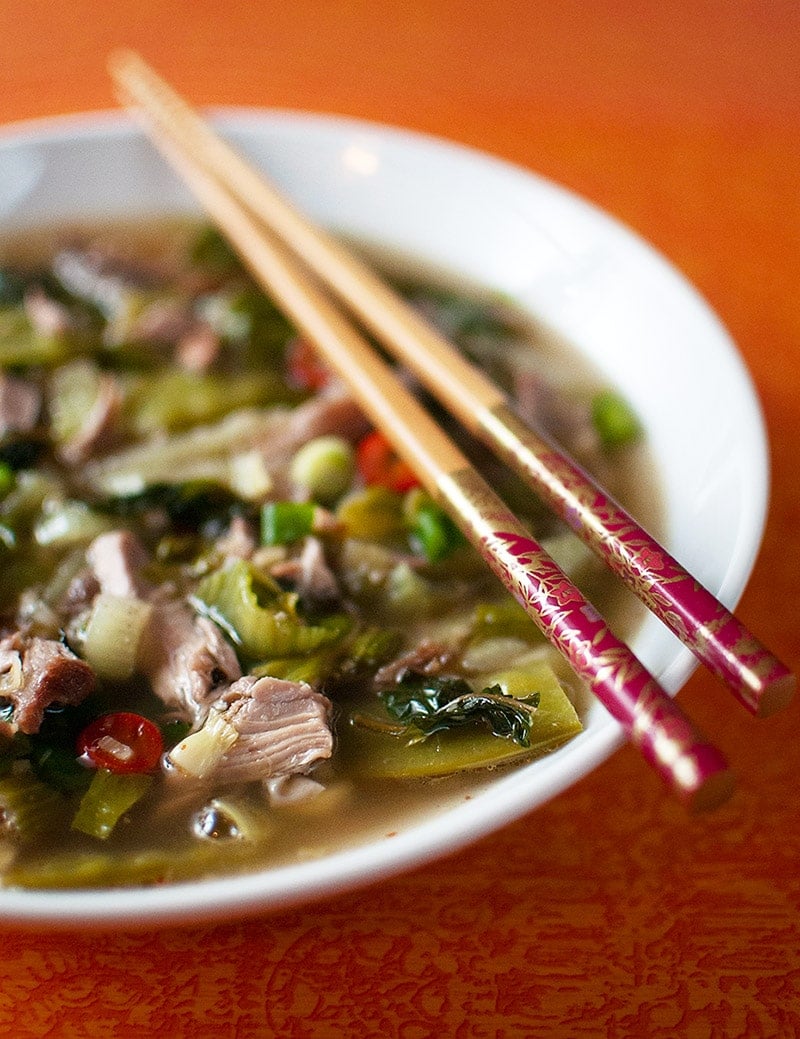
I got the inspiration for this squirrel stew recipe from an excellent cookbook called Cooking from the Heart: The Hmong Kitchen in America, whose co-author Sheng Yang lives right here in Sacramento. Sheng’s husband is a squirrel hunter, and she includes a squirrel stew recipe in the book. This is a riff off hers.
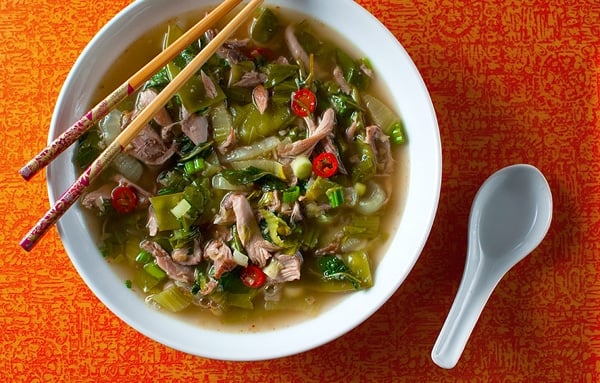
There are a few ingredients here that will be hard to find unless you have an Asian market around, notably the galangal. If you can’t find fresh galangal, skip it. If you can’t find fresh lemongrass, you can often find it in a little tube in the produce section, with the other herbs. The Sichuan peppercorns can be challenging, too, but just skip them if you can’t get any.
Hmong Squirrel Stew
Ingredients
- 2 squirrels, cut into serving pieces
- 3 tablespoons vegetable oil
- 4 cloves garlic, minced
- 1 stalk of lemongrass, white part only, minced
- 3 to 5 red chiles, chopped
- 1 tablespoon minced galangal (optional)
- 2 tablespoon minced ginger, peeled
- 1 quart chicken stock
- 6 lime leaves or 1 tablespoon lime juice
- 1 tablespoon fish sauce or soy sauce
- 1 pound bok choy or chard, chopped
- 1/4 pound snow peas
- 1 teaspoon ground Sichuan peppercorns (optional)
- Salt
GARNISH
- 1/2 cup chopped cilantro
- 1/2 cup chopped green onion
- 1/2 cup chopped mint
Instructions
- Heat the vegetable oil in a large pot such as a Dutch oven. Pat the squirrel pieces dry and brown them over medium-high heat in the oil. Remove them as they brown and set aside.
- Add the garlic, lemongrass, galangal, ginger and chiles and stir-fry over high heat for 90 seconds.
- Return the squirrel to the pot and add the chicken stock, lime leaves and fish sauce. You want the broth to cover everything by about an inch. If it does not, add some water. Bring to a simmer and cook until the meat wants to fall off the bone, between 1 hour and 2 hours. Remove the meat and shred it off the bones. Return it to the pot.
- Add the bok choy and the snow peas and simmer until tender, about 10 minutes. Add salt to taste and the ground Sichuan pepper.
- You can serve it as-is in bowls, or over some steamed rice in a bowl. Garnish with the cilantro, green onions and mint.
Nutrition
Nutrition information is automatically calculated, so should only be used as an approximation.



Great recipe and it was pretty easy too. The spice level was a bit high for the kids but I added some carrots and this pulled out some heat over time
Forgot to say this squirrel recipe sounds great, we got lots of bushy tails here in MI, so gathering ingredients will be easy. Love the variety of recipes
Just found your website while looking for some fish curry recipes and we’d just finished processing the deer my wife shot and I noticed your venison stock tips. My wife is dedicated to using as much of her kill as possible, and planned to roast bones for stock, so your tip on the parsnips is timely indeed.
Love your recipes, I expect to be a regular here.
I just tried this recipe, but added beaver meat and used beaver stock that I made. I also added some mushrooms and poured it over pho noodles. Amazing! Thanks for this really creative recipe. It’s great to learn how to cook exotic proteins in something other than gravy.
Hank .. i am hmong too.. and i live here in South Sacramento and a line cook at the lotus casino.. im also a hunter and squirrels is one of my all time favorite dish as a kid and now.. i know of a few dish if you would like to try..?
Thai: Sure! Bring ’em on!
Bobby: I’d use the Thai chiles.
Hank, I am making this greatlooking dish and have one question. Should I use red Thai Chiles or red Jalapenos. I grew both in my garden and would like to know what you prefer and also what would make it most authentic. Thanks!
Im hmong, and this looks pretty good. I use all the ingredients except for the bok choy, snow peas,and chicken broth. I use water only but just enough to cover the meat then slow boil it till it starts to get thick. Usually the final result are sticky fingers from the squirrel meat. Every hmong hunter knows what im talking bout sticky.
This recipe inspired me to hunt squirrels for the first time since my first hunting trip as a child decades ago in the mountains of Colorado. What a terrific way to prepare a squirrel! The kaffir lime leaves and lemongrass, both of which I grow in my garden, are great flavors for squirrel meat, which is surprisingly delicious. I also made a pot with rabbit (for the non-squirrel eaters) and that was very good, too. I recommend using pheasant stock, if you have it, in place of the chicken stock since it has richer flavors.
It is great to see the Hmong getting some recognition here in America for their great tradition of hunting and their excellent cuisine. More Americans should be aware of and appreciative for the Hmong’s efforts in the CIA’s Secret War in Laos in support of America and at great peril to themselves. Thank you.
Not only was that the best squirrel dish I have ever had it was one of the best stews I have ever had. My wife, who , as she says ” doesn’t do rodents” even liked it. Thanks for sharing this and the history behind it. I look forward to checking out your other recipes.
Pa: I got the idea for using galangal and kaffir lime leaves from the Hmong cookbook, so at least someone uses them in the stew. 😉
Don’t even know how I stumbled onto this site.
Pretty interesting. My father in law makes the best squirrel stew that I’ve tasted. The broth is totally yummy and he makes sticky rice to dip in the stew.
I don’t think this is actually authentic Hmong squirrel stew. I’ve never heard of using galanga in squirrel.
I don’t remember if Kaffir leaves AKA lime leaves are usually used in squirrel although we use it in a lot of similar stews.
However, you should never substitute limes leaves with lime juice. Big no no. Lime leave us used in stews because it adds a citrus aroma and flavor unlike any other. It is definitely not sour. Sometimes it is the key ingredient to dishes like this. And the lemon grass of course.
I haven’t tried squirrel stew yet. But I think I’ll give this Hmong squirrel stew recipe a try.
Great looking recipe. So you actually have to be licensed to hunt squirrel, fascinating! Is there a limit to the number you can “bag” in a day? Your recipe and the video makes me want to go get some.
I’d say that though both this soup and pho are clear soups of SEAsia, they are fairly different in the use of spices. I’ve never had lemon grass, galanga, or ginger in pho. Sounds more like a regular Lao or Isaan soup. Almost like the ubiquitous Tom Yum Goong shrimp soup of Thai restaurants, assuming the lime leaves are actually kafir lime that is.
What really interested me was the video in paragraph 3. I’ve seen that technique used on squirrels, bamboo rats, and civet, but in Asia, not here. The dish the Hmong guy prepared in his kitchen was a classic laap (often mis spelled and mispronounced by those heathen Thai people as larp)
It’s great to see the food of Laos being written about on American blogs, especially using wild ingredients. To this day Hmong living in villages away from the road in Laos probably get over half their protein requirements from wild meat they personally hunt.
Lastly a plug, for someone’s book, it’s called Food of Northern Laos, and they don’t use wild food in the ingredients but I think most Lao food is best with wild meat. They include both Hmong, Kamu, and Lue recipes but there is much overlap. https://www.foodfromnorthernlaos.com/ Sune Saap! (bon appetit)
Hamish: I think the release date for the duck cookbook is October 2013.
Jan: Skin off. I’ve never done the Hmong technique where you burn the fur off the squirrels. Maybe someday…
Hi Hank, when browning the squirrel is the skin on or off?
Thanks
Jan
I make a this broth all the time but use seafood odds and ends. Only it takes 5 minutes to cook. Never thought to use small game.
Its almost summer over here in Australia and getting really hot. I have a hare in the freezer and really needs some ideas. It’s too hot for a nice slow cooked stew. Was thinking about braising and shredding the meat for taco’s. Any thoughts or tips?
Thanks.
Ps: do you have a release date on your new book? Can’t wait.
Sounds great, and some interesting history to go with it. I still have folks look at me incredulously when I mention eating squirrel.
You have made me see squirrel in a whole new way! I love pho, and if I ever get my hands on a squirrel I’ll be making this.