
As an Amazon Associate I earn from qualifying purchases.
While Thai fish curry takes many forms, for me it’s almost always a green curry. It just seems to suit fish and seafood better.
What’s more, if you use a pre-made green curry paste — and I’m giving you a recipe for one here — or a good store-bought one, your Thai fish curry will come together in about the time it takes to make the jasmine rice you’ll want to serve it with.
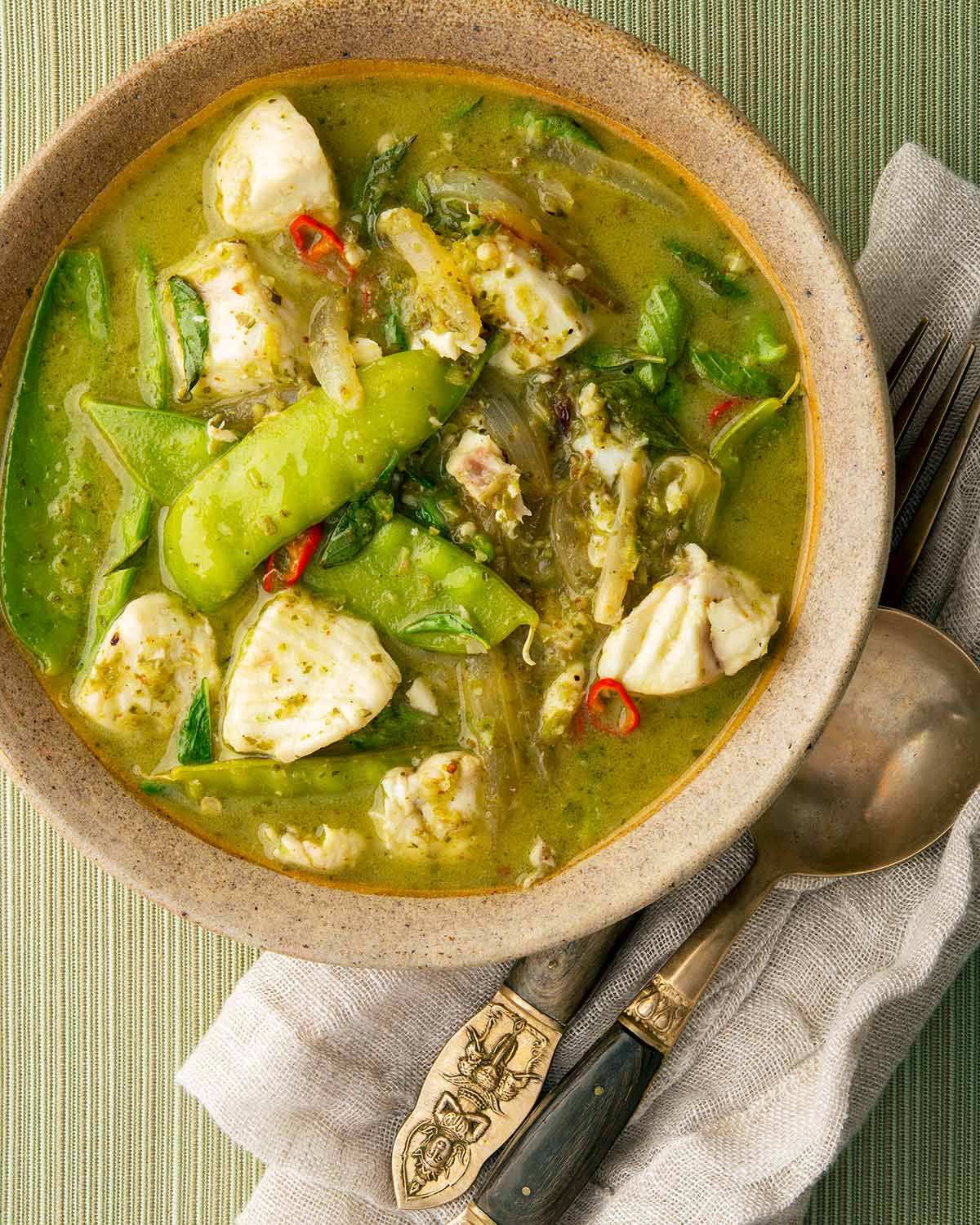
I am giving you a recipe for homemade curry paste because I prefer it that way – and I have Asian markets near my house. If you don’t, many supermarkets sell Thai green curry paste in little jars, and the Mae Ploy and Maesri brands are especially good. You can buy that in Asian markets or online.
This recipe makes more curry paste than you need, but it keeps in the fridge for several months.
If you do use a store-bought curry paste, especially one from a supermarket, doctor it up with a extra lemongrass and/or galangal, which is a rhizome a little like ginger. You can buy little plastic tubes of minced lemongrass in the produce aisle in many markets. a minced garlic clove helps a lot, too.
What fish to use? Pretty much anything goes with Thai fish curry. I am hard-pressed to think of a creature that won’t taste good swimming in this sauce. I typically use California halibut, rockfish, lingcod or leopard shark, all white meat fish local to me. But I’ve made it with oily fish and salmon, too. And shrimp, crab and lobster are classic. So have fun with it.
The only sorts of fish I’d avoid would be those that would dissolve in a curry, or the little fish like sardines or herring. In general, go for anything firm, or shellfish, or squid.
And keep in mind that Thai green curry works with lots of proteins, not just fish. I have a pheasant green curry that you could also use chicken or grouse or turkey with, and you’ll see green curry beef and other red meats, too.
(Want a change of color? Try my red coconut curry with fish or seafood.)
For the vegetables, snow peas are the norm, as are those little Thai eggplants. But green beans, little Thai chiles and herbs like Thai basil, cilantro or culantro are also very common. Go ahead and play with it.
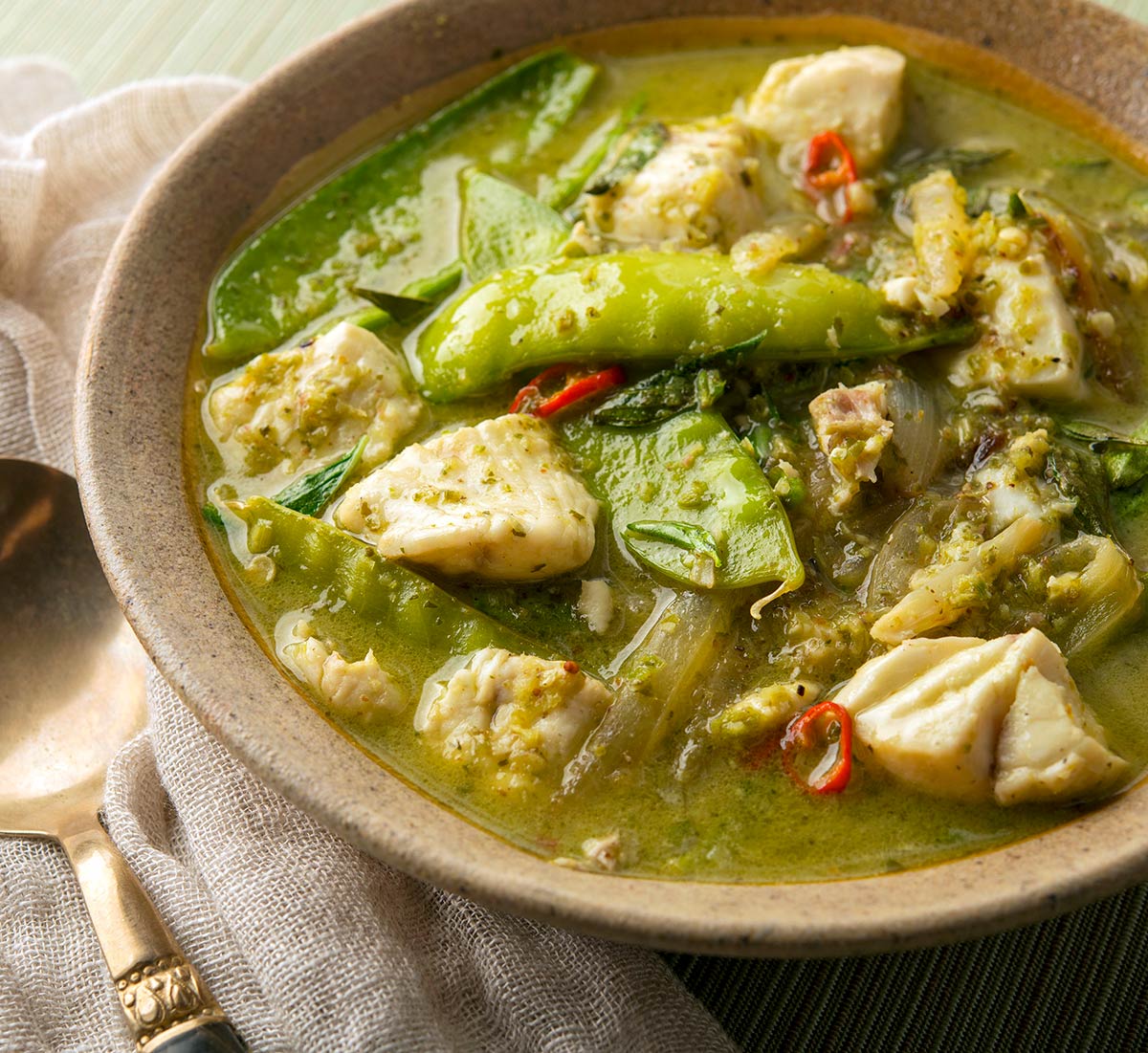
A couple other pointers: Use full fat coconut milk, and a good fish sauce with no weird, floating debris in it. If you can find it, palm or coconut sugar are better than regular brown sugar, and if you use coconut water instead of regular water, you’ll get one more layer of flavor.

The result? A Thai fish curry that is sour, salty, spicy and sweet. Restaurant worthy, and, dare I say, quick and easy — two words you don’t always see on this site.
Thai Fish Curry
Ingredients
OPTIONAL CURRY PASTE
- 1 teaspoon ground cumin
- 1 teaspoon ground coriander
- 1 teaspoon black pepper
- 1 teaspoon white pepper
- 4 cloves, or ¼ teaspoon ground cloves
- 1 teaspoon salt
- 5 garlic cloves, roughly chopped
- ½ cup minced shallot
- 1 bunch of rau ram or cilantro, about 1 cup chopped
- Juice and zest of 2 limes
- 2 medium dried shrimp, or 1 tablespoon shrimp paste (optional)
- 3 tablespoons minced galangal or ginger
- 1 stalk lemongrass, white and light green parts, minced
- 1 tablespoon fish sauce
- Lots of green chiles see below
CURRY
- 2 tablespoons peanut or coconut oil
- 1 white onion, sliced thin
- 6 ounces snow or sugar snap peas
- 4 tablespoons green curry paste
- 1 cup coconut milk
- 2 tablespoons palm or brown sugar
- 3 tablespoons fish sauce
- 1 ½ pounds skinless, boneless fish, cut in chunks
- Some chopped red chilies for color
- ½ cup Thai basil leaves
Instructions
CURRY PASTE
- To make the curry paste, put everything in a food processor and buzz to combine. A word on the chiles, however. They give you a lot of the color in the paste, so you will want a fair number. I’ve made this with about ½ cup of roughly chopped green Thai chiles and it’s fantastic, but very hot. If your heat tolerance isn’t quite there yet, use a similar amount of Anaheims, serranos or jalapenos. Typically, you will need to add around ¼ cup of water for the paste to come together fully. As I mention in the headnotes, this can be made well in advance.
CURRY
- To make the curry, heat the coconut oil in a pan over medium-high heat and sauté the onions until slightly browned on the edges, about 6 to 8 minutes. Add the snow peas, curry paste, coconut milk, sugar and fish sauce and mix well. Simmer this gently for 5 minutes. Add 1 cup of water or coconut water, the fish and red chiles into the pan and simmer another 5 minutes. Turn off the heat, mix in the Thai basil and serve over jasmine rice.
Nutrition
Nutrition information is automatically calculated, so should only be used as an approximation.



OMG! Made the paste, I went light on the chillies but will up it next time. Enjoyed this with fresh halibut cheeks and vermicelli noodles. I found the paste to be loose, more like a salsa but when stirred in with the curry it was outstanding. This will become a regular here. Thanks Hank!
Left out the sugar as the peas and coconut milk are sweetness enough, and served with quinoa for lower carbage. Delicious with Mae Ploy green curry paste and bog-standard Pacific rockfish from the super market! Thank you.
Just made it, it was AWESOME. THANKS
Delicious! Made this with red drum.
A good Thai curry is needed to shake off our deluging Northcoast winter right about now! I’m making a “seafood” version of this curry tonight for eight. Using my season’s unfortunately dwindling stash of Pacific halibut, some wild Gulf prawns (I buy a few frozen kilos of when I see a good deal) and a box CA squid. The same box of CA squid used to be so cheap (like $.50/lb) we used it for crab bait. It is still pretty reasonable if you buy it by the box… even if they call it calamari.
Mitch
Hey, another great fish for dishes where a firm texture is needed is Cabezon. It is also my favorite for a white fish ceviche (once frozen to required temp/time).
Delicious! I would be extremely happy to get a dish of this this quality at a Thai restaurant.
I happened to have the curry paste Hank recommended and it is great.
Absolutely fantastic!
My husband really loves curry. I’ve tried making other recipes but I fail. This time Thai Green Curry with Fish seems like my whole family love it and this recipe is one of my favorite food now.
Well my wife made this last night with some Walleye and Smallmouth Bass that we had in the freezer. It was phenomenal. Just had a bowl for my lunch today and it was still just as good. We’ve now done three curries from this site and every one a winner!!!
First time making a fish and curry. Even though I don’t know how it should taste, it tasted so good!
Fresh seafood choices are very limited in Nebraska so I made this recipe using white bass we caught last summer. It held up well, not flaking too much, and was absolutely delicious!! Thanks! I love your site, I’ve used lots of recipe’s from here for our wild game. 🙂
I sometimes cheat on my curry-making with spice pastes from Asian Home Gourmet. I’d love to make one from scratch but their lovely curry pastes will do.
MMM – we have some halibut in the freezer from a fishing trip last month. This sounds like a perfect way to use it.
Could you sub ginger for the galangal? We like the flavor of lemongrass, ginger and coconut milk.
Chris: THAT is a great idea!
The first time I made my own salt cod (recipe from Ruhlman and Polcyn’s book) I actually used it in a Thai Green Curry. I think salt cod is particularly suited to curries because of it’s firmer texture it resists breaking down into mush more than other fish.