
As an Amazon Associate I earn from qualifying purchases.
Fermented carrots are essentially an ancient method of pickling, much like dill pickles: No vinegar, just lacto-fermented goodness. Here’s how to make them at home.
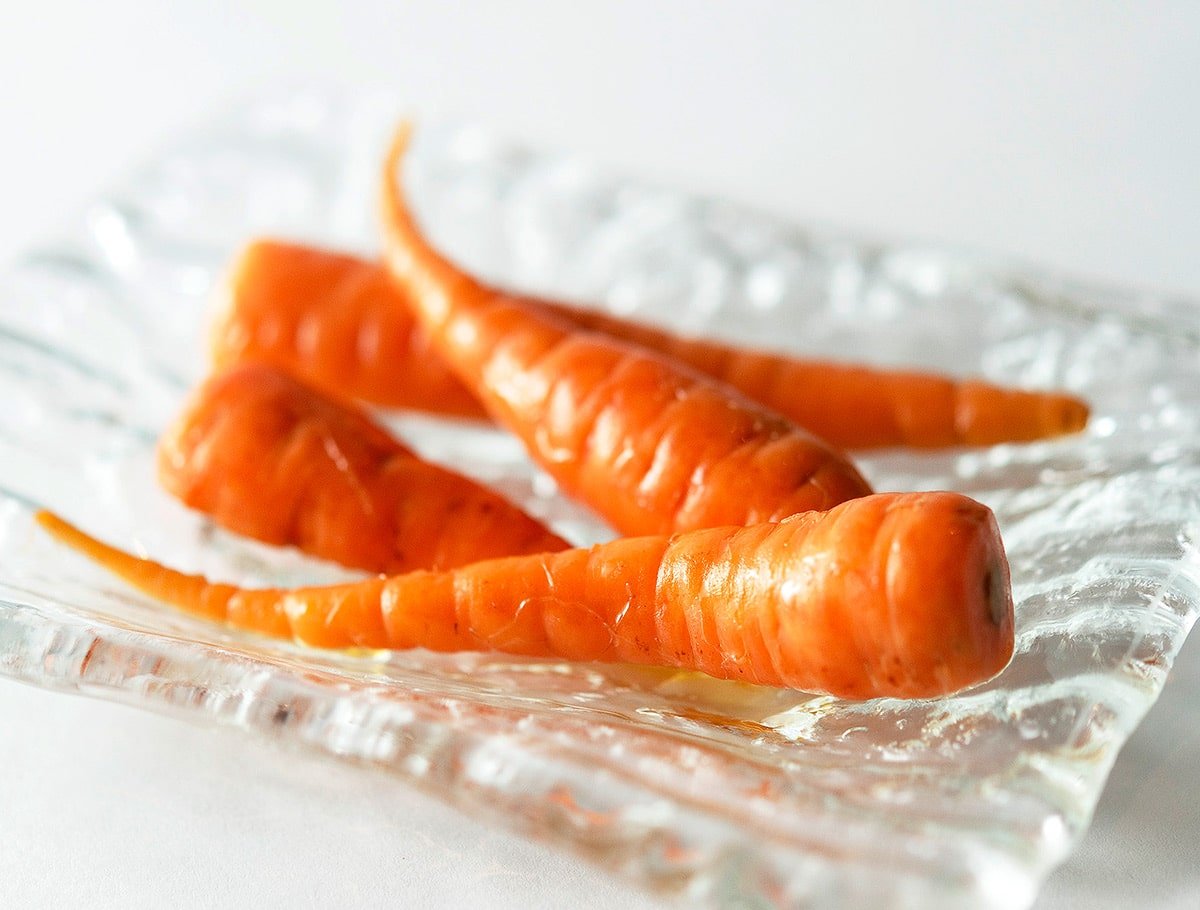
Obviously you will need carrots to do this, and you can basically ferment any sort of carrot — except for those monstrous field carrots, which are too thick. About 1 inch in diameter is as wide as you want them. Try using different colors. It’s fun.
You can make fermented carrots any time of year, but I find spring, late fall or early winter to be the best. The reason is because any sort of lacto-fermenting is best done when your house is coller than 70°F. The warmer the ambient temperature is, the harder it is to get the right mix of wee beasties to ferment your carrots.
So why ferment carrots? Other than the fact that you can make a tasty pickle with just salt and water, fermented carrots are better for you, nutritionally speaking, than vinegar-pickled carrots.
The same bacteria that make a tangy pickle help your digestive system, and lacto-fermented carrots are easier to digest (and tastier) than raw carrots.
Also, because fermented carrots are never boiled, the vitamins in them remain viable and available to you; vitamin C, for example, is notoriously volatile if heated.
Making Fermented Carrots
I’ve learned a lot about lacto-fermented pickles over the years from gurus such as Sandor Katz’s Wild Fermentation. Katz’s book The Art of Fermentation: An In-Depth Exploration of Essential Concepts and Processes from Around the World has become an object of obsession for me; it is the kind of book I wish I’d written, but am happy enough just to read.
The key to this kind of pickling is the proper ratio of salt to water and coolish temperatures: Hotter than 75°F or so and you enter the danger zone. This is why making fermented carrots is rarely a summertime endeavor.
You can use my recipe below, but for scale, shoot for about 2.5 percent salt by weight. And that is total weight, as in the weight of the water, herbs and carrots. You want 2.5 percent of that. Don’t go lower than 2 percent or higher than 5 percent.
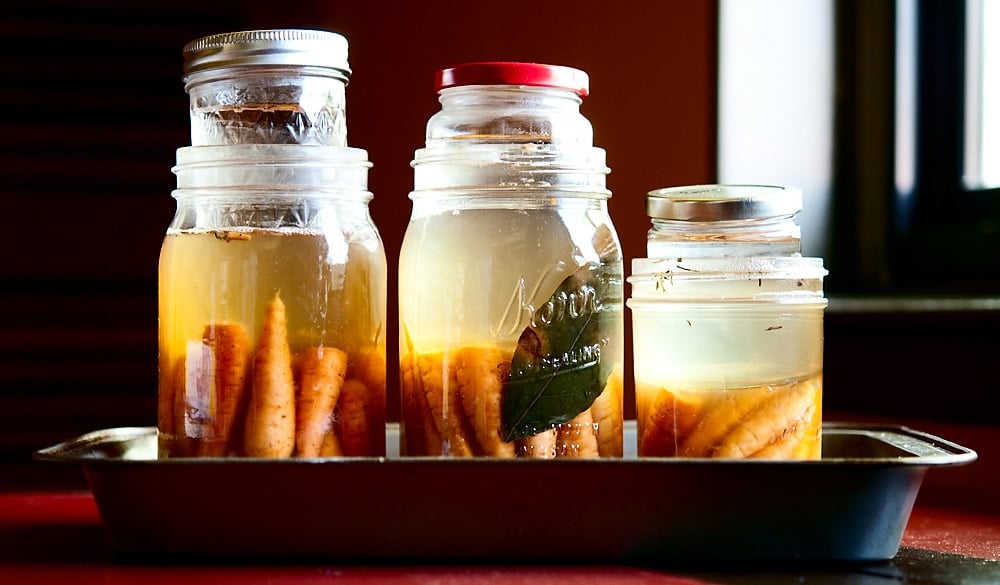
You’ll notice that the carrots in the picture above are well submerged in the jars. This is vital. If the carrots breach the surface, they can get moldy and soft and gross. You keep them submerged with either a smaller glass container that keeps them all under, as I did in the picture, or with plastic bags filled with the same brine you are pickling in.
How long does it take to ferment carrots? At least a week, really at least two weeks, and I prefer really tangy fermented carrots, so I let it go a full month.
The longer carrots ferment, the more sour they will be. Temperature matters, too. If your room is warmer than 70°F, the carrots will ferment faster. Anything colder than about 50°F slows the process down drastically.
My personal sweet spot is about 65°F — not so cold that I am freezing in my own house, but cool enough for a nice, slow ferment.
Troubleshooting
Things can go wrong when fermenting carrots. And more often, things can look like they’re going wrong when they are not. Cloudy brine is tops among them. The pickle brine will get cloudy as the fermentation continues. This is normal.
Another thing that happens is this wispy, white moldy thing shows up in the jar. That’s usually kahm yeast, and it’s perfectly harmless. You can pick it out if you want.
You can get real mold on the surface in long ferments. Spoon this off when you see it. This stuff you don’t want.
Bottom line: If your fermented carrots look nasty and are stinky. Toss them. Your natural senses will serve you well here.
Storing Fermented Carrots
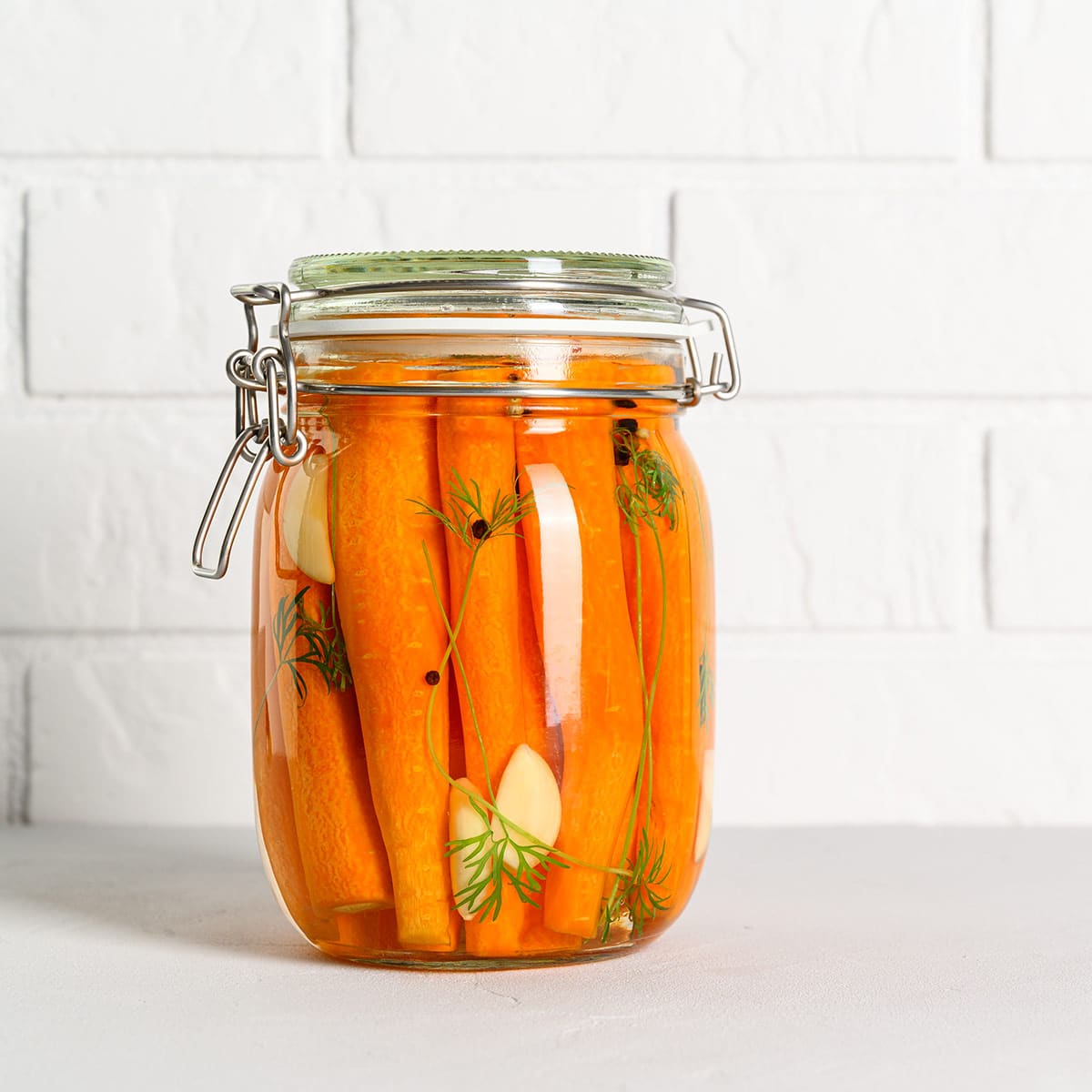
When the carrots are as sour as you want them, put the jar in the fridge. They will continue to ferment, very slowly, so you will want to eat them within a couple months.
Or, if you want to really stop the process, you can drain off the brine and simmer it for 5 minutes or so. This will kill the biological activity, but also deprive you of the good bacteria your innards are fond of.
If you are looking for more cool recipes for lacto-fermented vegetables, try my recipes for fennel sauerkraut, or pickled mustard greens.
Lacto-Fermented Pickled Carrots
Ingredients
- 2 pounds small carrots, peeled
- 4 cups water
- 3 tablespoons kosher salt
- 1 sprig of fresh thyme
- 2 bay leaves
- 1 dried hot chile
- 1 teaspoon cracked black peppercorns
Instructions
- Cut the carrots into discs the size you would want to eat at a cocktail party. Or leave them whole. Or split them in half lengthwise. The key here is to keep the thickest part of any piece no wider than about 1 inch.
- Boil the salt, water, bay leaves, black peppercorns and chile for a minute or so, then turn off the heat and let this cool to room temperature. This gets the flavors melding. Once the brine has cooled to room temperature, pack the carrots and the thyme sprig into a clean Mason jar and pour the brine over them, making sure the jars all get some of the spices.
- You will have leftover brine. Pour this into a plastic bag and tie it off. Push the bag into the jar — you want the carrots to be completely submerged in the brine. Alternately, fill a smaller jar that will just barely fit into the pickling jar with some water, screw on the lid and use that to prevent the carrots from contact with air. If the veggies hit air while fermenting, you get mold.
- Put the jar into a cool, dark place for at least 4 days. What’s cool? Cooler than 75°F. Like many things that ferment, 65°F is about perfect. Don't go colder than 45°F. You can leave the carrots in longer if you want — they will be saltier and tangier. I often ferment these carrots for a full month.
- Remove the bag or small jar from your pickling jar. To store your pickles, either do as I do and simply screw the cap on the pickles and put them in the fridge, or you can pour the brine into a clean pot and boil it. When it is cool, pour it back into the jar with the carrots and seal it up. If you want your pickles to be shelf-stable, you must boil the brine and then process it for 15 minutes or so in a hot water bath. Kept in the fridge, these pickles will last up to 6 months.
Notes
Nutrition
Nutrition information is automatically calculated, so should only be used as an approximation.






Try making escabeche this way, with cauliflower, carrots, onions, and jalapeños or serranos. One of our favorites. Add a little oregano.
Thanks of sharing ! For reference, I used 4 big carrots (1 lb) and 2 cups brine per at jar (including the volume in the weight bag).
Hi can I add one probiotic pill in there ?
Maggie: I have no idea, sorry.
Hank, can you explain step 3? I’m a bit confused. Once carrots and brine are in a jar, a bag goes in with it? Thanks!
Lindsey
Lindsey: Yes, the jar has no lid. The bag keeps the carrots submerged. Any method you can devise to keep the carrots submerged in the brine works.
Do I have to peel the tender home grown carrot before pickling/brining?
Evelyn: Nope.
This is the recipe that taught me that salt brine fermenting works on things other than cabbage. I love it, and it’s easy to adapt. (Curry spices like cumin, coriander, and fenugreek are a great variation – you end up with curried pickled carrots.)
Hi Hank…reading through the comments I’d say I’m experiencing something similar to eat Aaron describes. I made a batch according to recipe with some spice variation. The result after 4 days was simply a salt lick. I don’t min the salt but I had no tang at all. I waited 7 days with the hope that would change but still just salt and spice flavor. Is my only option for lacto-tang more time or can I reduce salt as Aaron hypothesized. I fermented at 64 degrees in a wine fridge.
Zach: I’d increase the amount of water in this case. It sounds like there is too high a concentration of salt in the brine. As a general rule, you want about 2 1/2 to 3 percent salt by weight of the carrots in the brine.
Also, what type of water you use matters. I’m betting those that didn’t work used chlorinated tap water. Chlorine kills yeast. Bacteria and yeast are what you need to ferment. Hence a dead ferment.
Hi Hank, I am really happy you are getting into fermentation more and more. I’ve been following you for a while now and was always a bit disappointed that you did not experiment with fermentation more. Good luck with the exploration!
Hi Hank
Tq for the reply.
I’m adding cumin, celery seed and black pepper to the beets – about a tsp each for my 5lbs of beets (it was on sale and I love juicing beets with cucumber).
I have made the purple cabbage sauerkraut and it is sitting pretty in a Tupperware(press down with another brine filled tupperware) but not tightly covered – can’t wait to taste it a fortnight from now.
I’m in the equator, so it’s summer year round and temp avg 30C. Maybe I need a fridge just to pickle them at 70F/20C for the first 2 weeks.
Regards
Hi Hank
Can I pickle beet roots like what you did with the carrots?
What spice would you recommend to compliment the beets.
Tq
Mase: Yes. Cut them into rounds or cubes and do the same thing. Cumin is a good spice with beets, as is celery seed or caraway or black pepper.
Just popped a jar for an antipasti plate. What a cool vegetable concoction. I can see why this is your go to for carrots. This will be a standard going forward.
I used my fermentation crock with the ceramic weights. Very interesting flavor at four days. I think I’ll jar and water bath them at seven days.
Instead of weighing the veggies down, I line the surface with plastic wrap, pressing out any air. This keeps the vegetables in the brine. If you’re worried about the plastic, don’t. High temps are not used so there is no leaching.
Hank, thank you so much for publishing this recipe. I have done kimchi awhile back and experimented with salty pickling, but have lost all my old recipes. (and they were great ones!)
I have made the brine and am waiting for it to cool and I would have to agree with one of the comments about it’s high saltiness. Pulling out the postage scale, I did some measurements to estimate the salinity of the brine.
Your recipe recommends 1/4 cups of salt per 4 cups of water. I weighed the salt (Diamond Crystal kosher) and it came out to 1.4 ounces per 1.4 cup. I also ensured the accuracy of my scale by measuring 1/4 cup of water, which came out exactly to 2 ounces, which is correct.
So, 4 cups (32 oz) of water with 1/4 cup (1.4oz) = 0.04375 = 4.3% brine.
In my limited experience, this seems quite high for a simple veggie like a carrot. If lacto-fermentation is a goal, then I would say that the relatively high salinity of this brine is inhibiting that process, which is probably why you are not experiencing much fermentation flavor. I believe that the salinity should be around the 2% range.
Oh, and I was curious as to what Morton’s Kosher salt would yield salinity-wise. I don’t have any, but found a site that gave the weight. Morton’s is 2.2 ounces per 1/4 cup, which is about 57 percent heavier than Diamond Crystal’s 1.4 ounces per 1/4 cup. (This makes me think that Diamond Crystal may not be *cheaper* than Morton’s–must investigate later.)
So, 4 cups (32 oz) of water with 1/4 cup of (2.2oz) = 0.04375 = 6.8% brine! That is quite a bit higher than using Diamond Crystal at 4.3% and, in my opinion, way too high for carrots. 🙂
I’m going to make two batches of carrots in parallel. One will use the brine at the recommended level in the recipe (which with Diamond Crystal would be 4.3%) and the other batch will have water added to it to bring it down to about 2.2%. Will try to report back results in a few days or a week. (Sorry for the long posting!)
We Polish folks love to make dill pickle soup with leftover brine and pickles. It’s a combo of chicken broth and pickle juice and celery, onion, carrot, shredded pickles and potatoes that’s been ever so lightly creamed. The next time you are in the Detroit area come check out Hamtramck’s Polish restaurants to give it a try. We met you at a book signing here and love your book. Can’t wait to buy the new one.
That sounds odd… but really good! Will try it this winter fer sher!
I wonder if you’d mind if I add a further comment (I’m not an attention-seeker!)
Weighing down the vegetables in jars, may be a problem for some, if we’re just using plain screw-top jars we’ve saved from previous uses. I have overcome this problem by finding some smooth, rounded, un-chipped, unblemished stones, of various sizes.
I have scrubbed them judiciously with a nailbrush, washing up liquid, and bleach, and washed them in the dish-washer, and stored them in a plastic box with a lid.
I prepare my vegetables, put them in the jar, cover them in brine, top up with a ‘cover’ of folded iceberg lettuce leaves, then press the appropriate stone on top. I make sure that the pressure of the lid pushes the stone down further, and really keeps all those delicious vegetables under brine.
So far, I have never experienced any contamination problems – but obviously, I wash and clean the stones as above, each time I have used them. I dry them carefully with a clean cloth or kitchen paper, and put them back into the store box.
If you decide to use this method, it’s really, really IMPORTANT to make sure the stones are flint, quartz or granite types, and not a porous rock!
Lynn and Rudy (I know these posts were AGES ago, but here goes):
The cloudiness is possibly due to a couple of possibilities:
Tap water that is chlorinated, and/or the type of salt used.
You need to either use spring water, or boil a good measure of tap water for 15 minutes, allow it to cool, and let it stand covered, for 24 hours, then use it to replace the brine in your jars, as per recipe instructions.
Just prepare the brine mix according to the recipe (but you could use fewer spices, as the current cloudy mix has already done some of that work!)and pour off the old cloudy brine. Fill the jar back up with the new cold brine, and make sure the carrots are submerged. I took a large outer leaf off an iceberg lettuce, folded it up, pressed it on top of the carrots, and closed the lid again. The lettuce leaf was also delicious!
If you used spring water, then perhaps it was the salt. Make sure the salt you use has no iodine, or anti-caking agents. These actually inhibit the fermentation process. Kosher or un-treated salt is best.
I found it best to sterilise my containers too.
I half-filled my glass jars with boiling water, then whizzed them in the microwave for 30 seconds. Remove (use oven gloves!) and empty. cover them with a clean, dry cloth, to allow the residual heat to evaporate any remaining droplets of water. I Sterilise the lids too, by pouring boiling water on them, in a bowl, and leaving them there until required.
Hope all this helps!!
Benboom. No, you can’t use frozen carrots. They get too salty and lose their texture. And no, 1/4 cup is most definitely not to much. But I use Morton’s Kosher salt. If you use Diamond kosher salt, which is cut finer, you might then be getting too much salt. Also, this is a salty pickle — that’s a natural part of this process. The “sense of fermentation” is never really that noticeable, i.e., tang or sourness.
After four days my carrots taste…incredibly salty, that’s all. I can tell there is some chili there, but I get zero sense of fermentation. But I have to say, 1/4 cup of salt is way too much.