
As an Amazon Associate I earn from qualifying purchases.
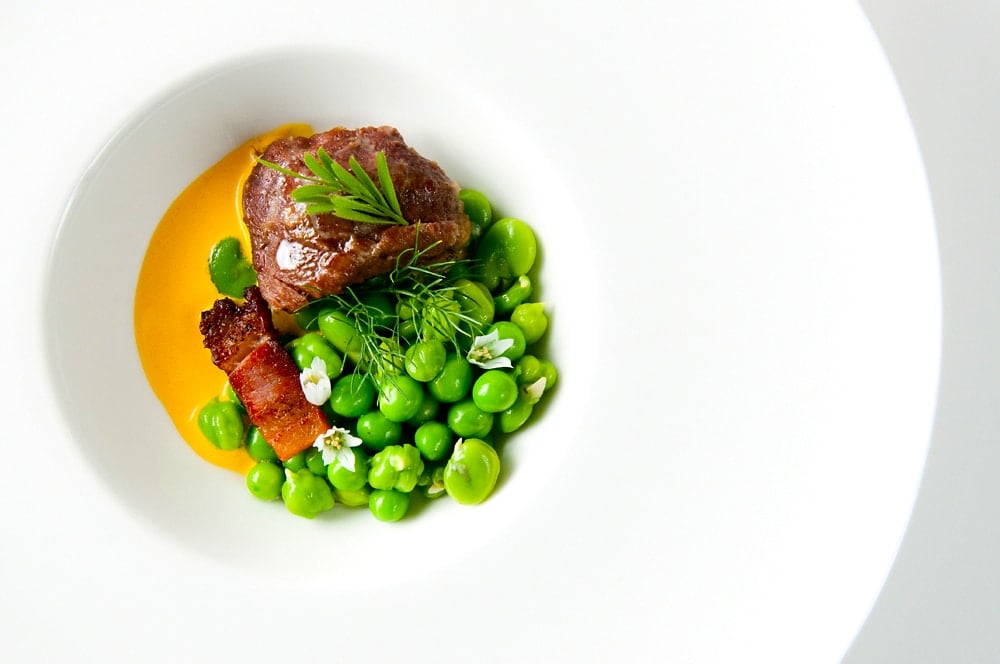
Time for a pretty dish. I call this one Cheek by Jowl because, well, that is exactly what it is: slow-braised pork cheek next to a baton of crispy-fried guanciale, which is jowl bacon. Oh yeah, and there are fresh peas, fava beans and chickpeas, a saffron-cream sauce and lotsa cool spring garnish. But let’s face it. This is all about the pork.
This one is worth your time. The braised cheek falls apart with a fork. And who doesn’t like crispy bacon? The various legumes are bright, slightly sweet, yet substantial enough to play the part of the starch.
The saffron-cream sauce is drop-dead gorgeous — I have a thing for mixing yellow and green — and its silky, slightly barnyardy-grassy aroma (that’s the saffron) link everything together. As a good sauce should. Finally, each garnish adds a flavor note: onion flowers, fennel frond, vetch tip.
The one down side to this dish? It’s small. It will not fill you up unless you have other courses. So plan accordingly.
Making Cheek by Jowl might look intimidating, I know. But it actually isn’t all that tough to make. In fact, the hardest thing to come by is the pork cheek. I got these off Matilda the Wild Pig, so I had an advantage. You can order pork cheeks from really good butchers, and you can buy pork cheeks online. 
You can’t really make a dish called Cheek by Jowl with no cheek. Beef cheeks, however, are more readily available. I’ve even used javelina cheeks.
Or you could scrap the whole name thing and just use a little bit of pork shoulder or neck meat. Hell, you can skip the guanciale and use thick-cut regular bacon. The dish will still be good. But it won’t be Cheek by Jowl…
Braised Pork Cheek with Jowl Bacon
Ingredients
CHEEK:
- 4 pork cheeks, or 1 1/2 pounds beef cheek, cut into portions
- Salt
- 1/4 cup lard
- 4-6 fresh sage leaves
- 2 tablespoons sherry vinegar
SAFFRON SAUCE
- 2 tablespoons unsalted butter
- 2 tablespoons minced shallot
- 2 tablespoons white wine or champagne
- Salt
- 1/2 cup heavy cream
- 1/2 teaspoon saffron, crumbled
PEAS AND JOWL
- 2 teaspoons lard
- 1/4 pound guanciale, cut into batons
- 1 cup shelled peas
- 1 cup shelled fava beans
- 1 cup shelled fresh green chickpeas
- Onion flowers, pea or vetch tips, fennel fronds for garnish
Instructions
- Salt the cheeks and put them into a vacuum seal bag with the lard and sage. Seal and cook sous vide at 180 degrees for 8-10 hours. If you don't have a sous vide machine, nestle the cheeks in a heavy lidded pot with the lard, sage and enough chicken stock to cover. Put in the oven at 200 degrees and cook until tender, about 6-8 hours.
- While the cheeks are cooking, bring a large pot of water to a boil. Add plenty of salt; it should taste like the sea. Boil the peas, favas and chickpeas for 90 seconds. Remove them and shock in a bowl filled with ice water. Once they are cool, set them aside in a bowl.
- Add the 2 teaspoons of lard to a small pan and fry the guanciale until crispy over medium to medium-low heat. Set aside and reserve the fat.
- When the cheeks are ready, make the saffron sauce. Sweat the shallots in the butter over medium heat until they are translucent. Do not let them brown. Add the white wine and boil this until the wine has almost all evaporated. Add the cream and saffron and stir well. Bring to the steaming point, but do not simmer. Add salt to taste. Let this cook for 10 minutes or so, then strain it through a fine-mesh strainer. Return to the heat just to keep warm.
- To finish, toss the peas, favas and chickpeas with the reserved fat from the guanciale, plus a little of the braising liquid from the cheeks. Paint the cheeks with the sherry vinegar.
- Plate by pouring a little sauce in each plate, Top with some of the pea mixture. Lay the cheek on one side of the plate, one or more crispy pieces of guanciale on the other. Garnish with the onion flowers, fennel frond and pea or vetch tip.
Nutrition
Nutrition information is automatically calculated, so should only be used as an approximation.



This recipe is awesome. I made this like four years ago and loved it. Only 1 5 star review? Come on, make it you will not be disappointed!
Hank and Company,
I am looking for a beef cheek taco recipe. Also known as cabaza tacos. Any leads??
Thanks!
Jeff: That’s basically barbacoa.
Made this last night, came out great. Unfortunately I was out of saffron, but the meats were so rich it was ok.
ok, gorgeous dish. wow. i’m definitely using that saffron sauce. again, can you open a shop and sell all these wonderful meats?
Great name, great color.
Ah – excellent information to know going forward
Much appreciated
Nathan: What you are getting then are not pork cheeks, they are pork jowls. There is a difference. The jowl can include the cheek meat, but the cheek never includes the jowl. The cheek is a lump of meat and connective tissue at the core of the jowl. You can see on my 100-pound wild pig it is no larger than the center of your palm. A jowl is huge by comparison.
You should be looking for a butcher who knows the difference between a cheek and a jowl. 😉
I have tried to use pork cheeks in several dishes but every time I get my hands on fresh cheeks there is too much fat. I understand that this is supposed to be an excessively fatty cut but after braising the jowl am left with nothing more than melted fat and no cut of meat to speak of (almost like overcooking foie). However, from the photo it looks like a fair amount of protein is present in your cheek.
Should I be looking for meatier cuts of cheek? Is sousvide the only answer?
Anyone have the direction I need for successful cheek cooking?
-Nate
Ruth – I am happy to verify that bear fat makes excellent pastry, though as it is softer once rendered than either butter or lard the final product can be very delicate. Sometimes I mix it with another fat. It does add a nice almost savory flavor to pie crusts, which makes it fantastic in an apple pie with a filling more on the tart side and served with very sharp cheddar instead of something like sweetened whipped cream. You can also grease your boots with bear fat.
Bear meat makes great pulled sandwiches with BBQ sauce.
Jamie: Sorry, I don’t have one ready yet. It’s on my to-do list for instructions.
Stef: Nope, I’ve not tried that. I am pretty extreme, but 36 hours is a bit long, even for me. 😉
Ruth: Absolutely. Do me a favor and let me know how it goes for you. I am still pretty new at working with bear meat.
Would this recipe work with bear cheeks? My hubby is planning on shooting a bear this spring (I hunt too but only for meat that we can eat!) and I am wanting to try some of the bear meat. I have heard that the fat makes great pastry too so I will try that as well.
All I can say is… awesome!
I love the style and presentation, colours are fantastic.
This looks so good. Will definitely give it a try. Have you tried doing cheeks at say 140F for 36 hours? It would be a completely different texture but might be interesting.
this looks awesome hank,
never thought about grabbing meat from the head of our wild boars, are there instructions somewhere for skinning out the head?