Tuscan Rabbit Ragu with Pappardelle

March 11, 2012 | Updated March 24, 2020
As an Amazon Associate I earn from qualifying purchases.
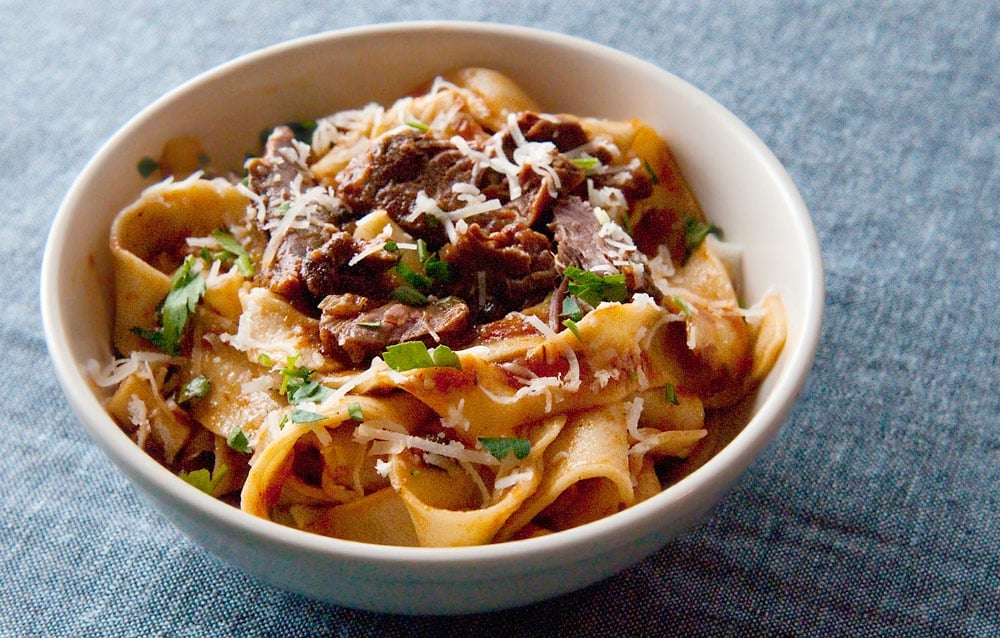
If there were a classic hare recipe, a dish that everyone has eaten, you could make a case for this one: Tuscan rabbit ragu with fresh pappardelle pasta.
The dish is well within the canon of Tuscan cuisine, just as the equally famous civet de lievre is in French cooking. Never heard of that dish? We English speakers call it jugged hare.
Hare is not often eaten in the United States. In fact, with the exception of the snowshoe hare in the north country, we don’t even call our native hares by that name: We call them jackrabbits. But make no mistake, a jackrabbit is a hare. What’s the difference? Quite a bit, actually.
Hares give birth to “precocious” young, meaning they can hop away from danger minutes after birth. Rabbits give birth to helpless little pink things. Hares are larger, smarter, faster — and in the kitchen, tougher — than are any species of rabbit. Jacks are to cottontails what pigeons are to doves, geese are to ducks, elk are to deer.
That said, unless you are a hunter, good luck getting your hands on a hare. So just use rabbit instead; most of the Italians do.
Most classic recipes for rabbit ragu will have you marinate the meat for up to 2 days in wine, vinegar and herbs. I altered this step by marinating the rabbit in buttermilk for 24 hours. Why? The meat smelled strongly of sage, and not in a good way. Buttermilk both tenderizes the meat (it’s the acid) and pulls out a lot of “off” aromas. If your jackrabbit doesn’t smell sagey or you are using a regular rabbit, you can skip this step.
And if you buy a hare, which to my knowledge you can only do online through D’Artagnan, you can just marinate it in wine and herbs as normal.
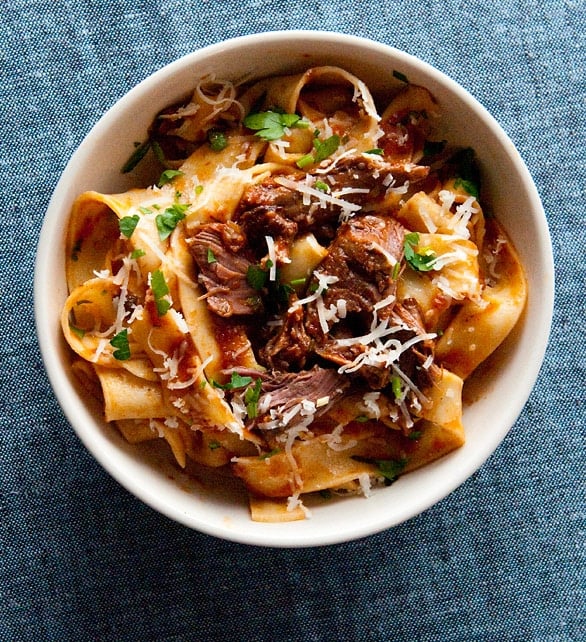
What does this taste like? Well, honestly it tastes a lot like a Bolognese sauce: Meaty, rich, tomatoey without being a true tomato sauce. The hare tastes a lot like well braised lamb and a little of the sauce goes a long way. If you’ve never eaten hare before, this would be a good way to start.
Tuscan Rabbit Ragu with Papparedelle
Ingredients
- 3 tablespoons olive oil
- 2-3 pounds hare legs, or lamb or beef stew meat
- Salt
- 2 cups chopped onion
- 1 cup minced carrot
- 1 cup minced celery
- 2 tablespoons sage leaves, chopped
- 2 tablespoons rosemary, chopped
- 2 bay leaves
- 1 handful dried porcini mushrooms, about 1 ounce, chopped
- 2 tablespoons tomato paste
- 2 tablespoons red wine vinegar
- 1 28- ounce can crushed tomatoes
- 1 cup red wine
- Parsley and grated cheese to garnish
Instructions
- If you need to soak the jackrabbit pieces, submerge them in buttermilk overnight. The next day, hack them into large pieces with a cleaver or kitchen shears. This will make them cook faster and fall off the bone easier. Rinse the hare under cold water and pat dry with paper towels.
- Heat the olive oil in a large Dutch oven over medium-high heat. Brown the hare pieces well. Take your time and do this in batches. Don't let the pieces touch each other as they brown. Salt them as they cook. When browned, set aside.
- When the meat has been browned, add the onion, carrot and celery and cook, stirring occasionally, until the veggies begin to brown. Add the meat back to the pot, then the sage, rosemary, bay leaves and dried mushrooms. Mix well and allow to cook for a minute.
- Whisk together the tomato paste and wine and add that to the pot. Add the vinegar. Turn the heat to high to bring everything to a boil, then add the can of crushed tomatoes. Mix well, drop the heat to a bare simmer -- only a few bubbles coming up to the surface -- cover and let this cook until the hare meat wants to fall off the bone, up to 3 1/2 hours.
- When the meat is tender, fish out the bay leaves and discard. Remove the hare pieces and pull the meat from the bones. Return it to the pot. Ladle out about 1/3 to 1/2 of the sauce and put it into a food mill with a medium grate attached. Alternately, put it into a food processor or blender. Puree, meat and all. If you use a food mill you will have some dry, stringy hare meat left in the mill; discard or feed to your pets. Return the puree to the pot.
- Serve with pasta of your choice. I serve by putting the pasta in a large bowl, tossing it with a ladle of the sauce, then plating. I top each plate with some more sauce, then some parsley and some grated pecorino cheese.
Nutrition
Nutrition information is automatically calculated, so should only be used as an approximation.



I have made your excellent recipe this year for the second time. First year I made it with “game poulet” as it was named here in Holland. This year with hare legs. Now I have made this a couple of times I have a few questions, if you don’t mind:
1) About marinating the legs. For 4 legs I added 1 bottle of red wine, 100 ml of red wine vinegar, 2 bay leaves, some sprigs of fresh thyme, two onions (chopped), I think 5 black peppercorn (smashed), 5 juniper corns (smashed). No garlic. Would that also be your choice ? These ingredients and in these quantities ?
2) In some hare recipes they add the sage, rosemary, onion, celery, carrot to the marinade and re-use that when cooking the hare. Is there a specific reason you chose to cook the herbs and vegetables with the hare and don’t add it to the marinate ? I must say I like it a lot but just a question
3) You add a 28 ounce can of crushed tomatoes. I like the rich sauce, but I noticed that on most Italian sites they only add some tomato paste. Is this your personal preference or is it based on some Italian recipe ?
4) One last question. I had the hare marinating for one day (I believe it should be two days) and then cooked the legs for about 3 hours in the sauce. When pulling the meat from the bones some legs had quite some red coloured meat on the bones. How to prevent that ? By the way, I did cook the shredded meat for another hour in the sauce
One last thing …. I really love this recipe !!!
Jan: To answer your questions:
1. Sounds good. Seems a bit heavy on the wine, though. I’d drink a glass before pouring it onto the hare.
2. Because the vegetables won’t add much to the flavor of the hare in the marinade, and I prefer them as-is in the sauce rather than soaked in wine.
3. It’s my personal preference. Either is fine, though.
4. Not sure about this one. Sounds fine though.
Hello Hank
Thank you for the inspiration to make this amazing recipe.
The Ragu was all that you said and more. Meaty and very flavourful.
The combination with the homemade Pappardelle was truly an amazing success.
Thanks again. I will be making this again as soon as Jack rabbit season comes around.
Hank, I had to make some changes to this recipe due to Circumstances (being far away from a Whole Foods/Artisan Food Store is the price one pays for being able to hunt rabbit in one’s backyard), but all in all it turned out amazingly for my first time hunting antelope jack.
You would not believe the amount of commentary I got for daring to eat a jackrabbit from my coworkers, but I told them if their bar for edible is “can I eat burgers or steaks from it”, they’re missing out on a lot of good eating.
Do you have a recipe you’d recommend if you get a good set of backstraps off a jack?
This recipe is currently on a low simmer at my stove but I couldn’t wait to say : THANK YOU! It tastes fantastic and I’m sure the flavors will only develop as time goes on. I felt entirely out of my element as I harvested a hare 2 days ago – but your posts on butchering and myriad of recipes and information has really helped me feel like I can totally handle the challenge. Thanks for your attention to detail and enthusiasm. It’s contagious.
One substitute- I had to use dried crimini mushrooms as I couldn’t find porcini, even at Whole Foods. I used about .75oz. I’m sure the flavors are a bit different, but the earthiness and supple smoothness of the crimini is a beautiful addition to the stew. It showcases the rosemary and other flavors so well.
I can’t wait to try more of your recipes as it’s just the beginning of hunting season this year! Entirely gracious for your work on this site and the care you take to be absolutely thorough.
This is excellent with Nevada desert hare. Tried your Sardinian hare stew recipe last week which was clean and light. That was good, but this one is lusty and rich. I’ll take lusty and rich. Well done, Hank. Thanks for sharing this.
A quick comment regarding the meat…. you could use any red meat for this sauce. I was actually thinking of trying pork next time.
The results are in……. this recipe is AMAZING!!!!! Firstly, I used beef stew for the meat, otherwise I would be eating alone. I did not have sage or mushrooms on hand so that was omitted and I used maybe have the amount of Rosemary because I find it to be a very dominating spice. I did soak the meat overnight in buttermilk. I used standard red cooking wine found at any food store. As for cooking, I used a large frying pan to start the sauce, and then transferred the sauce and seared meat into my electric crock pot on high for 3.5 hours. By the 3rd hour, the meat was falling apart. Lastly, I put the sauce and meat into my food processor, just a pulse or two was all that was needed to make the meat fall apart. I served this over papperdelle which is the perfect pasta to serve this with.
This recipe will be used repeatedly, the entire family devoured it! Thank you for sharing this recipe!!
I am currently making this recipe… I have it in my crock pot right now, hour and a half to go! Smells delicious and the few tastes tests I had so far were fantastic.
Tom: Yep, one black-tailed jackrabbit should be enough.
Viicky: I think wild boar would work pretty well, actually. Give it a go and let me know how it turns out.
This looks delicious. Think this would work with wild boar meat?
I’ll be making this one soon, probably this weekend. Do you think one whole blacktail will be enough?
My great grandmother homesteaded in Northwest Kansas and she commented that she was a little sick of eating jackrabbit all the time growing up. They used to drive them in herds and whack them by hand. I doubt she had this “exotic” recipe in the early 1900’s in rural KS. Since she made it to 103 years, maybe a little jackrabbit does the body good!
The last black-tailed jackrabbit I shot in KS was long enough that his front feet touched the ground when holding his rear feet near my belt. That was some time ago, and my mother pressure cooked it. I think she did it because she wanted it dealt with and gone with haste. She warned of the gamey flavor, yet topped with BBQ sauce it was quite tasty, dark meat. Tender too, thanks to the pressure cooker. This dish looks good, so I think another jackrabbit is in order next time I visit the plains.
Delicious! There are a lot of Jack Rabbit up here where I live as well. Been contemplating a small game license for the upcoming season. Would be nice to take advantage of delicious recipes like this one.
Haha Marcus! Being from Wyoming there are a few jackrabbits and people do do a lot of cooking with rabbit, deer, antelope. I am going to print this receipe off for a coworker who I am sure will be trying this receipe!
I saw a few jackrabbits while hunting in Wyoming last fall. Thinking I should bring my .22 along on the next trip.