Well, if it’s summer, it is zucchini time. Backyard gardeners everywhere are sneaking around, laying baseball-bat-sized zukes on people’s doorsteps, ringing the doorbell and dashing off into the night. OK, maybe not. But this is my favorite way to deal with a huge surplus of zucchini. Originally posted on July 2, 2009.
_______
It’s zucchini time in California. The annual Overrunning of the Squash has arrived. Yes, fresh zucchini are good — excellent, if you get them before they’re as big as truncheons — but anyone who grows zukes always has too many. And don’t get me started on zucchini bread. Not a fan.
I pickled some zucchini last year and they were good, but not as good as cucumber pickles. How else could I preserve them? Drying.
I’d read somewhere that the Southern Italians sun-dried their zucchini to keep them through the year. I’ve even seen a web page offering dried zukes from Sicily jarred in olive oil — at $10 plus shipping. Seriously?
But, try as I might, I could find no recipe or method for sun-drying zucchini anywhere on the web, or in my not insubstantial cookbook library. So I improvised.
I began by slicing the squash into disks. I then sprinkled salt on a large cookie sheet and set the disks down on them, and when the cookie sheet was filled I sprinkled the tops with salt.
I let this sit an hour. Now zucchini are basically squash-flavored water, so I was pretty sure an hour would draw out a lot of moisture and get the salt all the way into the slice — to preserve it from mold. It worked. Too well, in fact. In my next batch I’ll only “cure” them for 40 minutes if I am not going to put them up in jars. After an hour, the zucchini is borderline too salty to eat fresh, but would work well as a preserved product.
How to dry them? This took some thinking. I’d heard that the French string-dry their zucchini like apple rings, so I tried doing that. Not so good. The string will sag and the zucchini will all touch each other, slowing drying and trapping moisture — promoting mold.
Better was a metal or wooden skewer. At first I hung these in an ingenious ghetto fashion: I attached the skewer to the clips on the kind of coat hanger designed to hold skirts or pants. Nice, but then Holly couldn’t dry her clothes. I then switched to using our sausage/pasta drying rack.
These zukes above had been drying for a day in our very hot, very dry garage. I guess it was about 110 degrees in there at its peak, “cooling” to 70 at night. At that rate, the zucchini only took 36 hours to get to the soft, quasi-dried apple texture I wanted.
Could I have dried them all the way? Sure, but then I’d need to reconstitute them, and why bother? I might have dried them another 12 hours if I wanted to preserve them in oil. When they’re done, they look like this:
Kept like this in the fridge, I bet they’d last months. In this state, zucchini are still pliable and soft, but feel more like soft leather than watery squash disks. Chewy instead of crunchy. Savory instead of thirst-quenching, as a raw zuke can be on a hot day.
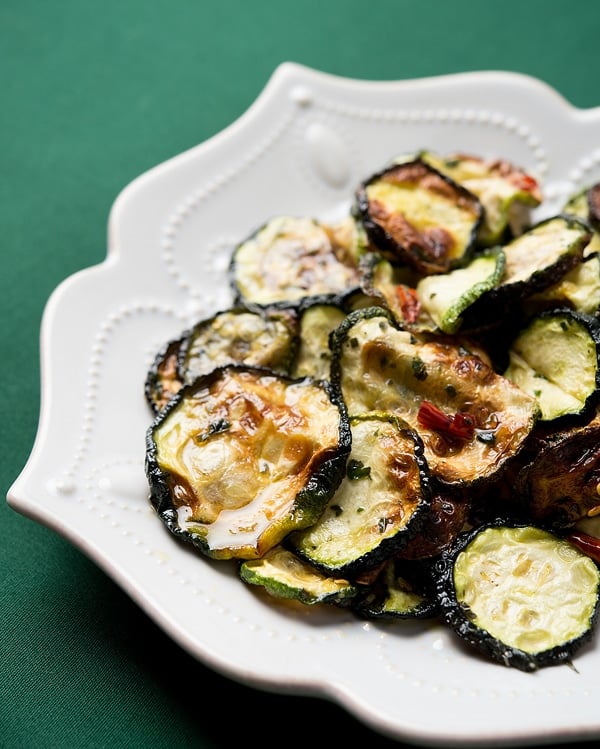
I plan to make more of these to preserve in olive oil later. But to start I wanted to cook these as I’d heard the Sicilians do: In olive oil, with mint and chiles. Holly thought I should add garlic, and I might do that next.
The dish couldn’t be easier, although there is one tip I can offer: Dried zucchini lack the water that normally causes that pleasing sizzle in a hot pan, so you might think you’re not heating the squash enough at first. Trust yourself, they will brown nicely. Keep turning them over until you get the look you want. I like a combination of well-browned bits with those just kissed by flame.
Make more of these than you think you need — Holly and I ate four zucchinis’ worth at one sitting with no trouble.
______________
SICILIAN SUN-DRIED ZUCCHINI
I had heard that the Southern Italians sun-dried their zucchini, and then either put them up in jars covered in olive oil, or sauteed them as a side dish. I never did find an Italian recipe, so this one is entirely mine. I think it works pretty well, and will be making this all summer long — it’s a textural thing: The dried zucchini concentrate what flavor they have, and with less water, become meatier — if I had to serve a vegan, this would be on the menu.
Use a dehydrator if you are in a moist climate, but here in Sacramento I just strung these on skewers and let them dry in our blazing hot garage for 36 hours.
Serves 4 as a main course, or 6 as a side dish.
Prep Time: 36 hours
Cook Time: 5 minutes
- 4 zucchini
- Salt
- Skewers
- 2 tablespoons olive oil
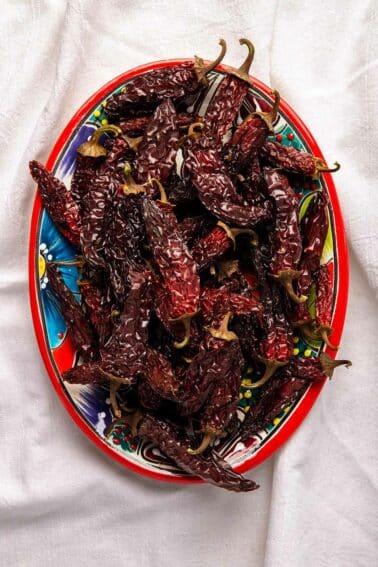
- 1/2 teaspoon cayenne or espellette pepper
- 2 tablespoons fresh mint, chopped
- Juice of half a lemon
- Slice zucchini into disks about 1/4 inch thick. Sprinkle salt on a large cookie sheet or two, then lay the zucchini on them. Sprinkle more salt on top. Leave at room temperature for no more than an hour — the longer you go, the saltier the zucchini will be. If you plan on preserving these in jars, go the full hour.
- Pat dry with a towel and skewer. Hang the zucchini in a hot dry place for 24-48 hours, depending on the temperature. You want them to be dry, but not hard. Think soft dried apricots…
- Once dried like this, they can be stored in jars, covered in olive oil, for months in the fridge.
- When ready to cook, heat the olive oil in a large saute pan over high heat until almost smoking. Add the zucchini rounds and toss to coat with oil. Turn the heat down to medium-high and cook until browned, about 3-4 minutes.
- In the final minute, add the cayenne and toss to combine, then do the same with the mint. Turn off the heat.
- Squeeze the lemon juice on the zucchini when you are ready to serve.


If you’re interested Hank, I have a great recipe for a Northern Italian torta that can be done with zucchini. Very rustic. Got it from my wife’s grandma, who got it from her mother who brought it with her through Ellis Island.
Let me know.
Nice. I like the non-dead animal dishes.
Hank – my mouth is watering! These look great.
I could just cry… my zuks won’t grow, and neither will my cukes. I’m certain my soil has a bacterial wilt in it… Next year, new soil, and big, raised beds.
In the meantime, I’ll bum some off the fam damily.
I’m overrun with tiny green and deliciously tart apples growing in my backyard. With over 7,000 varieties, I wouldn’t hazard a guess as to what they are, but I never suspected it was an apple tree. I’ll trade you my mystery apples for some zuccinni!
By far my favorite way to eat zucchini is a sort of a flash-drying process: Slice them very thin lenthwise on a mandoline, like 1/8 inch, then put them on a hot charcoal grill for 30 seconds or until they just begin to brown, turn, grill 30 seconds more, and then spread on a plate and drizzle with salt, olive oil, and fresh spear mint. One grill-full tends to correspond to one layer. The texture is incredible, fully cooked but al dente rather than mushy. I’m told this is a Neapolitan preparation; it’s clearly closely related to your Sicilian style.
Any word on the lard crew?
Rob: Yes! Sent it along.
Rebecca: These zukes were from farmer’s market, but I might have a need for those apples…
Ben: Sounds excellent! And I’m having some trouble rounding up Sacto folks who need pork fat. OK all you who are reading this: If you want some Bledsoe pork fat, email me so we can set up an order!
While I would happily kill for good pork fat, Pennsylvania is not exactly in your neighborhood (although I’m on vacation in Seattle, but still too far off…sigh…)
On the other topic, while I realize that zucchini bread is not everyone’s thing, I do have a fabulous recipe for a chocolate zucchini cake that could seriously drive you to distraction.
Intriguing combination of ingredients and techniques. I’ll have to try it out, but first we need to grow the things! Hoping to have our first squash by Aug 1.
As long I get a taste of whatever the apples become, we’ve a deal. You and Holly should swing by and grab a bag.
The zukes are overrunning the garden here so this post comes in real handy Hank. Thanks to all for their recipes
Zuccini is the only vegetable with it’s own zip code.
Advice picked up from Cornell on growing squash. Do it in containers with new potting soil each year.
Hank,
Don’t forget the often neglected Zuccini Cannon for purposes of home defense. Squash on.
DMS
wow… in love with this idea. really, really in love with it. i wish i had more damn space to do things like this.
I worked in Trenton when I got out of college and there was this joke that I heard in the “Little Italy” section of the city In late summer, you need to keep your car doors LOCKED or you will find your backseat full of Zuccinis in the morning. Everyone had gardens and grew the stuff.
Many years ago, when Molly O’Neill had a column in the NYTimes Magazine, she wrote about growing up in the kind of place where no one ever locked their cars. Except in zucchini season, when, if you left it unlocked, you would come back to find your car filled with zucchini.
Just found you (via Cottage Smallholder). Thanks for the zucchini tips. Since I just signed up for my hunter safety class, I’ll be back for the game recipes.
PS — And just now I see that another commentor heard the same story! It got around, I see.
[...] So, you got a few zucchini left over from yesterday’s excursion to the garden or from your friend’s last visit 10 minutes ago? Read the tale that goes along with the recipe from Hank Shaw, aka Hunter Angler Gardener Cook, and “boyfriend” of outdoor blogger Holly Heyser, who does most of Hank’s food photography. Lucky gal, lucky guy and lucky us … ‘cuz this zucchini recipe looks mouthwatering marvelous. See http://www.honest-food.net/blog1/2009/07/02/what-to-do-with-all-that-zucchini/ [...]
[...] fruit and vegetables. Hank over at Hunter Angler Gardener Cook had me licking my lips over his dried zucchini. But we don’t have a sweltering garage and I didn’t want to waste fuel running the oven all [...]
Having made my way here via The Cottage Smallholder, and with the inevitable glut of zucchini (or courgettes as we like to call them), I am now desperate for Rob’s Northern Italian torta recipe.
Can you pass it on please?
[...] aside from a plan for zucchini bread/cake/muffins, trying out Sun-dried Zucchini, and wondering about the feasibility of zucchini chips…I’m on the search for fresh [...]
Your homebrew squash drying method reminds me very much of the traditional Hidatsa Indian technique described in “Buffalo Bird Womans Garden.” I have found it an interesting read and you may also enjoy it.
Hank this is awesome! Going to make these this week.
Great idea! I love the thought of putting the stifling heat of our garage to good use (not to mention the loads of zucchini that our garden is already producing).
I’ve frozen zucchini before and it works, but not great – I’d much rather dry it and this sounds wonderful.
I’ll second you on the zucchini bread and another commenter on the chocolate zucchini cake – it is wonderful, so moist, so rich!
If you were to preserve them in olive oil with herbs and chili, would you need to process them in a water bath? I feel like that may turn the zukes to mush. Does the cure/drying process take care of preventing bacteria growth and botulism? I think people would appreciate zucchini as a gift if it came canned in olive oil. Thanks for the idea, I look forward to experimenting!!
Joey: I did not process mine. I kept them on the shelf, totally covered in olive oil — with all the air bubbles pushed out — for 6 months and they were still good. I am pretty sure the cure/drying takes care of any botulism issue, but I am not 100% certain. Any microbiologists out there?
Oh my god, this recipe looks amazing! So unusual and yet so simple. Can’t wait to try it!
Hi Hank, A couple of things: we found a good book you might be interested in: “Preserving Food without Freezing or Canning” by The Gardeners & Farmers of Terra Vivante. (see: http://www.amazon.com/Preserving-Food-without-Freezing-Canning/dp/1933392592/ref=sr_1_1?s=books&ie=UTF8&qid=1310737581&sr=1-1)
The zucchini and beans are coming hot and heavy with the tomatoes to follow soon. So your reprint is most welcome. We have one of those tent green houses with wire shelves that gets up to 120 everyday. The screened doors keep the insects off the veg. So we cut up two giant zucc and spread them over the shelves. I’m hoping this works – I hate canning.
Yesterday the question of botulism came up for us too. “Should I ask Hank?” I said to Masha. But I see someone has beaten me to it.
As far as we can find out (see: http://www.foodsafety.wisc.edu/consumer/fact_sheets/Botulism.pdf) botulism is an anaerobic bacteria that creates spores found. It’s found in the soil that forms a toxin as it grows. So storing the veg in oil won’t kill the bacteria – it’s anaerobic – it needs a no air environment to grow. And if the bacteria is present the toxin gets formed. Cooking the veg before you eat it will kill the bacteria, but the toxin will still be present. It seems you need to kill whatever bacteria might be present before it creates the toxin. The above book recommends a boiling vinegar bath for the dried veg that is then poured off prior to preserving in oil. The acid kills the bacteria making a sterile environment.
All this said, I am NOT a microbiologist so take whatever I say with a very large grain of salt. In addition these methods have been used for millennium to preserve food. You’d think that they wouldn’t still be used if they routinely produced a poisonous product. Finally I have no idea what the temperature required to kill the bacteria is. Our compost pile gets up to 120 and is supposed to kill everything. If I dry the veg in a 120 degree greenhouse, you would hope that would also kill everything. If anyone has any better information, we would be very interested to hear.
Congrats on the success of your book.
Best, Kim
Looks like my above note is incorrect. The toxin is rendered inert by cooking, but the spore is not destroyed and can create more toxin if stored in an anaerobic environment. E.g.: canned veg can produce botulism even after being heated. Stored raw garlic in oil is especially known to be botulism prone. See: http://en.wikipedia.org/wiki/Botulism
So I wrote to the author of the article I cited above. Our correspondence follows:
Hi Barbara,
My wife and I read your Botulism fact sheet (http://www.foodsafety.wisc.edu/consumer/fact_sheets/Botulism.pdf) and have a question. We have an excess of summer vegetable and would like to dry and oil cure some for winter use. We have an unused greenhouse that gets up to 120º where we dry the sliced veg. Is this hot enough to kill the C. botulinum bacteria? Do you think additional precautions are necessary? One recipe we found calls for dipping all dried veg and herbs in boiling vinegar prior to encasing them in oil.
Please advice. Many thanks.
Kim
Answer:
Kim,
We do not recommend storing vegetables in oil for the reason that you cite – risk of botulism poisoning. If you were to do this, the vegetables must be very dry, water activity less than 0.85. The greenhouse temperature might kill the vegetative cells of C. botulinum over time, but would not affect the spores. It is the spores that we worry about.
Barb
After I dehydrate tomatoes I pack em in bags and store in the freezer ..just to be safe. Maybe that would also work for the dried zucchini?
My mother-in-law (Maltese) often uses zucchini (although she prefers marrow). Her recipe is quite close to the one quoted above but she adds a small amount of bread crumbs as well.
[...] Sicilian Sun-Dried Zucchini from Hank Shaw at Hunter Angler Gardener Cook [...]
Hi, I was reading your post on drying zucchini and thought I would add a suggestion. I was watching the travel channel and they were in Italy and they were drying vegetables and zucchini in particular. They were salting as you did but they would layer then on a screen and set them in the sun to dry, they were also drying fish this way. this may be a new option for you to try. I hope it helps I may try it my self. Debra
[...] Hank Shaw’s site; Hunter, Angler, Gardener, Cook he has a recipe for Scicilian Sun-dried Zucchini. It looks great and best of all, easy! photo [...]
[...] Plant some zucchini this spring, then when you get a bumper crop and have no idea what do with it you can try this method from California cookbook author Hank Shaw. [via Hunter Angler Gardener Cook] [...]