
As an Amazon Associate I earn from qualifying purchases.
Fennel is a friend of mine. Not only do I grow its domestic cousin every year, I can also gather wild fennel pretty close to every month of the year here in California. And not just Cali: Here, and in many other states, wild fennel grows so widely it is a weed. A delicious, anise-flavored weed.
First off, wild fennel and garden fennel are one and the same plant, Foeniculum vulgare. Exactly why it almost never sets a bulb is likely because the original fennel brought here was not the bulbing kind. Yes, brought here: It’s a European immigrant, believed to have been brought to the New World by Italians.
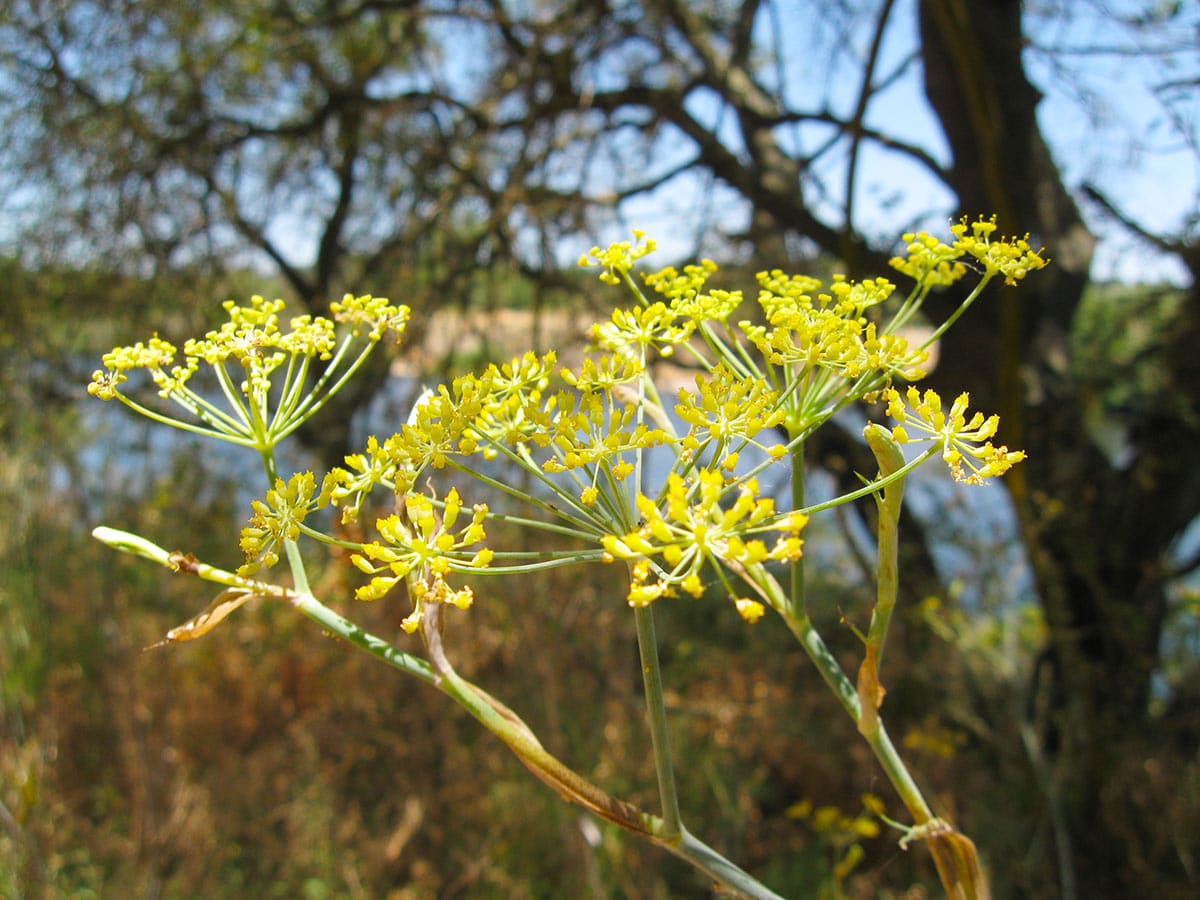
Many states have branded this lovely, anise-scented plant a noxious weed; one of my friends, a biologist named Charlie, was once employed to kill any fennel he saw on Catalina Island. Suffice to say it’s OK to pick as much of this plant as you want.
Here is a cool map that will help you find wild fennel near you. Click on each state or province to get more granular data.
Wild (really feral) fennel differs from garden fennel primarily in that it rarely sets a bulb and has smaller seeds than the domesticated variety. Both are perennials down to Zone 6 (winter lows down to -10°F) and possibly down into Zone 5, where winter temps drop all the way to -20°F. Tough plants. Fennel is herbaceous, meaning it “dies” every year and regrows in spring; it’s actually not dead, the root is just fine.
According to the USDA, wild fennel grows all over America, except for the Intermountain West, Oklahoma (oddly), Vermont and New Hampshire, Indiana, Arkansas and Mississippi. It also supposedly grows in British Columbia, Ontario and Quebec, although I’ve never seen it there. Honestly, however, I’ve never personally seen wild fennel anywhere other than California and the Pacific Northwest.
Wild fennel is invasive, thanks to all those seeds. Yes, birds eat them, but nothing seems to bother the plants themselves. I know of one patch that is at least 17 years old, only because that’s how long I’ve lived in California. I am betting it is far older than that.
It typically likes disturbed areas, and is often near roads. I don’t advise picking fennel near busy roads, however, because the soils can be tainted.
All parts of wild fennel are edible and delicious in their own way: Stalks and stems, fronds, flowers, unripe and ripe seeds, even the root.
Now, how to identify wild fennel. At first you might find it tricky because fennel is in the same family as carrots, parsley, dill and, well… hemlock. Yeah, Socrates’ famous final drink. Hemlock is among the most toxic plants in North America. But side by side they don’t look very similar.
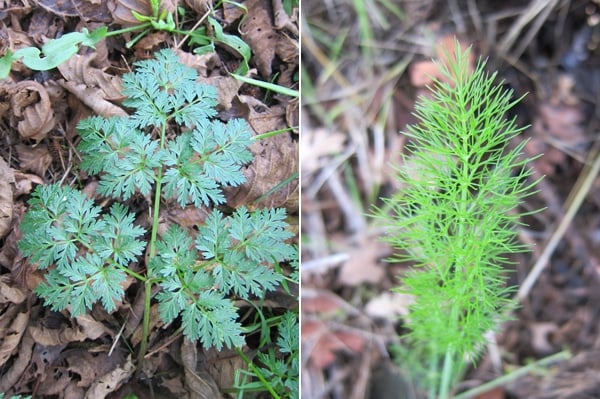
Hemlock is on the left. They do grow next to each other a lot, at least here, so remember these leaves. There is a better way to be certain, however. Use your nose. Fennel smells sweet, like anise or licorice. Hemlock is smelly in a bad way. I think it stinks of mice.
Really the only way you can mix them up is if you are after the dried seeds. At the seed-gathering stage, both hemlock and fennel will be taller than most people, typically up to seven feet tall. In winter, before there’s new growth but after the seeds have fully dried, they can be mistaken for one another. My advice on gathering wild fennel seeds is to gather between late August and October. That way you will still see the foliage, even if it is dried out or wan looking.
Gathering Wild Fennel Seeds
Wild fennel seeds take a long time to ripen, but you do want to get them before the birds do. Birds, especially little warblers, love to eat fennel seeds. When the time is right, grab a paper bag and some scissors.
Once you’ve found your fennel, look at each seed head: Many will have been either pillaged by birds, or never set seed at all. Look for the seed heads with the largest seeds and snip off the whole head with scissors and put it into your bag. It shouldn’t take long to fill a grocery bag.
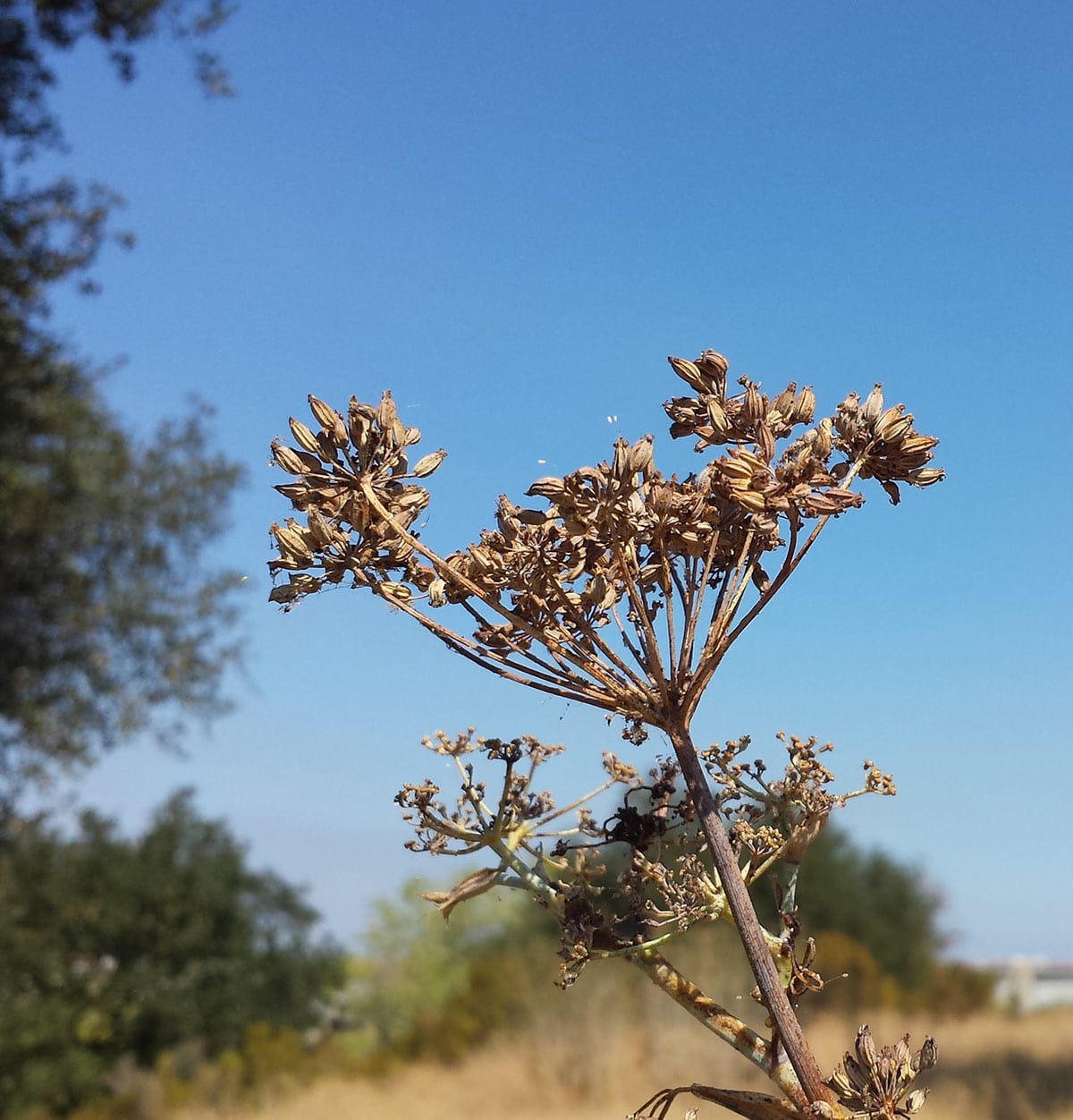
Once you get home, get yourself something to toss the empty seed heads in (compost bag?) and a broad, flat container like a casserole dish or a baking sheet. Take each seed head and remove the seeds from each little cluster with your thumb and forefinger, dropping them into the dish below. The force and motion I use is a lot like wiping something sticky off your fingers. I managed to get 4 ounces of seed in about 25 minutes of doing this.
When all the seed heads are free of seeds, toss them in the compost and turn your attention to the dish of seeds, which will need to be cleaned. I pick through and find all the little clusters that fell in (they look like teeny octopi or spiders) and remove them. It helps to have tweezers. Pick through and remove as many little twigs, bugs and debris as possible.
Finally, put your seed into a jar and freeze it for a week. Why? There might be insect eggs or grown bugs you missed in your seeds, and you don’t want an infestation in your seed. Freezing will kill everything too small to see. Once you’re done with this step, keep your fennel in the spice cabinet. It will last a year or so.
I use dried wild fennel seeds constantly in my cooking, but their highest use, in my opinion, is in making finocchiona, fennel salami.
Wild Fennel Almost All Year
Depending on where you live, wild fennel has something to offer almost all year long. It starts in late winter here in California, spring everywhere else.
Walking around, you will see the skeleton of last year’s growth, probably half blown down by winter storms. But look at the base of the plant and you will see the new growth.
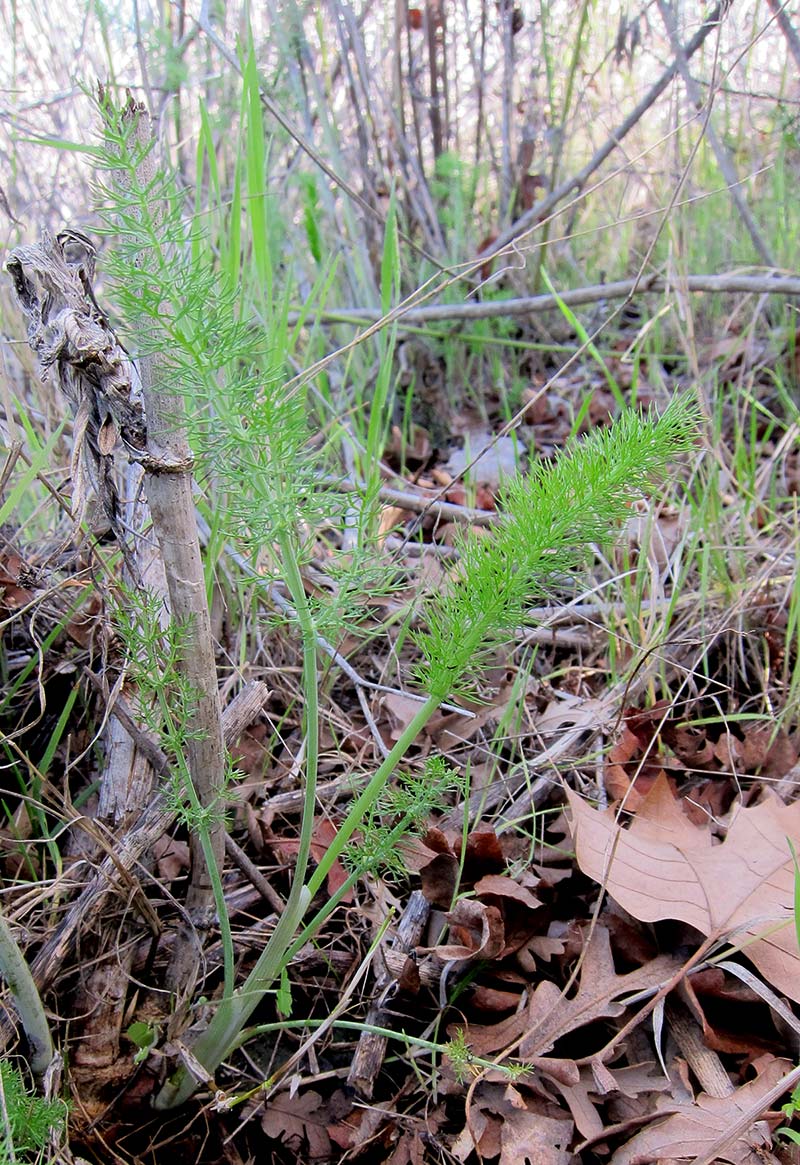
These wispy little shoots are tender, sweet and very flavorful. Use them in salads, stir fries, or wherever you want a fennel punch. This will continue as the plants grow all through spring.
During this time I often make my fennel-tomato pasta sauce to go with pasta. The sauce is sweet and tangy and strong, but not so strong as to mask the fennel’s flavor from the pasta itself.
You can also preserve the fresh stalks and stems of wild fennel by making fennel sauerkraut, which also works well with the bulbs of garden fennel.
Wild Fennel Pollen
High summer is a busy time if you are into wild fennel because the plant is both setting seeds and is in full flower. The flowers can be eaten as a garnish, but their real treasure is fennel pollen.
It is a trendy ingredient, frightfully expensive if you have to buy it. But, you can gather fennel pollen yourself. There are two ways to do it, and each has advantages. The easiest way is to gather lots of fennel flower clusters and put them in a paper bag, tying the bag closed and the stalks together. You then hang this somewhere and as the flowers dry, the pollen drops into the bag.
The plus side of this method is that you don’t have too much work to do. The downside is that you get dried pollen, which is good stuff… but not nearly as wonderful as fresh pollen.
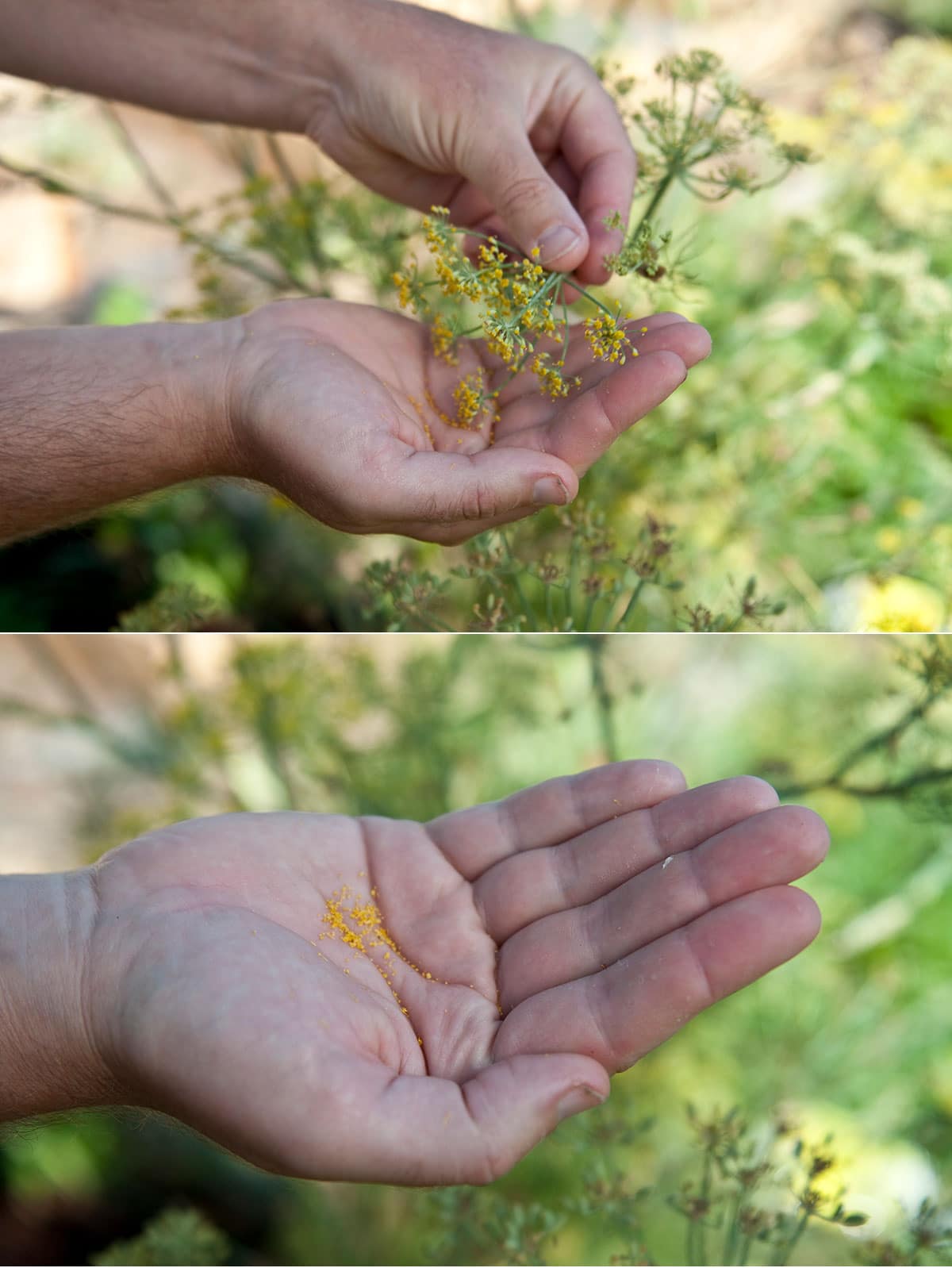
You collect fresh fennel pollen by going to each flower head and shaking it into a bag, dislodging the pollen, which will be a lovely, creamy yellow. Incidentally, this works with either garden or wild fennel.
It’s not easy to collect a lot of fennel pollen, no matter which method you use. Each flower head will only have about a 1/4 teaspoon of fennel at the most.
There is a reason why fennel pollen isn’t cheap. It is easy to gather, but because each flower yields so little pollen, it can take an hour of gathering to collect an ounce. You’ll also get all sorts of creepy crawlies in the pollen, which need to be evicted before you can store it. A few seconds in the microwave kills anything too small to see.
All this work is worth it. Not only is fennel pollen beautiful to look at, it has a beguiling anise flavor that is unlike that of the rest of the plant. The pollen tastes warmer and rounder than either the seeds or the bulb.
How do you use the pollen? All sorts of ways, really. I’ve made an Italian olive oil cake with fennel pollen, used the pollen in soups and sauces, dusted it on meat and fish, and put it in a Greek fennel cookie I call Bacchus Biscuits.
Green Fennel Seeds
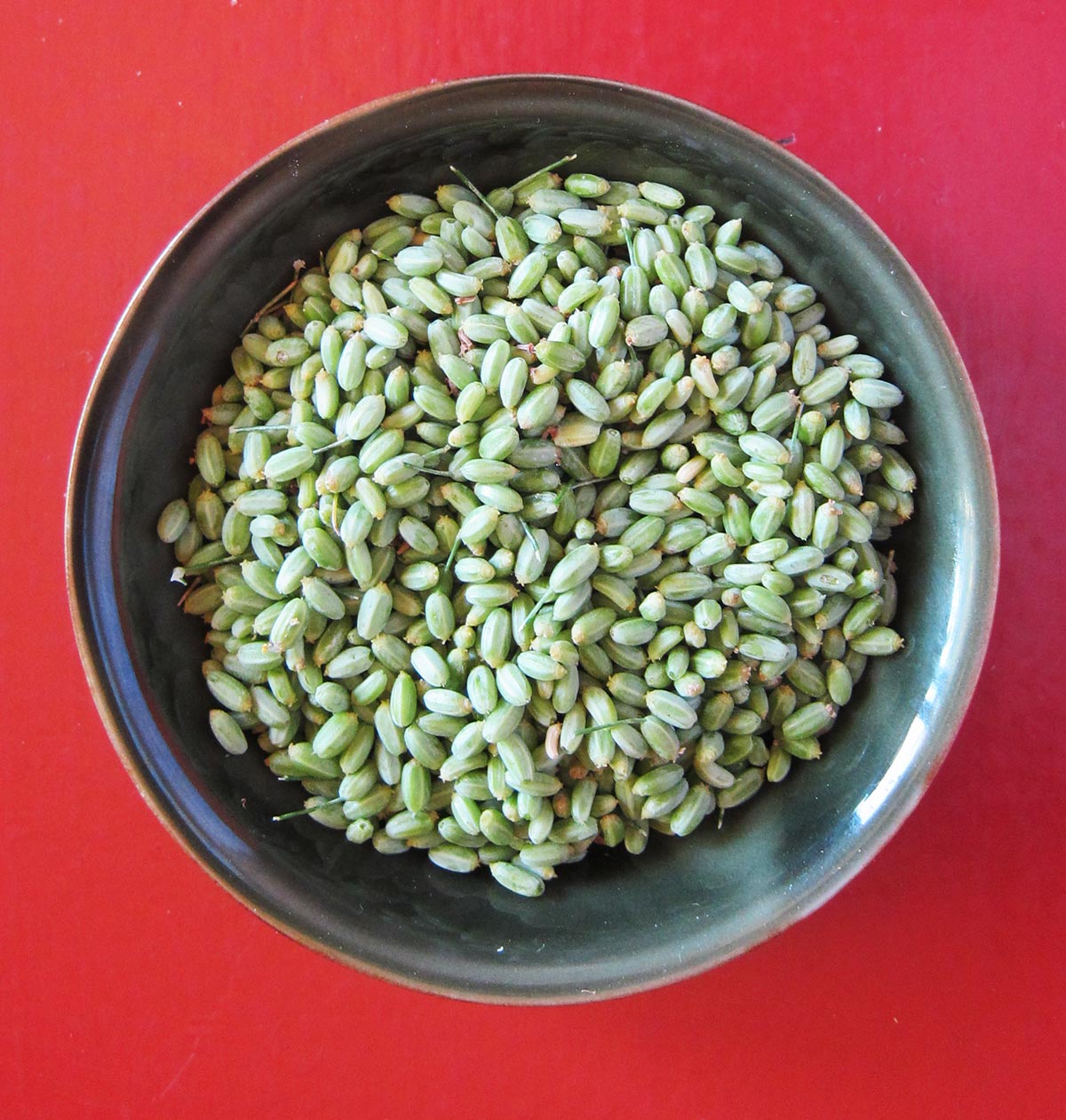
These are the hidden treasure of wild fennel. Walking around a patch in July or August, you will see the seedheads ripening. But the seeds themselves remain green for some time. If you eat one, it will be a revelation: Juicy, crunchy, sweet, and very strongly flavored. I love them.
I will gather green fennel seeds just to eat, but I like them on ice cream, too. Green fennel seeds can also be preserved by submerging them in simple syrup. Kept in the fridge, this will last months.
I hope this little tutorial has inspired you to gather some wild fennel. After all, it’s invasive, and eating the invaders is one of the best ways to deal with a pesky plant.



I have grown up seeing the plant we called dog fennel and I’m in awe that it might be wild fennel. I hadn’t really thought about it much because I’ve never cooked with fennel. I am thinking of trying my hand at a dish with the plant. I want to cook with the right plant. Any tips?
Lori: Remember that “dog fennel” is NOT real fennel. Be careful with your ID. Dog fennel is Eupatorium capillifolium and is toxic. Don’t eat that.
Its very nice of you Hank in taking the time to share your knowledge with others. I’m a hunter gather also but am new at harvesting fennel, we grow sage for our sausage and hopefully fennels next. Thanks, mark
here in the Var we have a profusion of wild fennel yellow flowered towering plants, I am ready to go harvest for that delightful splash of flavour
salut!
I’m in Northern CA and I come across what I believe is wild fennel but it has white flowers. All the pictures I have seen only show fennel as yellow. I wanted to harvest some but am too new to really know what’s going on. Is this really fennel or a crafty imposter?
Thom: It’s an imposter, and maybe a deadly one — hemlock has white flowers. Fennel always has yellow flowers and smells strongly of anise.
Do you have words of wisdom for telling Wild Fennel Vs. Dog Fennel (which is toxic) – I have stuff in my yard which smells sweet like anise and (yoiks) tastes sweet – I was 1st told it was wild, and then someone else came and said it was dog fennel and dangerous to eat.
Thanks
Jonathan: Well, wild true fennel grows only in a few states, as it isn’t very frost hardy. Dog fennel is native the South and East. And at least to me, they look nothing alike. They have a different growth habit, smell different, and their leaves are different. Look up Eupatorium capillifolium and then Foeniculum vulgare and you’ll see. Where do you live?
North Carolina. Dog Fennel for sure, looking at those pictures. Glad I only nibbled a little. Everything I read says dog fennel tastes bitter, and this stuff was fairly sweet. Time to plow it under.
I’m just over the border, 10 minutes down the mountain from NC in Salem, SC and enjoyed the true fennel shoots today in my salad. Although it had a slightly bitter taste, the anise dominated. It has a much finer, feathery
look, like the other images I see here, whereas the dog Fennel is more needle- like. Love all the sharing here, thanks!
Thanks much, cousin it (wild anise being grown from seeds in Orange County, CA) is growing in my backyard. What a wonderful plan. Every morning I break off so many eat it as a peruse the garden. I also enjoy making vodka infused anise, but this luscious infused vodka is very delicious and addictive. I’m looking forward to the summerAnd following your pollen collection and use advice. Enjoyed the read, and I have two of your books hook line and supper and Hunt gather garden on the way looking forward to the reads, all the best.
Hi ,I live in Australia , Victoria and have found Fennel growing wild where I walk . Its fronds looks exactly the same the fennel in the shops . It has no bulb . I’m so glad I have read the information you have provided. This fennel has not yet flowered so I will wait until it does and try your tips . Does the Dog fennel that is poisonous have yellow flowers as I don’t want to get sick . ?
Wild fennel grows down here along the South Coast of Australia as well. Wollongong, Kiama and all surrounding suburbs, it’s flourishing atm in summer ?
What about the root?
was researching Fennel for weed ID for a weed management project. Glad I found you as I have learned a lot about this plant and will now be able to baffle people with my brilliance when I extol the virtues of wild fennel and the domestic one
I have this weed all over my yard (which was farmed once upon a time, so “disturbed land” definitely applies to it). I thought it was dog fennel, which, from what I have read, has questionable edibility (and even if you lean towards yes, it’s only okay in small amounts), but everyone says that dog fennel (aka stinking chamomile) smells bad and doesn’t taste very good. But the stuff in my yard smells good when broken, like a fennel or carrot, and that’s what it tastes like when I try it. So I have been trying to figure out if this is really dog fennel or something else.
Do you know if wild fennel and dog fennel are two different things? It might be I have wild fennel, which is why it smells and tastes right. It would be nice to know that it’s good to eat because I like the taste of it and my domestic fennel has died out. If I can use this stuff instead, I won’t ever need to plant any again because it’s EVERYWHERE.
Keri: Dog Fennel is Eupatorium capillifolium, a very different plant from wild true fennel. Use that Latin name to start digging around on the Internet to see if what you have is that, or true fennel, which is foeniculum vulgare
Reputed wild fennel map is nothing but a blue/white background gradient.
William: Thanks for that. Looks like USDA is changing all their URLs. I think I have the right link now.
So I grew fennel in my garden for the first time this year. I don’t know if I planted it too late, or didn’t water enough, but they never really formed nice big bulbs. Right now, my entire crop is pretty tall, and LOADED with little yellow flowers, with quite a few of the plants that flowered earlier having set delicious green seeds. I had planned on chopping all the plants up, freeze drying, and using for all my stock/broth making this fall and winter. But now I am not so sure how to get the best harvest from my crop. Would it be as good without the nice big bulbs, or should I just try to harvest pollen and the seeds?
Growing Florence fennel (the bulbing variety) is quite a bit harder than the non-bulbing variant.
Google some growing sites and there are a number of good helpful tips.
For starters, for bulbs they need consistent watering and very fertile soil.
Charles: Sort of. They bulb up really easily here in California — in a garden — and they come back bulbing, too, if you cut all but one of the re-grows the following season.
I found some wild dried fennel stalks with seeds along the coast of Galicia Spain. I thought first it was dill. I sowed them in the Philippines. 2 plants survived in pots.
Great info.! I nibble on the green tips on hikes. …good to know there are an edible fennel variety!
Went out for a quick forage this frosty morning and scored a load of wild cabbage sprouts and some fennel seeds, still fat and soft. Have you ever cooked cabbage with fennel seeds? If so, was it good?
We have wild fennel here in New Zealand, especially where I come from .. This has given me some great ideas as alot of the time we are surrounded by it yet like you say has become a pest or infestation .. Not anymore .. I always new fennel had many health benefits but was unsure how to go about collecting or using it for specific use .. This has definitely helped .. kapai to mahi ( Great work )