Cheese, Terrines and New Adventures
Feb 22nd, 2010 | By Hank Shaw | Category: Charcuterie, Wild Game | Comments | 30 Comments |I have embarked on a pair of new food adventures recently: making pates and terrines, and making cheese from scratch. Two things I had said to myself I’d never do, although I know deep down that I will never say never to anything. It was only a matter of time.
I come by this particular neurosis honestly. For a glimpse of my future, all I need to do is look at my parents.
Both in their mid 70s, my mother just picked up the dulcimer for the hell of it, and has recently been taking classes to transform herself from a shutterbug into a serious photographer. My dad is if anything more eclectic. He had himself made a real Spanish guitar so he could pick up what has been a lifelong hobby. He learned how to mend porcelain to museum quality in his “retirement.” He took surfing lessons. Bought, then sold, a motorcycle. Hell, if dad called me some day and said he was going skydiving over the Grand Canyon, I’d say, “Cool. Let me know how it was,” and move about my normal day. We are an odd family.
Cheese had been on my mind forever. It is essentially charcuterie with milk instead of meat: You take a fresh product that has lots of fat, encourage good bacteria to defeat bad ones, drive away most of the water content and age it to develop even more flavor.
What had stopped me was a good initial guidebook. Finally, when I was laid up with my torn Achilles, I did some research and landed on 200 Easy Homemade Cheese Recipes. Why? Because it had lots of recipes for Mediterranean cheeses, hot-weather cheeses like feta, labneh, mozzerella, ricotta, mizithra and caciocavallo. These were the cheeses of my favorite recipes, which tend toward the hot regions of Spain, North Africa, Turkey, Greece and Southern Italy. At last I had a road map to make these products!
My first adventure was with a fresh, cow’s milk mizithra, basically a Greek Farmer cheese. I prepped by ordering rennet, cheese mats, a few molds, and some bacterial starters from the New England Cheesemaking Supply company. Holly found the milk I needed, which was pasteurized but not homogenized — this is apparently very important in making cheese, and ultra-pasteurized dairy cannot be used at all.
I followed the directions to the letter, something I rarely do, and sure enough the milk curdled properly. I ladled the curds into a cheesecloth-lined colander and let them drain for a full day, periodically squeezing the bag to tighten the bind on the curds.
With all that whey — I go more than two quarts of it from the three quarts of whole milk I’d started with — I decided to make ricotta. So I reheated the ricotta and tossed in some vinegar as the directions said… but got nothing. No curdling or separation of solids. Frustrated, I tossed it. I have since learned there are several other ways to make fresh ricotta from whey, so I plan to get back to it soon.
The cheese you see at the top of the page is the result. According to the book, it is a Greek fresh mizithra, but my Greek friends say that no mizithra is ever made with cow’s milk; it’s always sheep or goat. Oh well, so it’s not a real mizithra. It was still pretty good.
First we ate it straight. Very creamy and milky, the texture was at first a little like mozzerella, but then as you ate it the cheese it squeaked in your mouth, kind of the way fresh mushrooms will squeak in a hot pan. The texture was a little tofu-like, which I am not real thrilled about.
What next? Well, maybe it would melt well? I sliced some on toast and tried that, but alas, the cheese did not melt. But it did brown a bit along the edges. Hmmmm…
Fried cheese! Who doesn’t love fried cheese? And better yet, I would make my own sexed-up version of fried mozzarella sticks, using the concentrated tomato jam I made with Brandywine tomatoes last season.
Is there anything you can’t make tasty by breading it in panko and frying it in olive oil? If you’re wavering, then let me answer: No. No, there isn’t.
These were a lot like mozzarella sticks, only the cheese was creamier and a little molten. The sauce is killer, by the way — it’s only Brandywine tomatoes and salt, cooked down overnight to get a thick, rich consistency. Umami-licious!
All in all, a good first start. I plan on making feta cheese next.
On to terrine land. I had trash-talked terrines for years as nothing more than fancy meatloaf. Unmanly cuisine. The epitome of the pinky-in-the-air high-end French cooking I still don’t much like. I even skipped entirely the terrine chapter when I read Ruhlman and Polcyn’s Charcuterie.
Why the change of heart? I was getting tired of making fresh wild duck sausages, and my dry-cured experiments with wild duck and geese have been middling at best. And with duck season just over, we have a bunch of ducks in the freezer. Still, I did not come around to the idea of a pate or terrine until I began reading a wonderful book recommended to me by Ron Zimmerman of The Herbfarm restaurant: The book is by Roy Andries de Groot, and it is called Auberge Of The Flowering Hearth.
De Groot’s book is helping to warm me up to French cooking, or to be more specific, French provincial cooking. The auberge in question is set in Chartreuse (where the green liqueur comes from) and it is set in the Alps. There are a lot of wild game recipes there, and a few spectacular wild game terrines. Nice, but what really set me off was that Mademoiselle Vivette would make these pates or terrines on a Monday for “fast food” during the week.
A terrine will keep? I had no idea. That changed everything. I am trying to be frugal and not buy lunches at work, so I need to bring something nice. Stews are a standby, but I can get bored of them. I wanted to bring sandwiches. Corned venison was a great choice, but that’s gone now.
How about a wild duck terrine sandwich, served with fresh sorrel leaves and a little mustard on whole wheat? Yeah, baby, yeah! What’s better, I can make enough over the weekend for the whole week.
I bought a Le Creuset Enameled Terrine pan, and went back to Ruhlman and Polcyn for specific proportions; they have the best structural recipes of any charcuterie book I’ve seen. For flavors, I went with de Groot’s book as well as Jane Grigson’s Charcuterie.
I was a little nervous, making an emulsified forcemeat. If it breaks, Very Bad Things Can Happen. So I kept everything cold, and lo and behold! It worked. Making a terrine is really nothing more than a glorified meatloaf.
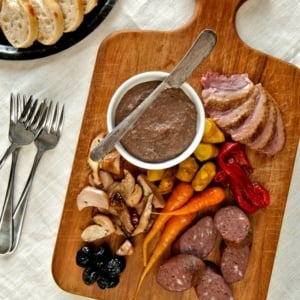
It was awesome. Pretty pink duck meat, little pearls of white pork fat, flecks of fresh minced sage and black pepper. What’s the big thing in the center? It’s what fancy people call “interior garnish.” It’s what I call “The Hidden Yum Yum.” Think of it as the Baby Jesus in the king cake, only this is a piece of seared mallard breast.
The taste is smooth, slightly salty and just spicy enough to make you notice. I served it over some dandelions and wild chicories we pulled out of our front lawn, sauteed in duck fat.
I am a new convert to this, and you can bet you’ll be seeing more pates and terrines here. Soon.


Fantastic looking pate mate. I have long been a fan of pate, and generally preferring a more coarse textured rustic terrine. The charcuterie book indeed has some great recipes for it. If you are getting into French provincial cooking, you should certainly check out “French Provincial Cooking” by Elizabeth David. She, like you (and I) have little time for fussy French haute cuisine, but she has a huge love of the rustic food of the French country. There are some good pate recipes in there too – and quite a few involving game. The book was written back in the 50s, and based on a lot of very old French recipes handed to her from French cooks. A really enjoyable read too – half travel, half food – very direct, witty.
Awesome. I’m so impressed by your experiments.
Great stuff! Phoebe and I tried cheesemaking a couple of years ago, and made a queso blanco, but it was too bland. It was best fried, too. You can’t make ricotta from vinegar-curdled stuff, so we used the whey to cook our pasta, and that turned out good.
That’s one fantastic-looking terrine – almost enough to make me go out and buy a duck to try it.
The fresh myzithra looks great, no sense in throwing out the whey when everything should and can be used.
Hola,
I have not tried my own cheese outside of some very basic recipes (vinegar curdled ricotta, some labneh out of yogourt).
I did recently break my terrine cherry and made the pate de campagne out of the Charcuterie cookbook –with the addition of some solid chunks of duck confit from a local guy who sells it for $3.99/leg (sadly, overrun by tourists right now in Vancouver so I have not stocked up again). Waiting on my hunting license before I can go out and try my hand procuring my own ducks (with an experience friend, of course).
My verdict on homemade terrine: Delicious, but definitely needs the help of a crowd to eat. I threw a sunday lunch + drinks to make a dent in the 2ish pounds I had and still had a large amount left after 6-7 people came through. By wednesday, I was pretty tired of it. It’s less of a luxury item when you have scads of it!
I only use my own ricotta in cooking. I refuse to buy it in the store. Whey too easy……pun intended.
Cheese as charcuterie with milk is an interesting analogy, and the way you described it made a lot of sense….
Hank, I started to make simple cheese, as well as yogurt & kefir a couple of years ago, and it is a blast.
Even if you can’t make ricotta out of the whey left from mozzarella, don’t throw it out. It’s fine to use as stock for vegetable soup, as well as for bread and pizza, instead of water (or as partial replacement of water)
Welcome to the wonderful world of pates and terrines! I’m glad you changed your mind about this gorgeous branch of Charcuterie, as Ruhlman calls it “The Cinderella Meatloaf”
Is the inlay in your pate a duck breast?
My first few experiments with cheese making, to use your words, have been middling at best as well. I’ve been making ricotta for years, but cheese with rennet and such for only a few months. I suspect I need to locate some non-homogenized milk.
Now that I found I have a duck supplier right in the hood… I like the idea of this duck terrine… yours looks spectacular! So many books to buy to make it though… I have a de Groot … I know people who remember him walking around the village with his dog… he was blind but could he taste and write, just need a Ruhlman or your recipe!
Nice “Baby Jesus” line, Hank. Especially the way you sliced through it.
Does the person who gets the interior garnish have to make the terrine next year?
I loved this post!! And your comments about your M&D, brought up memories of my Mom starting to paint at 60.
I made simple cheeses years ago, along with homemade yogurt and fresh bread that was part of the rules for anyone reaching majority in the 60′s. Your assessment of that type of fresh cheese is spot on. Best fresh and slightly warm. The idea of frying it is brilliant tho, and the next time I make cheese you can bet that I will fry up some.
The terrine, well, I will now open up the Ruhlman book I got for Christmas and learn something new.
Matt: I do need to get Elizabeth David’s book. Can’t imagine why I’ve not yet bought it.
Josh: Whey to cook pasta? Great idea!
Adele: Buy a duck… all the cool kids are doing it…
Peter: Coming from you, that’s a compliment! I will be making a lot of Greek cheeses in the coming months, so I’d be grateful for any suggestions.
pg: Good tips. I like the idea of confit in the terrine. I make labneh, too, and will post on it when I get the recipe I want perfected.
Scott: So how to YOU make ricotta? There seems to be all kinds of ways to do it.
Sylvie: I like the idea of using the whey as the “water” in bread, pizza or pasta dough. Thanks for the tip!
E. Nassar: You bet it’s a seared mallard breast! Delicious, too.
Deana: Start with the Ruhlman and Polcyn book, and go from there. I did not know de Groot was blind…
Holly: Yep. That means you make the terrine next year. Hee hee hee.
Sharon: Repeat after me – “everything is good fried.”
Hank: No.
1 gallon whole milk, 1 quart heavy cream, juice of 3 lemons. Bring milk and cream to a rolling boil(wet the cooking vessel with cold water prior to putting in milk and cream to prevent scorching) remove from heat, add lemon juice. Let it sit for 10-20 minutes, pour into cheesecloth lined sieve. Drain for as long as you’d like, depending on how you like your ricotta. That’s it.
Hank – Another great post. I think that you have fantastic insight and you never fail to inspire. Thank you
Best way to eat merganser, scaup, sea ducks? Pate.
We eat so much ricotta that I’m going to have give it a go. Scott makes it sound so easy….
Cheese is a project I intend to tackle this year too. I’ve got my order for supplies ready, just have the pull the trigger when I feel I have the time.
It’s funny that terrines should be of interest to you just now. I’ve been toying with the idea of trying to reproduce a “meatloaf” that was at least halfway to being a proper terrine that I had at the Bier Circus in Brussels. It had chopped apples, raisins, Orval cheese, probably some beer, and, by the color of the meat matrix, plenty of cream. Certainly a finer texture than any normal meatloaf as well. It was memorable, obviously.
Also, your post calls to mind a terrine I took home to the dorms for the weekend while in culinary school. It was duck (with pork fat of course) accented with cherries (dried/rehydrated, if memory serves), pink peppercorns and cream. There might also have been some fresh ginger in the mix, but I can’t say for sure. Again, memorable, if a trifle chic. I ate the whole thing over the weekend; probably my caloric allotment for an average week.
I just stumbled upon your site today and have really enjoyed reading some of your posts.
I have also recently wanted to make an effort to get back to the days of my youth when my family ate a lot of our own catches and kills, grew our own food, and made our own cheeses. So, it’s very timely that I came across your writings.
Thanks!
Scott: Thanks! I will try that this weekend, maybe for a wild greens and ricotta ravioli…
Carolina Rig: Ding! Ding! Ding! Winnah! You are exactly right, this is perfect for “trash” ducks because you cut out all the fat and skin.
Kevin: Up there in Calgary, you ought to make Alpine cheeses…
Kate: You ate a whole terrine in a weekend?! Wow. I salute you.
Patrick: Glad you like it! I hope to not disappoint.
Well, okay, not a whole terrine. Just what was left of one after plating. Probably at least half a standard terrine.
Thanks for this post, I have been looking for some great guidelines on cheese making. My husband keeps rolling his eyes at me, but I’ve been bitten by the make-your-own bug (ok it happened two years ago) but cheese seemed elusive to me. I’m Turkish and CANNOT find good feta where I live (jn NE Florida where there are absolutely no middle eastern stores), and really would love to make my own. I’m going to order the book you suggest, no time like the present to try!
I just found your site and subscribed (thanks to Tastespotting). Looking forward to keeping up with your posts! Love the pictures as well.
Hank, thanks for inspiring me. I read your post and then tried something new this week- I made pasta from scratch for the first time. Tagliatelle first, for starters, and then Tortellini filled with roasted garlic, butternut squash and goat cheese. The cheese making will have to wait a bit.
I’ve been following your site for a few weeks, and I really like it. It’s extremely well written, the photography is fantastic (sigh), and the topics are, well, inspiring… thanks for writing.
Looks like your cheese turned out great! I’ve been wanting to try making homemade cheese for a few years now, but have never gotten around to it. Still on my “list” though. Sorry your ricotta didn’t turn out. I was reading a while back on this website that you can’t make ricotta from whey left over from an “acid precipitated” cheese. Something about depleting all the albumin protein in the original cheese-making. Not sure if your mizithra falls in that category, but it may explain why you weren’t able to render any curds from the whey. In any event, the link has a nice explanation about making ricotta. Try, try again?
The link gives several nice ways to make ricotta. I’ve done it several ways. I’ve heated it to 190 and used citric acid. That one I had to pitch. Of all the ways I’ve tried, the way I outlined earlier in the post is the most reliable. As far as it not being as creamy as store bought………try it the way I stated, add the quart of cream to the milk. Fantastic!
Before I got knocked up, terrines and rillettes were at the top of my “to master” list. This just lit a major fire under my ass. And the fromage blanc? Well, now you’re just showing off.
I’ve just started making cheese too, since late December! Some have been amazing and some not so good…. but chilaquiles with a mild young homemade Jack and garden salsa are So. Damn. Good.
If you don’t have the Time Life Series book on Terrines try and track it down.
It is more modern then Grigson, who uses some techniques that will give the food police hives, not that that is bad, and has a lot more variation than Charcuterie by Ruhlman and Polcyn.
Just replace the computer which is why I’ve been missing for a while, took 6 weeks to ship.