The Best Way to Make Acorn Flour

September 26, 2013 | Updated February 12, 2021
As an Amazon Associate I earn from qualifying purchases.
There is really only one good way to make quality acorn flour: Cold leaching.
Leaching, as is pulling something out. In this case, that something is tannin, which is present in all acorns. Different acorns have different levels of tannins, but in general oaks of the red oak family have more, the white oak family less. One, the Emory oak of the Sonoran Desert, has almost none at all.
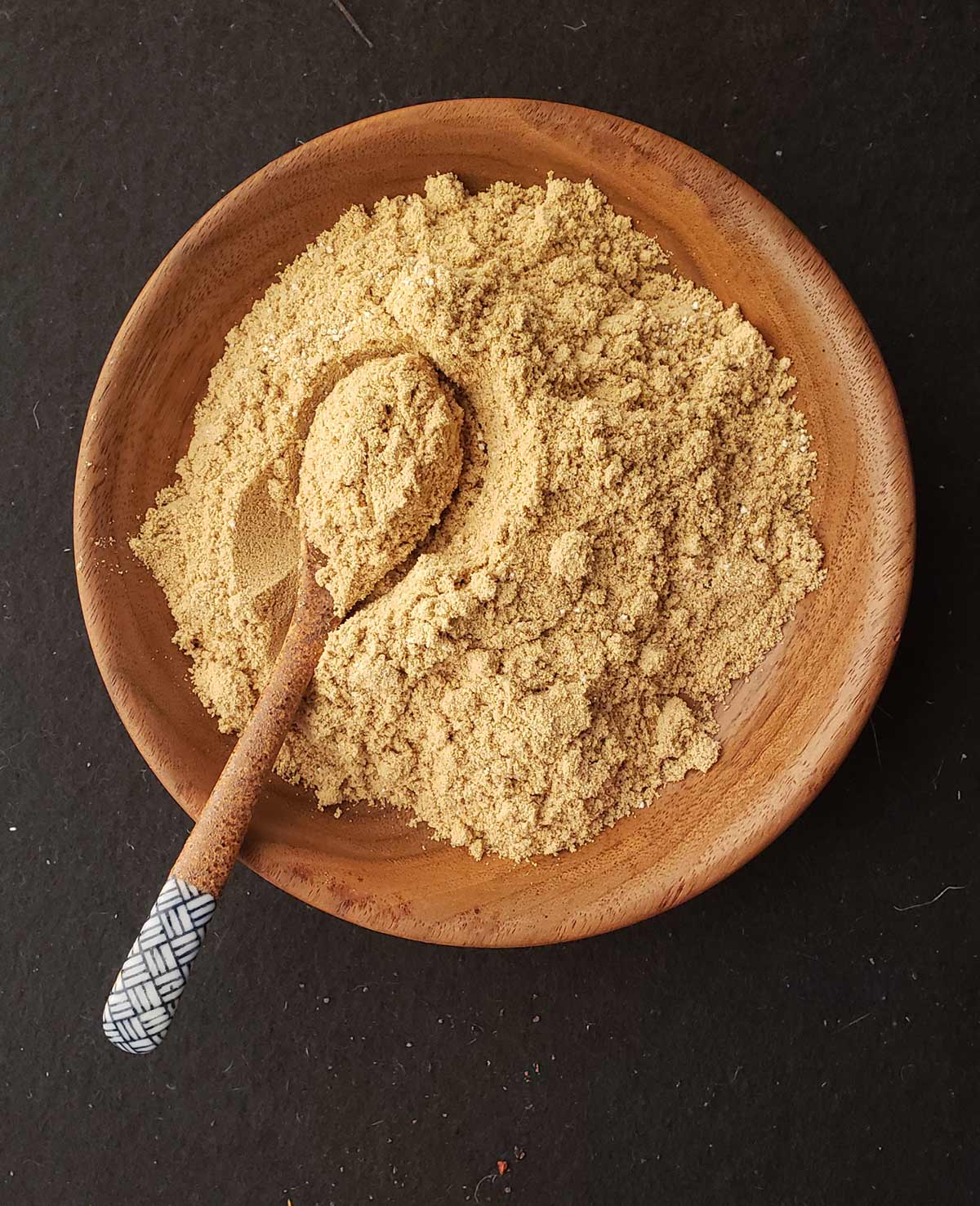
Before I go much further, let me answer the question in many of your minds: Why the heck would I bother making flour from acorns? First, flavor. It’s a lot like chestnut flour: Nutty, a little sweet and just generally interesting. Second, nutrition. Acorns vary in nutrition. Some are very starchy, some oily, a few high in protein. Third, it’s just kinda fun to make something useful and tasty out of something many of us mistakenly believe is poisonous.
In my original post about eating acorns, I recommended the boiling water method of leaching out all those bitter tannins. This works fine, and is comparatively fast; you can have a batch of acorns leached in the time it takes to watch a football game, which is about three hours for those of you who have never actually watched a football game.
The problem? The resulting acorn flour is very dark, and the boiling process destroys a key starch in the acorns — a starch that acts a lot like gluten in wheat, i.e., it helps the acorn flour stick to itself, or to thicken gravy or a roux.
I have found myself using acorn flour mostly for making roux, coating meats or as a flour additive in baked goods, tortillas, and pasta. So that starch is pretty important to me.

Cold leaching solves this problem. It preserves the starches and, when dried properly, keeps the flour lighter — closer to whole wheat than that dark chocolate brown you can get with boiling water-leached flour. The tradeoff is time. It takes at least a few days to “clean” your flour, and it can take more than a week.
But it’s easy time. All you need to do is tend your flour once or twice a day. Here’s how to go about it.
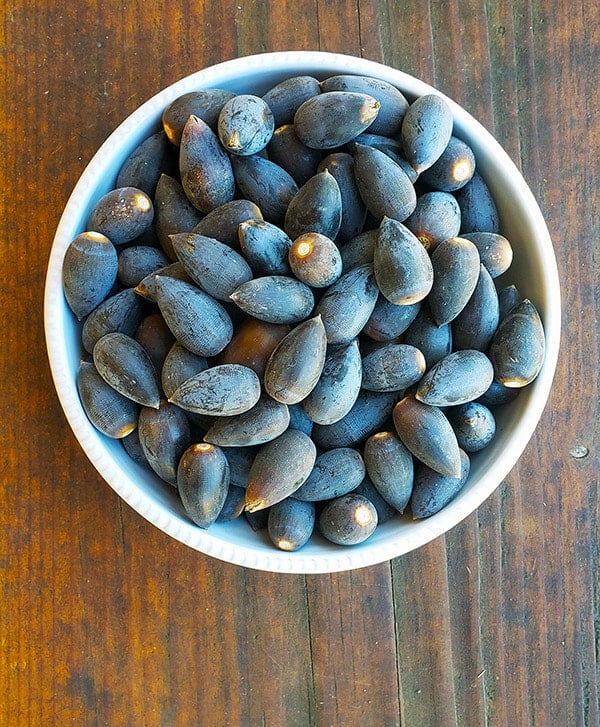
Start with acorns. I know, obvious, right? But know that they need not be fresh. Last summer I made a batch of flour from some red oak acorns I’d picked the previous October. I’d laid them out in a shallow layer in a large tray and just let them dry out. When it came time to crack the shells, it was so much easier than with fresh acorns; fresh acorn shells are pliable, and don’t crack like, say, a hazelnut’s shell.
You will need to soak your shucked acorns in water overnight, though — and it’s the devil to get the papery skins off dried red oak acorns. Those skins darken the flour and are very tannic.
I don’t really bother working too hard at removing the skins, but there is a trick that helps get them off (the skins are called the “test”): Freeze your acorns fresh. When they thaw and you crack them, the skin comes off a lot easier. The problem is storage. Acorns are bulky and can take up a lot of space in your freezer. But hey, if you want that skin off, it will help.
Regardless, shuck your acorns into water. This helps prevent them from oxidizing. I find that if I leave acorn nutmeats out, they turn brown over time. If they are fresh acorns, the papery skins should slip right off once the acorn has soaked a bit.
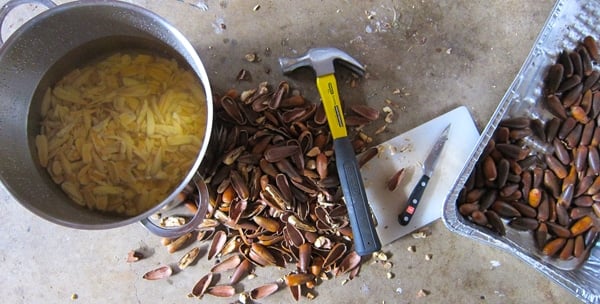
If you have some acorns with worm-eaten bits, you can cut off the bad part if you want to and toss the good part into the bucket of water.
Once your acorns are all shucked, put enough of them to fill a blender or food processor (use a food processor if your blender isn’t too strong) up about 1/3 of the way. Add enough water to fill the bowl of the processor or blender up halfway. Buzz the crap out of it until you get what looks like a coffee milkshake. Play a mean trick on your friends by pouring them some, and watch the hilarity.
Now, you will need a large container. The absolute perfect container to my mind are those big glass jars you get at the Asian market to make kimchi. You can buy gallon glass jars online or in many hardware stores for about $15. Pour the “coffee milk shake” into the big jar and keep adding more until you have about 50 percent ground acorns and 50 percent water. Cap the jar.
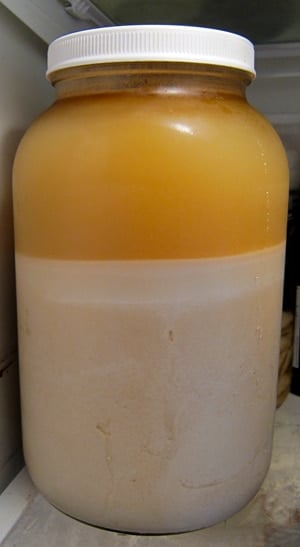
Put the jar into the fridge or just a cool place — it must be below 75°F or the flour will ferment — and walk away. Each morning, pour off the water, being careful to not lose too much of your acorn flour. Refill the jar, cap it and shake the hell out of it, turning it upside down to make sure all the acorn flour is suspended in the water. Repeat as necessary.
Now, there is an added tip you can do to make an even higher quality acorn flour: Strain the water every day through cheesecloth. Why? Look at the picture above: See the top layer that’s lighter in color? It’s acorn fat and starch.
It’s so light some will pour off every day as you change the water. Straining through cheesecloth preserves this fat and starch and will make your flour even richer and tastier. Do this and you will be rewarded with flavor later.
You know your acorn flour is ready when you roll some around in your mouth and it tastes really bland. Not tannic or bitter at all. Roasting can eliminate a little bit of tannin, but we’re not roasting in this case, so you want the flour to be as “clean” as possible.
For California Valley oak acorns, Eastern white oak acorns or other “sweet” acorns, this process could take as few as three days. But 5 days is more normal. California black and blue oaks take about a week. And Eastern red oak acorns? They took 10 days. When in doubt, go another day. You can’t hurt the flour by leaching a few extra days.
Now you have a bunch of soaking wet flour. First thing you will need is cheesecloth. Any supermarket will have it, but I have taken to using real cheesecloth, i.e., cloth actually used in cheesemaking. You can buy real cheesecloth online or in specialty shops.
Line a fine-mesh strainer with some cheesecloth and set it over the sink. Pour the water in the jar through it, catching all the flour.
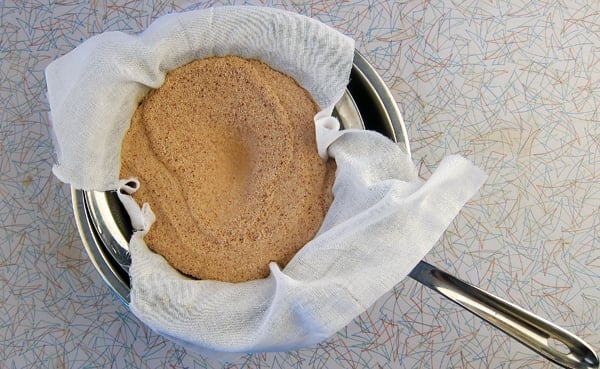
Squeeze the cloth tight around the flour to extract as much water as possible. This is why I use real cheesecloth — the cheap stuff at most supermarkets is too porous and thin to do the job very well, forcing you to squeeze less and spend more time drying — and the longer the drying time, the darker the flour. You will be left with what looks a lot like a ball of clay.
Tip: Let the water in the bowl settle for 1 hour. Carefully pour off the water and you will see a layer of what looks like beige house paint or melted coffee ice cream. This is acorn starch and fat. Use a spatula to scrape it into the container you are drying your acorns in.
Now you need to really dry your flour, unless you plan on making something with it right away. I almost never do this.
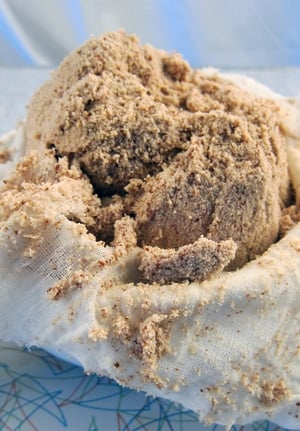
Spread your wet flour on a baking sheet, or on a solid dehydrator tray; the trays you use for fruit leather. I prefer the dehydrator because I can dry at a lower temperature. Or, if you do this in summer, you can dry outdoors or in a hot garage.
Dry at as low a temperature as you can. I use a dehydrator set at 95°F. Check in on your flour every few hours, turning it over so it dries evenly. This can take anywhere from an hour to a day. You want the flour to be dead dry. No moisture.
You are almost there. You now have what is essentially acorn “corn meal,” a gritty, coarse “flour” you can use to make polenta with; it’s pretty good, actually. But to make real flour you need to grind it one more time.

To turn your acorn polenta into acorn flour, grind the dried meal in a spice grinder, coffee grinder, or, best yet, a Vitamix fitted with dry blades. This is what I use, and it is worth every penny.
If you have a flour sifter this is a good time to break it out. Grind and sift into a clean bowl until you have nothing but pure, powdery goodness. A typical coffee grinder will require about 35 seconds of grinding to get there, my Vitamix takes only 15 seconds.
Your acorn flour is mildly fragile, especially if you are dealing with high fat acorns, like blue oaks, live oaks and red oaks. I store mine in quart Mason jars in the fridge or freezer. Stored this way, the flour will last for several years — which is good, because oaks don’t drop huge amounts of acorns every year.
Does all this sound like a lot of work? Well, I won’t lie to you: It is. And like I said, this process makes the highest quality acorn flour possible. There are easier ways, but the quality of the flour is inferior. This will make you quite aware about how we take regular wheat flour for granted. Do this and I can guarantee you will not be tossing around acorn flour the way you would with all-purpose. It’s too precious.
How to Make Acorn Flour
Equipment
- Cheesecloth
- A large jar
- Blender
Ingredients
- 3 pounds acorns
- Water
Instructions
- Start by shelling your acorns into a bowl of cool water. This will take about an hour, more or less. I typically do it while watching television. Putting the shells in water immediately will prevent them from oxidizing.
- Once you have all the acorn meats shelled (a little of the brown skin, called the test, is OK), puree them with water in the blender. Pour this into your large jar and set in a cool place, cooler than about 60°F. I will often refrigerate it. Temperatures too warm will cause it to ferment.
- Every day, up to twice a day, carefully pour off the water and replace it. As an added, but optional step, you can pour the last of each day's water -- the stuff with the most fine sediment in it -- into a baking sheet and let the water evaporate from it. What's left is pure acorn starch, which you can use exactly like corn starch.
- After about four or five days, taste the meal. It should be bland, not bitter. If it is still bitter, keep changing the water until it's not. Each species of acorn will need different leaching times.
- When the wet meal is ready, move it to a strainer lined with cheesecloth. Strain out as much water as possible. In this step, you really do want to capture this last water because it is loaded with starch. Let that water evaporate from a baking sheet.
- Lay out your wet acorn meal to dry. I use a dehydrator set at 95°F. Shoot for conditions like that. An oven is too hot and will turn the flour dark brown.
- When the meal is completely dry, add it and any chunks of acorn starch to a spice grinder or blender and buzz until completely fine, like wheat flour. Store in a jar in the fridge or freezer, so the acorn fats don't go rancid. It will keep this way a year or more.
Notes
Nutrition information is automatically calculated, so should only be used as an approximation.






Hello Hank,
Thank you for the detailed description. I am trying this process with red oak acorns and I am noticing that my acorn “coffee” goes from light tan to dark brown during the leaching process. Has this happened to you? It may be that everytime I had water it has lots of oxygen because it is coming from a bubbly faucet, could that be my problem? Is there anything wrong with dark brown acorn flour?
Woods: Absolutely nothing wrong with dark brown flour! I just like to try to keep it as light as I can.
Wow! This was super interesting. I’m Native American from Northern California and have had a long association with acorns. I’m old now, and in a wheelchair, and I’m not able to get out and do the gathering, so it has been a while since I’ve gone through the process However, I often considered experimenting with making other things with the ground acorn flour other than the traditional version of “acorn soup” that I’m familiar with. I didn’t grow up with the tradition, I guess my family was too “colonized.” lol. When I met and married my husband, though, his tribe had ceremonies celebrating the relationship between Native people and acorns. I learned to appreciate the labor-intensive process and the end product, which I enjoyed. Many of the steps I’ve learned are quite similar to what you’ve described. As time has passed, even Native people have adapted to new ways of doing ancient practices, so most of us freely utilize grinders, blenders, freezers, and such, but it is quite humbling to realize that the ancestors of the oak trees that I live among have provided food my son’s ancestors for thousands of years. Anyway, thanks for the recipes, I may try those muffins yet! With respect
Wow! This experience was empowering and humbling.
I almost gave up halfway through because I wasn’t sure it would turn out, but 60 days later I had acorn flour.
Thanks for sharing.
I used the acorn flour to make 2 loaves of your persimmon bread (amazing), some acorn flour pancakes (yummy) and going to try cookies next.
Thanks again ??
Thank you for this recipe! I just wanted to let others know that whatever acorns I picked have taken almost 2 months to leach out the tannins. So clearly, it’s a process, dont rush it! Imagine the satisfaction tho when I finally tasted it and no longer had to immediately spit it out? I just put it in the dehydrator to finally finish up this seemingly neverending process. I can’t wait to bake and brag about my homemade flour!
never mind the question about sprouting … I found a post & reply from like 2015 about it!
Next question – all of my acorns fallen do not have the cap on them. Texas live oaks.
Some I definitely see worm holes – most do not. When I open some up, a few show some small wavy brown lines but some don’t. We did have a weird summer with heat and drought. Any thoughts – should I go ahead and try out the drying, shelling & leaching … or wait a season?
I had 15 gallons of acorns drop on my porch this week (acorn year) and was wondering if anything could be done with then apart from feeding the wild boars up the woods. Your recipe for making acorn flour caught my attention and I will be making the first trial batch this weekend. Luckily I have most of the required equipment already: coffee grinder, dehydrator and large mason jars/kimchi jars. Just need to find a cheese cloth tomorrow. This should be fun. Thanks/Patrik
Is there a way to dry the flour if you don’t have a dehydrator?
John: Yes. You can lay it out in a thin layer on a baking sheet and, if it’s dry, let it dry out in your garage. If it’s wet out, crack the oven open and set it to “warm” and put the flour there. Either way you will need to stir it once in a while so it dries evenly.
I live in an apartment without a garage- is it okay to air-dry it out indoors in that case or should I just get the dehydrator?
Hello Hank! Trying this for the first time, and your explanations are super helpful. I had a question regarding the straining through cheese cloth as you pour off the water everyday to preserve the fats and starch. Do you reintegrate the bits caught into the cheese cloth with a quick stir or something?
Thank you 🙂
Katelyn: Yes I do.
Help! I got distracted over the past couple of weeks and didn’t stir the acorn mixture enough and I’m worried that it may have fermented. There was so much work put into it, I’d hate to waste it if I can still do something with it. Do you have any suggestions? (Anything that I’ve found online is for whole fermented acorns.)
Alicia: Is it sour? If not, it’s not fermented.
I made several different batches (because it took so long to shell those darn acorns!) – the first batch definitely has a sour smell, the second didn’t smell bad but tasted sour, the last batch doesn’t smell or taste sour.
Alicia: Bummer. Then yeah, they’ve fermented. My guess is the one that doesn’t smell or taste sour has the most tannins in it, which will protect against fermentation.