Cooking the Magnificent Matsutake

December 19, 2012 | Updated November 02, 2020
As an Amazon Associate I earn from qualifying purchases.
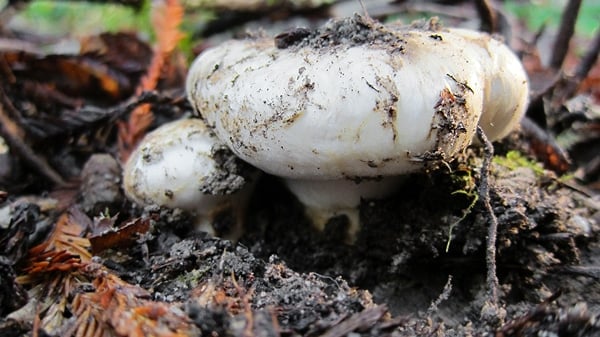
Matsutake mushroom. Pine Mushroom. Tricholoma magnivelare. After having never even knowing of their existence for the first 30 years of my life, I’ve cooked with them enough since I’ve moved out West a decade ago to get a sense of how to cook this magical mushroom. There’s a lot to know.
For starters, confusion reigns about which mushroom we are actually talking about. Our matsutake is not the same as the one in Japan, nor is it the same as the “matsutakes” found in the Eastern United States or in Europe, where a related mushroom is known as the pine mushroom or St. George’s mushroom.
The Latin names for matsutake are all over the place, too, and the mushroom has been jumping genuses for years now. Suffice to say this is one of those “species complexes,” like honey mushrooms or oyster mushrooms or grissettes.
All of them, however, are large, firm mushrooms that are more or less white or ivory colored. Almost all live with conifers of some sort, although here in Northern California they like tanoak and a few other plants I will not mention. Gotta guard my spots, you know…
That of course leads me to another aspect of matsutake mushrooms: They are expensive. Horrifically so. I saw some old, crappy ones in our local Whole Foods last month and they were charging $35 a pound for them! And perfect Japanese matsutakes can fetch more than $100 each. It is the only mushroom I know of where the commercial competition has been so fierce that many pickers once carried pistols with them.
What’s the big deal? Well, matsutakes are very firm, which makes them exciting to work with as a cook. They are big, so you can do all sorts of things with them. But the real reason is the aroma. Ah, the aroma of a matsutake.
The most famous description is from David Arora, who wrote the bible on North American mushrooms, Mushrooms Demystified. Arora describes the smell of a matsutake as a combination of wet socks and red hots — red hots being a once-popular cinnamon candy, for anyone not familiar with them.
I’m not so sure about Arora’s description, however. I think they smell like pine trees, resin and wet earth — although it definitely has a cinnamon thing going on, too. Apparently the Japanese matsutake have the strongest aroma, followed by our Western ones.
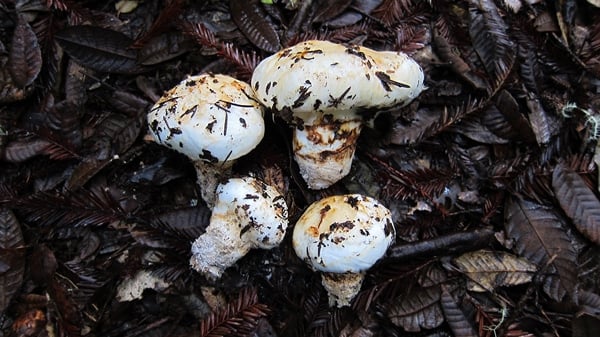
What you see pictured above are top-quality matsutakes. You can tell because their veils are still attached to the stem. This veil breaks as the mushroom ages. From an eating standpoint, as the mushroom ages, the quality loss is mostly in aroma — but also in the mushroom’s health benefits, if you believe in that sort of thing.
Strong scientific evidence suggests that eating lots of matsutakes can reduce or inhibit the growth of tumors (if you happen to have any) and that they are a powerful scrubber of the sort of “free radicals” that can lead to cancer (and anarchy). By far the best matsutakes are large ones that have not yet broken their veil.
As far as identifying matsutakes in the field, it’s not that tricky — but you do need to study up on them with a good field guide. As I mentioned before, Arora’s Mushrooms Demystified is the best book, but there are other good ones, including the Field Guide to Mushrooms of Western North America and North American Mushrooms: A Field Guide to Edible and Inedible Fungi.
Here in Northern California, you do need to watch out for a couple poisonous amanitas that look sorta similar, notably A. smithiana and A. silvicola. Amanita expert Debbie Viess notes that the ring around the stalk of a matsutake points upwards, not down as it would with an amanita, and that matsutakes are way more firm than any amanita. “Matsie buttons are so hard that they can squeak when cut,” Viess notes.
Just to be safe, look over every mushroom you bring home before eating — even experienced shroomers can accidentally pick an “off” one, and with some amanitas, that mistake can be, well, costly…
When it comes to cooking matsutakes, Japanese cooks are the undisputed masters. Most of what I know about this mushroom is from researching Japanese methods and recipes. The Japanese revere matsutake, which means “pine mushroom,” and treat them like the special ingredients they are, although I am certain the Koreans and Chinese do, too. If you know of any Korean or Chinese matsutake recipes, please share!
The Japanese have a few rules when cooking matsutake:
- Never wash them. Just wipe the mushrooms down with a damp paper towel or cloth.
- Slice them thickly, or else you lose the aroma.
- However you cook them, do so in a way to preserve that aroma, i.e., steaming, wrapped in foil, in rice (see below) or in a clear soup.
That said, I’ve read all sorts of conflicting information on how “best” to cook matsies. Some say slice thin and eat raw. Some say never sauté. Others wax poetic about sautéed matsutake. Here’s what I know.
The first thing I ever did with matsutakes was to coat them in olive oil, salt them, skewer them on rosemary branches, then broil. (It was raining out, otherwise I would have grilled them.) They were delicious. Still firm, still smelling of cinnamon and pine, with just a little caramelization on either side. The Japanese grill their matsutakes simply this way, too, only using shoyu and mirin. Lesson learned: Don’t mess with these mushrooms too much, or you will lose what makes them special.
I’ve also scattered sliced matsutake on trout or steelhead and wrapped the whole thing in foil. Again, big-time aromas and flavors. Lesson learned: Matsutakes really benefit from a cooking method that traps the aroma, as well as a shot of acid at the end.
Another classic matsutake mushroom dish is a clear broth with the mushrooms. My friend Jaden Hair has a great version of this recipe on her website, Steamy Kitchen. The Japanese make this with dashi broth, but a light game broth, like grouse or pheasant, is perfect, too.
I’ve also tempura-fried matsutakes, which is awesome. Fried mushrooms can be heavy and greasy, but tempura is by definition light and crispy — what’s more, the batter holds in the aroma. Lesson learned: Everything tastes good fried.
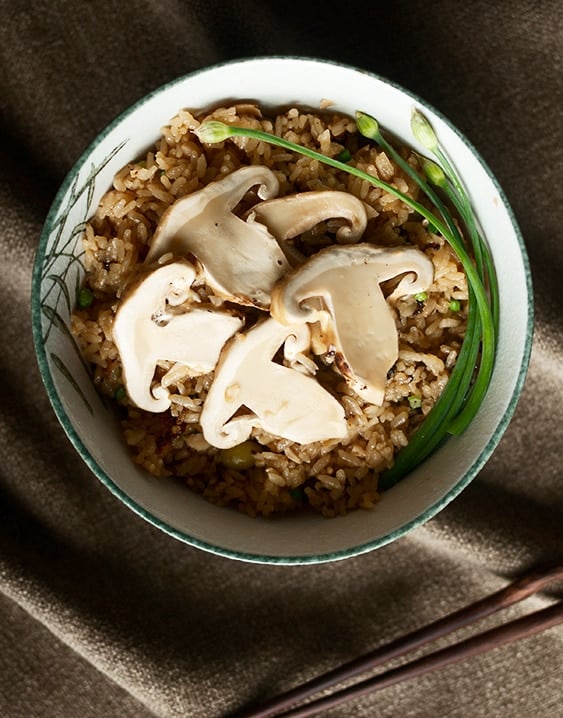
But if you’ve never cooked matsutakes before, you really ought to start with the bedrock dish: matsutake gohan, a Japanese rice dish. it’s easy as pie, really captures the aroma and flavor of the mushrooms, and is about as Japanese as you can get.
Matsutake Gohan, Japanese Matsutake Rice
Ingredients
DASHI
- 4 cups water
- 1 ounce dried kombu seaweed
- A big handful of shaved bonito flakes
RICE
- 8 ounces matsutake mushrooms, sliced and chopped (see below)
- 2 cups short- or medium-grain rice
- 2 tablespoons sake
- 2 tablespoons soy sauce
- 1 tablespoon mirin
- 1 teaspoon salt
- 10-12 gingko nuts, peeled (optional)
- Chives or Japanese mitsuba for garnish
Instructions
- If you are making the dashi, here's how. Pour the water into a large pot and add the kombu. Turn the heat to medium. Keep an eye on the pot, and at the moment it boils, remove the kombu. You can dry it out again and reuse it if you want to. Add the bonito flakes and simmer for 10 minutes. Strain this through a fine-meshed sieve and set aside. If you are using chicken stock or instant dashi, just use it when you cook the rice.
- For the matsutake, trim the stems so you can make pretty slices. Slice the mushrooms about 1/4 inch thick. Save the pretty cross-sections. Chop the remaining parts roughly.
- Put the chopped matsutake, rice, sake, soy, mirin, salt and enough dashi (or chicken broth) to cook the rice (follow the directions on the package, as different rices need different amounts of liquid to cook properly) in a bowl and let it sit for at least 10 minutes, and up to an hour. When you are ready to cook, put the contents of the bowl into a rice cooker or a pot and add the gingko nuts if you are using them. Lay the pretty slices of matsutake over everything. Cook according to your rice's directions.
- When the rice is done. Turn off the heat and let the rice steam for another 10 minutes. Lift off the pretty matsutake slices and set aside. Fluff the rice and mix in the chives; this rice is supposed to be a little sticky, by the way. To serve, put in bowls and lay the matsutake slices over each bowl.
Nutrition
Nutrition information is automatically calculated, so should only be used as an approximation.



This was my first time cooking matsutake, and this recipe was a fantastic way to really experience the flavor. I picked them on Friday morning and the scent was unusual but faint. After a day in the fridge it intensified. A little goes a long way with this mushroom!
We used to leave the big old soggy ones behind when mushroom hunting until we made stock with a couple of big ones that never fully dried after a very wet outing.
Now, we take them all home, regardless of how big & soggy they are, and make 100% matsutake stock. Nothing but matsies, no onion, no celery, no carrot, no nothing. Super concentrated matsie flavor.
This allows us to get the matsie flavor throughout the year in a whole slew of dishes (gohan, sauces, meatloaf, etc.).
But the most memorable dish was when we decided to make French Onion Soup using 100% matsie stock. It’s the best onion soup we’ve ever tasted. The sweetness of the cooked down onions is a perfect match and really brings out the matsie flavor.
Hi. Do you freeze the matsi stock? I live in Powell River and I have an overabundance of Pine Mushrooms. Hoping for more recipes so that I can enjoy throughout the year 🙂
I used to give away all my matsutakes because I wasn’t a big fan. Your recipe here taught me how to keep the cinnamon flavor in dishes. Thanks
What an interesting read i found on your site. Thank you for sharing!
I guess we are fortunate that we have two Japanese supers in our community. As far as matsutake, I only knew to buy in them at those stores. In our frig, there is a good sized pack of them that was hard to pass up, seeing them starring in the produce section of one of those stores. I had to check if they are from Japan–but they are “product of US”. Interesting indeed.
We hace found matsutakis here in Maine under hemlocks along the shores of lakes. I use them sparingly, slicing off a quarter of a shroom, chopping coarsely and then adding it to beef and broccoli stir fry and other stir fries. The aroma carries through and the mushrooms add another taste dimension. I use safflower oil flavored with sesame oil.
As I learn more about foraging for wild mushrooms, I appreciate sites like this. Thank you for the excellent recipes and lessons!