My First Steelhead
Nov 30th, 2009 | By Hank | Category: Fish, Hunting & Fishing Stories | Comments | 21 Comments |
I’ve always read about steelhead trout, about how they were mystical, elusive forces of nature that, once you catch one, you will be forever addicted to the pursuit of them. Now that I’ve caught three, I wish I could say I understood all the fuss.
I can’t. I am not transported to the astral plane having now caught these sea-run rainbows. Steelhead are not even close to being the toughest fighters I’ve ever encountered, and having now eaten some, not even close to being the tastiest fish I’ve stuck a fork into.
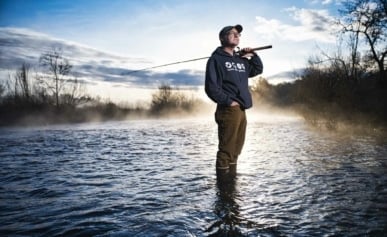
All this said, however, steelhead do fight well and do taste good. Plus I got to fish the Trinity River for them, which is an added bonus. Holly and I traveled to Trinity County after a Thanksgiving duck hunt in the Klamath Basin, so this was our cast-n-blast bonanza. We met our guide Jon from Five Rivers Guide Service (we fish with him a lot), and set out in weather so cold that ice clogged the guides on our rods.

Everything about this trip was similar to our expedition in search of the Trinity’s famous spring-run king salmon last summer: We fished a similar stretch of river, using similar tackle and caught similar fish; steelhead are a rainbow trout that runs back and forth between the ocean and freshwater, and scientists say they are more closely related to Pacific salmon than they are to all the other trouts.
Steelhead were just thinking about entering the river when we fished for salmon. They come up in late summer and early fall, along with the fall-run chinooks, who were mostly spawned out and dead by now. Their bodies littered the river bottom like ghosts.

Not long after we began fishing, Jon was showing us where he wanted us to cast our flies when a steelhead tore into one. Jon quickly handed the rod to Holly, who began fighting the fish. It jumped clear out of the water twice and ran off toward a sunken tree. “Uh oh,” Jon said, knowing what was to happen next. The fish spun around the tree, snagging the line. Stalemate. We moved the boat around to try to unwrap what the steelhead had done, but he broke off and swam away.
That was a highlight of what became a slow, grinding day of fishing. I’ve read that steelhead fishermen, who are often also grouse hunters and pursuers of other reified game, count their days not in caught fish but in hookups; this is similar to the “flushes per hour” that grouse hunters mark. It shows that actually catching the game is harder than connecting with it.
For the most part we cast flies dangling from a bobber through the current. Cast and retrieve, cast and retrieve. In stronger water we let out swimming “hot shot” lures that danced like a little fish in the water. Steelhead will bite them out of aggression, thinking they are a small fish in the steelhead’s turf.
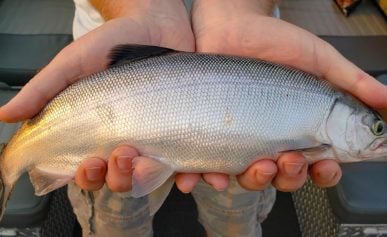
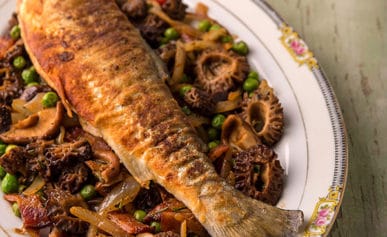
We were doing just that when one hit hard. It was a no-doubt-about-it bite, more like a saltwater fish than a trout. The fish began taking line, but unlike the last fish did not jump. I managed to reel it in pretty quickly, and just like that I had caught my first-ever steelhead trout. (It’s the fish in the top picture.)
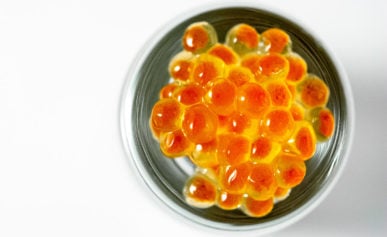
It is undeniably pretty, with rosy cheeks and a silver belly. I like the spots, too. We checked to see if it had all its fins. It didn’t. It was missing its adipose fin on its back, which meant that it was a fish raised in a hatchery — and that she’d be dinner. Only hatchery-raised steelhead can be kept, and I was eager to see what steelhead tasted like. As an added bonus, this fish was full of roe, half of which I kept to make caviar, half we’d use as bait.
On we went, casting and retrieving. The weather warmed and we finally got comfortable. Hours passed and I needed to take a leak. “OK Jon, get ready for your fish. I’m going to take a leak now.” Generally speaking, the best way to attract game is to be unaware or indisposed. No sooner had I started my business when I head Jon’s line sizzle. “Whoa! It’s a fish!” he said. Yeah, right. “I’m not even kidding!” In a flash, I’d zipped and took the rod from Jon.

This trout was not as energetic as either the one Holly’s fought or the one we had in the boat. But it still felt like a good fish. Into the net and we had our second fish of the day.
This one was skinny, though, maybe 4 pounds. Jon suggested we let it go, and I agreed. Hard to let one half of your limit swim away, but I hoped to catch a better fish later. And you can’t play swap out with trout because they die too easy.
On we went, until we got to a shady, chilly pool where Jon had caught fish the previous day. Jon cast roe from our first steelhead, which had managed to convince the second to bite, while I cast artificial flies. Over and over and over. We were going to give up when we saw a trout jump. Then Jon had a takedown; a soft bite. “They’re here,” he said. “We just need to figure out what they want.” He changed flies. I now had a stone fly on my line.
There was this gentle snag somewhere in the drift. I’d hit it a dozen times. The bobber would drop into the water, then pop up a few feet later. No fish. I’d gotten used to it, when it happened again. I gently jogged the line through it and felt weight. “I may be getting that stick,” I said. Then it jerked back. No stick. Fish!
And so began a good 5-10 minute battle with what seemed like a very large, very sullen steelhead. Honestly it felt exactly like the battle I had with the 20-pound king salmon this past summer, only I was using a ultralight line. The fish was willful and determined, more cape buffalo than lion. Bovine. I’d reel in, he’d take the line back out. Repeat as necessary. I tightened the drag on the line twice, and he still pulled away. But no acrobatics, no screaming runs. Just will. Like that salmon, or the big blue catfish back in Virginia.
Eventually Jon netted him. A male, probably between 7-8 pounds.

Cool fish, yes? Keep in mind I have not messed with the color of this at all. This is what they look like. You can see he is darker than the she-fish we caught earlier, with a bigger head and stronger jaws. The darker color means he’s been in the river longer than the she-fish had been, meaning he’ll be more “rivery” tasting than the hen fish.

I was glad I’d let go that other fish, as this one was the closest I got to the mystical steelhead experience.
Back home, I planned on using everything. I regretted letting go of half the roe, as I wanted to try making caviar from the eggs. Just like our salmon extravaganza, Holly and i would eat these steelhead nose-to-tail.
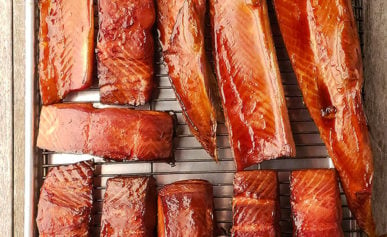
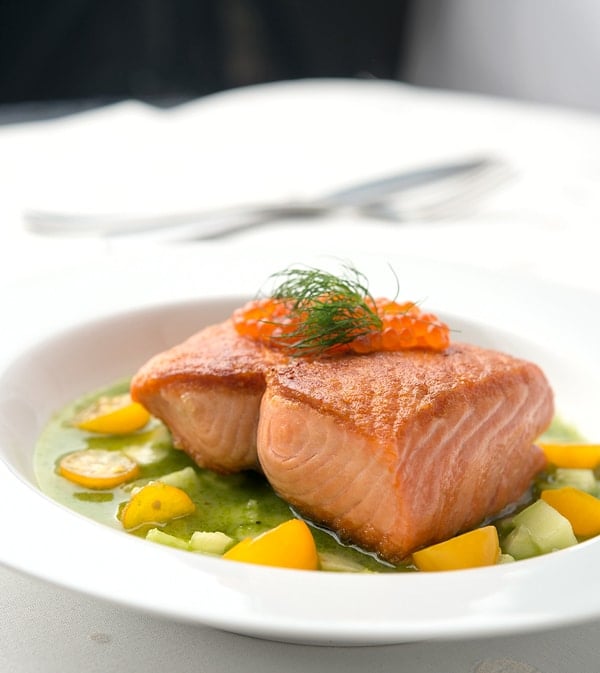
First up was filleting them. Jon said they’d be leaner than the chinooks and lighter in color. He was of course correct. Steelhead is still plenty fatty, but nothing like the spring salmon. Nor is it as shocking orange as those salmon were. More like that weird orange color that people who spend too much time in tanning parlors get.

The meat is far softer than salmon, too. More delicate. And a little fishier. I know this makes steelhead sound like a trash fish, but unfortunately I must compare it to the Trinity River spring king salmon, which in my opinion is far and away the tastiest salmon or trout I’ve ever eaten. Poor steelhead, it’s like comparing your local beauty queen with Halle Berry.
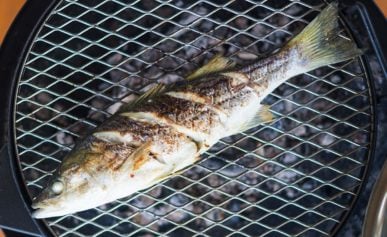
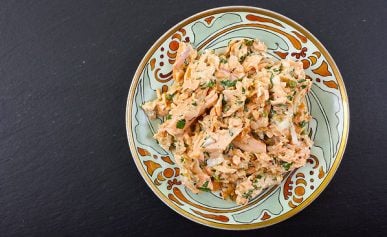
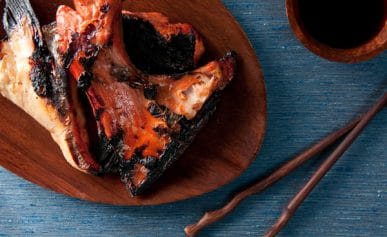
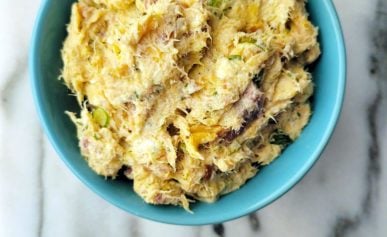
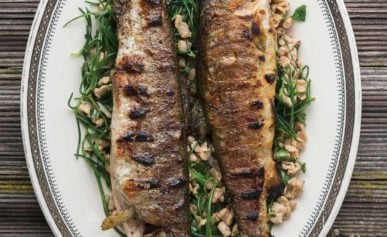
On to the eating. I started by grilling the heads, bones and bellies of the two steelhead I brought home. I could have eaten the collars as an appetizer, but these were not huge fish so I decided to just flake all the meat out in a bowl. I got a little more than a pound of meat this way — not bad, eh?
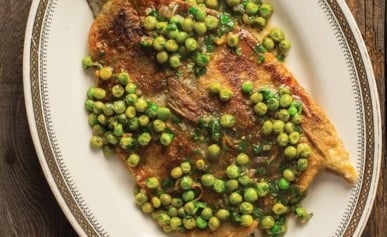
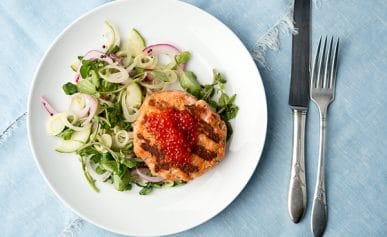
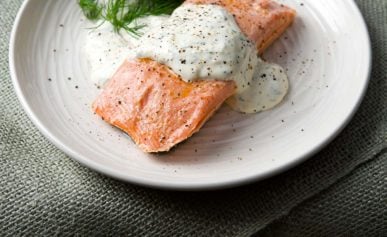
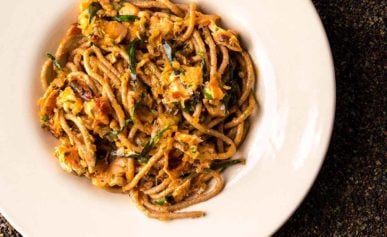
I have enough to make a salmon salad, more or less like the classic tuna salad I make, as well as a new dish inspired by a good wild game cookbook I own, Wild at the Table: Steelhead ‘omelet.’

Hard to say what this is, exactly. The recipe inspired by it was for a quiche, and it had way more cream than I used. It’s not really a souffle, nor is it a classic omelet. It’s kind of like a frittata. Whatever, it’s good. This is one of the few places I deviate from my “no cheese with fish” rule, and the added rich saltiness of the pecorino cheese works just fine with the flaked steelhead.
(Click for the full steelhead omelet recipe.)
So what do I think with my first close encounters with the wily steelhead? Definitely fun, and they are tasty fish, but not nearly so much as an ocean-caught or spring-run king salmon. Still, I will reserve full judgment on the fighting qualities of steelhead until I hook into a big native fish. Maybe next year.
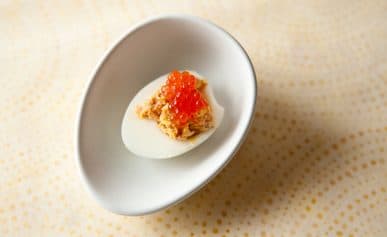
NEXT UP: A Japanese-inspired steamed steelhead with matsutake mushrooms, and the results of my caviar experiment.


I do not understand the no fish with cheese rule I always hear about. Is there an explanation for it?
Congrats on your catch!
Looks amazing. Never been on a steelhead but one of these winters in MI I”ll try my luck.
I am curious about the thanksgiving feast at HAGC….perhaps something fun?
Take care…
r.
Garrett, I don’t understand Hank’s fish-cheese rule either, but I’m grateful when he breaks it once in a while. These were delicious!
As a native Oregonian and son of a die-hard steelheader, I’ll admit, there’s not much comparison between a 20 lb chinook and a 7 lb steelhead, but put a bright 10 lb chinook up against a bright 10 lb summer steelhead, and you’ve got a contest. I think a brighter steelie may change your mind a bit on the taste as well. But when they get their colors, not many are prettier!
Hooking a wild summer-run steelhead on a skated dry fly on a gin-clear northern Vancouver Island river has induced religion in some folks. These fish embody everything that remains pure in our diminishing wilderness. Farther north, once Skeena River steelhead enter your bloodstream – there are no other fish.They are made of immovable mountains and unstoppable tides. I say these things having never eaten a steelhead. In fact, doing so has never even entered my mind.
Reverence is a funny thing…
Great stuff, man! I’m glad you had such a great time, and I’m not jealous or bitter AT ALL that me and my cousin went out to Gray Lodge for two hours of duck hunting until we noticed that some A-hole was hunting our dekes, so we instead walked 47 miles through dry land to see that’s right see three snipe and two hen pheasants…
Typical day. I can’t WAIT to read about your duck hunting experiences over Thanksgiving break.
As for the steelhead, it’s a salmonid, as are all rainbows. No native trout in California, as far as I know (browns are not native here, and brookies are neither native nor trout, but char). I agree that they are really beautiful creatures, and fun when on the line, and that I don’t understand the mystique, either, though I do get the mystique of Northern California.
Garrett and Holly: The no-cheese-with-fish thing is mediterranean in origin. It is basically a view that fish ought to be a meal that is “clean” the way Japanese food is thought of as clean. Cheese sullies that, and adds a weight to a dish that I normally don’t want with fish or seafood.
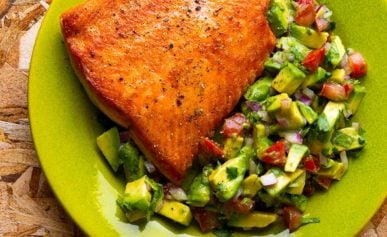
So tonight I wrapped the steelhead in foil and baked it with a little butter and sake. Delicious.
R: Nothing special for Thanksgiving, as we were up in Klamath duck hunting. Had a great deep-fried turkey leg and some excellent venison-chestnut stuffing, though…
Chad: You are exactly the sort of steelheader I was thinking of. I can’t quite fathom chasing a fish without ever eating it, but to each his own. I might feel the same way when I finally land a real wild steelie…
Josh: Thanks for the biology! I knew the steelhead situation was confusing.
Cheese & fish. Take a look at the Legal Seafood Seafood Casserole recipe about two thirds down the page at the following link – http://legacy.signonsandiego.com/uniontrib/20050112/news_lz1c12seafood.html
It’s wonderful!
Only once have I tangled with west coast steelhead and must say the lone fish I landed out of the four I hooked on the Deschutes River were every bit as acrobatic and stubborn as I had read. Poached in a sage infused veg stock back at camp made for quite the dinner.
Josh: Native California trout….and cool blog
http://www.nativetroutangler.com/2005/08/california-heritage-trout.html
Hank: Can’t wait to hear about the caviar experiment.
Hank – it’s funny, I see a coho, sockeye or chinook and I see perfect food. I see a steelhead and I see a perfectly cast fly, a smashing take and a greyhounding fish heading back to the ocean. I’ve killed enough salmon as a guide and even commercially to ensure a special place in hell – but I just can’t bonk a steelhead. That being said, I’ve never caught a hatchery version…
Great post – as usual.
cb
Nice job, Hank, but before you get too far down the smack-talkin’ road with regard to steelhead, let me remind you that catching a small hatchery steelie on the Trinity, though fun, is not in the same category as hooking into a wild 20-pounder on the fly on, say, the Skagit or an Oly Pen river. When you’ve done that, get back to me about the resulting heart palpitations, etc.
Cheers,
Lang
Hello! I’m new here. Fantastic blog!! I’ve got a few friends that do quite a bit of hunting and foraging in norcal. I’m excited to see what you’re doing on this blog. Will be perusing the site shortly! Your steelhead looks beautiful, it’s making me hungry.
Beautiful fish! The colors are amazing. It’s hard for me to imagine a 7-8 pound trout. Whoa!
Here’s some info on “No Cheese With No Fish”.
Some of his info is a little sketchy. My Catholic wife knows of no restriction on dairy for Fridays: “We grew-up eating Mac & Cheese with our fish sticks on Friday”. She’s 58 this year.
As a bone-fide steelhead junkie, fly-tier & designer, and fellow hunter/food aficianado, I must assume that the steelhead you caught were of hatchery origin (especially since they wound up in your kitchen!) and therefore can understand how they could leave you wondering what all the mystery and reverence around steelhead is all about. I recommend you give them another shot – perhaps spring-run wild fish on a swung wet fly (no “bobber” or “indicator”), will chage your mind. Perhaps not, but consider the possibilities!
Excellent blog – I can see that many hours of my life will become consumed by perusing these posts…
Piscator: You are correct, it was a hatchery fish. My issue with fishing wild ones is the catch-and-release aspect: I’m not overly fond of the practice, as there is an inherent mortality rate even with this. So my question to you is whether a wild steelie tastes better than a hatchery fish? If that is the case, I would be happy to give it another go. Love me or hate me, but I am at the core a meat fisherman – I fish to eat; the thrill of fighting the fish is great, but secondary.
WOW! First time to visit your blog, must say the site is very impressive.
About Steelhead; my husband is a stream fishing guide (trout) in the Lassen Mountain area but he lusts to catch the all might Steelhead. I think your issue may be you don’t fish for stream trout “ALL THE TIME”, therefore you can’t compare other fishing (ocean, lake, etc.) to catching a Steelhead. Just a thought! Keep up the wonderful work, will visit again.
Diana: Thanks for the kind words. You might be right, as I almost NEVER fish for trout. Dunno exactly why, as I like the flavor. Mostly because they tend to be smallish in the Sierra streams. And don’t get me wrong, it was fun to catch steelhead, just not THAT fun.
In a way its too bad this experience was somewhat anti-climatic for you. There are so many factors that influence fighting qualities of fish, even at the same species level, hatchery vs wild the least really but because hatcheries tend to raise different strains to avoid competing genetically with wild production therein does lie a hatchery related difference. But I agree, nothing salmon-wise beats an ocean or near ocean king salmon. I understand the unwilingness to “catch & release” but there is no reason to release hatchery fish, and every reason to release wild fish, (where they are marked so you know the difference) hence the conundrum where both exist together. By the the way, the “swap out” thing you mention is usually an illegal act just about anywhere, so you shouldn’t do it regardless.
Thomas: As for catch-and-release, obviously I catch and release illegal fish! You can’t keep any wild steelhead in California, to the best of my knowledge, so if we’d landed one, it might not even have seen the inside of the boat. What I don’t like about catch-and-release is the constant harassment of perfectly legal, edible fish, especially “nervous” ones like trout, which die easy.
And the swap-out thing is something I’ve not done since I lived in Virginia, where it works well with river-run white bass, catfish, etc — none of these are nervous species that seem overly affected by being in a cooler full of river water for a few hours…
Hank,
Sorry to hear that you were disappointed with your steelhead experience. I fish the Lewis and Kalama Rivers in SW Washington – primarily for Winter Steelhead. I suspect the lack of flavor, the lackluster color and the poor texture mean that you had gotten into spawning or spawned-out summer hens (snakes, we call them).
I think you would find winter fish, and fishing much more to your liking – if you don’t mind the cold (the oarsman in a drift boat is the only warm one onboard). The winter fish don’t usually show up until December. When I take friends, we’ll often anchor at the upper end of a hole and let the plugs work while I fry up bacon and eggs for breakfast or heat up some jambalya to wash down with red wine at lunch. And who knows – “Fish on!” – like you said, when you aren’t paying any attention. But good god man…the meat of a fresh winter fish has no peer