
As an Amazon Associate I earn from qualifying purchases.
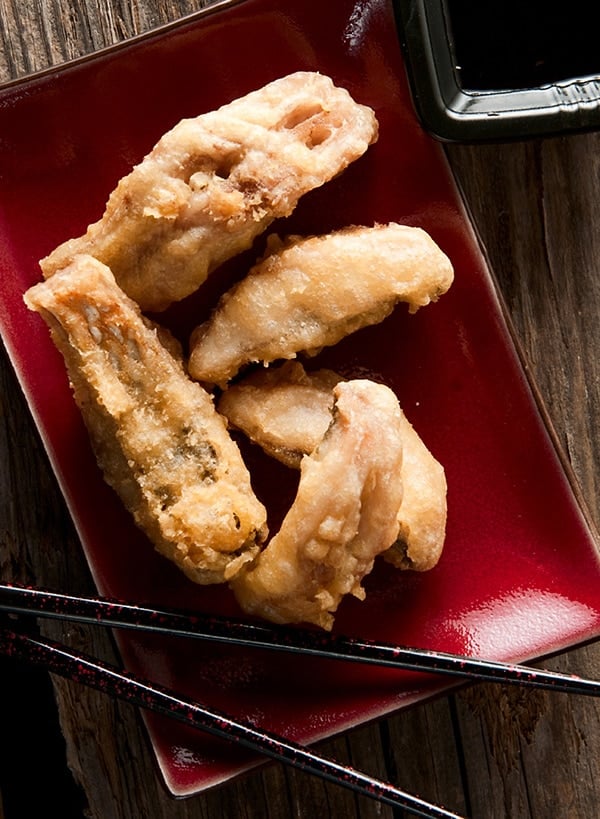
Unless you are an eater of American shad, that giant river-running herring anglers greet eagerly every spring, you might not fully appreciate just how elated I am right now. You see, I have solved the most vexing problem facing any shad angler: How to deal with the bones of a fish the Indians referred to as an inside-out porcupine?
The answer: Honegiri tempura.
Walk with me a minute here. Shad are among the tastiest fish in North America, but also happen to be the boniest. So unless you are possessed of that supernatural skill in boning a shad (which apparently isn’t hard once an expert shows you a few dozen times — only there are fewer than a score of those experts left), you must deal with the bones in other ways.
I’ve smoked shad, with good effect, and I have steamed them in broth, also with good results. I have even developed a quasi-boning technique that creates boneless “shad fingers.”
Then I remembered an old episode of the original Iron Chef, in which they featured Kyoto chefs and the odd-looking pike eel. A daggertooth pike eel apparently is as bony as a shad, so to deal with the eel’s bones, Kyoto chefs practice something called honegiri, or pike-eel bone-cutting technique.
It goes something like this. Start with a side of the fish that has been cleaned and trimmed, with the rib bones removed. Lay it horizontally in front of you and get the sharpest knife you own; I happen to own a very sharp sushi knife, although Kyoto chefs use a special honegiri knife. Start with the head end of the fillet and work towards the tail end.
The process is deceptively easy: You firmly-yet-gently slice across the fillet, through all the bones but NOT through the skin.
If you see the cuts I am doing in the picture, I am actually making them wider than they should be in a true honegiri cut: The Kyoto chefs slice every millimeter or so. I am slicing every 5 millimeters. Why? Partially because I am not a Kyoto chef, but also because shad is a helluva lot softer than eel, which is among the world’s firmest fishes. The soft meat separates easily from itself, and in the back third of the fillet some pieces will come out entirely.
What this technique does is slice the zillions of bones into many smaller pieces. And no, it does not mean you will just get more bones in your throat. By cutting the bones so thin, it opens up far more surface area to the hot oil — and deep-frying is one of my long-time tricks to deal with bones in other fish, such as pickerel or northern pike. Oil at 360-375ºF with soften those bones to the point where you hardly notice them.
Normally, with chunks of pike, you need to fry the fish pretty hard. But using honegiri means you can gently fry the shad in a tempura batter. I happen to be pretty fond of my recipe for tempura batter, which is a little more involved than some, but works great every time.
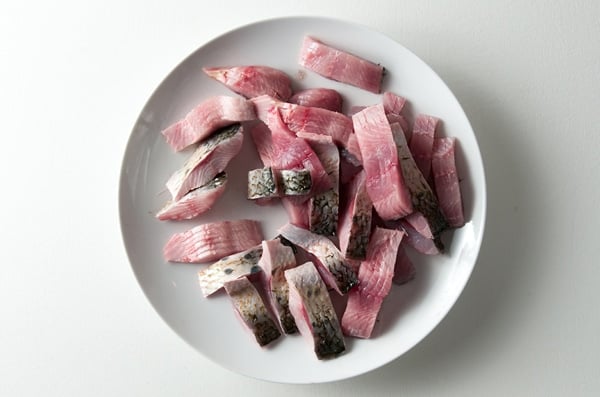
You portion the shad into pieces, then salt them. Get the oil heating and, once it’s hot, only then do you prep your tempura batter. One key to good tempura is to not mix the wet with the dry ingredients until the moment you are ready to fry them — the wet ingredients also need to be very cold.
As for a sauce, I would suggest a traditional ponzu sauce, or just soy sauce.
Dip the shad pieces in the batter and fry for 2 to 3 minutes in batches. Two tips: Move the pieces around in the oil with a chopstick so they don’t stick to the bottom of the basket, and have an oven set on “warm” with a paper towel-lined pan to keep your shad warm while you do the subsequent batches.
Holy crap was this good! Holly, who is a total persnickety whiner when it comes to fish bones, barely noticed them; except for one stray that I missed cutting.
Shad is rich in omega-3 fatty acids, and possesses more than its share of mouth-filling umami. Combine that with some salt, a light crisp tempura batter and a sharp dipping sauce and we had gone where no shad eater has gone before. Kanpai!
Boneless Fried Shad Tempura
Ingredients
- 4-6 shad fillets, cut in the honegiri technique
- Salt
- Vegetable oil for cooking
- 3/4 cup rice flour or all-purpose flour
- 1/4 corn starch
- 1/4 teaspoon baking soda
- 1/2 teaspoon salt
- 1 cup ice cold sparkling water
- 1 egg yolk
- Sauce for dipping
Instructions
- Get your cooking oil up to 360-370 degrees. While the oil is heating, cut the shad fillets into serving pieces and salt lightly. Mix all the dry ingredients for the tempura batter. Turn your oven to the "warm" setting, and place a cookie sheet inside. Place a wire rack on top of the cookie sheet.
- When the oil it hot, mix the egg yolk and the sparkling water into the dry tempura batter ingredients and stir only until just combined; it's OK to have a few lumps. Dip some of the shad into the batter, making sure the batter gets into the slits you cut into the fish using the honegiri technique. Fry the fish until golden brown, about 3-4 minutes. Make sure the fish does not stick to the bottom of the pot, and use a chopstick to dislodge any pieces that do stick.
- When each batch is done, transfer it to the wire rack in the oven. When all the fish is done, serve at once with ponzu sauce, soy sauce or any other dipping sauce.
Nutrition
Nutrition information is automatically calculated, so should only be used as an approximation.



Good recipe: I have used this recipe for shad and it works fantastic. BUT I have also used it to cook other baitfish: large shiners, suckers, it works on all. I dont regret eating baitfish.
I believe that if you search for “Honyaki Knife” you will find something appropriate – though be sure to sit down before you see the prices. I think that any number of single bevel knives would work. Here is a video that shows the honegiri technique https://youtu.be/WFb-dBEkIYc
Hank,
You should check out Captain Vince Russo’s (complex) technique for completely boning a shad (Cleans over 600 bones) https://youtu.be/fTAgJWTTm4I
His videos are quite educational, telling you how to clean different kinds of fish.
Ed: I am familiar with that skill. I’ve been doing it, off and on, since about 1996.
That’s a great resource- thanks for mentioning!
I see you are leaving the skin on. Are you scaling it first?
Mike: Yes, I am.
Excited to try this recipe at the next shad run! Question for you: do you use hickory shad as well or just the American shad? I know Americans can be tasty but I wasn’t sure if hickories were essentially the same?
Mack: Yes, hickory shad work fine here. I used to catch them in Virginia.
Once again my friend – – – you are the man! thanks for this site!
Yesterday we had the most delicious fish, probably ever. I caught shad on Columbia (this year we have 350K shad crossing the Boneville a day on some days!) Brought fish home and prepared it according to your instructions, sir. What a marvelous recipe. God bless you, sir!
Just wanted to say thanks for the recipe Hank! I just made this for my family and even my youngest who doesn’t like fish loved it. I was amazed that I never noticed a single bone, I was expecting there to be small crunchy bones but that wasn’t the case at all. I usually pressure most of my shad and I froze a few fillets to try this recipe, definitely planning on freezing more fillets during this years run. I do have one question: have you tried using the honegiri technique on the fresh fillets and then freezing the prepped pieces of fish? Curious if that would work to save on some of the prep time when cooking it later in the year, or if they won’t hold up well after they are frozen.
Having trouble finding a “honegiri knife”, is it the same as a Nakiri Knife?
Thanks!
I just tried this recipe. AMAZING! Even my wife and kids loved it. Thank you so much!
I thought of this same technique for this fish a couple years ago, but never got around to actually trying it. Nice to see that it works! And your results are lovely.
By the way, pike conger eel actually isn’t all that firm: it’s kind of mushy, to be honest, which is part of why this technique was invented. Otherwise, you’re largely confined to boiling the thing to make stock.
One fish I have never eaten is shad. I always thought they were no good to eat. Our lake has a lot of them, how are they caught? What bait?
Chris: You might be out of luck. I am talking about American and hickory shad, which only live in rivers. you might have the much smaller gizzard shad in your lake. The only time I’ve ever seen a gizzard shad eaten is, oddly enough, in high-end Japanese sushi.