Corned Antelope, Anyone?

Mar 26th, 2009 | By | Category: Charcuterie, Wild Game | Comments | 19 Comments |

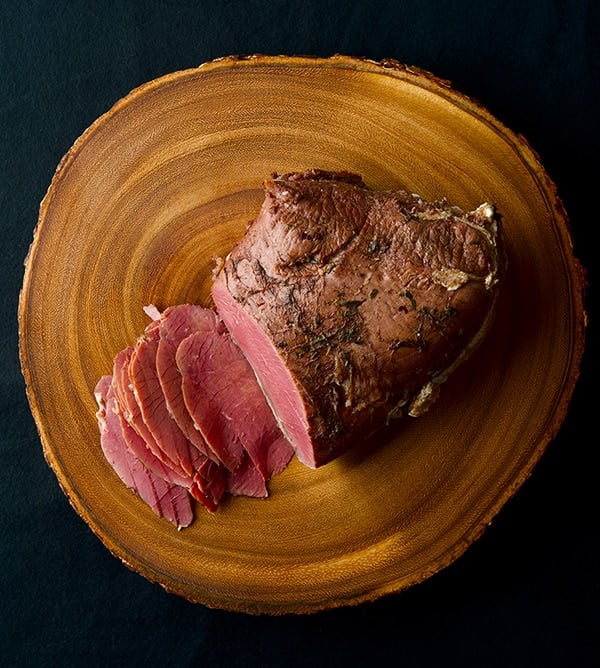
corned-antelope-main

I’ve always loved corned beef and its cousin pastrami, especially in Reuben sandwiches. As a child I always wondered how in the world they got the beef that pretty red color. And what in hell was with the “corned” part?

Years later, when I began to make my own sausages and salami, I occasionally came across recipes for corning beef, typically a brisket. At first I passed them by, as I don’t really buy beef.

But I do hunt deer and antelope and elk – and that might as well be beef, right? So I tucked away in the back of my mind the idea that I would make corned venison with a big leg roast. Someday.

That was in 2007, which also happened to be the last time I shot a deer; I killed two pronghorn antelope on that trip, too, and must say that I prefer these odd prairie goats to deer — mild and lamb-like, with an aroma almost floral. For those of you who hunt antelope, know that you need to get them chilled down as fast as humanly possible because, being high-strung and jumpy, antelope run hot. Add to this the fact that antelope hide holds in that heat like nobody’s bid-nez and you have a recipe for stanky, spoiled meat if you don’t watch out. Fortunately I had an understanding guide.

pronghorn

I digress. I never made corned antelope or venison that fall. Slipped my mind. (I did make a bresaola out of the backstrap of one of the ‘lopes that was fantastic even a year later, though.) Fast forward to a few weeks ago — and I think you know where I am going with this — and I find this hunk o’antelope buried in my box freezer. It was more than a year old. Thank heaven for vacuum sealers.

I opened the package and soon realized that the antelope was little worse for wear. Smelled OK, texture was fine. A tangent: Holly and I shot quite a few ducks and geese this year and I have been planning (hopefully) clever ways to prepare them, and I thought I’d make corned goose breast. Why not? OK, so that’s the reason I was again thinking about corning meat. This antelope roast was a sign: Do it now. So I did.

In the process, I learned a lot about ”corning.” Corn, as many of you might know, is what the old English called any grain. And back in the 17th century (or possibly earlier), the rock salt used to cure the beef was known as corns, as they were about the size of grains of grain. I suspect that we still call it “corned beef” because it just sounds better than “pickled beef.” Calling it pickled meat evokes the spectre of pickled pig’s feet, and even I turn my nose up at that one.

I used as a point of departure a recipe in Michael Ruhlman and Brian Polcyn’s Charcuterie , a book I highly recommend when starting to learn the craft. Know that the essence of corning is curing the meat in brine. That’s it — you are preserving the meat in a salt pickle. Everything else is nuance.

Do you add flavorings to the brine? Yes, you do; it’s what makes your corned meat different from mine. Do you add sugar? Probably, as it softens the salty twang of a salt-only brine. Do you add nitrite? Yes. And this is where I defend the stuff: Nitrites are what give you that pretty rose color. Nitrites add flavor. And most importantly, nitrites defeat botulism, which is among the most toxic substances known to man.

Can you make corned meat without nitrites? Yes. But it will look gray, lack the proper flavor — and you will have a small-but-real possibility of dancing with your new friend clostridium botulinum. And it will be a brief dance. Do nitrites cause cancer? Not in the levels used in modern meat. The poison’s in the dose, like a lot of things. Booze for one. Fat for another. OK, I’ve said my piece. If you hate the notion of adding nitrites to your brine, leave them out.

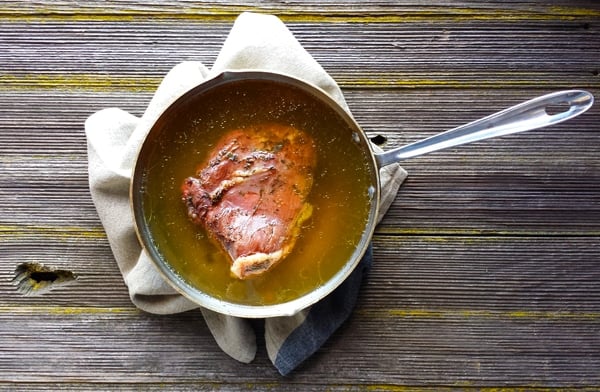
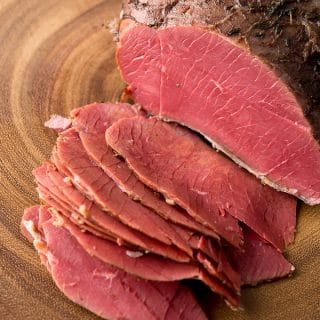
corned-antelope-detail1Back to the corned antelope. Basically you make a tea out of salt, sugar, spices and a little nitrite, let it cool and soak the meat in it. How long? Depends. How salty is your brine? How big is your meat? (Sorry, couldn’t resist.) Five days is typical, but you might need to go as long as two weeks with a big honkin’ slab of brisket. But basically this is a pretty forgiving process. Leave it in as long as you think it will take the osmotic elves to reach the center of the meat. And then leave it another day or two.

On to the cooking. Strike that. I need to tell you that once the meat is brined it is at its most stable. It is, after all, very very salty now. Should you want to save it for later, leave it in the brine in the fridge for a week or two extra. But if you are thinking about doing this, you will want a strong brine.

Now on to the cooking. All you do is simmer ye olde hunk of meat in water for many hours until it is meltingly tender. Easy, right? Sorta. Trust me on the water thing, though — there is a ton of flavor in the meat and you don’t need to muddle things with fancy broths and sauces. Here are a few tips:

  • Cut a piece off the roast and fry it to test. If it is only a little too salty for your taste, submerge the meat in water in a pot not much larger than the roast itself. This will prevent the osmotic elves from leaching out too much salt and flavor into the water.
  • If you screwed up and the meat is not salty enough (again, you can cut off a test morsel), add salt to the cooking water to the point where it tastes like the sea. Remember to leave the meat in the brine longer next time.
  • If you think your meat is REALLY salty — if you have left it in more than a week it might be — Use a larger pot of water, and the elves will take care of things for you.

How long to simmer? At least 3 hours, and up to 6 for a slab. Check on the water to make sure it still covers the roast.

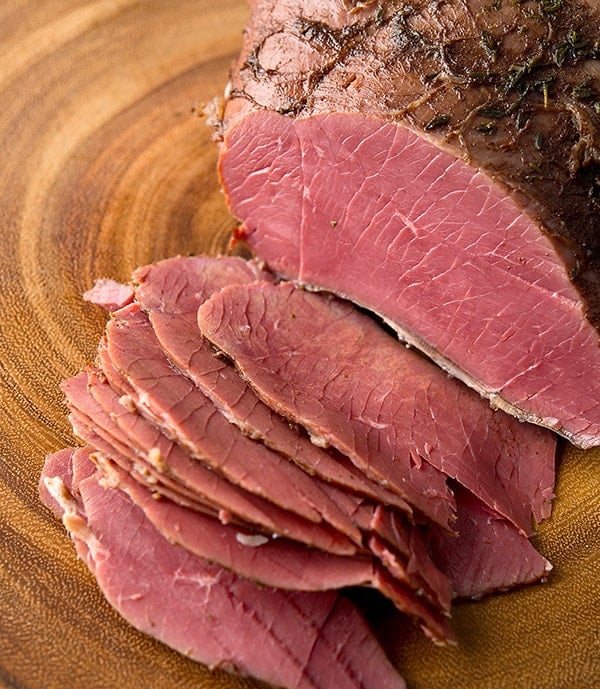
Eat your lovely corned beef — or lamb, antelope, venison, yak, nutria or whatever — in slices, hot or cold. Mustard is a must. I like sauerkraut with it , too. Don’t gild the lily, though. Simple is best here.

corned-antelope-plate

Anyone who wants to give this a go can read my full recipe here.

You don’t need to have large lumps of meat lurking in the dark corners of your freezer to make a spectacular series of sandwiches — obviously this is best with fresh meat. But know that even after this antelope had spent 17 months in the deep-freeze, after the transformation of the corning process it was so good I’d happily serve this to anyone. Really.

Tags: , , ,
Print This Post

________________


Subscribe to comments for this post

19 comments
Leave a comment »

  1. Mmm, corned beef (or whatever) on a toasted rye is just awesome. Love it with an ice cold beer.

  2. God, that’s gorgeous… I wish I’d saved a bigger hunk of my pronghorn.

  3. I made corned goose last fall and it is definitely worth trying. Goose hash is heavenly!

  4. This, THIS, is why I keep coming back to Hunter, Angler, Gardener, Cook day after day.

  5. Inspiring – it’s been put on my to-do list!

  6. This post certainly shows why you’ve been nominated for the James Beard Award! I would never have considered attempting my corning my own beef, let alone antelope. Now, you’ve got me thinking…

  7. Hank,

    While a vacuum packer works really well for fish and fowl, for larger chunks of meat I’ve had much better results wrapping the pieces first in Saran Wrap (tightly, pressing all air out) and then in butcher paper (again, tightly and with 2 layers of paper surrounding the meat). This will keep elk, deer or antelope for a very long time with no freezer burn and no worries about the vacuum package losing integrity, letting in air, and letting your meat burn.

  8. Good point about the vacuum sealer, mdmm! The sealer is fantastic — unless it loses its seal, in which case you need to eat the item fast. I get a few failures every year, and then it’s “Oh. Looks like we’re eating this tonight!”

  9. Hunting acquaintance of mine when I lived in Colorado had the good local butcher convert some Antelope into Antelope pepperoni and Antelope pastrami. Was wonderful but I’ve long lost track of him and the recipe.

    As for them retaining heat…don’t shoot them running or soon after running because of the lactic acid buildup you’ll get in the meat (i.e. muscles), get to them quick, dress/bleed them fast, and pack some snow in them if available or else keep the thoracic cavity propped open with sticks or somesuch, so they cool fast.

    My suggestions as a hearty Antelope eater. Nothing better than a good Antelope.

    Hint for people that haven’t hunted them: If you spook them, they have a habit of running but then they cool off and circle around you as opposed to flee and never be seen again. If you shoot them when they are spooked and running, even if you get to them fast, the meat is going to be less than ideal. They’re sprinters and it shows up in the muscles biochemically which reflects on the taste if you get one wrong. That’s why some people think Antelope is the most disgusting meat on the planet, they got served a portion that was hunted and handled poorly once and will refuse to ever touch any again for the rest of their lives.

    Happy Hunting and Eating,
    Thomas

  10. You have the most interesting ideas for your game meat. I’ve always been stuck with stew..no wonder I’ve never liked game. I love your recipes.

  11. Corned antelope….mmmm……

  12. Weaseltee: Goose hash? That sounds FANTASTIC. And because I love culinary miscegenation, I’d wrap it in a tortilla – that makes it highly portable, and ideal for breakfast in the duck blind.

  13. Fascinating. Absolutely fascinating. This is why food is so fascinating and why I am studying it (I’m a culinary school student).

    Cheers!

  14. again, just checking in to say – i loved reading this post. just wonderful. i’ll file it away in the things i’ll probably never do category – but would like to.

  15. I found your site after trying the Duck Niederwald recipe in Field and Stream, which was excellent by the way. I’ve been thinking for a couple years now about corning a wild turkey breast, mostly because every time I breast one out they look exactly the same size and shape of a brisket and I like to try different things with game. I can’t stand the same old cooked in a crockpot with cream of mushroom soup game recipes. This site is a delight, my new favorite.

    I’m going to visit family in Oklahoma in a week and I’ll be there for turkey season. Last year I shot a jake and picked 15 lbs of morels less than a quarter mile from my cousin’s back door-got any suggestions for this combo if I’m as lucky again this year?

  16. Sounds incredible. Now I’m craving pastrami.

  17. this is wonderful! i found your site today after hearing your interview on insight. my husband would love to start hunting, deer specifically, and just asked me the other day if we could make corned venison. now i know how! i’ll definitely be back to see what you’re making. we’re just up the hill in auburn and all about eating local and in season – i have a feeling you’ll be quite the inspiration.

  18. I’ve always heard our domestic antelope (not really an antelope, right?) is quite tasty. Cormac McCarthy’s “No Country for Old Men” begins with a memorable (and ultimately tragic) pronghorn hunt, although the hunter is a feckless poacher and bites off more than he can chew…

  19. [...] with corned beef.  The reason can be summed up with this little blurb from Hank Shaw’s awesome site. Do you add flavorings to the brine? Yes, you do; it’s what makes your corned meat different from [...]

Leave Comment

CAPTCHA Image