Taking the Cure – Wild Game Charcuterie

Feb 12th, 2009 | By | Category: Charcuterie, Wild Game | Comments | 16 Comments |

overhead-charcuterie

Curing meat stirs something primal within me: It is an ancient alchemy, a way to turn scorned cuts of meat into something sublime, a way to connect with a past we’ve all but lost. These are not original ideas. Any of you who make your own sausages, salami or cured meats know this, as does anyone who spends much time around salami-makers. As true as they are, such thoughts are part of the canon of the charcutier.

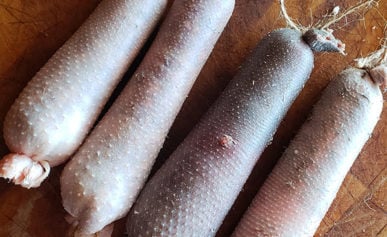
I’m not so different from my fellow scholars of salt and meat, but reasons baser than the mystical keep me buying hog casings and back fat.

I like the permanence of cured meat. I like that I can (and have) served a tangy wild boar fennel salami that is 18 months old — and even better than it was when it was a newborn. I like that I can vacuum-seal a piece of cured meat and come back to it later and taste it as it was, or that I can let it hang, on and on, until it becomes something entirely different. And should my power fail and my freezer die, my cured meat will live on.

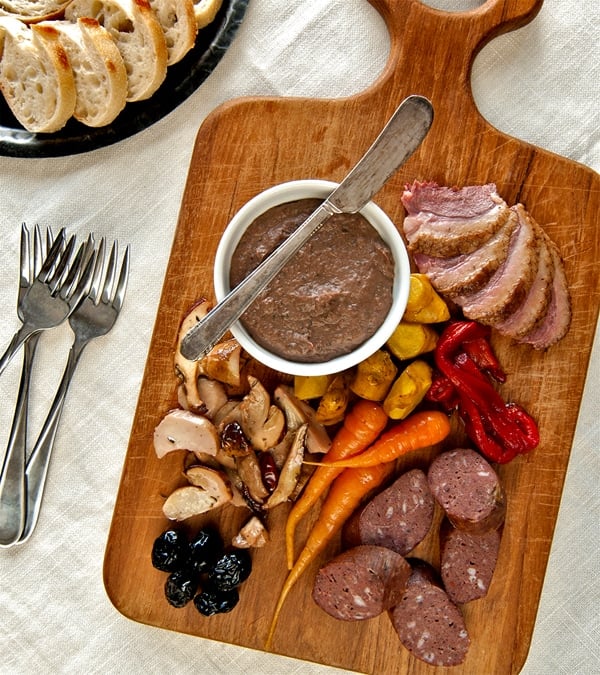
I also admit I enjoy the “wow” factor when I serve my handmade charcuterie to others, especially strangers. That “you MADE this?” look never gets old. Not everyone knows how to do this stuff, although it is not difficult if you want to learn. (I have several recipes posted in the Wild Game Recipes section if you are interested.) Curing wild game meats adds another layer. Hunting something, killing it, butchering it, and then making a cured goose breast or a wild duck soppressata or a venison sausage is outside the realm of even many accomplished cooks. I like that I can do this.

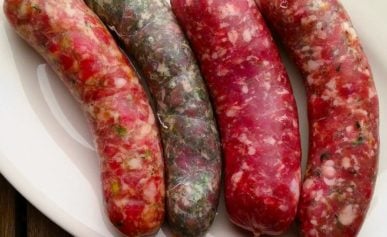
I make all my game sausages entirely of the meat of whatever it is, plus pork fat (Life is empty without pork fat). Hunters, should you take your game to a butcher for processing, he will likely mix it with up to 40 percent pork (often factory-farmed pork), because he thinks that you will not like the pure stuff. He’s probably right for most hunters, but remember that fat governs any meat’s flavor, so even my all-duck or all-wild boar sausages aren’t as strong as you may think. In fact, I add back a fair bit of skin and natural fat to bump up the “ducky” flavor in my sausages.

curing-fridge-main

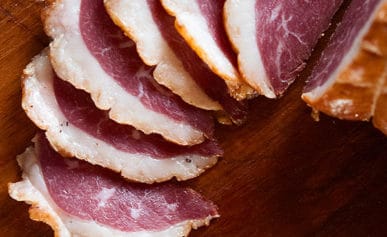
I am awaiting my wild duck soppressata. It is a spicy dried salami that hangs at the back of my curing fridge these days; I think it may be ready by the end of this month, but we’ll see. Like all wild duck charcuterie, it will be a dramatic meat: deep burgundy — like a petite sirah — with snowy white pork fat, or in the case of a prosciutto, natural fat the color of a cut cornfield.

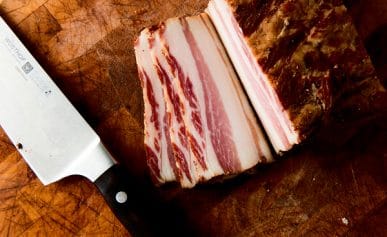
Not everything I do is from wild meat. I am curing guanciale, as well as the livers, of that Mangalitsa hog I acquired some months ago. They are still curing; Incanto chef Chris Cosentino cures his pork liver for a year.

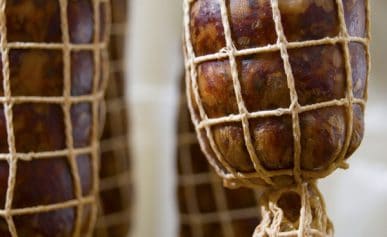
finocchiona-verticalI also made a fennel salami from a wild sheep Holly shot last year, an attempt to recreate a hint of an excellent elk finocchiona I made in 2006.

When I think about that it changes my perspective on food: “Ah, the 2006 was an excellent year for elk charcuterie — the humidity was right, the fat sweet, the fennel strong.” Sound like wine? Curing meat puts me in that same mindset. I think in months and years instead of minutes or hours.

Time slows and I grow zen-like when minding the cure. “I should check on the fridge today,” I think. Three days pass. When I open the fridge, the humidity may be 70 percent, it may be 60 percent. Temperature? A constant 55 degrees. “Oh, I see a little mold has arrived.” I rub it off with a cloth soaked in red wine vinegar. It does not return. Weeks pass. I grasp the goose breast or salami and press gently: still too soft. Give it another week. Or two.

pork-liverKnow that fat cures slower than muscle. A lean antelope bresaola I made in 2007 cured within two weeks. As it continued to age, it hardened into a slab that required a steady hand and a stout knife to cut slices thin enough to where I could see through them. Served that way, the antelope was superbly dense yet light on the tongue, salty but not overwhelmingly so, meaty with a certain I-don’t-know-what that marked it as wild game.

But it’s gone now. Forever. I will never have nor will anyone eat this same antelope bresaola again, even if I follow my recipe precisely. No other antelope will taste exactly like this one (a beautiful, wide-horned 14 1/2-inch Wyoming buck), and the curing conditions never will be exactly the same again. Those ruby slices are a memory.

As it should be. Like wine, cured meats develop a personality — partly as a result of your influence, partly as a result of the animals’. Your animals have eaten different things, and the pork fat you obtain will have similar issues of pedigree. All may have been butchered differently. In the kitchen, your hand at seasonings may be a touch different, and the vagaries of temperature and time and humidity all take a star turn in the making of great charcuterie.

My 2008-09 vintage is in mid-stream; I plan to make several more batches before the weather warms in April. This year is marked by a surfeit of ducks and geese, and no venison — something I intend to fix next season. But that too is part of charcuterie’s beauty: Every year will be different. Like life.

Tags: , , ,
Print This Post

________________


Subscribe to comments for this post

16 comments
Leave a comment »

  1. I am in awe.

  2. Your charcuterie is gorgeous, but I find myself squinting around it to try to get a gander at your curing fridge? What’s your setup? It’s so dry up here in MT that I need to get some kind of curing box organized, and since the used appliance store is right across my back alley, I’m thinking of using a fridge.

  3. Here in Illinois, I know the processors don’t use any of the deer’s fat when making venison sausages, saying that it has an “off” flavor. Do they just mean “strong”? Can you tell us more about how you assess the quality of fat from game before deciding to use it?

  4. Charlotte: I get so many questions about my curing fridge I will have to write it up in its own post. Stay tuned…

    Larbo: I go into it at length in this post, but the short version is yes, they mean “strong.” Most Midwestern whitetails spend a lot of time eating waste grain like corn, or better yet alfalfa. Should you get a deer like that (as opposed to a sagey mule deer, for example), what I would do is cut off a piece of the back fat and render it slowly in a pan: If it smells nice, I’ll use it for charcuterie. If I don’t like the smell, I’ll use beef tallow or pork fat.

  5. Having just started home charcuterie myself recently, I totally appreciate this post. It is addictive. Really addictive.

    And you sir have access to some of the best stuff to make charcuterie with – I am jealous, really jealous.

  6. Hank, this is a beautiful and evocative post. A smoke house is one of my dreams. My grandmother made an incredible smoked duck, and the taste of smoked cured sausages are part of my childhood memories. I am glad you are thinking of a post of your curing “apparatus”. I am very much looking forward to this.

  7. I always learn so much when I visit you blog. Good information and very well written!

  8. Nice one, Hank. Especially like the comparison of cured products and wine – completely agree. I have a date coming up with some goose, moose, elk, and pork fat myself. Can’t wait.

  9. Your experiments in curing have me salivating–and wondering how I can carve out some time (sorry) to get into this “ancient alchemy.” Very nice post.

  10. I love the cured meats; wish I had the time and equipment to do it myself. Looks awesome.

  11. What a great post! I have been dabbling on the edges of preserved foods, mostly stuff in vinegar, but later this year, I hope to take on some meats, fish, and green walnuts.

    I will be calling on you, I’m sure, or at least searching through your cool-a blog!

  12. Even in my depressed state your charcuterie brings a smile to my face. I guess I love food…

  13. Thanks everyone for your kind words! I definitely want to hear about your experiments with charcuterie as well — especially you, Kevin: You know I am insanely jealous of your constant supply of moose.

    Josh, I will teach you how to make salami in return for a supply of green walnuts. I want to pickle some as well as make nocino.

    Murasaki, I am sorry you are depressed. I always find that a few slices of salami, crusty bread, some pickles and a handful olives to go with a big glass of red wine makes me happier when I am feeling down…

  14. We had crusty bread and spicy elk sausage last night, but how I would love a little salami with the leftover bread today. You’ve inspired me to research salami making before this year’s hunts. I’m so glad I came across your blog!

  15. Hi Hank, good afternoon;
    In producing your ‘Canada Goose Prosciutto’ do you use a marinade and/or puff a little smoke on?

  16. I’m in awe of all of the fantastic looking stuff in your fridge! I plan to steal your idea of storing wine in there. I had thought of trying to dual purpose a fridge as both curing chamber and kegerator, but for some reason wine storage never occurred to me.

Leave Comment

*