
As an Amazon Associate I earn from qualifying purchases.
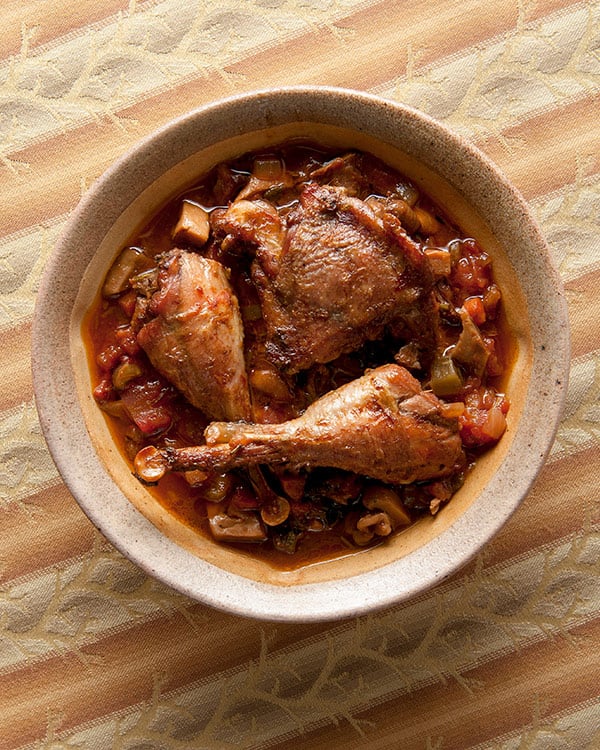
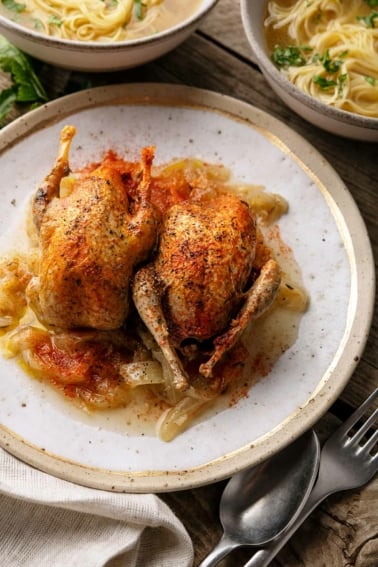
I do a lot of comfort food with big, flavorful, stew-y things loaded with tomatoes and herbs and some sort of meat. In this case the meat is pheasant, and what better dish than pheasant cacciatore?
Hunter’s style. The French call it chasseur, the Spanish cazadores, the Italians cacciatore. This dish in its variations exists in all three countries.
But it is usually done with chicken, which makes me wonder: Is this the meal the failed hunter gets from his wife when he returns empty-handed? “Oh, Enzo!” she cries. “I am so sad for you — I’ll go kill another chicken for dinner.” Is this a meal eaten in sullen reflection of missed shots, sore feet, or birds flushed just a little too far away?
Probably not. I do not know the actual history of hunter’s style chicken, but I am guessing it is an outgrowth of the 17th century — and was initially done with pheasants or partridges. If I am right, cacciatore is a fascinating amalgam — tomatoes imported from the New World, pheasants from China.
Another possibility is that this is what the housewife (or servant, more likely, given the European hunting tradition), stewed for several hours while the hunters were out chasing pheasants or deer, making this chicken stew a welcome-home meal. If anyone has any insight into the history of cacciatore, I’m all ears.
What makes chasseur or cacciatore or cazadores unique? As far as I can tell, it requires these things:
- A white meat, such as chicken, pheasant or rabbit
- White wine
- Tomatoes
- Mushrooms
- “Woodsy” herbs such as sage and rosemary
This dish is so satisfying, the way only the combination of tomatoes, wine, mushrooms and meat can be. I’d used pheasant legs and wings from birds that had hung for three days, and they were tender and deeper-tasting than any pheasant I’d eaten before. So I can happily say my experiment with hanging pheasants has, thus far, been a success.

Could you use chicken here? You bet, but please do your best to locate a stewing hen; try a Mexican or Asian market. These older hens taste better and can stand up to stewing better than the fryers or roasters, which in my opinion are too young.
What sort of mushrooms? A variety. Buttons are fine, but bolster them with some good dried ones. What sort of wine? A dry white: Think Pinot Grigio rather than a buttery Chardonnay. Herbs? Definitely sage and rosemary, but you could play with thyme, savory, oregano and parsley, too.
Finally, you must — must — have good bread to eat with your pheasant cacciatore. If you are really hungry, add a big dollop of polenta, too. Buon appetito!
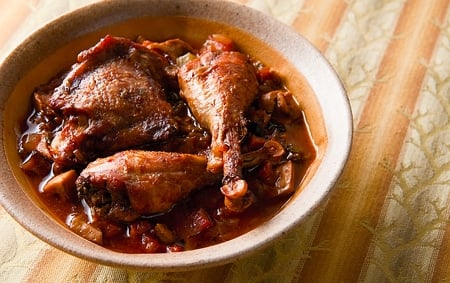
Pheasant Cacciatore
Ingredients
- 2 pheasants, cut into serving pieces
- 1/4 pound pancetta or 4 strips bacon
- 3 tablesppons olive oil (or pheasant or chicken fat)[/ingredient]
- 1 chopped celery stalk
- 1 chopped carrot
- 5 cloves chopped garlic
- 1 onion, sliced into half-moons
- 1 quart crushed tomatoes
- 2 cups white wine
- 1 tablespoon chopped fresh sage
- 1 tablespoon chopped fresh rosemary
- 1 teaspoon crushed juniper berries (optional)
- 4 bay leaves
- 1/2 ounce dried mushrooms (about a handful)
- 1/2 pound fresh mushrooms, any kind
- Salt and pepper to taste
- 4 tablespoons minced parsley
Instructions
- Preheat oven to 350°F. If using, cut the pancetta into little batons about 1/4 inch thick. In a large braising pan or Dutch oven, heat 2 tablespoons olive oil or pheasant or chicken fat over medium heat and cook the pancetta or bacon. Remove and reserve.
- Add the pheasant pieces and brown them well. Take your time and do it in batches. Remove the pheasant pieces as they brown. Add the carrot, celery, onions and the fresh mushrooms and turn the heat up to high. Sauté them until the onions are wilted and are beginning to brown. Add more oil if needed. When they begin to brown, add the garlic and cook for another 1-2 minutes, stirring occasionally.
- Add the herbs and the dried mushrooms and the white wine and turn up the heat to maximum. Stir well. Let the wine cook down by half. Add the tomatoes and mix well. Add some salt if needed. Add the bacon and the pheasant pieces, skin side up. Do not submerge the pheasant, just nestle the pieces into the sauce so the skin stays out of the liquid.
- Cover and cook in the oven for 45 minutes. Check to see of the meat is thinking about falling off the bone. Sometimes with a young pheasant all it takes is 45 minutes. An hour or more is typical. When the meat is as tender as you want, remove the cover from the pot and cook until the skin crisps, about 30-45 more minutes.
- Move the pheasant pieces to a plate. Add the parsley to the pot and mix to combine.
- To serve, ladle some of the sauce out, top with a pheasant piece and serve with either polenta or a good crusty bread. I like a dry rose or a light red like a Sangiovese for this dish.
Notes
Nutrition
Nutrition information is automatically calculated, so should only be used as an approximation.



Five star recipe, add fresh oyster mushrooms, and did the sautéing then slow cooker and a Insta pot for five hours. It was the best way and better the second day.
The hunters in my family enjoyed this recipe. Didn’t find dried mushrooms, so only used fresh mushrooms.
History of cacciatore! Thanks for the recipe, I’m going to try it with a sharptail.
https://piccolaitalianh.com/cacciatore-is-some-of-the-oldest-and-best-food-in-manchester/
One of our favorite pheasant recipes which I make about once a month in fall and winter. I really like the flavor profile over a standard cacciatore that uses basic Italian herbs, the sage and juniper just go well with pheasants that I’m shooting in the sage steppe of Eastern Washington.
Awesome dish! I’ve made it with skinless pheasant and it works great.
You could eat an entire pheasant done this way by yourself without even noticing anything but the deliciousness.
It was excellent. I think it works best with breasts. The legs were a little tough. I may have overcooked them slight while waiting for people to arrive. But the recipe was top notch!
Wow. This was great. My wife and daughters loved this dish. They all cleaned their bowls completely. My wife even took some to work the next day.
I served mine over wide egg noodles because that is what I had around.
Hank,
What are your thoughts on using a darker meat such as greater prairie chicken for this recipe?
Thanks
John: It should work. But I generally use dove or pigeon or duck recipes with sharpies or prairie chickens.